
“Most B2B SaaS teams are trained to start every customer conversation with pain: “what are you struggling with?” The trouble, as April Dunford points out, is that your product doesn’t solve 9,000 pain points, it solves a handful. Chasing every problem a prospect raises leads to scope creep for you and disappointment for them.”
The fix is three principles from Dunford's keynote. First, know which discovery mode you're in: customer discovery (finding a problem worth solving) isn't product discovery (finding the solution), and neither is sales discovery (checking whether a prospect fits what you already do). Second, be opinionated about your market: tell prospects plainly what you do and don't do, and point them elsewhere when you're not the fit. Third, say no to custom pitches, because a prospect with a different pain usually isn't your target customer. All three depend on doing customer discovery well: uncovering a high-priority problem that a significant, specific segment is struggling to solve today.

I was watching April Dunford's keynote How to Craft a Story that Sells while eating my morning porridge earlier this week (the glamorous life of a startup founder) when she described this eerily familiar scenario:
“When I started in marketing, I was taught to start with the customer’s pain. Most of the sales reps I worked with had been trained to do that too. So in a sales meeting, they would walk in and have the pain discussion, like “what’s your pain, what are you struggling with”. Then the reps would try to build a custom pitch to respond to whatever the customer’s pain was.
On the surface this makes a lot of sense, until you actually dig into it and it’s like — dude, we have this crummy little piece of software that does two things. I don’t solve everybody’s pains! I can go in and have that nice conversation but at the end of the day I only solve these two little things, so why don’t I just lean into that?
We spend too much time on “customers have all this pain and we need to understand the pain” when most of the time our software doesn’t actually solve 9,000 pain points, it solves a very limited number of them. We act like we’re custom software houses when in fact we have a product that just does these four things and we should just focus on that.”
I'm sure I'm not the only one who's ended up 30 minutes into a call discussing a completely different customer problem than the one my product solves. Why do we do this to ourselves when it's so obviously bad, and causes scope creep for us or disappointment for the prospect, or both?
Her talk was full of practical advice for avoiding exactly this. This post breaks down three principles from the keynote to help you use customer problems better in your research, sales and marketing.
Principle 1: Know the difference between discovery modes
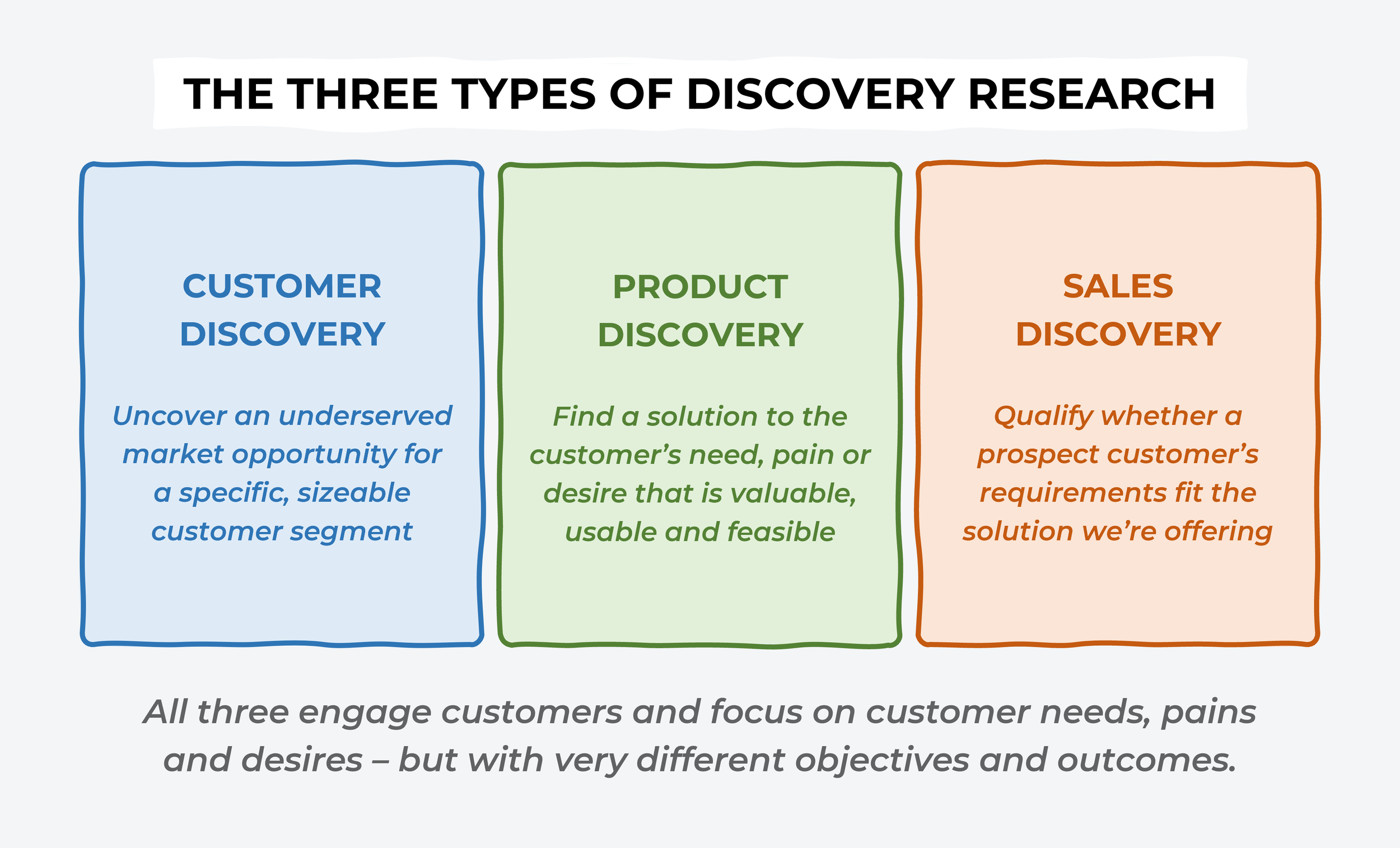
The kind of conversation April is describing is called discovery, a fancy way of saying "researching and framing the problem space" (via NN/g). But problems sit at the centre of a few different customer conversations, which is why it's so easy to pick the wrong kind of "discovery" and hit a dead end. A quick definition of each shows they're clearly different:
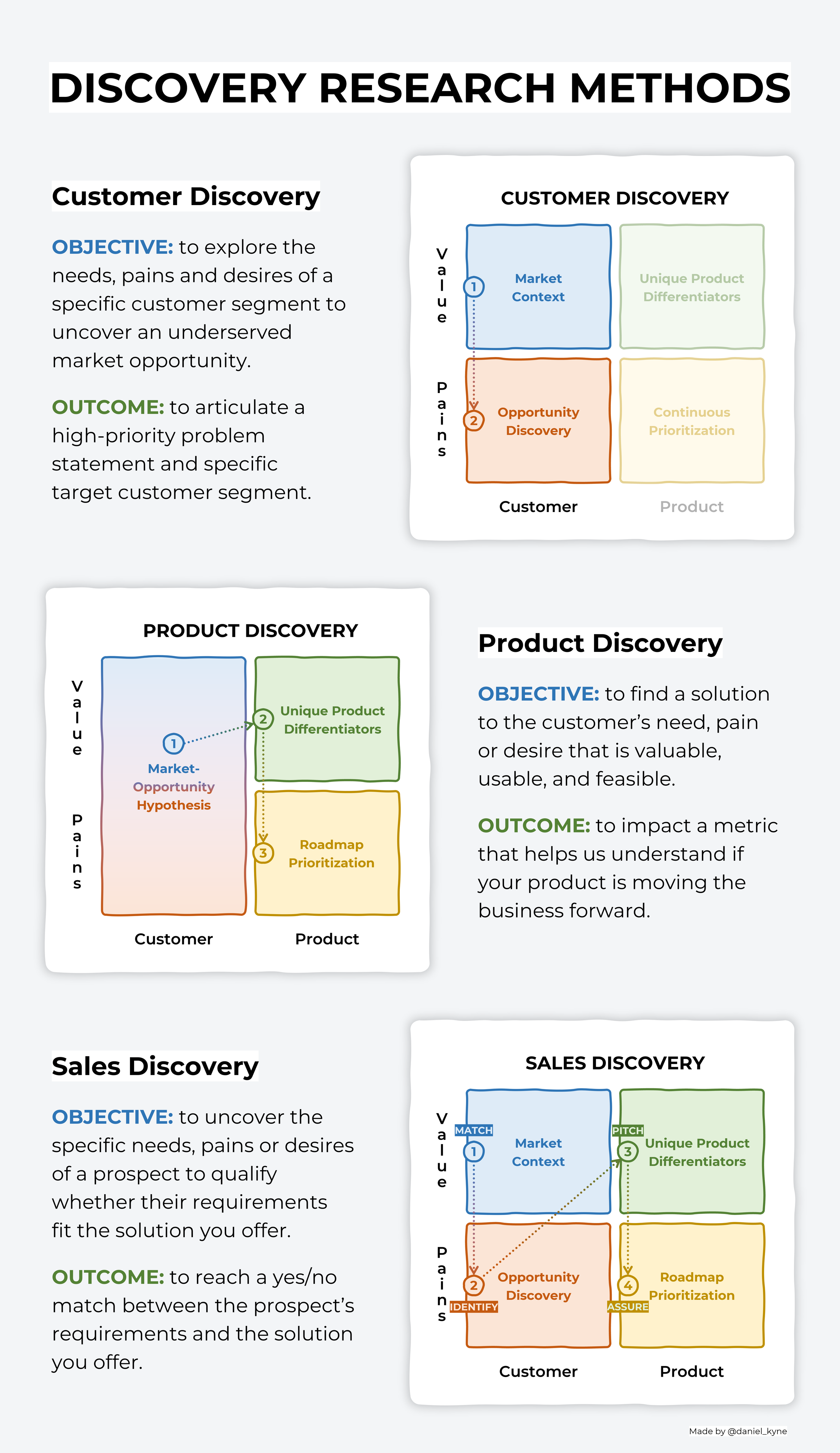
Customer Discovery explores the needs, pains and desires of a specific customer segment to uncover an underserved market opportunity.
Product Discovery aims to find a solution to the customer's need, pain or desire that's valuable, usable and feasible (via Marty Cagan).
Sales Discovery uncovers the needs, pains and desires of a prospect customer to qualify whether their requirements fit the product you offer.
| Discovery mode | What it uncovers | The question it answers |
|---|---|---|
| Customer Discovery | The needs, pains and desires of a specific segment, and an underserved market opportunity | Is there a high-priority problem worth solving? |
| Product Discovery | A solution that's valuable, usable and feasible (Marty Cagan) | How do we solve it well? |
| Sales Discovery | Whether a prospect's requirements fit the product you already offer | Is this prospect a fit for what we do? |
In April's story, the reps should be doing sales discovery, but they act like they're doing customer discovery, because they wrongly assume any customer problem points to a commercial opportunity.
Early-stage founders often make the same mistake. When they should be in customer discovery mode, finding a high-priority problem to solve, they're in product discovery mode instead, trying to improve a product they've already built. They find out during sales discovery that they've built a fix for a mild inconvenience no target customer cares about, all because they skipped customer discovery.
Principle 2: Be opinionated about your market
“I think really good sales and marketing involves saying “look, these are your options, this is what you could do. If you think this is interesting, you should come to us because we do this stuff,” instead of saying we solve all the pains. We don’t solve all the pains. We only solve a tiny bit of the pains.”
April's main message is that we shouldn't be afraid to tell prospects when they're better off with a competitor's product. You know your category and the options in it far better than your customers do. Use that to sharpen your differentiation: talk about why you built your product, not just how.
April has a good four-step process for this:
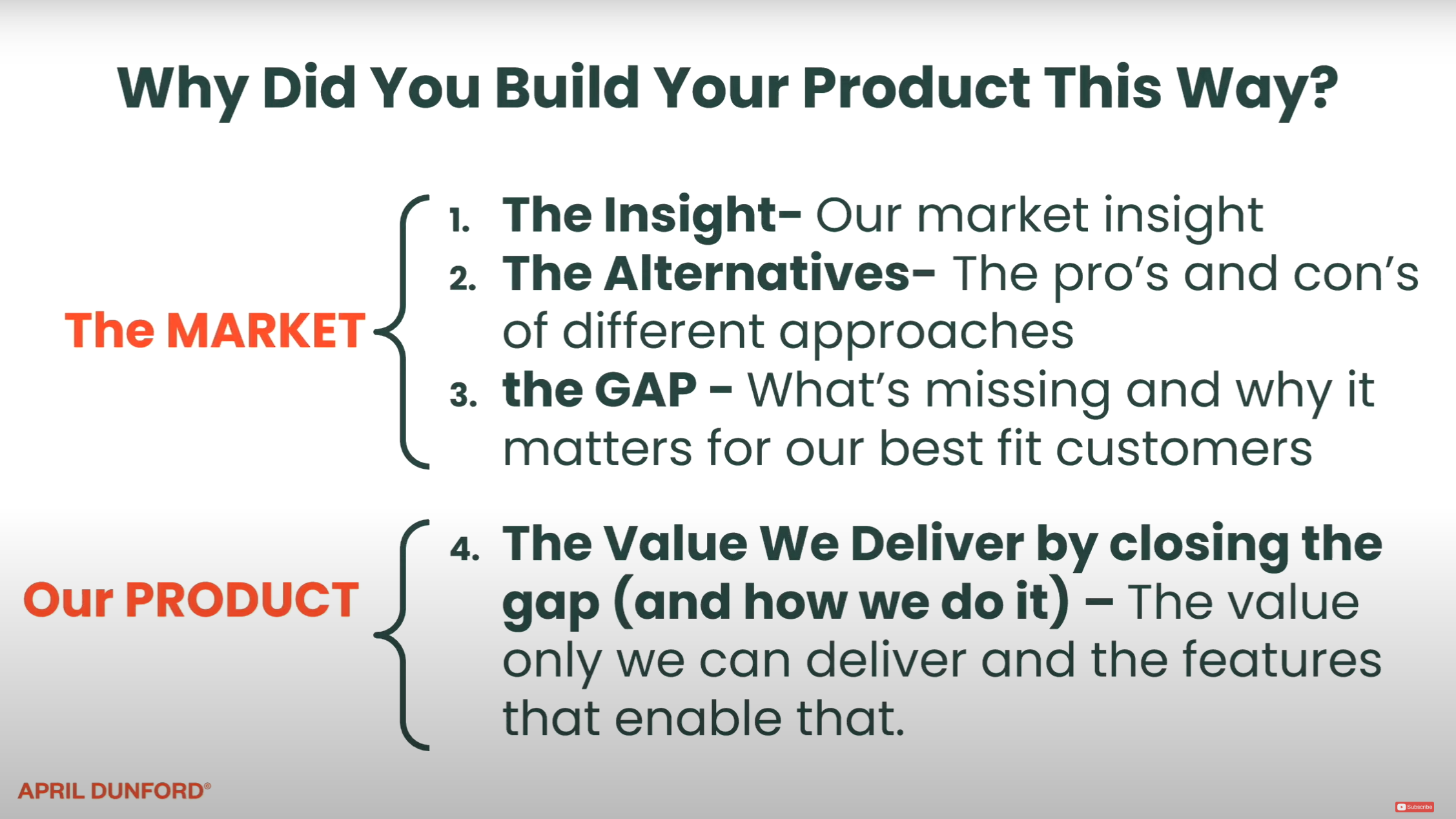
^ Screenshot from April’s keynote “How to Craft a Story that Sells” (via MicroConf)
Here's an example of how I do this for our product OpinionX:
Insight: Product teams rely on user research to understand what customers are thinking, how they're feeling, and what their priorities are.
Alternatives: Typeform is great for collecting simple user data during onboarding, and you can make all sorts of fancy graphs for your PowerPoint deck using tools like SurveyMonkey and Qualtrics…
Gap: But if you're doing user research, you need to measure and compare how customers think by customer segment. That's the most important data there is, and you can't get it from the usual survey tools.
Value: We built a survey tool specifically for ranking because ranking questions are the best way to understand people's priorities. Then we give you the features to segment, map and correlate people's ranked priorities by customer segment because that's the data product teams actually need for their most important decisions.
To hold this kind of market opinion, you first have to nail your discovery research and turn what you find into features that set you apart, from your target customer's point of view, in your category. Once that work's done, shout about your opinionated view so you stand out to potential customers. The clearer you are, the easier your sales discovery gets.
Principle 3: Say no to custom pitches
“We act like we’re custom software houses when in fact we have a product that only does these four things and we should just focus on that.”
If your prospect has a different pain to the one you solve, chances are you're not talking to your target customer. It can be hard to notice, though, because you did such great customer discovery research…
If you nail your research and launch with appealing positioning, you'll probably attract customers from outside your target segment too. The more enthusiastic they are, the more tempted you'll be to widen your target customer definition.
Redefining your target customer to cover several segments is a surefire mistake for an early-stage product. It can feel like you're opening up a bigger opportunity, and at first the extra segments might have similar enough use cases that it seems to work, but eventually different segments need different product features. I learned that the hard way, pulled in opposite directions until we had to pick which segment to prioritise.
Without a well-defined target segment, you're basically forcing your reps into custom pitches. WeatherBill is the famous example: with a couple of months of runway left, it rewrote its pitch and banned reps from talking to any segment that wasn't the exact target customer. That correction moved them from a failing startup onto a billion-dollar exit path in a matter of weeks.
Why it all depends on customer discovery
“The trick of this isn’t actually figuring out the customer’s pain — the trick is figuring out which customers have the pain that we solve and whether there are enough of them to build a business on. If there isn’t, we need to go back to the drawing board.”
Customer discovery is the foundation that successful sales, marketing and product work gets built on. You can only build the right product, and match it to the right customers, if you understand the market-level problem you're trying to solve.
The best way to succeed at customer discovery is to know what a good outcome looks like. The goal is to "uncover a high-priority problem that a significant segment of specific customers are struggling to solve today."
"High-priority problem" → enough of a pain that they're actively searching for a fix.
"Significant segment" → there are enough customers to justify building a product.
"Specific customers" → you can identify and describe who is and isn't your target customer at a market level.
"Struggling to solve today" → they're already spending time and money on something that isn't working for them.
If in doubt, before any discovery session, ask what your research objective is and what a good outcome looks like. Here's a quick overview of each discovery research type:
For a dedicated guide to data-driven customer discovery, see The Discovery Sandwich, a simple approach to user research that product teams at scaling startups like Labster use to find and contextualise their customers' highest-priority problems.
For more on identifying your target customers' highest-priority problems, see Problem Stack Ranking: How Stripe Validates New Product Ideas.
For more on product discovery techniques, there's nobody better than Teresa Torres and her frameworks for Opportunity Solution Trees and Continuous Discovery Habits.
Frequently asked questions
What's the difference between customer discovery, product discovery and sales discovery? Customer discovery finds a high-priority problem worth solving for a specific segment. Product discovery finds a solution to that problem that's valuable, usable and feasible. Sales discovery checks whether a given prospect's needs fit the product you already offer.
Should B2B SaaS teams focus on customer problems? Only the problems your product actually solves. Your software solves a handful of pain points, not thousands, so chasing every problem a prospect raises causes scope creep and disappointment. Lean into the few things you do well.
What is customer discovery trying to achieve? A single outcome: uncovering a high-priority problem that a significant, specific segment of customers is struggling to solve today, ideally one they're already spending time and money trying to fix.
Why shouldn't you write a custom pitch for every prospect? Because a prospect with a different pain to the one you solve usually isn't your target customer. Relying on custom pitches is a sign your target segment is defined too loosely, which eventually pulls the product in conflicting directions.
If you enjoyed this blog post, consider subscribing to our newsletter The Full-Stack Researcher, where we share actionable research advice for startup founders and product managers.