
QuestionPro vs. OpinionX for advanced surveys?
QuestionPro is a well-known name in the survey space, offering a cheaper alternative to ‘all-in-one platforms’ like Qualtrics and SurveyMonkey.
But for many in-house researchers like marketing managers, UX researchers, and product managers, how does QuestionPro stack up against a purpose-built platform like OpinionX when it comes to market research studies like maxdiff, conjoint, segmentation, and pricing surveys?
In this article, we'll compare QuestionPro and OpinionX across the research methods that actually matter for product and growth teams, plus pricing, ease of use, and team collaboration. The goal is to help you figure out which platform is the right fit based on how your team actually works.

Contents
Why Your Platform Choice Matters for Advanced Research
QuestionPro Overview
OpinionX Overview
Conjoint Analysis Comparison
MaxDiff Analysis Comparison
Segmentation Analysis Comparison
Pricing Studies Comparison
Platform Pricing Comparison
Ease of Use & Respondent Experience
Collaboration & Support
Side-by-Side Feature Comparison
How to Choose the Right Tool
Bottom Line
Why Platform Choice Matters for Advanced Research
Conjoint analysis, MaxDiff surveys, and other advanced survey methods are powerful tools for measuring how people make trade-offs between competing priorities. They're used by researchers to inform pricing strategy, product roadmap prioritization, feature bundling, competitive positioning, and more.
The tool you pick for these research methods shapes the entire project, like how long setup takes, who on your team can actually run the study, how flexible the analysis is, and what you'll pay. For in-house teams at growing companies — where the person running the research is often a PM, UX researcher, or growth lead rather than a trained statistician — these differences matter more than they might seem from a pricing page.
Two platforms can both offer "conjoint analysis" as a feature while delivering very different experiences in practice. One might require thousands upfront before you can even see the feature in action, while the other lets you build and test your full study design for free before committing to any pricing plan. That gap in accessibility directly affects whether advanced research methods become part of your team's regular toolkit or stay as something you only do once a year when the budget allows.
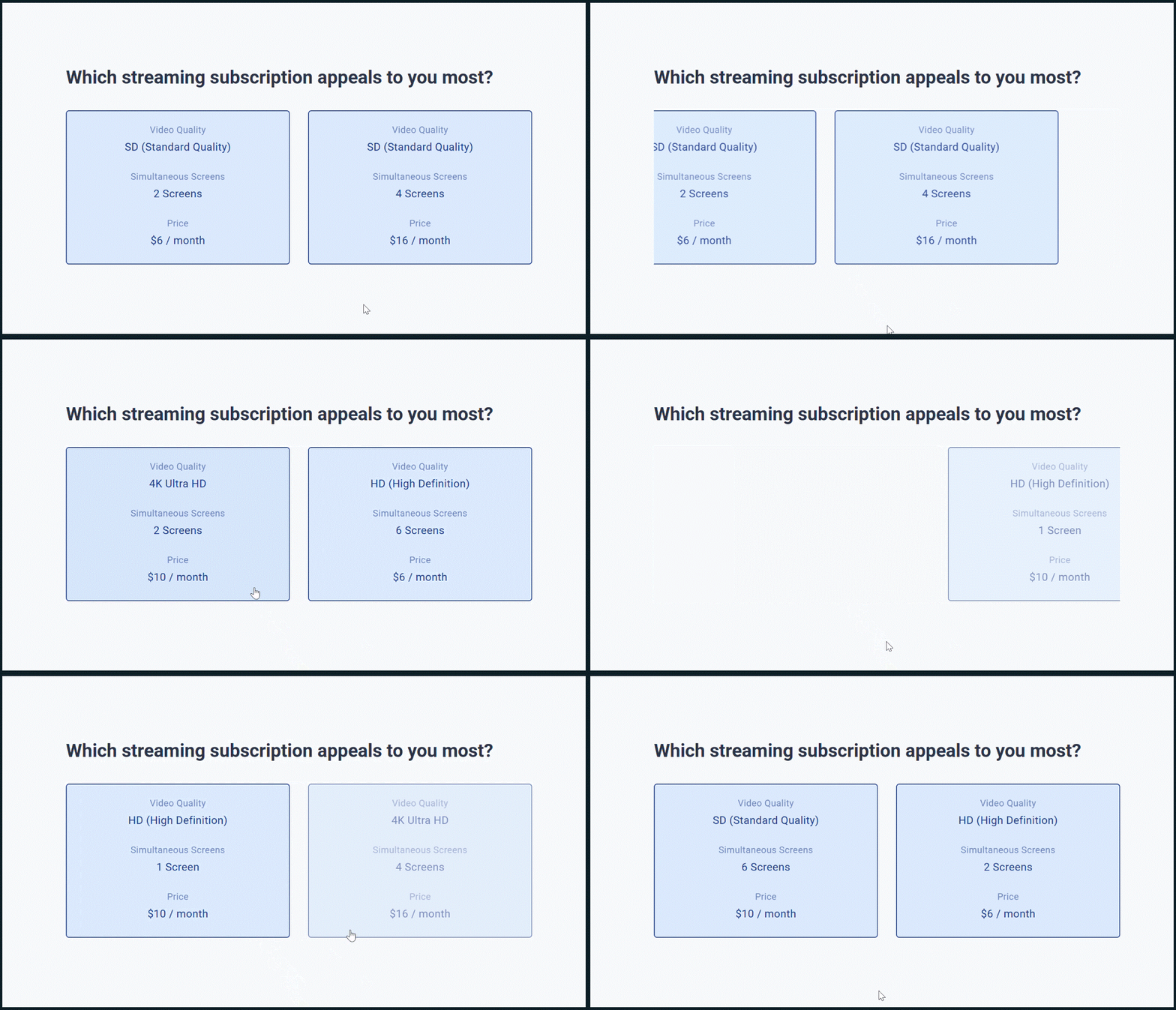
Example of a conjoint analysis voting on an OpinionX survey
1. OpinionX
OpinionX is a online platform for teams running advanced market research surveys. Having been specifically designed for this use case, OpinionX is ideally built for teams to run these methods in-house without a specialist background, with a library of templates and use cases, prepaid consulting time on premium plans, and an easy-to-use interface with clever automations to turn “advanced” surveys into stress-free studies.
It offers survey methods like conjoint analysis, maxdiff analysis, pairwise comparison, points-based ranking, and ranked-choice voting alongside standard question types like multiple choice, rating scales, matrix grid, and open-text response — all in a flexible survey builder.
Unlike QuestionPro, OpinionX makes all of its research methods available on every plan, including the free tier. You can build a complete conjoint or maxdiff study, configure all analysis settings, and collect results from up to 10 participants without paying anything. This means you can test your exact study design before committing to a paid plan — which is a huge advantage when you're learning a new method or need to validate your attribute structure before scaling to a larger sample.
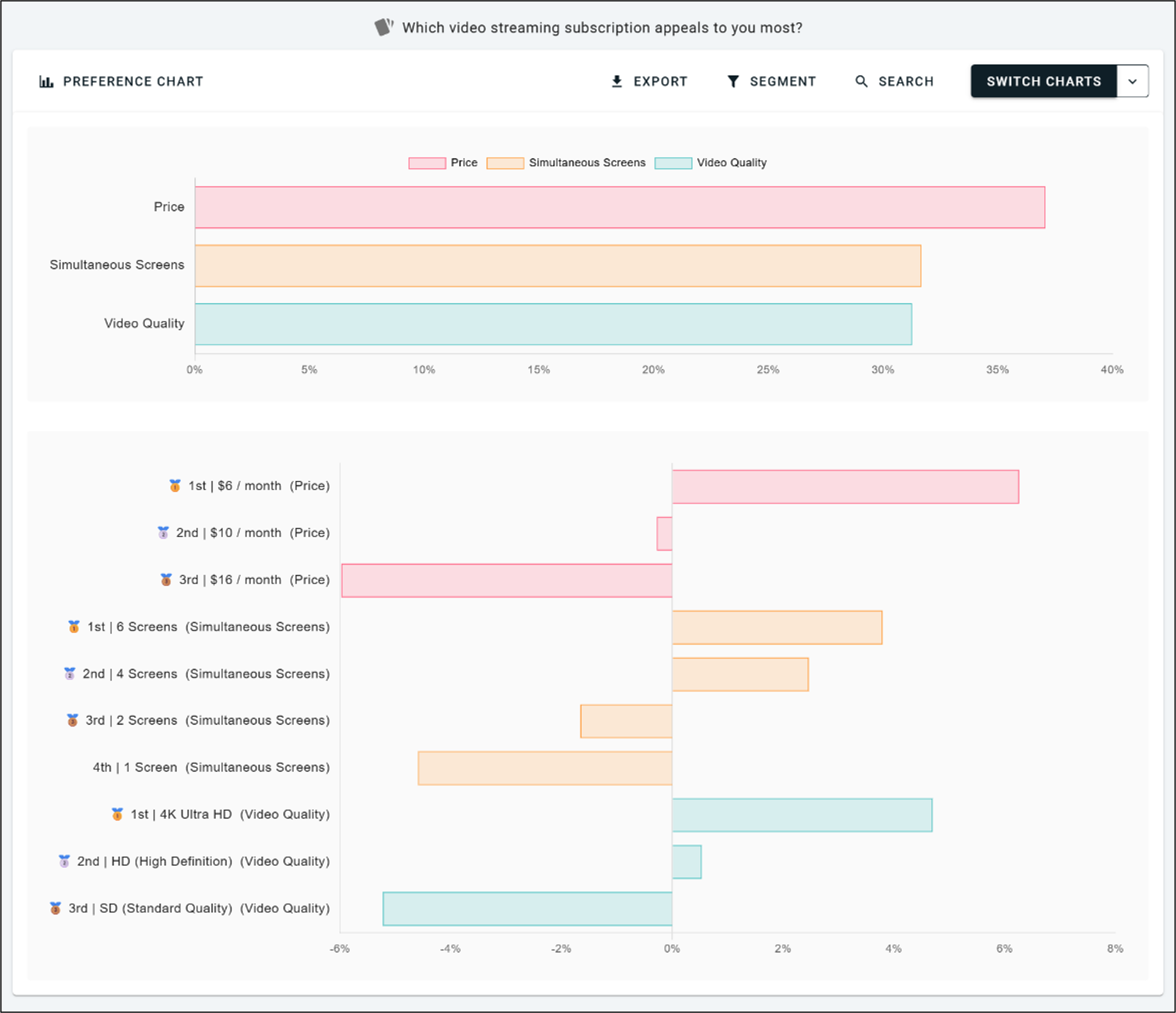
Example of conjoint analysis results, automatically calculated on OpinionX
OpinionX Strengths
Every research method is available for free. OpinionX's free plan includes full access to conjoint analysis, maxdiff, pairwise comparison, points-based ranking, display logic, multi-language setup, and all analysis features for up to 10 participants per survey. This means you can build your study, test the survey flow, collect a small sample, and evaluate the format of results, all before deciding whether to scale up. No credit card is required and there's no sales call to get started, just jump right in.
Built for newbies and experts alike. OpinionX offers specialist survey methods in a non-specialist platform, with templates and sample surveys, simplified language without unnecessary jargon, automated results, team collaboration, and even prepaid consulting for when you need a more experienced set of hands to help. Setting up a conjoint study takes 5–10 minutes, the platform handles calculating utility scores, marginal willingness to pay, market share simulation, and rejection rates automatically, and presents the results in plain language without unnecessary jargon or complexity. This makes advanced methods accessible to PMs, UX researchers, and growth leads who might not have a statistics or quantitative background.
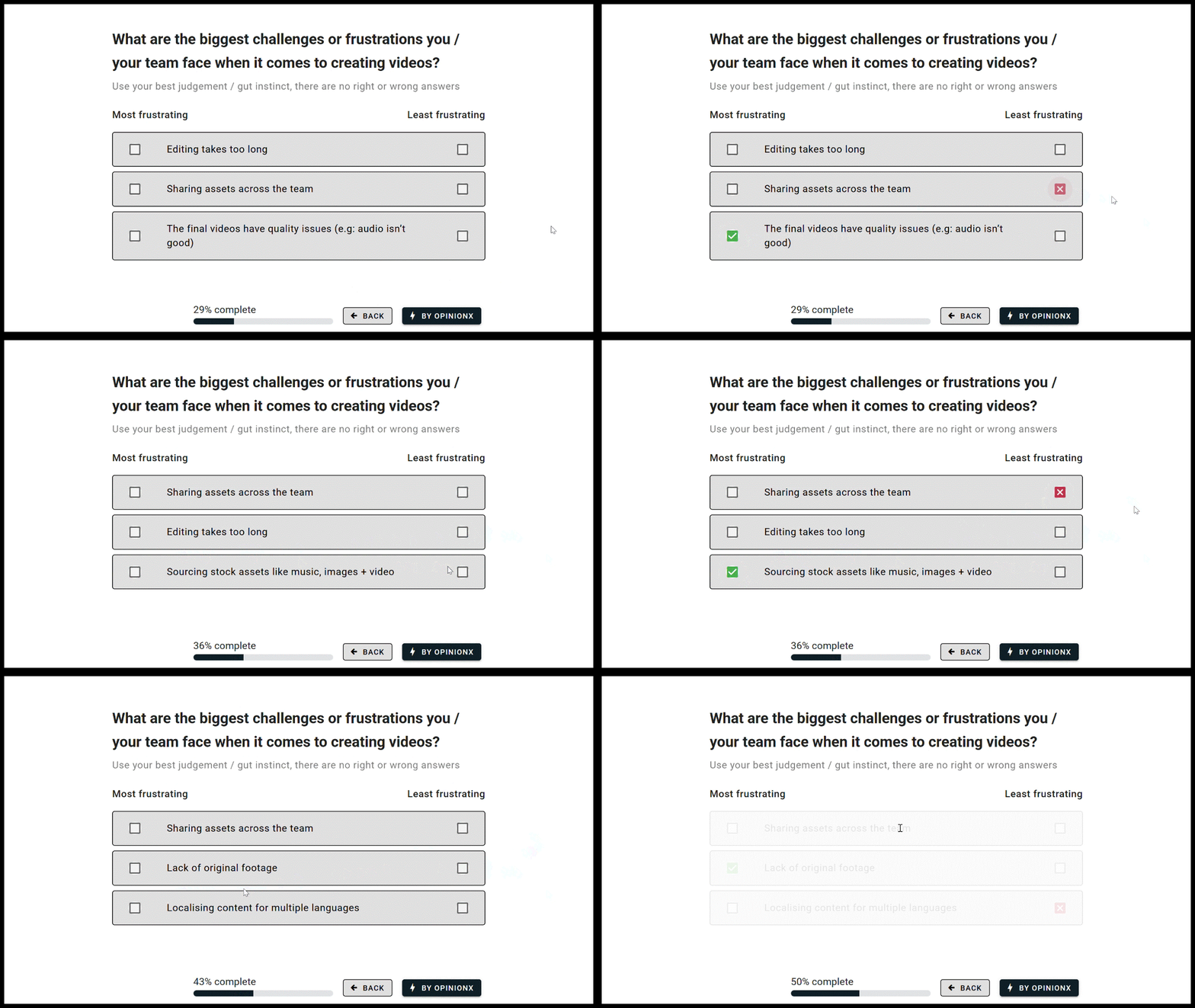
Example of a participant voting on a maxdiff analysis survey on OpinionX
Flexible survey builder. Unlike platforms that treat conjoint or maxdiff as specialized study methods outside of their survey builder, OpinionX lets you combine any question types in a single survey. You can add demographic questions, screening questions with branching logic, and open-text questions alongside multiple conjoint sections in one survey flow. This flexibility means you can collect segmentation data and run your conjoint study in the same session, then filter your results by segment in one click.
Automated advanced analysis. OpinionX's conjoint analysis includes a scenario simulator that predicts market share, revenue outcomes, and rejection rates for any combination of attribute levels. Marginal willingness to pay is calculated and charted automatically. Rejection rate analysis identifies which specific product characteristics cause people to reject a product entirely. These outputs are built into the dashboard — no manual calculation or export required.
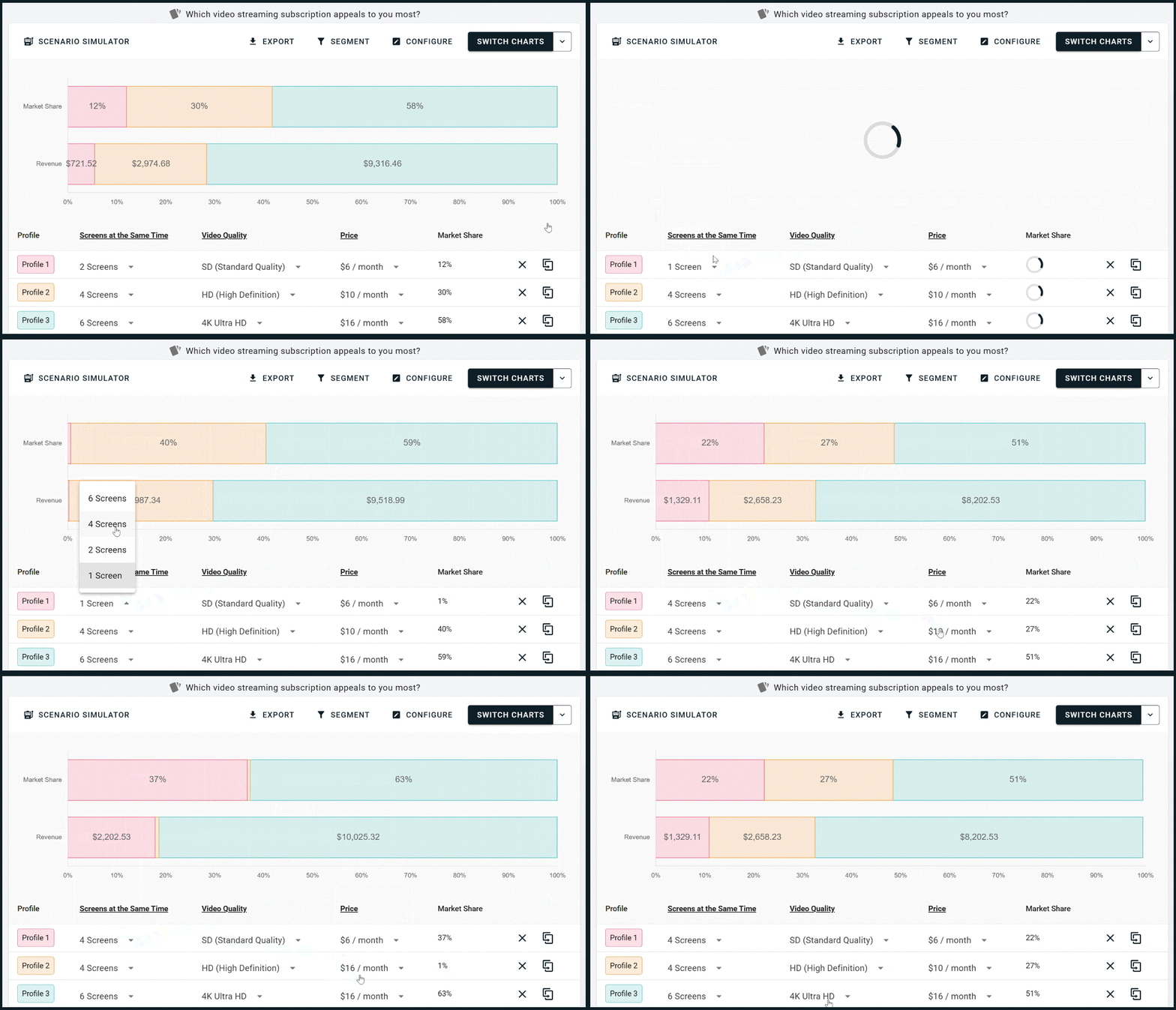
Segmentation built into the results. OpinionX supports filtering results by any answer in the survey, head-to-head segment comparison, crosstab views with up to 30 segments simultaneously (with colour-coding to surface differences), and clustering analysis that groups similar respondents together and identifies their shared characteristics. You can also view participant-level results to identify individuals with specific traits — useful for recruiting follow-up interview candidates.
Transparent, accessible pricing. OpinionX's paid plans start from $360/year for unlimited researcher seats. For a team of five, that works out to $72 per person. Compare that to $22,500 on Sawtooth Discover, $10,000 on QuestionPro, or $2,895 on Conjointly (prices as of May 2026). There's no per-seat pricing on OpinionX, no minimum seat requirements, and no sales call needed to get started. Just simple and transparent options.

Filter your results in one click on OpinionX’s results dashboards
No arbitrary setup limits. OpinionX doesn't impose attribute-level limits like some competitors. You can include as many attributes and levels as your research requires, and OpinionX’s built-in calculators will automatically suggest how to configure your survey to produce robust results.
Prepaid expert consulting included. All OpinionX premium plans include time with expert researchers who can help with survey setup, distribution strategy, and analysis. This is already included in the subscription price for premium plans.
OpinionX Weaknesses
Newer platform. OpinionX has less of an established reputation than QuestionPro in academia, although you will still find plenty of academic references for OpinionX too. Despite this, QuestionPro’s aggregate-level results for conjoint analysis means it offers much less rigorous data compared to OpinionX’s gold-standard algorithmic models for conjoint analysis (which is Hierarchical Bayes Multinomial Logit, or HB-MNL for short).
Narrower method library. QuestionPro offers a more extensive range of question types, including obscure methods like tubepulse and homunculus studies. However, despite this, many of QuestionPro’s methods like conjoint and maxdiff analysis are locked away on their enterprise tier and cannot be used without a $10,000+ payment. OpinionX’s growing range of market research and pricing study methods, by contrast, are all available on its free plan, giving you a much easier option to test and experiment with when you’re trying to plan your research projects.
2. QuestionPro
QuestionPro is a broad survey and research platform that competes with Qualtrics and SurveyMonkey. It offers a wide range of survey question types, data collection tools, and research modules across customer experience, employee experience, and market research. Founded in 2005, QuestionPro’s employee base is primarily in India and Bangladesh, where approximately two-thirds of employees are located.
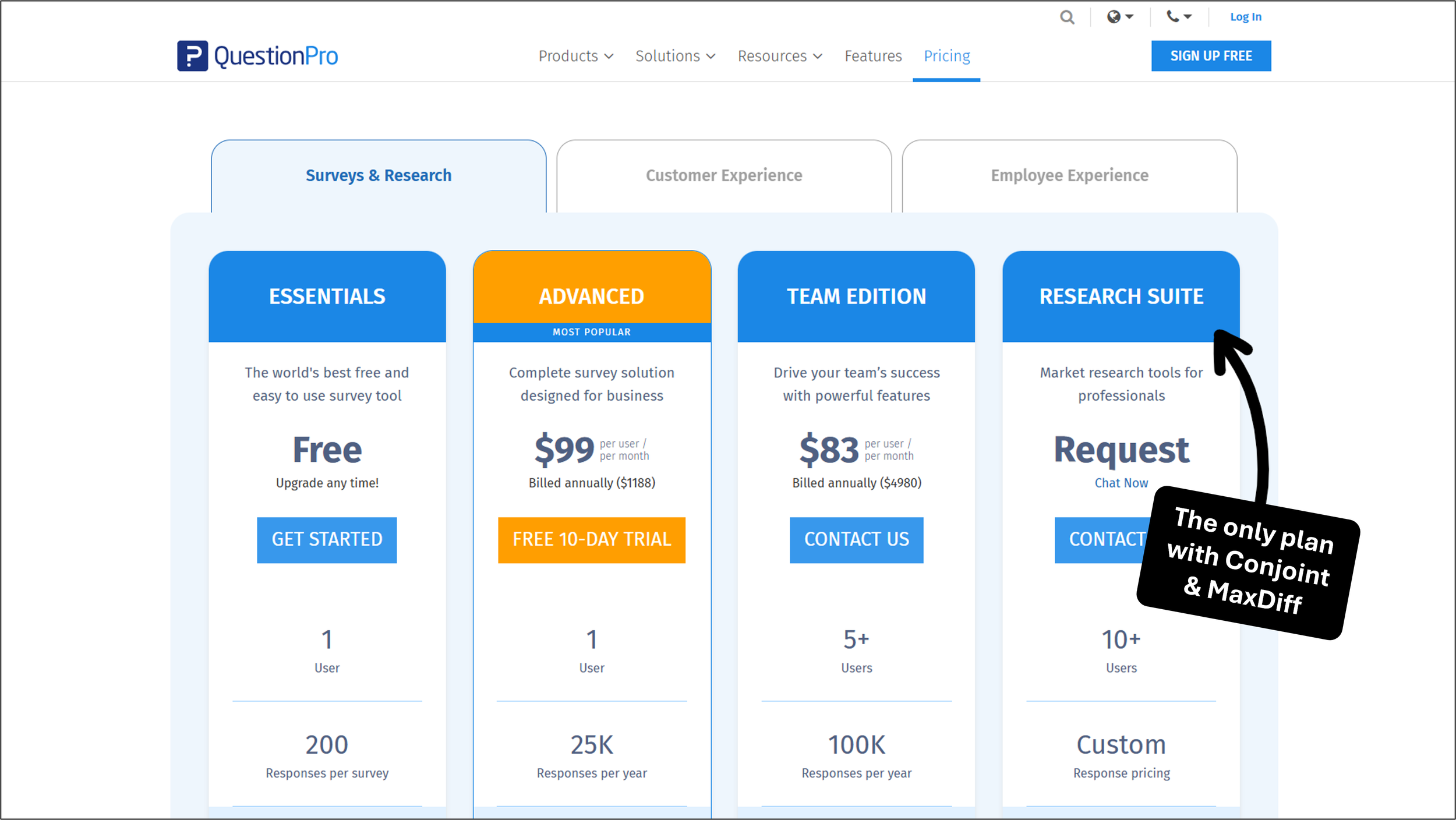
Screenshot in May 2026, may be out of date, check for updates
QuestionPro Weaknesses
No free tier or free trial. While QuestionPro overall has a free tier, it doesn’t include any survey types like like conjoint or maxdiff analysis. Instead, advanced survey methods are locked away on QuestionPro’s enterprise tier, which cannot be tested or accessed in any way without booking a demo with a salesperson.
Expensive, opaque paywall. Survey methods like conjoint and maxdiff analysis are only available on the Research Suite tier of QuestionPro, which has quote-only pricing starting from $10,000/year. There's a 10-user seat minimum, so even a two-person research team pays this full price, and larger teams must pay an additional per-seat price beyond their initial 10 licenses.
No individual-level conjoint analysis. QuestionPro uses multinomial logit estimation for both conjoint and maxdiff. This gives you aggregate-level results, useful for understanding the overall sample, but it does not produce individual-level utility scores. More advanced platforms like OpinionX use Hierarchical Bayes (HB) estimation, which lets you understand each respondent's preferences individually. This matters most when you want to run segmentation analysis on your results or when your audience is diverse enough that an average obscures meaningful differences between groups.
Reported contract and renewal issues. Multiple verified reviews on G2 and Capterra describe aggressive renewal practices, including attempted price increases exceeding 50% at renewal, refusal to allow plan downgrades, and at least one case of survey data being withheld until the customer renewed at the higher price. These reports are worth considering during procurement, especially for teams that value vendor flexibility.
Dated survey design and complex interface. Users describe QuestionPro's survey-facing design as "older" or "outdated" compared to modern tools, and the platform interface itself as "overwhelming" and "unintuitive." For researchers whose participants are often their own users and customers, the quality of the survey-taking experience can negatively affect response rates and data quality.
QuestionPro Strengths
Breadth of research methods. If you do pay for the enterprise-tier Research Suite on QuestionPro, you unlock a broad range of survey formats, ranging from obscure research methods like homunculus studies to more basic polling types like NPS, CSAT, or employee engagement surveys.
Anchored MaxDiff. QuestionPro supports both binary-direct and dual-response anchored MaxDiff models. This is a meaningful feature that lets you go beyond relative rankings to establish an absolute threshold, separating "must-haves" from "nice-to-haves" rather than just ordering items from most to least preferred.
Panel access. QuestionPro integrations enable access to 22M respondents via third-party panel integrations. This is a separate cost on top of the platform license, but having it built into the same tool simplifies the workflow if you need to source external respondents rather than surveying your own users.
— — —
OpinionX vs QuestionPro for Conjoint Analysis Surveys
Both QuestionPro and OpinionX offer choice-based conjoint (CBC), the most commonly used conjoint method in industry. However, there are significant differences in setup experience, analysis depth, and overall accessibility.
QuestionPro provides a wizard-based setup for CBC with support for random and D-optimal experimental designs, prohibited pairs (to exclude illogical attribute combinations), and a market segmentation simulator for testing product profiles after data collection. It calculates attribute importance scores, part-worth utilities, and preference shares. However, it uses multinomial logit estimation only, meaning you get aggregate-level results but not individual-level utility scores. Its own documentation recommends keeping studies to 4-6 attributes with 2-4 levels each, and features/levels cannot be added or changed after the conjoint question is saved. Additionally, you can’t offer respondents a ‘back’ button for conjoint questions.
OpinionX also supports CBC with automated results charts, profile logic (a more advanced version of ‘prohibited pairs’ for preventing unrealistic profiles), a scenario simulator that predicts market share, revenue, and rejection rates, automatic marginal willingness to pay analysis, a ranked concepts list showing which product configurations have the highest net preference, and rejection rate analysis to identify deal-breaker characteristics that could drive churn. Results can be filtered and compared across segments directly in the dashboard and on an extensive crosstab tool for conjoint analysis results. All conjoint features are available on the free tier, setup takes just 5-10 minutes, and there are no limitations on attributes, profile numbers, or levels per attribute.
The most practical difference for most product teams is that QuestionPro requires an upfront $10,000 commitment to unlock their Research Suite before you can even create a conjoint question, whereas on OpinionX you can build your full study, test it with a pilot sample, and evaluate whether the analysis functionality is right for your research — all without spending a single dollar.
— — —
OpinionX vs QuestionPro for MaxDiff Analysis Surveys
MaxDiff Analysis (also called best-worst scaling) asks respondents to pick the most and least important item from a series of randomized sets. It's one of the most reliable methods for ranking a long list of features, messages, or priorities by relative importance.
QuestionPro offers standard MaxDiff only on its enterprise tier ($10,000+ per year). It supports up to 30 items in a maxdiff list, voted on in sets of 3-6 items at a time. Its standout feature is anchored MaxDiff, with both binary-direct and dual-response models available, which lets you go beyond relative ranking to identify absolute thresholds. Analytics include share of preference percentages and best/worst breakdowns. Like its conjoint analysis format, QuestionPro uses aggregate-level logit estimation only (no HB), and the back button is disabled on MaxDiff questions.
OpinionX supports MaxDiff with randomized sample sets, asking respondents to pick the best and worst item in each set (with customizable ‘best’ and ‘worst’ voting labels). Unlike QuestionPro, there is no limit on OpinionX for the number of items in a MaxDiff list. Results are presented as ranked preference scores that surface the relative importance of every item on the list. Results integrate directly with OpinionX's segmentation tools, so you can compare how different user groups ranked the same list of items. MaxDiff is available on all plans including the free tier.
Both platforms will produce reliable MaxDiff results for the most common use case of ranking a long list of items to find out which features, messages, or priorities matter most. QuestionPro's has the advantage of offering anchored MaxDiff but a hard limit of just 25 voting options, while OpinionX is much more accessible with a flexible free tier, no list limit, and a starting price that is 27x cheaper for maxdiff analysis research.
— — —
QuestionPro vs OpinionX for Segmentation Analysis
QuestionPro offers is cross-tabulation and data filtering. You can define segments based on how respondents answered survey questions (up to 5 criteria with AND/OR logic) or based on imported custom variables (up to 255 variables). You can then compare segments side-by-side in reports and apply segment filters to your conjoint and MaxDiff results. This is useful for comparing predefined groups — for example, looking at how enterprise customers vs. SMB customers ranked features differently. But QuestionPro does not offer any statistical segmentation methods like cluster analysis for automated segment discovery. The maximum number of active segments is 10.
OpinionX offers several layers of segmentation. You can filter results by any survey answer or imported data, compare segments head-to-head, and view a crosstab with up to 30 segments simultaneously with colour-coding to highlight where groups differ. When creating segments or filters, you can use nested AND/OR logic to define custom segments, and you can save those (from Beyond filtering, OpinionX includes clustering analysis that automatically groups similar respondents together and identifies the characteristics they share. You can also view participant-level results — seeing how each individual respondent voted — which is particularly useful for identifying follow-up interview candidates or spotting outlier profiles.
For most product teams, the practical question is: "Do I already know which groups I want to compare, or do I need to discover what groups exist?" If you know your segments (e.g. by company size, role, or plan tier), both platforms can show you how they differ. If you want to discover natural groupings based on how people actually responded, like finding clusters of users with shared preferences that you didn't define in advance, then OpinionX's clustering analysis handles this natively, while QuestionPro requires you to export your data and use a separate statistical tool.
— — —
QuestionPro vs OpinionX for Pricing Research Surveys
Pricing research is one of the highest-stakes applications of survey methods, and the right approach depends on where you are in the pricing process.
QuestionPro supports three pricing research methods: Van Westendorp, Gabor-Granger, and conjoint-based pricing which lets you include price as an attribute and use the market simulator to test pricing scenarios. However, the conjoint limitations apply here too: aggregate-level analysis only, no individual-level willingness-to-pay modelling.
OpinionX approaches pricing research primarily through conjoint analysis, with price included as one of the product attributes. The marginal willingness to pay chart automatically calculates how much value each individual attribute upgrade or add-on is worth, translating utility scores into dollar amounts. The scenario simulator lets you model revenue outcomes for different pricing and feature combinations, and price sensitivity can be analyzed across different participant segments. OpinionX also supports Gabor-Granger surveys as a dedicated method through its survey builder.
For early-stage pricing exploration on a brand-new product, QuestionPro's Van Westendorp implementation is straightforward and easy to deploy. For more sophisticated pricing work — understanding willingness to pay for specific features, modelling the revenue impact of different price points, or testing how pricing interacts with other product attributes — conjoint-based pricing is more powerful, and OpinionX's automated marginal willingness to pay analysis removes the manual calculation step that most other platforms require.
— — —
Comparing Price for OpinionX vs QuestionPro
This is one of the starkest differences between the two platforms.
QuestionPro has four pricing tiers. The free Essentials plan supports 1 user and 200 responses per survey — but does not include conjoint, MaxDiff, or any advanced question types. The Advanced plan costs $99/user/month (billed annually, roughly $1,188/year) and still does not include advanced methods. The Team Edition costs $83/user/month with a 5-user minimum and still no advanced methods. The Research Suite — the only plan with conjoint and MaxDiff — is quote-only, with a publicly reported starting price of approximately $5,000/year, a 10-user seat minimum, and annual contracts only. Panel access, research services, and response overages are additional costs.
OpinionX includes all research methods — conjoint, MaxDiff, pairwise comparison, points-based ranking — on every plan, including the free tier. The free plan allows up to 10 participants per survey with full access to all analysis features. Paid plans start at $360/year with no per-seat pricing and no minimum user requirement. All paid plans include unlimited researcher seats and prepaid consulting time with expert researchers.
To put this in context: a team of five researchers could get full access to conjoint and MaxDiff on OpinionX for $360/year. The same team on QuestionPro would need the Research Suite at roughly $5,000+/year and would be paying for 10 seats despite only using five. That's a 14x price difference before accounting for any response overage fees or panel costs on QuestionPro.
— — —
QuestionPro vs OpinionX for Ease of Use & Respondent Experience
Setup complexity. QuestionPro's interface is described in multiple independent reviews as "overwhelming" and "cluttered," with a steep learning curve for advanced features. Setting up conjoint surveys on QuestionPro requires navigating the wizard carefully, once features and levels are saved, they cannot be edited. OpinionX, on the otherhand, is designed for researchers who are new to these methods. Conjoint setup on OpinionX only takes 5-10 minutes, and the platform guides you through configuration with suggestions for optimal design, examples, and easy to understand language.
Survey-taking experience. QuestionPro's survey design is functional but dated. Multiple reviewers describe the visual presentation as "older" compared to modern survey tools. OpinionX's survey interface is purpose-built for conjoint and ranking-style questions, designed to be clear and engaging for respondents who may be unfamiliar with trade-off exercises.
Respondent experience matters more than people think. If your survey participants are your own users or customers (which is typical for in-house product research), a confusing or unattractive survey hurts your response rate and data quality. An 80% completion rate versus a 50% completion rate can be the difference between a study that produces actionable insights and one that doesn't reach statistical significance. OpinionX has mobile-optimized interfaces for question types like conjoint analysis and matrix grid, which are typically sub-optimal on mobile devices using traditional survey platforms like QuestionPro.
Auto-capture of abandoned surveys. OpinionX saves every vote cast by a respondent, even if they abandon the survey before submitting. These partial responses can be included or excluded from results with one click, helping you capture the maximum dataset from your sample. QuestionPro does not offer this functionality.
— — —
QuestionPro vs OpinionX for Collaboration & Support
QuestionPro on the Research Suite includes role-based access control, shared survey libraries, report sharing via links, and a dedicated success manager. The InsightsHub repository provides a central place to store and share research findings across the organisation. However, at least one reviewer has reported that the BI dashboard wasn't accessible across multiple users on the same account, and there's no real-time co-editing of surveys.
OpinionX includes unlimited researcher seats on all paid plans (no per-seat pricing), so there's no cost barrier to giving every PM, designer, or researcher on your team access to the platform. OpinionX premium plans include prepaid consulting time with expert researchers for hands-on help with survey setup, distribution strategy, and analysis. This consulting is included in the subscription, not a separate paid service. Live-chat support is available to all users for technical issues or quick questions during research. You can create folders within workspaces to organize projects, create folder-based access restrictions to keep sensitive surveys private, and nest folders to design your own custom workspace structure.
For small teams (1-5 people), OpinionX's unlimited seats and included consulting are a clear advantage, as you're not paying for empty seats and you have expert help available when you need it.
— — —
Side-by-Side Feature Comparison
| Feature | OpinionX | QuestionPro |
|---|---|---|
| Free tier with Conjoint / MaxDiff | ✓Fully flexible free tier | ✕Sales call required, no access |
| Paid plan starting price for Conjoint / MaxDiff | $900/year | $10,000/year |
| Minimum users required | No minimum, full flexibility | 10 user seats minimum for ‘Research Suite’ |
| Researcher seats | Unlimited, no extra cost | Pay per seat |
| Choice-Based Conjoint | ✓Gold-standard model | –Aggregate-level results only |
| MaxDiff Analysis | ✓ | ✓ |
| Anchored MaxDiff | ✕ | ✓ |
| Pairwise Comparison | ✓ | ✕ |
| Points-Based Ranking | ✓ | ✕ |
| Market Share Simulator | ✓ | ✓ |
| Marginal Willingness to Pay | ✓ | ✕ |
| Rejection Rate Analysis | ✓ | ✕ |
| Segment Filtering on Results | ✓ | ✓ |
| Crosstab Segmentation | ✓Up to 30 segments | ✓Up to 10 segments |
| Clustering Analysis | ✓ | ✕ |
| Participant-Level Results | ✓ | ✕ |
| Van Westendorp Pricing | ✓ | ✓ |
| Gabor-Granger Pricing | ✓ | ✓ |
| Homunculus Research | ✕ | ✓ |
| Auto-Capture Abandoned Surveys | ✓ | ✕ |
| Conjoint Setup Flexibility | ✓No limitations, full flexibility | ✕Features/levels can’t be edited after launching |
| Attribute-Level Caps | No caps, full flexibility | Recommended 4–6 attributes |
| Prepaid Consulting | ✓Included in price | ✕Separate paid service |
| Third-Party Panel Recruitment | ✓Via third-party panels | ✓Via built-in third-party panels |
| NPS/CSAT/Employee Surveys | ✓ | ✓ |
| Multi-Language Support | ✓ | ✓ |
| Automated Language Translations | ✓Free, no limits | –Only for short surveys and only available on paid plans |
| Branching Logic | ✓ | ✓ |
— — —
How to Choose the Right Tool
Choose QuestionPro if…
You need niche research methods. Research formats like conjoint analysis and maxdiff analysis are more rigerous and easier to use on a purpose-built platform like OpinionX, but if you need niche question types like homunculus, then QuestionPro is a great option for you.
You specifically need anchored MaxDiff. If your study requires an absolute threshold (not just a relative ranking), QuestionPro's anchored MaxDiff implementation is a genuine differentiator.
Choose OpinionX if…
Price matters. With a flexible free plan and premium tiers that start at a very affordable $360/year for your entire team, OpinionX is an order of magnitude more affordable than QuestionPro’s $10,000/year minimum price for conjoint analysis. This cost advantage opens up advanced survey methods for teams that otherwise couldn't justify the budget.
You need to test before you commit. OpinionX's free tier gives you full access to methods like conjoint surveys, maxdiff analysis, and pricing studies. You can build, test, and evaluate your entire study before spending anything, which is simply not possible on QuestionPro without going through their sales process.
Your team isn't made up of specialist research scientists. OpinionX is designed to make methods like conjoint analysis accessible to PMs, UX researchers, and growth leads who don’t have a statistics background. Automated analysis, plain-language results, and included expert consulting all lower the barrier to doing rigorous research in-house.
You need mixed-method flexibility. Combining conjoint or maxdiff with other question types in a single survey, and filtering results by segment in one click, is straightforward on OpinionX. On QuestionPro, the advanced methods are more complex and isolated from the rest of the survey experience.
You want to discover segments, not just compare them. OpinionX's clustering analysis groups similar respondents together automatically and identifies their shared characteristics. This is valuable when you don't already know what segments matter, which is often the whole point of running the research.
Respondent experience is a priority. If your survey participants are your own users and customers, the quality of the survey-taking experience affects response rates and data quality. OpinionX's purpose-built interface for trade-off questions makes for a vastly better mobile experience and its auto-capture of abandoned responses help you get the most from every participant.
— — —
Bottom Line
QuestionPro is a capable platform with genuine breadth. If your organization already has a license for the QuestionPro Research Suite, it will get the job done for your advanced market research studies.
But for the majority of product teams, UX researchers, and growth leads at scaling companies — people who want to run advanced research methods without a $10,000 commitment, a mandatory sales process, and minimum seat prepayment that they don't need — OpinionX is the more practical choice. It gives you the same core methods at a fraction of the cost, with more analytical depth (automated marginal willingness to pay, clustering, rejection rate analysis), a better respondent experience, expert support included in paid plans, and overall just a lot more flexibility and accessibility for your research needs.
The most telling difference might be the simplest one: on OpinionX, you can set up a full conjoint study and see real results in just a matter of minutes, for free. On QuestionPro, you can't even see the conjoint feature without talking to a salesperson. For teams that value speed, transparency, and learning by doing, that difference shapes everything that follows.
Try OpinionX for free → conjoint analysis and maxdiff surveys available for free, no credit card required.
This page was last updated in July 2026. Pricing and features change frequently. We recommend verifying current details directly with each provider (OpinionX pricing,QuestionPro pricing).
Tool comparisons inherently involve subjective judgment; the opinions expressed are those of the author based on firsthand testing.