
“Three of the ten conjoint analysis tools compared here have a permanent free tier that runs a full conjoint study: OpinionX (25 participants per survey), Sawtooth Discover (50 participants per survey) and Conjointly (20 responses per advanced method). OpinionX’s paid plan is $900 a year for unlimited participants, surveys and researcher seats, which is the lowest published annual price for conjoint among the survey platforms on this list.”
Conjointly Professional costs $2,895 per team per year and Alchemer puts conjoint on Full Access at $1,895 per user per year (three users max). Qualtrics Strategic Research costs $5,040 a year for 1,000 responses, and you buy conjoint projects separately through an account executive.
Sawtooth's paid plans, QuestionPro's Research Suite and Quantilope's Enterprise plan are quote-only, 1000minds charges $3,500 per survey or $25,000 a year, and SurveyMonkey doesn't offer conjoint analysis at all. We checked prices on each vendor's own site on 30 September 2026.
Conjoint analysis shows which product attributes people care about most when they compare products and decide what to buy. It's how teams make better calls on pricing, feature prioritisation and bundling.
Most conjoint analysis software is priced like the method is exotic, which it isn't. Several platforms on this list gate conjoint behind their most expensive tier or sell it separately, and some won't even let you see it without a sales call. Pick the wrong one and you lose time and a lot of money, and probably get poor-quality insights too.
This post compares 10 of the most popular conjoint analysis platforms so you can pick the best fit for your next research project. If you're still getting up to speed on conjoint analysis, these guides cover the basics:
Ultimate Guide to Conjoint Analysis (Explanation, Tools, Examples)
13 Types of Conjoint Analysis (Explained with Image Examples)
8 Alternative Survey Methods To Use Instead Of Conjoint Analysis
How your Conjoint Analysis results are calculated (advanced guide)
What are the 10 most popular conjoint analysis tools?
| Platform | Entry price for conjoint | Test before buying? | Verdict |
|---|---|---|---|
| OpinionX | Free, then $900/year for unlimited participants and seats | 🟢 Free tier, 25 participants per survey, every feature | 🟢 Simulator, Profile Logic, MWTP, segmentation, several methods in one survey |
| Conjointly | $2,895/team/year | 🟢 Free Basic tier, 20 responses per method | 🟡 Broadest method range; conjoint and MaxDiff run as separate linked experiments |
| Sawtooth Software | Not published, quote only | 🟢 Discover free up to 50 participants per survey | 🟢 The rigour standard for ACBC and MBC |
| QuestionPro | Research Suite only, quote only, 10+ users | 🔴 Not on the free plan or trial | 🟡 Conjoint sits inside normal surveys, but only on the top tier |
| Alchemer | $1,895/user/year, max 3 users | 🟡 7-day trial | 🔴 Simulator is an Excel template, no willingness-to-pay report |
| Qualtrics | $5,040/year + separate conjoint purchase | 🔴 Not on the free account or 30-day trial | 🔴 Sales-led, one conjoint block per project |
| Quantilope | Enterprise plan (10 users), quote only | 🔴 Demo, pilots for select clients only | 🟡 Enterprise insights teams only |
| 1000minds | $3,500/survey or $25,000/year | 🟢 15-day free trial | 🟢 Best pick for formal MCDM work |
| SPSS | Base from $99/user + $79/user add-on, or Premium perpetual licence (quoted) | 🟡 Free trial, conjoint coverage not stated | 🔴 Analysis tool, not a survey platform |
| SurveyMonkey | Doesn't offer conjoint | 🔴 Not applicable | 🔴 LaunchPad covers MaxDiff and Van Westendorp, not conjoint |
What separates conjoint analysis software?
Every conjoint analysis tool here can run a choice-based survey, and most now let you add ordinary questions around it. They differ on the analysis you get once the votes are in and on what the price actually includes, and plenty won't let you see any of it before you sign a contract.
| Capability | OpinionX | Conjointly | Qualtrics | Alchemer | Sawtooth |
|---|---|---|---|---|---|
| Built-in market share simulator | ✅ | ✅ | ✅ | 🟠 Excel template | ✅ |
| Prohibited pairs | ✅ Profile Logic | ✅ | ✅ | ✅ | ✅ |
| Marginal willingness to pay report | ✅ | ✅ | ✅ | ❌ | 🟠 Lighthouse Studio |
| Segmentation on conjoint results | ✅ | ✅ | ✅ | 🟠 | ✅ |
| Several advanced methods in one survey | ✅ | 🟠 Linked experiments | ❌ One conjoint block per project | ✅ | ✅ |
| Run a real study before paying | ✅ 25 per survey | ✅ 20 per method | ❌ | 🟠 7-day trial | ✅ 50 per survey |
| Published price that includes conjoint | ✅ $900/year | ✅ $2,895/year | ❌ Conjoint priced by sales | ✅ $1,895/user/year | ❌ Quote only |
Most evaluations come down to three rows.
Several advanced methods in one survey. Qualtrics gives you one conjoint block per project and makes MaxDiff a separate project type, while Conjointly runs conjoint and MaxDiff as separate experiments you link with a redirect. On OpinionX, conjoint, MaxDiff, Van Westendorp and Gabor Granger are all blocks you can drop into the same survey, so a study that needs two methods stays one survey with one set of participants.
Run a full study before paying. Only three platforms here let you. Sawtooth Discover's free tier is the most generous at 50 participants per survey, then OpinionX at 25 per survey and Conjointly at 20 responses per advanced method. OpinionX's free study includes the simulator, the willingness-to-pay report and segmentation.
A published price that includes conjoint. Qualtrics, Sawtooth, QuestionPro and Quantilope all need a sales conversation before you know what conjoint costs, while OpinionX, Conjointly and Alchemer publish theirs. OpinionX's $900 a year covers unlimited participants and researcher seats.
Are teams switching conjoint tools, and why?
They are. Two of the comparisons on this page have already been made by people running actual pricing studies:
Pace Pricing, a specialist pricing agency, moved off Qualtrics to OpinionX and says it's better and easier to use.
Émilie at Soucy Group evaluated Conjointly and Alchemer alongside OpinionX and picked OpinionX.
Neither had a reason to pick the cheaper option unless it did the job, and in Pace Pricing's case research is the product they sell.
1. OpinionX
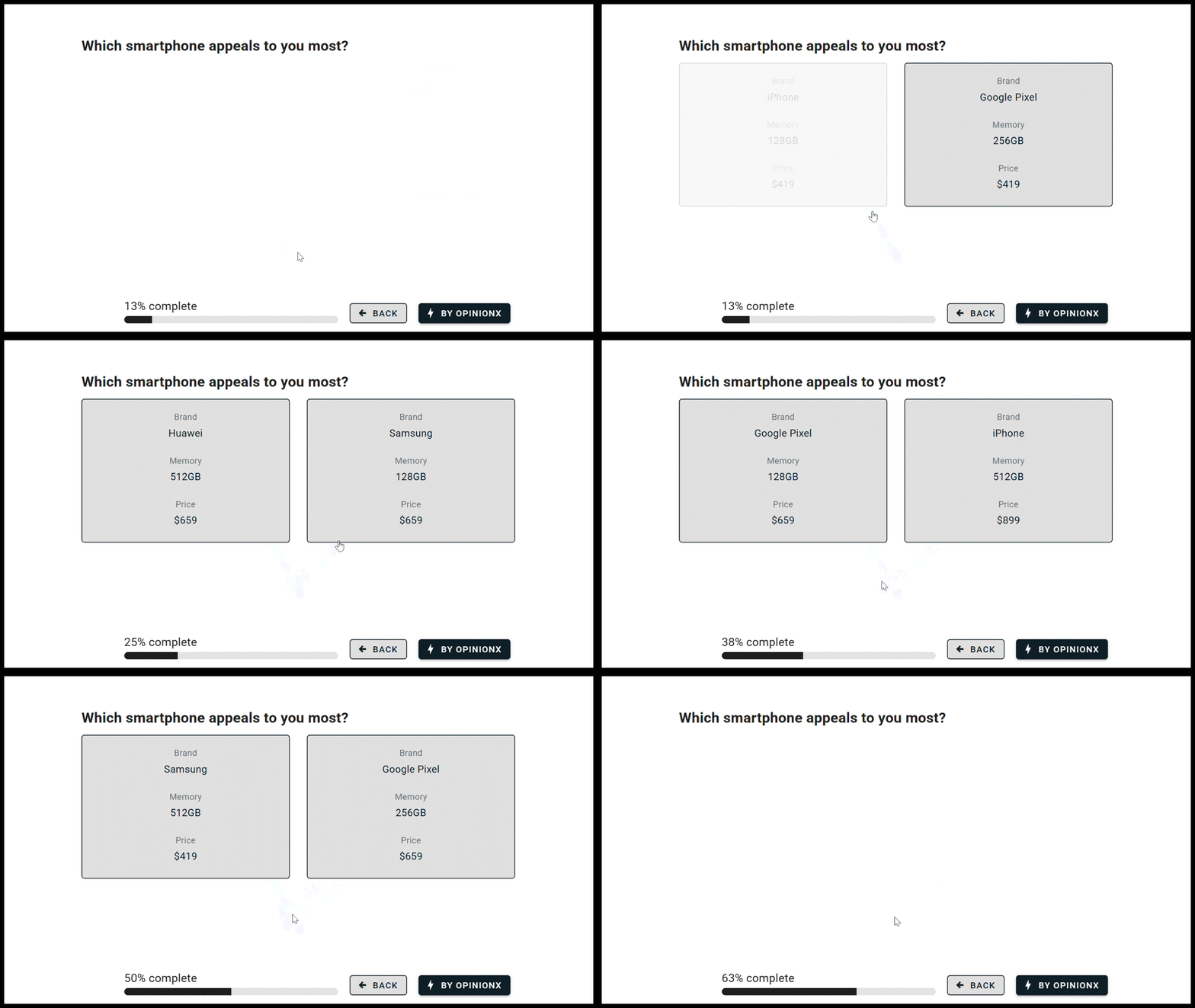
Verdict: the lowest published price for unlimited conjoint studies among the survey platforms on this list, with the market simulator, willingness-to-pay report and segmentation all on the free tier.
OpinionX is an advanced market research survey platform for conjoint analysis, MaxDiff and pricing research. Teams at Google, Amazon and Shopify use it. Conjoint sits on the free tier with every feature unlocked (design, analysis, simulator) and a cap of 25 participants per survey, so you're running an actual study rather than a demo. Use it to learn the method, test a setup or validate early, then scale to bigger samples on a paid plan.
Let's take a closer look at:
i. How OpinionX works
ii. OpinionX's conjoint features
iii. Pricing plans breakdown
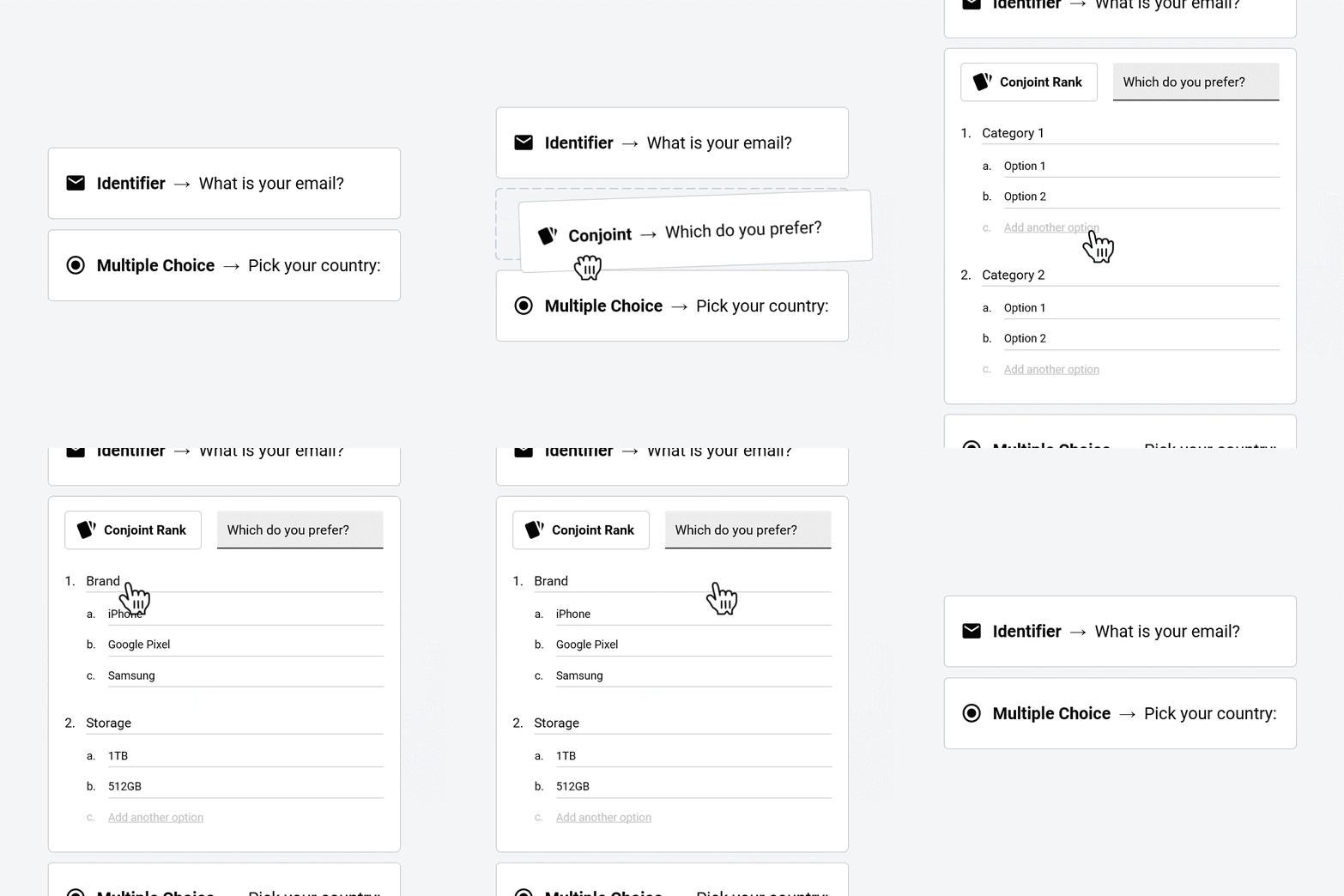
^ Building a conjoint analysis survey on OpinionX
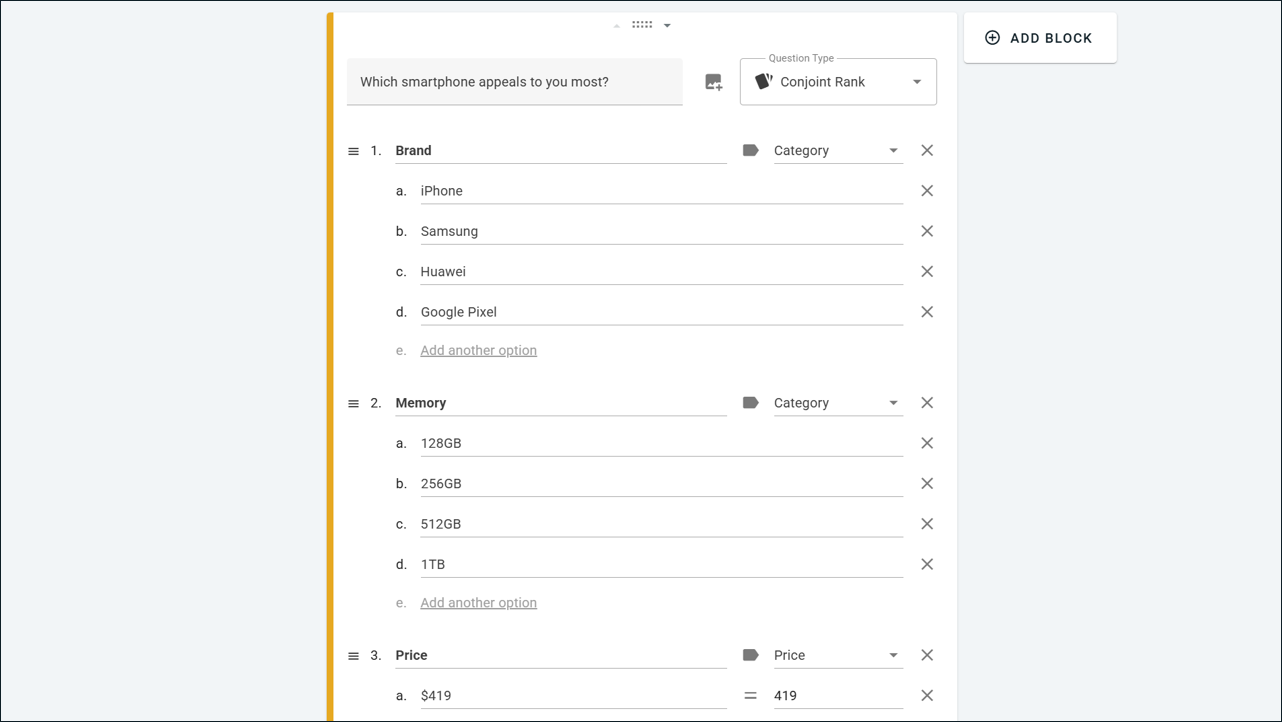
i. How does conjoint work inside an OpinionX survey?
On OpinionX, conjoint is a block like any other, and every question type is on the free tier. You can run conjoint analysis and MaxDiff analysis alongside standard formats like Multiple Choice, Rating Scale and Open Text Response, and drop each one anywhere in your survey.
Flexibility
Mix and match those formats however your research needs: demographic questions at the start or end, open-ended questions, branching logic that sends participants to different conjoint questions based on their earlier answers, even pricing methods like Van Westendorp and Gabor Granger in the same survey as your conjoint.
Most tools on this list let you add ordinary questions around conjoint too, but combining advanced methods is where they fall apart (see the Qualtrics and Conjointly limits above).
Filtering
Filter your results in one click to compare how different groups of participants voted:

Segmentation
Or put every segment side by side in one table to spot the groups whose preferences differ sharply from everyone else's:
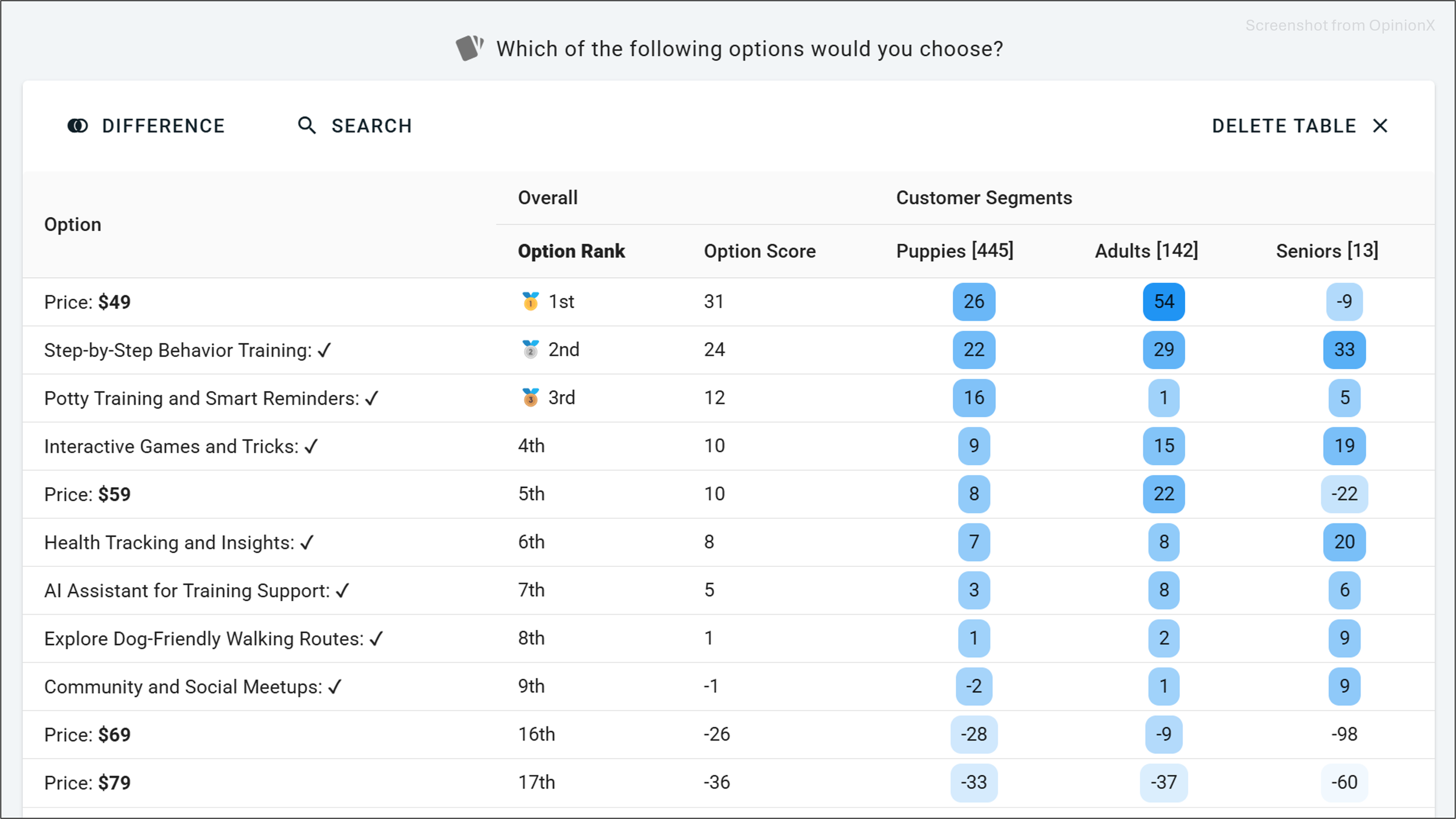
^ Example from Dogo’s pricing optimization conjoint → read the full case study
Enrichment
Segments build themselves from any Multiple Choice question in your survey. Got that data in your CRM or a product analytics tool already? The enrichment feature matches it to participants' conjoint votes, so you don't have to ask for it again.
Segmentation is a big deal in product research. Knowing which features or pricing models people prefer overall only gets you halfway; you need to know which types of customers care about them, since that's what decides pricing, positioning and what you build next. Needs-based segmentation goes deeper on how to build useful segments.
ii. Which conjoint reports does OpinionX calculate?
OpinionX calculates your conjoint results automatically with Hierarchical Bayes (HB-MNL) scoring and shows them in several formats. How conjoint results are calculated explains the HB scoring in detail.
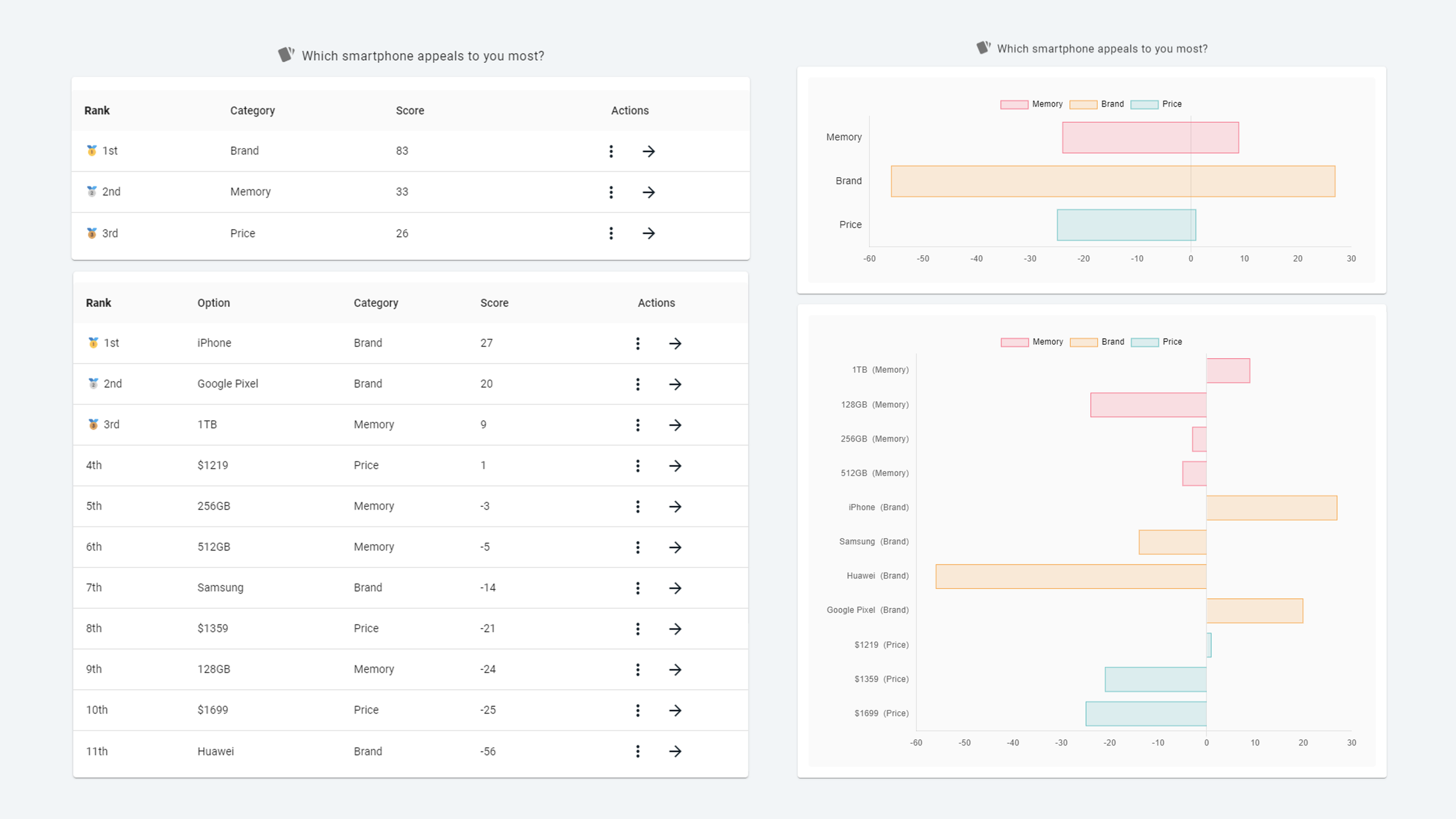
Conjoint results. View the scores (part-worth utilities) in a data table or as a bar chart.

Scenario Simulator. See how the market would react to competing products: build three products and OpinionX works out the market share and revenue each would get, straight from your conjoint results. The conjoint market simulator guide covers how to use it.

Marginal Willingness To Pay. See how much more someone will pay for a specific upgrade, like moving from a 128GB iPhone to a 256GB model. More on reading it in the marginal willingness to pay guide.
Ranked Concepts and Rejection Rate. Alongside the Preference Chart, OpinionX also ranks the full product concepts and shows how often each option gets rejected.
Profile Logic. Conjoint shows participants random combinations of product features and asks them to pick the one they like best, but not every combination makes sense (a $0/month plan with a dedicated account manager, say). OpinionX's Profile Logic stops those pairs from showing up together.
Alchemer is the thinnest of the five platforms in the feature matrix above: it has prohibited pairs, but its simulator is a downloadable Excel template and it has no willingness-to-pay report.
Setting up your first conjoint study and want a second pair of eyes on the categories, options and Profile Logic rules? Book a free 30-minute setup call (no obligation) and a research expert will go through your design with you.
iii. What do OpinionX's pricing plans include for conjoint analysis?
Most tools charge thousands just to unlock conjoint analysis, while OpinionX lets you create conjoint surveys for free and you don't need a credit card.
Free 🆓
Create unlimited conjoint analysis surveys.
View full survey results for up to 25 participants per survey.
Conjoint scores calculated automatically.
All question types unlocked, including conjoint and MaxDiff.
View individual participants' conjoint results.
Enrich your results with data from your CRM or an external spreadsheet.
Automated charts like the Market Share Simulator, Marginal Willingness To Pay, Ranked Concepts and Rejection Rate.
Analyze 🪙: $900/year
Unlimited conjoint studies with unlimited participants per survey, unlimited researcher seats, 90 minutes of prepaid research consulting and the option to remove OpinionX branding.
Accelerate 💰: contact sales
Dedicated consulting hours for survey design and analysis, enterprise-grade security like 2FA and SAML SSO, private team folders and procurement support. It's for bigger teams with strict security and support requirements.
Here's the full comparison of OpinionX plans.

OpinionX summary
🟢 Price: unlimited conjoint surveys for free, up to 25 participants per survey, with all analysis features included. Analyze removes the participant limit for $900/year, and Accelerate adds enterprise scale, security and support.
🟢 Trial: the free tier is the trial, and it isn't crippled.
🟢 Conclusion: OpinionX treats conjoint like a normal survey method anyone can learn and use in their own research, not a gated enterprise feature.
Want a conjoint analysis tool that's flexible and priced in the open? Start with OpinionX. Read how to create conjoint analysis surveys on OpinionX or make one now:
2. Conjointly
Conjointly is our closest direct competitor on this list and the one OpinionX gets compared with most often. It's a market research platform with lots of analysis tools, including Van Westendorp, TURF analysis and conjoint analysis. It's SOC 2 and ISO certified, which saves you a headache if you're going through a security review, and it covers more methods and question types than we do.
Conjointly's free Basic tier is permanent, not a trial: every advanced method runs free up to 20 responses, including the preference share simulator and segmentation. Professional costs $2,895 per team per year with no limit on users, Ultimate starts at $10,000 a year, and there are no monthly plans.
Compared with OpinionX, conjoint and MaxDiff run as separate experiments linked by a redirect, so a study that needs both becomes two experiments instead of one survey. Editing after launch is limited too: you can add questions to a launched study, but you can't delete them or change their type once saved.
Émilie at Soucy Group evaluated Conjointly and Alchemer alongside OpinionX, and chose OpinionX.
🟠 Price: $2,895/team/year, roughly 3x OpinionX's paid plan. Ultimate from $10,000/year.
🟢 Trial: free Basic tier, 20 responses per advanced method.
🟠 Conclusion: capable but more complex to use, and the linked-experiment setup catches people out when a study needs more than one method. Pick Conjointly if you need compliance certification today. OpinionX vs Conjointly has the full head-to-head.
3. Sawtooth Software
Sawtooth pioneered digital conjoint in the 1990s and has been the reference point for over 30 years, with deep expertise, webinars, training programmes for researchers who want to upskill and a lot of methodological authority.
It sells two products. Lighthouse Studio is a Windows desktop application and the most advanced discrete choice software available, and it supports Menu-Based Choice (MBC), Adaptive Choice-Based Conjoint (ACBC) and designs nobody else offers. Sawtooth Discover is the cloud platform for standard choice-based conjoint and MaxDiff, with a free plan covering up to 50 participants per survey and unlimited surveys.
🟠 Price: Sawtooth doesn't publish prices for its paid plans; you get a quote for both Discover Professional and Lighthouse Studio.
🟢 Trial: free up to 50 participants per survey on Discover, the largest free allowance on this list.
🟢 Conclusion: if you need adaptive conjoint or menu-based choice, buy Sawtooth. We don't do adaptive conjoint and won't pretend otherwise. For standard choice-based conjoint, you'll need a quote to compare it against OpinionX's $900. Conjointly vs Sawtooth vs OpinionX and OpinionX vs Sawtooth go deeper on this.
4. Qualtrics
Qualtrics sells conjoint inside its Strategic Research product, and getting to it is both expensive and slow. You can buy Strategic Research self-serve at $420/month ($5,040 billed annually) for 1,000 responses shared across all users, then conjoint projects cost extra on top, priced by an account executive, and Qualtrics doesn't publish that price.
Conjoint isn't available on the free account or the 30-day Strategic Research trial. You can add demographic or consent questions around a conjoint project, but each project holds one conjoint block, and MaxDiff is a separate project type.
After the demos, the pricing calls and the contract, you get a barebones conjoint tool that looks like it's from 2009. See for yourself:
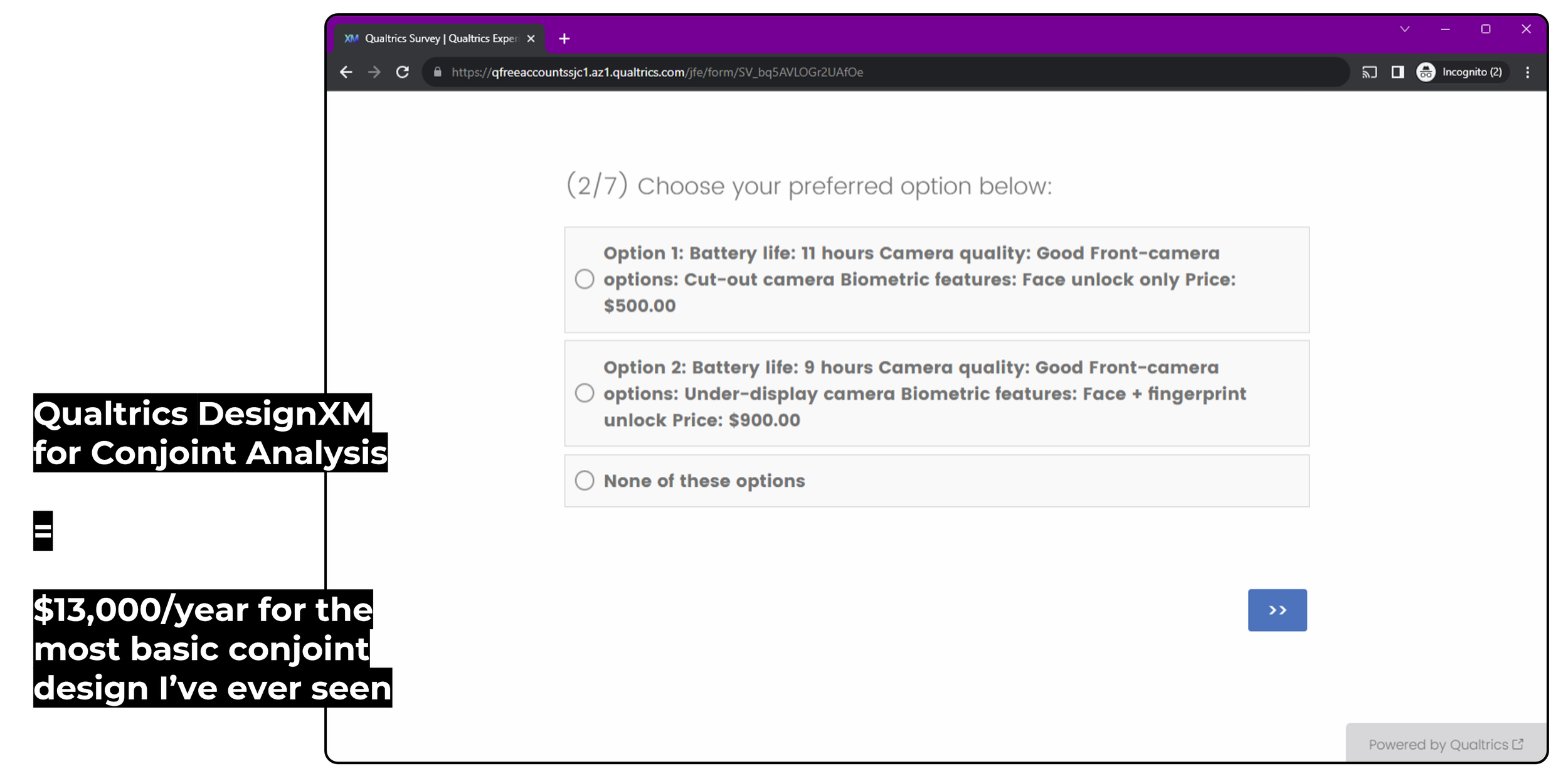
🔴 Price: $5,040/year for Strategic Research, plus a conjoint purchase priced by sales.
🔴 Trial: none for conjoint; you only get to see it through sales.
🔴 Conclusion: avoid. Paying $5,040 a year before anyone's even priced the conjoint add-on, for what's in that screenshot, makes no sense.
5. SurveyMonkey
SurveyMonkey mentions conjoint on its website but doesn't offer conjoint analysis on any plan or as a service, and its own MaxDiff page says so.
Since June 2026, SurveyMonkey sells advanced methods through LaunchPad, a pay-per-study product with no subscription, starting at $1,000 per study. LaunchPad covers MaxDiff (sold as Feature Prioritization, with TURF included) and Van Westendorp (sold as Price Optimization), with a built-in panel of 335M+ people, but not conjoint.
🔴 Price: not applicable, since there's no conjoint. LaunchPad studies start at $1,000 each.
🔴 Trial: none.
🔴 Conclusion: avoid for conjoint, because there isn't any. If you need MaxDiff or Van Westendorp, LaunchPad works, but every study is a new purchase. OpinionX vs SurveyMonkey compares the billing models.
6. QuestionPro
QuestionPro is an all-in-one survey platform that takes on Qualtrics and SurveyMonkey with a broad feature set at a lower price, and the interface suffers for it: lots of functionality crammed in and not much thought given to usability.
Conjoint is a question type you add inside a normal QuestionPro survey, but only on the top-tier Research Suite plan. Research Suite is quote-only ("contact sales for pricing"), needs 10+ users and uses custom response pricing. The free Essentials plan and the 10-day trial of the Advanced plan don't include conjoint, so you can't see QuestionPro's conjoint tool without talking to sales.
🟠 Price: quoted, top tier only, 10+ users.
🔴 Trial: none for conjoint.
🟠 Conclusion: a full-suite platform with the same problem as Qualtrics: you can't see the conjoint tool before you buy it. QuestionPro vs OpinionX has the full comparison.
7. SPSS
SPSS came out in 1968, IBM bought it in 2009, and academia and government still use it a lot. It's a statistical analysis tool, not a survey platform, so you'll need something else to collect the data.
The Conjoint module comes with the SPSS Premium edition on a perpetual licence, which IBM prices on request. On a subscription, you need Base (from $99 per user) plus the Complex Sampling and Testing add-on (from $79 per user). IBM offers a free trial but doesn't say whether it covers the conjoint module.
🟠 Price: from $99/user plus a $79/user add-on on subscription, or a quoted perpetual licence.
🟠 Trial: free trial available, conjoint coverage not stated.
🔴 Conclusion: old and it shows. A dated interface, a steep learning curve and a lot of manual setup make it a poor fit for teams that want flexible conjoint research, and even if you already run SPSS for analysis, you'll still need a survey tool.
8. 1000minds
1000minds is a decision-making platform for health economics, public policy and academic research. It launched in 2003 and it's best known for its patented PAPRIKA algorithm, an alternative to the Hierarchical Bayes and linear regression models most conjoint platforms use. You can add your own questions to a 1000minds survey alongside the trade-off questions.
Conjoint costs $3,500 per survey on the self-service option (up to 5,000 participants), or $25,000 a year for the research platform with unlimited surveys and shared team access.
🟠 Price: $3,500 per survey, or $25,000/year for unlimited surveys.
🟢 Trial: 15-day free trial.
🟠 Conclusion: if you're an academic or policy researcher running formal multi-criteria decision analysis, 1000minds is a highly specialised, well-respected tool and it beats us for that job. For everyday commercial product research, the pricing and narrow scope make it overkill. Conjoint vs the analytic hierarchy process covers where the two approaches differ.
9. Quantilope
Quantilope is a consumer intelligence platform for large enterprises, with lots of automated advanced methods including choice-based conjoint with a market simulator, plus an AI assistant (quinn) for study design and reporting.
Conjoint and segmentation sit on the Enterprise plan only, which comes as a 10-user package and is quote-only. The entry Business plan (3 users, from $2,000/month) doesn't include conjoint. There's no self-serve trial; access starts with a demo, and Quantilope offers pilots for select clients.
🔴 Price: quoted, Enterprise plan only.
🔴 Trial: none; you need a sales demo to get in.
🟠 Conclusion: a serious option for enterprise insights teams replacing agency-led research with a done-for-you partner. For smaller teams or occasional conjoint studies, the entry point is impossible to justify.
10. Alchemer
Alchemer (formerly SurveyGizmo) sells itself as a cheaper general-purpose alternative to SurveyMonkey and Qualtrics for small teams who want a simpler full-suite survey tool.
Conjoint is on Alchemer's Full Access plan only, at $1,895 per user per year billed annually or $275 per user per month. Full Access tops out at three users, and bigger teams move to a custom-quoted business platform account. There's a 7-day free trial with no card needed, and a limited free plan that doesn't include conjoint.
🟠 Price: $1,895/user/year, so $5,685/year for the maximum three seats.
🟠 Trial: 7-day free trial.
🔴 Conclusion: competitively priced as a general survey tool but thin for conjoint. It has prohibited pairs and you can segment the data, but the market simulator is an Excel template you download and fill in, and there's no willingness-to-pay report.
What about Pollfish?
Pollfish (now part of Prodege) has a built-in panel of 250M+ consumers, which makes it a strong option for recruiting participants fast, especially for international studies. It's free to join and you pay per survey response, starting at $0.95. The pricing calculator lists conjoint as a paid add-on.
Pollfish is worth a look if you mostly need panel access, but a dedicated conjoint platform gives you far more for the analysis itself, and you can buy survey participants through OpinionX too.
When shouldn't you use conjoint analysis tools?
First things first: check you actually need conjoint before comparing prices. Most projects people buy conjoint software for don't, and cheaper methods answer the question faster.
Conjoint suits a simulated purchase decision between similar products, made by one person who already knows what kind of product they want, on attributes you can name in advance. Miss any of those and you're paying for features you won't use.
If you're ranking a list of problems, features or messages instead of product configurations, pairwise comparison or MaxDiff will get you there with far less setup. With no price benchmark at all, conjoint can't help you yet, but Van Westendorp can.
When not to use conjoint analysis goes through ten scenarios in detail, and 8 alternatives to conjoint covers what to use instead.
Which conjoint analysis tool should you pick?
Pick Sawtooth if you need adaptive conjoint, menu-based choice or the methodological depth that comes with 30 years of it, because nothing else here comes close.
1000minds is the answer for formal multi-criteria decision analysis in health economics or public policy.
Conjointly makes sense if you need SOC 2 or ISO certification signed off today and you're happy running conjoint and MaxDiff as separate linked experiments.
OpinionX covers everything else, especially if you want the full conjoint toolkit at a published price. Every feature is on the free tier, capped only on participants, and $900 a year removes the cap for your whole team.
You shouldn't be paying thousands of dollars for conjoint analysis software, since it's a survey format you can set up yourself. Build your conjoint analysis surveys for free on OpinionX and save your team the time and money. You get the lowest published price of the survey platforms on this list, a flexible survey builder and every advanced conjoint feature:
✅ Market share simulator
✅ Profile Logic (prohibited pairs)
✅ Marginal willingness to pay report
✅ Segmentation and clustering analysis
Read how conjoint survey setup works on OpinionX, or create a free conjoint analysis survey in a few minutes.
Frequently asked questions
What's the cheapest conjoint analysis software? OpinionX has the lowest published annual price for conjoint among the survey platforms on this list: it's free for 25 participants per survey, then $900 a year for unlimited participants and seats. Sawtooth Discover and Conjointly also have free tiers (50 participants per survey and 20 responses per method). Every other platform here needs payment, a trial or a sales call first.
Which conjoint analysis software has a free trial or free tier? OpinionX, Sawtooth Discover and Conjointly have permanent free tiers that run full conjoint studies. 1000minds offers a 15-day trial and Alchemer a 7-day trial. SurveyMonkey doesn't offer conjoint, and Qualtrics, QuestionPro and Quantilope keep it behind a sales process.
Can you run conjoint analysis inside a normal survey? On most platforms, yes. OpinionX, Conjointly, Sawtooth, QuestionPro, Alchemer, Quantilope, 1000minds and Qualtrics all let you add ordinary questions around conjoint. The bigger difference is combining advanced methods: Qualtrics allows one conjoint block per project, and Conjointly links conjoint and MaxDiff as separate experiments.
What's the difference between OpinionX and Conjointly? Conjointly has broader method and question-type coverage, plus SOC 2 and ISO certification. OpinionX puts several advanced methods in one survey where Conjointly links separate experiments, and costs $900 a year against Conjointly's $2,895. Both have free tiers. Here's the full comparison.
Do you need a market simulator for conjoint analysis? If you're using conjoint for pricing or product decisions, yes. The simulator turns scores into a market share prediction you can act on. Alchemer only offers an Excel template for it, so check this before you buy a general-purpose survey tool.
About The Author:
Daniel Kyne is the Founder and CEO of OpinionX, an advanced market research survey platform for conjoint analysis, MaxDiff and pricing research. OpinionX runs every method on its free tier, including conjoint analysis, pairwise comparison and points-based voting.