
Conjoint Analysis vs. Analytic Hierarchy Process (AHP) — Explanations, Differences, Examples, Use Cases
“Conjoint analysis and the Analytic Hierarchy Process (AHP) both rank options across multiple dimensions, but they work in opposite ways. Conjoint is implicit: people pick between whole product profiles, and the method works backwards to figure out how much each attribute mattered. AHP is explicit: people directly rate how important each criterion is against every other, in a structured hierarchy, using pairwise judgements.”
Use conjoint when you want to know how customers trade off product features in a realistic buying decision, especially when attributes are nested (options belong inside categories). Use AHP when you have a clear set of independent criteria and want a transparent, defensible weighting, common in internal or group decision-making. If you only need to rank a single flat list of items by importance, neither is worth the overhead; a simple ranking method like pairwise comparison or MaxDiff is the better fit.
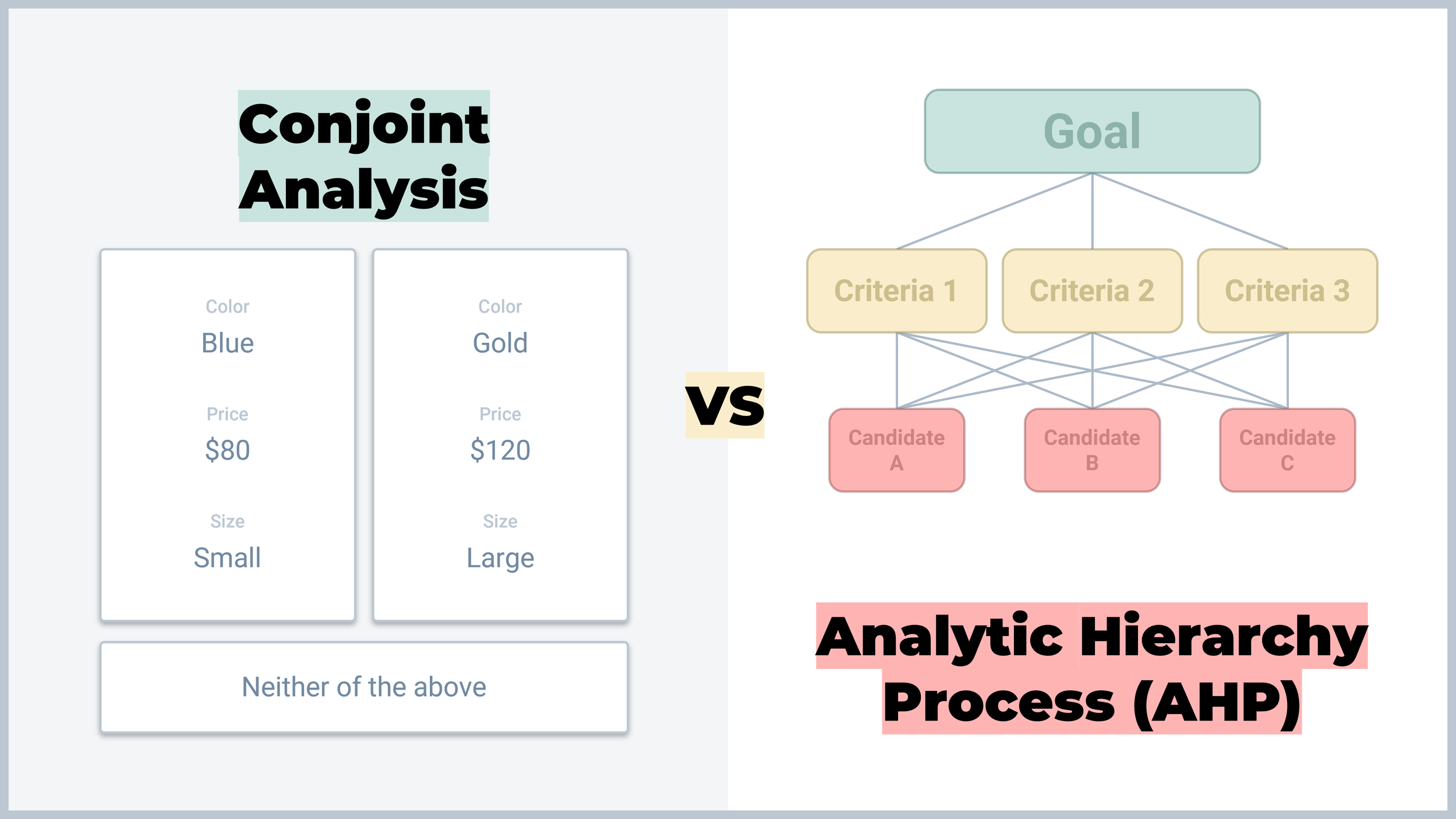
Explaining the difference between Conjoint Analysis and Analytic Hierarchy Process (AHP)
When you want to rank a list of options, there are several survey methods to choose from:
Ask people to rank the entire list from 1st down to last place → ranked choice voting.
Give everyone 100 points to allocate among the options → points-based ranking.
Break the list into head-to-head pairs and rank by how often each option is picked → pairwise comparison.
Break the list into sets of 4 options at a time and ask people to pick the best and worst in each set → maxdiff analysis.
But what happens when you're ranking things that don't belong to just one list, when you have a multi-dimensional scenario? That's where conjoint and AHP come in.
Conjoint Analysis
In conjoint analysis, your options belong to categories, and you want to know which categories matter most, but also which options within each category people prefer. To do this, conjoint gives people a set of profiles. On each profile you see the same categories (say colour, size, weight), but the options within each are randomised (blue, green, red, and so on for "colour"). Each time someone picks the profile they like most, those profiles disappear and a new set with randomised options appears.

Example of pairwise voting on a conjoint analysis survey hosted on OpinionX
By tracking which profiles people pick each time, conjoint identifies the categories that influence decisions the most and which options people are most drawn to.
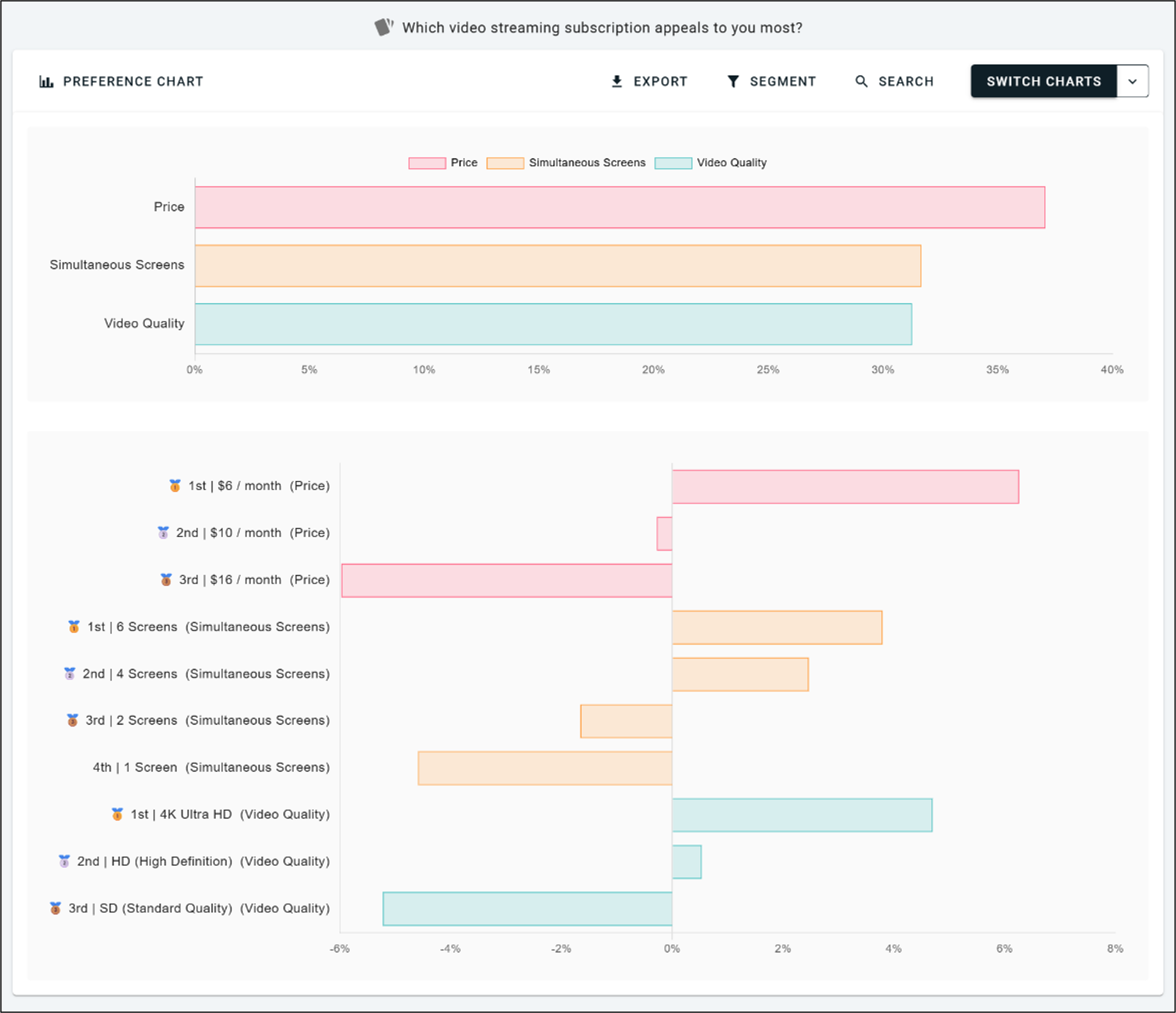
Example of conjoint analysis results from an OpinionX survey
Analytic Hierarchy Process (AHP)
Where conjoint measures the importance of categories and options at the same time, AHP has two separate voting phases.
In the first phase, you check which criteria matter most when making a decision. If you're deciding between streaming platforms, your criteria might be price, catalog, and seats per subscription. To see which matter most, you put them into head-to-head pairs and vote on a 1-9 scale to show which criterion is more important.

Say the first stage of our AHP results tells us that when we're considering a streaming platform:
50% of our decision is based on the shows and films they offer (catalog).
35% is based on the monthly subscription price.
15% is based on how many people can share the account (seats).
These percentages are called weights, and they tell us how each criterion matters to us when weighing the candidates. In the second phase, you take one criterion and compare each candidate on it. You start by comparing Netflix, Disney+ and HBO in head-to-head pairs, voting on that same 1-9 scale for which offers a better price. Then you repeat for catalog, and again for seats.

That second phase gives you a score for how well each candidate performs on each criterion. For the last step, you combine the scores and weights into a total for each candidate. That total tells you which candidates are strongest overall, given how much each criterion matters to you.

So AHP separates "what matters most" from "who's best at it", lets you answer each independently, then combines them into a single result to help you pick.
Main differences between conjoint analysis and the AHP method
Both methods help you make multi-criteria decisions, but they're almost never interchangeable.
1. Implicit vs. explicit data
Conjoint analysis acts like a hypothetical purchase decision between a set of offerings. It looks at people's behaviour and calculates what matters most from their choices. That's implicit scoring: weights are based on what people do. AHP instead asks people to state exactly how much each thing matters. That's explicit scoring: weights are based on the numbers people pick to say how important each criterion is.
2. Nested vs. independent information
In conjoint, options are nested. They belong to separate categories, and two options from different categories can't be directly compared. You'd never ask someone whether they'd prefer a blue car or a $50,000 car. Instead you compare the colour options against each other, the price points against each other, and then weigh whether price or colour matters more overall.
AHP has no nesting like this. You have a list of criteria to help make the decision and a set of candidates to choose from, and those are two completely separate, independent things.
3. Why vs. what outcome
The output of conjoint is a model of how people think when they decide. It's a trade-offs engine, showing which categories they spend the most time considering and whether each option makes the product seem more or less attractive overall. Those insights help you make decisions easier for people, by communicating the factors you know they care about, or by checking which combination of options they'd pick before you commit to a big launch. It's a model of why people act the way they do, one you can use in plenty of ways afterwards.
AHP is better thought of as a way to inform one specific decision about what to do. You do calculate weights for each criterion, but the weights aren't the point. You're not running an AHP survey to discover that 50% of someone's purchase decision rests on catalog. You're running it because you're trying to decide whether to buy Netflix or Disney+. That makes AHP more useful when you want to bring structure to a big decision, or fold many people's input into one collective choice.
Incorrect explanation of their differences
Despite what ChatGPT might tell you, choosing between conjoint and AHP based on your job title is terrible advice. Both can be used for market research, and both can inform internal decision-making. They're two survey methods that suit different scenarios and produce quite different outcomes. If in doubt, paste the URL for this article into your LLM chat with a description of your scenario and ask it to help you decide which method fits.
When to use conjoint analysis vs. the AHP method?
TL;DR:
Choose conjoint if you're evaluating multi-dimensional bundles, your criteria interact, you need pricing data, or you want to simulate real-world choices.
Choose AHP if your criteria and alternatives are separate dimensions, you want explicit and transparent weights, the criteria are abstract or qualitative, or you need a clear audit trail.
Consider simpler ranking methods (pairwise comparison, maxdiff) if you just need to rank a list of items by importance and don't need the full apparatus of either advanced method.
When to use conjoint analysis
Your options belong to discrete categories. This is often the case for products, subscription plans, service packages, or feature configurations.
The categories interact. The value of one thing depends on what else is in the bundle. A premium feature set might be worth $30/month, but not if it comes without any customer support. Conjoint captures these trade-offs naturally because participants see complete profiles. AHP would miss the interaction entirely, because it evaluates each criterion in isolation.
You need to model pricing or willingness to pay. Conjoint is particularly strong when price is one of your categories, because you can calculate how much each upgrade is worth in dollar terms. It isn't limited to pricing, but that capability makes it a go-to for pricing research, since it handles price trade-offs better than any alternative.
You want to simulate real-world choices. The comparison format, picking between two complete options, mirrors how people actually evaluate products. That makes conjoint results more predictive of real behaviour than methods where people rate abstract criteria in isolation.
You need predictive modelling. Conjoint data can simulate hypothetical scenarios, like "What happens to preference if you raise the price by $5 but add a feature?". Conjoint simulators let you interrogate your results without running another survey.
Some scenarios where someone might use a conjoint survey:
A product manager testing different configurations ahead of launching a new SaaS tier.
A growth lead trying to improve conversion rate by testing different subscription bundles.
A UX researcher evaluating which combination of features and onboarding experience users prefer.
A marketing manager comparing landing page value propositions that combine different benefit claims.
Despite its reputation as a "marketing" method, conjoint works wherever the decision involves choosing between multi-dimensional options. If you're a PM evaluating product directions where each one trades off across features, timeline, and resource cost, that's a conjoint problem, even though it's an internal strategic decision.
When to use the Analytic Hierarchy Process (AHP)
Your criteria are independent of each other. The importance of "ease of use" doesn't change with the price. "Strategic alignment" matters the same regardless of development effort. If that describes your situation, AHP's independent weighting makes sense. If your criteria interact, conjoint will give you more relevant results.
You want to weigh the criteria explicitly before evaluating options. AHP separates "what matters?" from "which candidates are best at it?". That's valuable when the weighting itself is the contentious part of the decision, say your team can't agree on whether user demand or revenue impact should drive the roadmap. AHP lets you resolve that first, then apply the agreed weights to evaluate options.
The criteria are qualitative or abstract. Things like strategic alignment, team morale impact, brand fit, or long-term scalability are hard to put into conjoint, because they don't have a discrete list of options within each the way "price" or "seats" does. AHP handles abstract criteria comfortably, because it only asks "which of these two matters more?", a judgment people can make even for fuzzy concepts.
You need a transparent audit trail. Because AHP produces explicit weights at each stage, the final ranking is fully traceable. You can show exactly why a decision came out the way it did: "Vendor A won because we weighted integration capability at 35%, and Vendor A scored highest on that criterion." Conjoint does produce relative importance weights and part-worth utility scores, but AHP's approach is valuable when you need to justify a decision to leadership or other stakeholders.
You're working with a small group of evaluators. Traditional AHP was designed for expert panels and small stakeholder groups. It works well when 1-10 people need to reach a structured consensus. For larger participant pools, survey-based methods like conjoint, pairwise comparison, or maxdiff can produce similar relative importance scores without AHP's fixed structure.
Some scenarios well-suited to AHP:
A product team deciding which of three strategic initiatives to pursue this year, weighted by criteria like user impact, revenue potential, and engineering feasibility.
A UX research lead evaluating vendors for a new research platform based on cost, feature set, support quality, and integration with existing tools.
A hiring committee scoring final candidates against independently weighted criteria.
A leadership team choosing a new office location based on commute time, cost, talent pool access, and client proximity.
Common mistakes when choosing between conjoint & AHP
"Conjoint is for marketing, AHP is for internal decisions"
This is the most common misconception, and the one that leads people astray most often. Both inform decisions, both can be used for market research, and both are multi-dimensional ranking methods. Conjoint can serve internal strategy instead of AHP if the scenario fits it better. The difference is about the structure of the problem, whether your criteria and options naturally bundle together or are separate dimensions, not about which department you sit in.
Using AHP when your criteria are nested
If the value of one criterion depends on the level of another, AHP's independent weighting will miss it. If "fast delivery" matters a lot at a high price point but barely matters at a low one, AHP struggles to capture that, because it weights "delivery speed" the same regardless of price. Conjoint captures the nuance naturally, because participants see both dimensions together.
Using conjoint or AHP when you just need a simple priority ranking
Not every multi-criteria decision needs conjoint. If you have a list of features and just want to know which matter most to your users, use a simpler ranking method. Look at pairwise comparison, maxdiff analysis, points-based ranking, or even a plain ranking poll. Use conjoint and AHP when the problem needs them, not for the sake of it.
Assuming AHP requires the Saaty Scale
AHP is a framework. You build your hierarchy (goal, criteria, candidates), compare candidates in pairs, weight them, then score the candidates. The Saaty Scale, the 1-9 rating system traditionally used to collect the comparison data, isn't a mandatory component. You can opt for binary pairwise comparison (which is more important, criterion A or B) without the scale, to simplify the process. If you've dismissed AHP because the Saaty Scale feels impractical, you may have dismissed the framework when you only needed to swap the scoring method.
Trying to force one method when your problem needs the other
Ask "What combination of features will customers prefer?" and try to answer it with AHP, and you'll get criteria weights and feature scores but miss the trade-off dynamics. Ask "Which strategic initiative should we prioritise based on four independent criteria?" and try to answer it with conjoint, and you'll struggle to define meaningful profiles, because the criteria don't naturally bundle into options.
Tools for conjoint analysis, AHP, and ranking surveys
Conjoint analysis tools
I've previously reviewed the 10 most popular conjoint analysis survey platforms in detail. The best platform for building and running your own conjoint surveys is OpinionX. It's built for teams who want to run conjoint projects themselves without being experts or needing specialist training. Through plain language, a flexible survey builder, results automations, and a library of templates and sample surveys, OpinionX turns conjoint from an advanced market research method into one anyone can use.
Beyond the survey itself, OpinionX has automated results features for conjoint like a scenario simulator, a marginal willingness to pay chart, rejection rate analysis, and more. It also lets you filter, segment, and compare results by group to see how sub-groups voted differently.
The free tier gives you all survey question types and analysis methods for up to 25 participants per survey, so you have everything you need to check whether conjoint is the right method for you. And if it is, OpinionX is also the cheapest way to run conjoint surveys. Its premium plan is $900 a year for unlimited researcher seats, against Conjointly at $2,895 per team per year, Sawtooth Discover at $4,500 per user per year (with Sawtooth's Lighthouse Studio starting at $10,900 a year for a single user), and Qualtrics, which is quote-only enterprise pricing. Competitor prices verified from each vendor's own pricing page in August 2026; re-check them before quoting, since they change often.
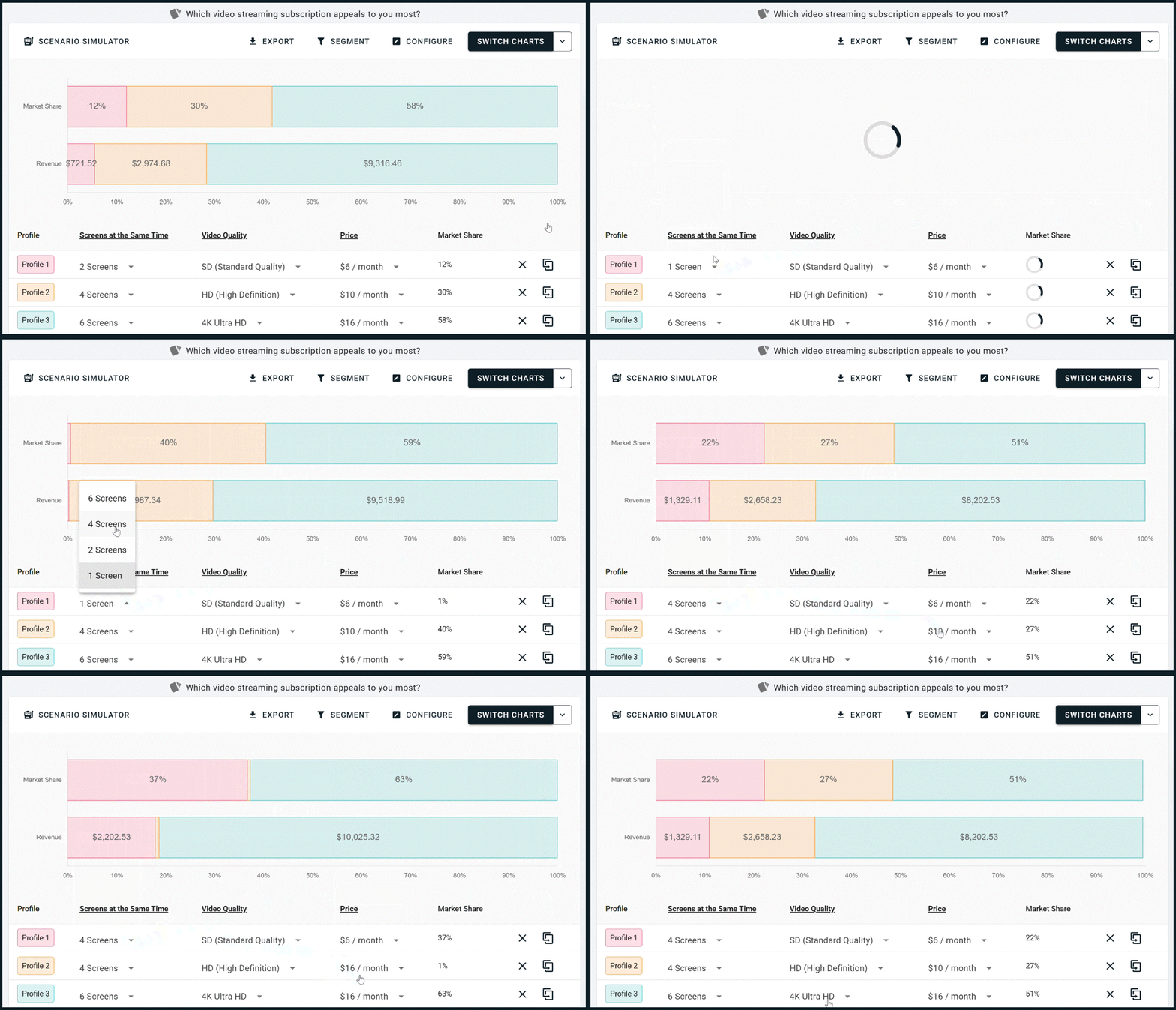
OpinionX’s 'Scenario Simulator’ lets you test different combinations of options from your conjoint survey and see projected market share and revenue outcomes for each profile.
AHP Tools
The Saaty Scale and its calculation method mean AHP generally can't be run on most survey tools, at least not in an automated way that avoids manual spreadsheet work. The main options:
Expert Choice by Comparion is the enterprise standard for AHP. It was developed by Ernest Forman, a collaborator of AHP's original creator Thomas Saaty, and supports group decision-making, sensitivity analysis, and resource allocation. It's the most full-featured AHP tool, and priced accordingly.
SuperDecisions is a free desktop application created by the Creative Decisions Foundation (founded by Saaty himself). It supports both AHP and the more advanced Analytic Network Process (ANP). The interface is dated, but it's the most capable free option for serious AHP work.
AHP-OS is a free web-based tool by Klaus Goepel that handles group AHP decisions in the browser. It's lightweight, well-documented, and a good starting point if you want to try AHP without installing anything.
SpiceLogic AHP Software is a desktop tool with a more modern interface than SuperDecisions. It includes features like transitivity enforcement (which reduces the number of comparisons needed) and sensitivity analysis.
ComcastSamples is a free open-source tool for single-player AHP voting, which cuts out the fluff and offers a basic input tool to help you reach an informed decision on your own.
Ranking and prioritisation survey tools
If you've realised by now that you just need to rank a list of items by importance, not the full apparatus of conjoint or AHP, here are the survey methods to consider.
Pairwise Comparison takes your list of ranking options, shows participants two items at a time, and asks which matters more. This is the same pairwise comparison as AHP, but without the 1-9 intensity scale. Results are ranked by "win rate", the percentage of pairs in which an option was picked. OpinionX runs pairwise comparison on its free tier.
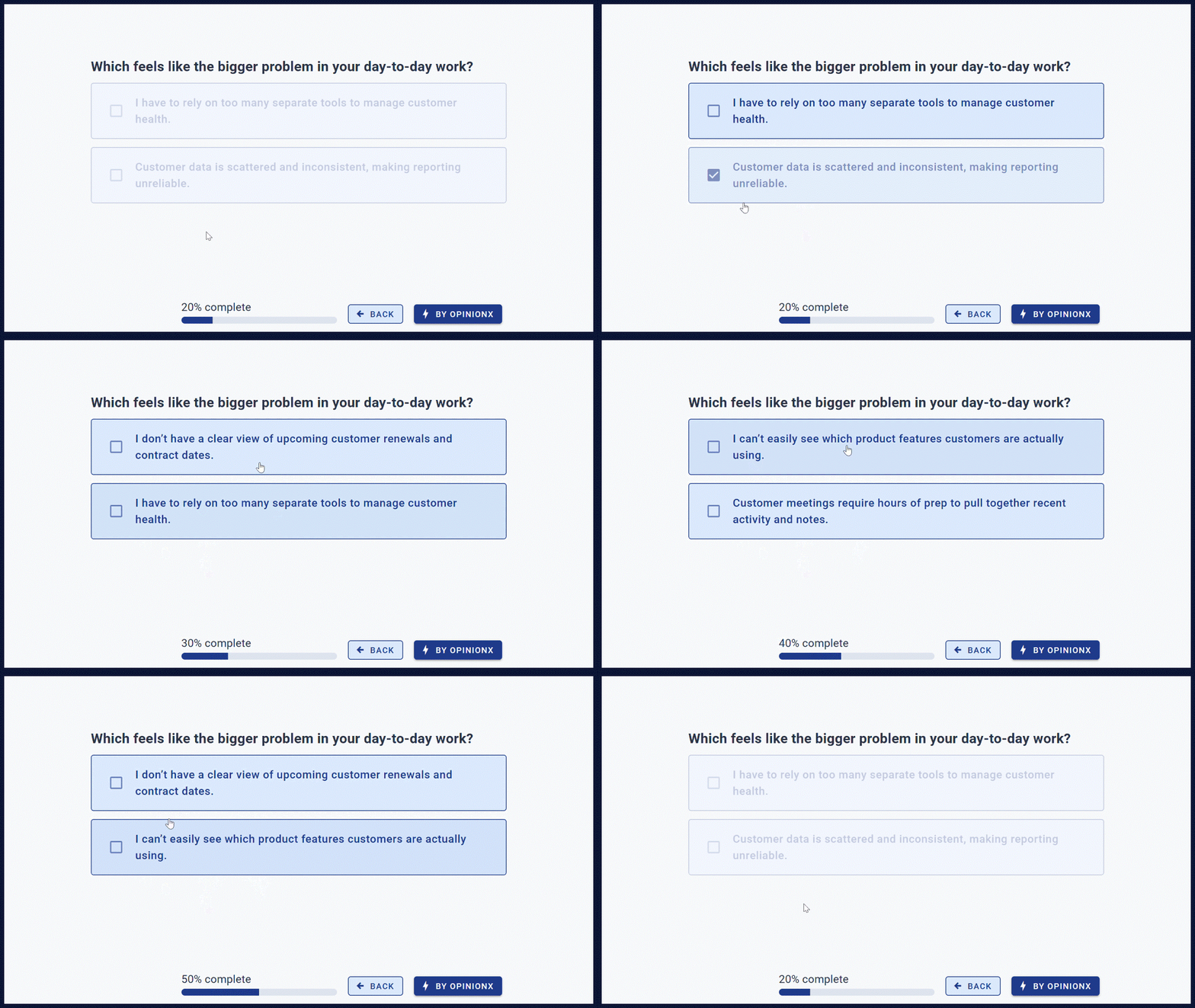
Example of a pairwise comparison ranking survey on OpinionX
MaxDiff Analysis is similar to pairwise comparison, but shows 3-6 options at a time instead of a pair, and asks participants to pick the most and least important option in each set. It produces a ranked results list you can sort, segment, and search. OpinionX offers maxdiff surveys on its free tier.

Example of a MaxDiff Analysis survey from OpinionX
Points-Based Ranking gives each participant 100 points and asks them to spend them on the options based on how important each is to them. This surfaces the intensity of someone's preferences more freely, and suits budgeting consensus, deciding investment priorities, or simulating bundling decisions. OpinionX runs points-based ranking on its free tier.

Example of a points-based ranking survey hosted on OpinionX
Ranked Choice Voting is the best-known survey method for measuring preferences and priorities. It shows the full list and asks people to rank it from highest to lowest preference. Use it only with small lists of 3-10 options; beyond that, a sample-based approach like pairwise comparison or maxdiff, which breaks options into more digestible sets, is better suited. Create free order ranking surveys on OpinionX.
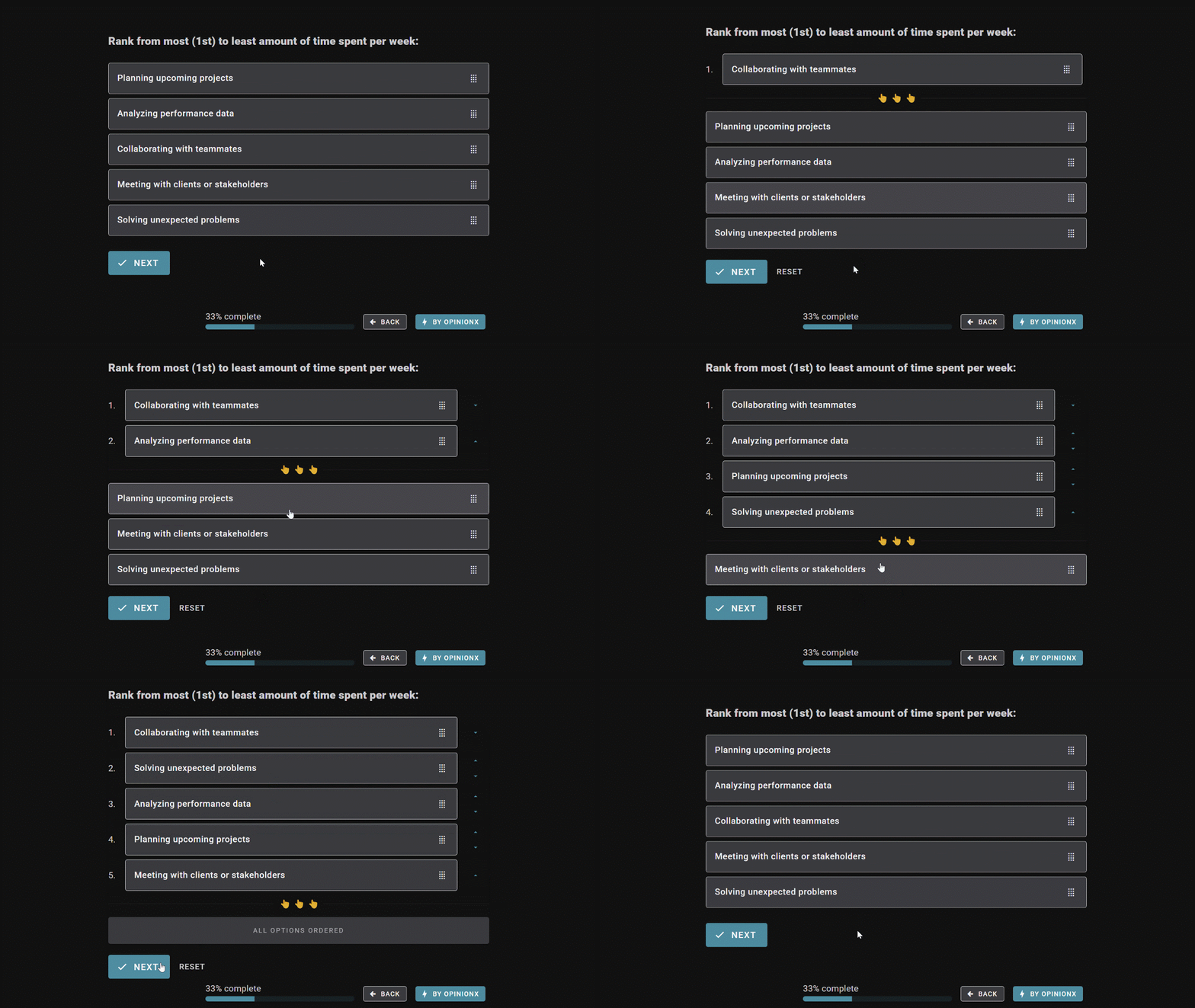
Example of a ranked choice voting survey hosted on OpinionX
These four methods cover the middle ground of prioritisation research, where you need more rigour than a simple 1-5 star rating scale but don't need to model attribute bundles (conjoint) or build a full decision hierarchy (AHP). Feature prioritisation, user needs ranking, initiative scoring, and value proposition testing all tend to land here.
Whether you choose an advanced method or a simple voting poll, OpinionX is built specifically for ranking surveys. Its free tier lets you create surveys that include methods like conjoint and maxdiff. All plans include prepaid consulting time with expert researchers, so if you get stuck with survey setup, distribution, or analysis, an OpinionX expert is available to help.
Frequently asked questions
What's the difference between conjoint analysis and AHP? Conjoint analysis is implicit: people choose between whole product profiles and the method infers how much each attribute mattered. AHP is explicit: people directly compare how important each criterion is against every other in a structured hierarchy. Conjoint captures how people actually trade off features; AHP captures how they say they weigh criteria.
When should you use conjoint analysis instead of AHP? When you want to understand how customers trade off product features in a realistic buying decision, and especially when your options are nested inside categories (like colour, size and price). Conjoint mirrors a real purchase choice, so it's better for pricing, product and market-share questions.
When should you use AHP instead of conjoint analysis? When you have a clear set of independent criteria and need a transparent, defensible weighting you can show stakeholders, which is common in internal or group decision-making. AHP makes the reasoning explicit and auditable.
Do you need the Saaty Scale to run AHP? No. The Saaty Scale is the traditional 1-to-9 rating scale associated with AHP, but it isn't a strict requirement. AHP's core is the structured pairwise comparison of criteria; the specific scale used to capture those judgements can vary.
What if you just need to rank a simple list? Then neither method is worth the overhead. Use a straightforward ranking method like pairwise comparison, MaxDiff, ranked choice voting or points allocation, all of which rank a single flat list by importance without the extra machinery.
Conjoint and AHP answer the same broad question, "what matters most across several dimensions?", from opposite directions. If you want weights revealed from real choices, that's conjoint. If you want them stated openly and traceably for a decision you'll have to defend, that's AHP. And if you only need a flat list ranked by importance, skip both and reach for a plain ranking method.
Want more like this? Over 42,000 researchers and product people get The Full-Stack Researcher in their inbox. Subscribe for the next one.
You can run conjoint analysis and every ranking method mentioned here on OpinionX for free: $0, unlimited surveys, unlimited researcher seats, capped at 25 participants per survey, then $900 a year to lift the cap (full pricing).
About The Author:
Daniel Kyne is the Founder & CEO of OpinionX, the platform for advanced market research surveys. Hundreds of the world’s top product teams use OpinionX to measure their customers needs, map customer segments, and test pricing changes — all inside this one easy-to-use platform for advanced surveys.
→ Try OpinionX for free today