
“A Constant Sum question (also called points allocation) gives each participant a fixed budget of points to divide across a set of options, so you learn not just the order of their preferences but the magnitude: not simply that they prefer apples to bananas, but that they’d put 9 of 10 points on apples. That makes it stronger than a plain ranking when you need to see how much more one option matters than another. It’s the method a Google Docs product manager used in beta (“if you had $100 to spend improving Google Docs, how would you spend it?”), where testers put 89% of their points on document formatting and pointed the team straight at their highest-impact problem. Use Constant Sum for explicit, rational trade-offs like pricing and feature value; use an implicit method like pairwise comparison when the decision is more subconscious.”
What is a 'Constant Sum' survey question?
Constant Sum (also known as points allocation) is a survey method where participants allocate a budget of points among a set of options according to their preferences. Here's an example of a Constant Sum survey question:

Constant Sum is a good way to rank a set of options because participants show the magnitude of their preferences, not just the order. We don't just learn that Simon prefers apples to bananas, we see that he'd give 9 of his 10 points to apples.
What's an example of Constant Sum having real impact in a user research project?
I bet you didn't know Constant Sum played an important role in the early success of Google Docs.
Back when Google Docs was still in beta, the team was working with pilot users to improve the product before public launch. As a beta product it was rough around the edges, so the team was collecting feedback about which aspects needed improvement most. They gathered suggestions during informal interviews and testing sessions, but the tallied results showed such a wide range of wanted features that the team was left unsure where to focus, until they ran one simple experiment.
A product manager asked beta users: "If you had $100 to spend on improving Google Docs, how would you spend it among this list of problems?". The result was strikingly clear. Beta testers allocated 89% of all points to document formatting.

^ Google Docs, October 2006 (lacking a lot of formatting…)
They took that into user interviews and asked testers to explain their formatting problems in more detail. Minor text changes could destroy an entire document's format, costing the user hours of work to fix. It was a big enough problem that it often made beta testers rage quit and abandon Google Docs entirely.
The team had discovered something important about user research: asking users to suggest problems is unreliable, because it depends on problem recall at that exact moment, which people are notoriously bad at. Rather than tallying feature requests, Constant Sum let the team measure the magnitude of each problem's impact on their beta testers, surfacing the highest-leverage problem to solve.
When is Constant Sum the right question to use in a survey?
The choice comes down to implicit versus explicit. Pairwise comparison (voting on a series of head-to-head pairs) reads people's preferences without asking them to state them, which suits decisions where the subconscious is in charge, like ranking a list of potential names for a new idea, where it's hard to weigh many options rationally at once. Constant Sum asks people outright what matters and by how much, which suits rational decisions, like ranking which features in a paid plan drive the most value for you as a customer.
| Pairwise comparison (implicit) | Constant Sum (explicit) | |
|---|---|---|
| How it works | People vote on a series of head-to-head pairs | People divide a fixed points budget across options |
| What it reveals | Implicit preferences, without asking people to state them | Explicit preferences, and the magnitude of each |
| Best for | Subconscious decisions, like ranking a long list of names | Rational decisions, like ranking which paid features drive the most value |
What research questions could I answer with Constant Sum?
Here are three survey questions well suited to the Constant Sum format.
1. Customer preferences
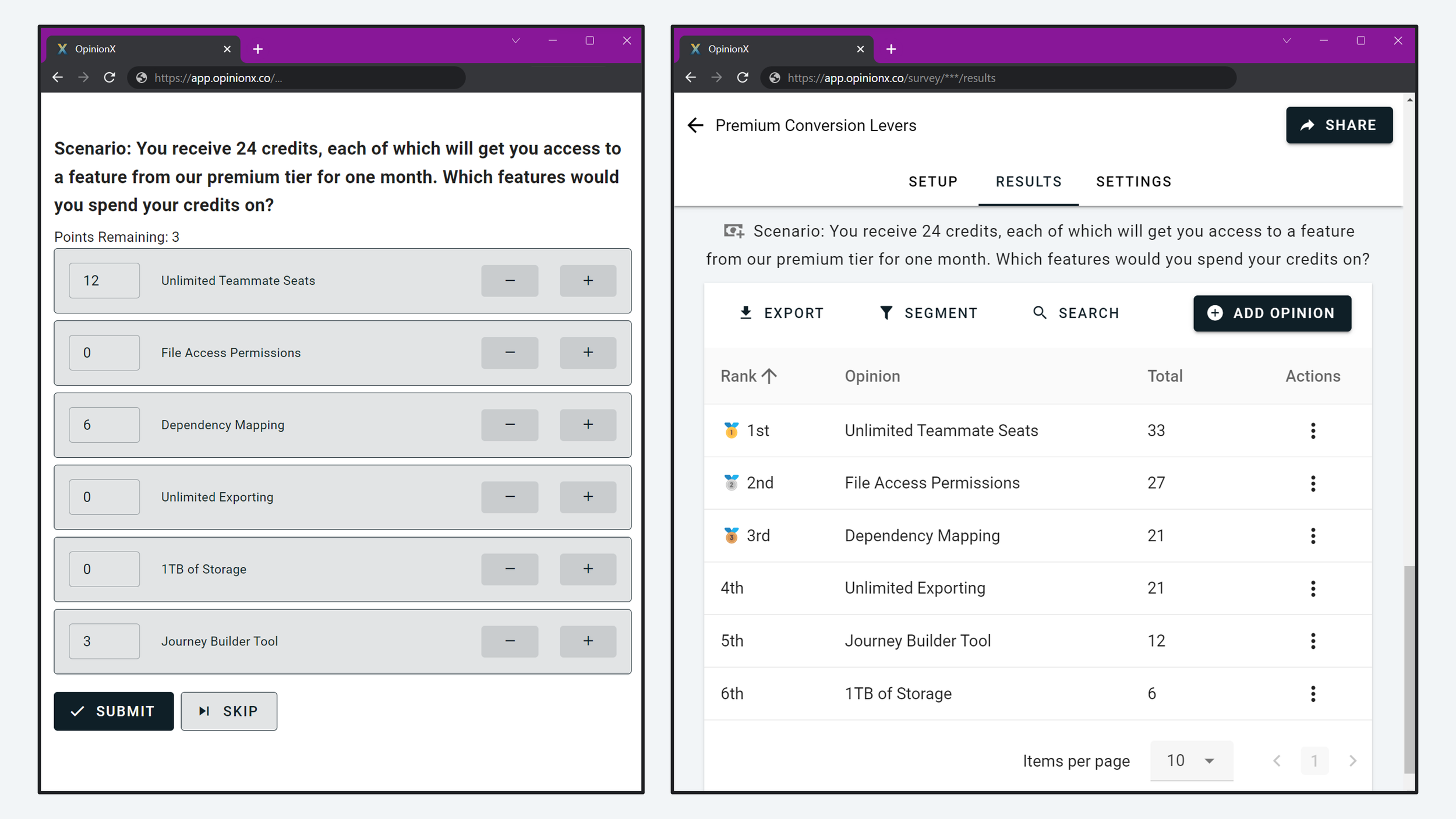
If you've got a range of options you're deciding between, like which features most entice your freemium users to upgrade, Constant Sum is often more insightful than other comparison formats, for the same reason it worked for Google Docs: it shows you how far apart the options really are.
2. Value association
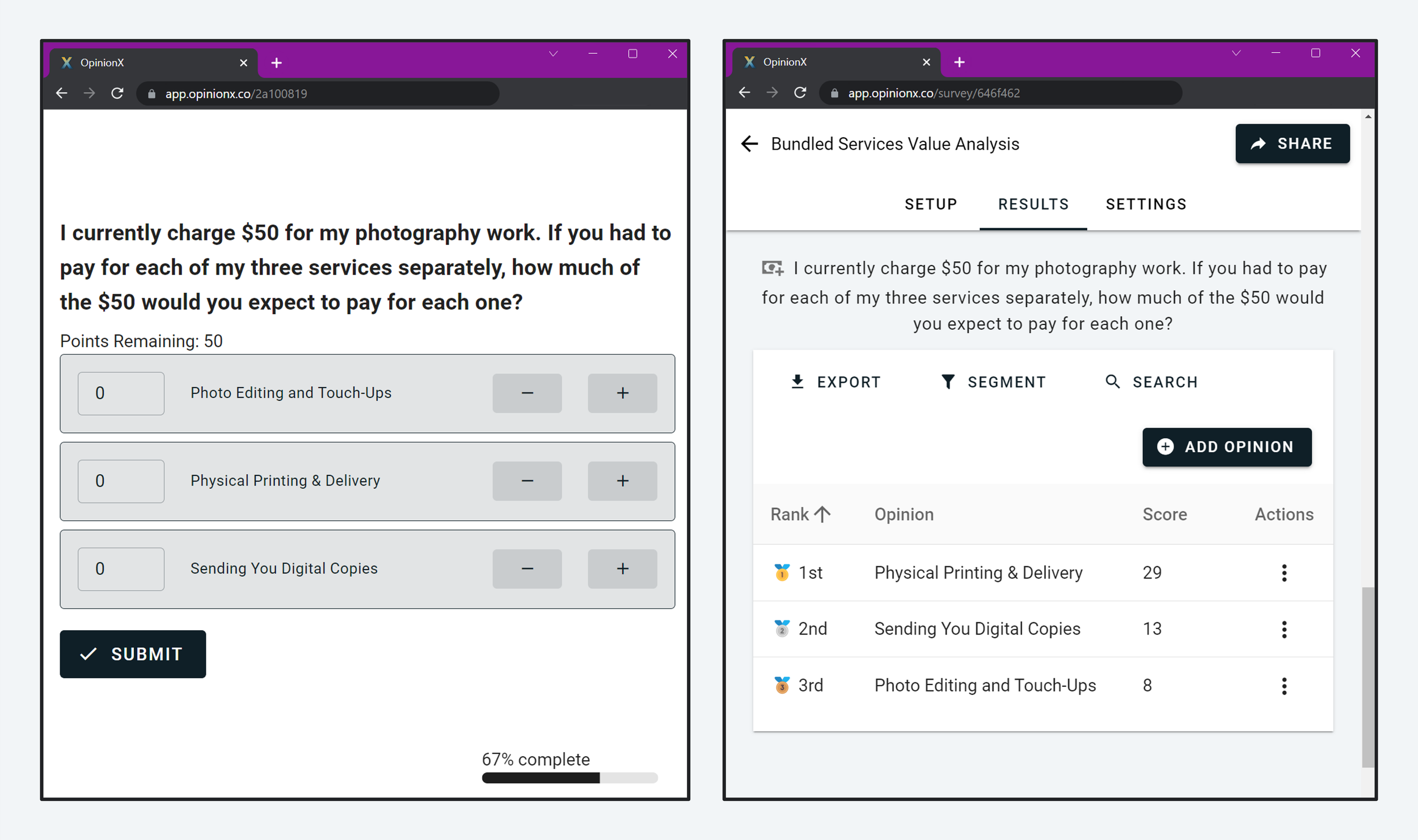
Say you run a business that rolls several services into one: you're a graduation photographer charging $50 to edit the photos, mail physical prints, and share digital copies for future use. You're thinking about splitting these into separate products to raise your prices, but you don't know which ones customers value most today. Give participants $50 in imaginary points to divide by how much they'd expect to pay for each separately, and you'll surface your target customer's perceived values.
3. Time breakdowns
Casey Neistat had a famous 2015 YouTube video called Fat and Lazy, where he broke his average day into 24 one-hour slots to show viewers what he spends his time on.
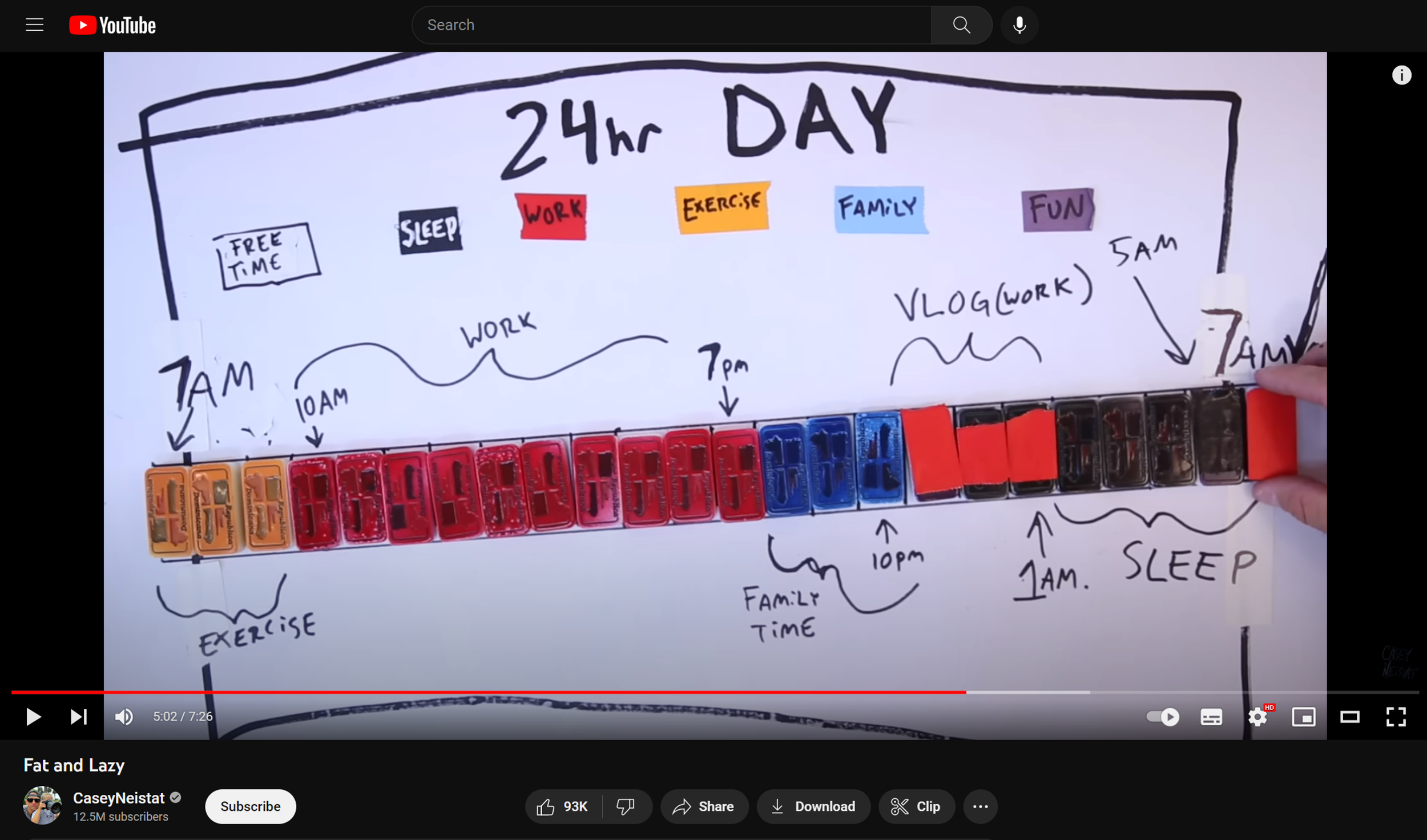
You can run the same exercise with research participants using a Constant Sum question. The average American office worker spends 37 hours a week working, so give each participant 37 points and ask them to show what they spend that time on.

Which survey platforms offer a Constant Sum question type?
Even though it's a popular research method, many of the best-known survey tools don't offer a Constant Sum or Points Allocation format, including Google Forms, Microsoft Forms, Typeform, SurveyMonkey, Slido, SurveyKing, and Jotform (surprisingly, none of them).
Alternative 1: OpinionX
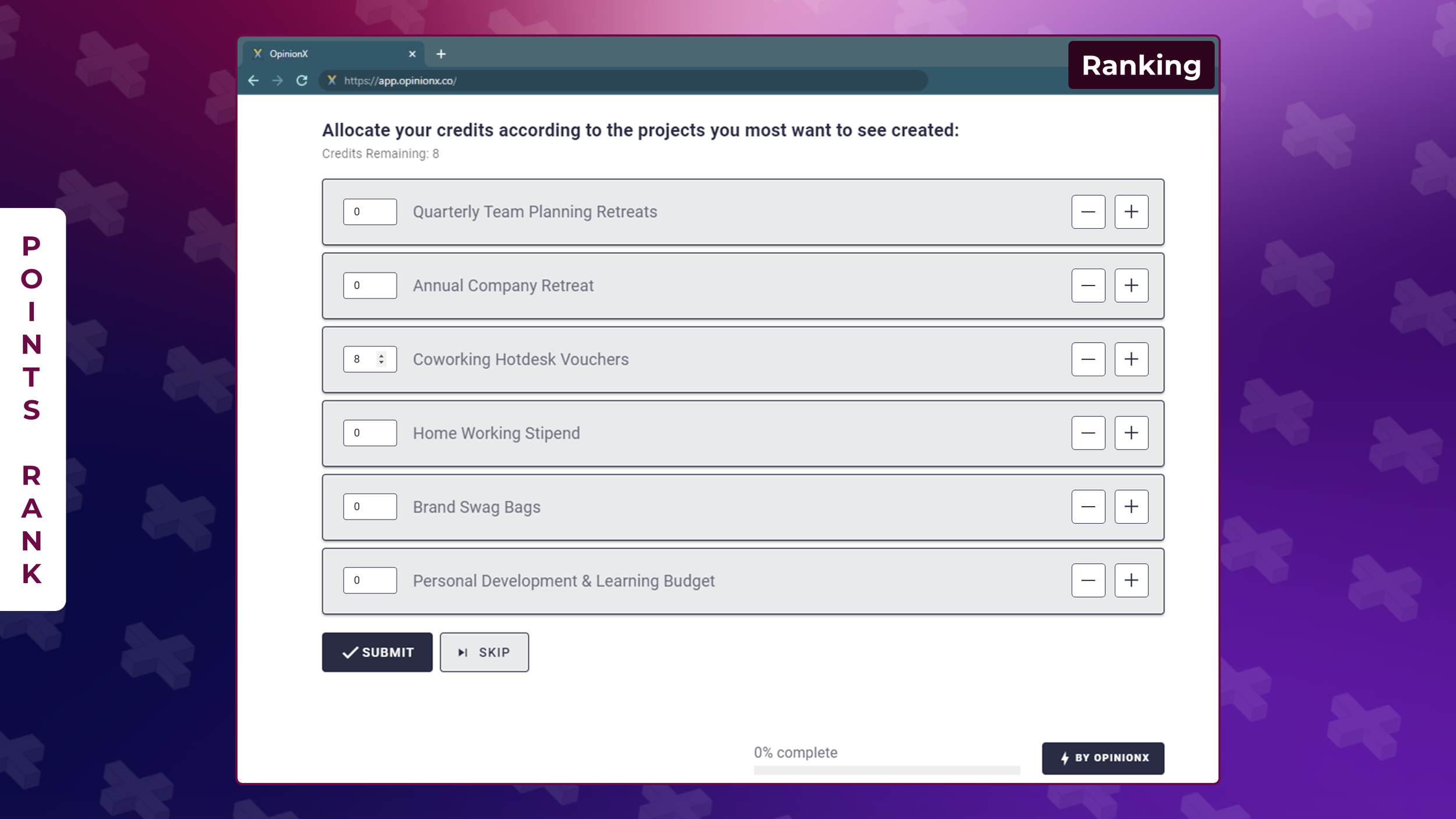
All the screenshots of Constant Sum questions in this post were taken from OpinionX, a research tool built specifically for ranking surveys. All of OpinionX's ranking formats, including its Constant Sum format "Points Rank", are on the free version.

↖ Constant Sum is called “Points Rank” on OpinionX
Free version: the free version of OpinionX gives you unlimited surveys with unlimited questions and unlimited ranking options. Every question type is included, and you can have up to 25 participants per survey (no monthly or annual limit, just per survey).
Setting up your first Constant Sum survey and want a hand choosing options and a sensible points budget? Book a free 30-minute setup call and a research expert will walk through it with you, no cost, no obligation.
Alternative 2: Mentimeter
Mentimeter is an audience engagement tool built for classrooms, with a Constant Sum format called "100 Points" that gives participants 100 points to allocate, but only in bundles of 10. You can't change it from 100 points or the 10-vote bundles. Mentimeter is built for live presentations rather than research surveys, and its free tier is capped by monthly participant volume, so it suits classroom polling more than an ongoing research study.
Alternative 3: Polly
Polly is an app for running polls in Slack, Microsoft Teams and Zoom. It has a Constant Sum option, though it's limited to 10 options and a maximum budget of 100 points per participant. The free version has no response limit but only keeps 45 days of results history, and it lives inside chat tools rather than as a standalone survey.
Create a free Constant Sum survey
You can have your first Constant Sum survey up and running in less than 5 minutes on OpinionX. There's no time limit on the free version and no need to add credit card details; the free tier genuinely is just free, so there's no reason not to give it a try.
Frequently asked questions
What is a Constant Sum survey question? A question that gives each participant a fixed budget of points (say 100) to distribute across a set of options according to how much they value each one. Because the total is fixed, people have to make real trade-offs, which reveals the magnitude of their preferences, not just the order.
Is Constant Sum the same as points allocation? Yes, they're the same method under two names. Participants spend a set budget of points across options; the more points an option gets, the more it matters to them.
When should I use Constant Sum instead of a ranking? When you need to know how much more one option matters than another, not just which comes first. A plain ranking tells you A beats B; Constant Sum tells you A got 60 points and B got 10, so the gap is large. It's especially good for pricing and feature-value questions.
What's the difference between Constant Sum and pairwise comparison? Constant Sum is explicit: people directly state how much each option matters. Pairwise comparison is implicit: people vote on head-to-head pairs and their preferences are inferred. Explicit suits rational trade-offs (pricing, features); implicit suits more subconscious decisions (like ranking a long list of names).
Which tools offer a Constant Sum question type? OpinionX (called "Points Rank", on the free tier), Mentimeter (a "100 Points" format built for live presentations), and Polly (inside Slack, Teams and Zoom). OpinionX is the one built specifically for research ranking, with analysis and segmentation on the results.
Want more like this? Over 42,000 researchers and product people get The Full-Stack Researcher in their inbox. Subscribe for the next one.
You can build a Constant Sum survey on OpinionX for free (it's called "Points Rank"), with unlimited surveys and questions and up to 25 participants per survey, no credit card needed (full pricing).