
GABOR GRANGER SURVEYS
Find the price that maximises revenue using a Gabor Granger survey
Gabor Granger surveys show each participant a series of prices and ask them, yes or no, if they'd buy at each one.
OpinionX sets up the survey, picks which prices to show each person and runs the analysis for you, so you can find your optimal price.
No credit card required
Trusted by scaling startups, research agencies, and large enterprises alike


What is a Gabor Granger pricing survey?
Gabor Granger is a survey method that measures the most people will pay for a product. Each participant sees a specific price and answers yes or no to buying at it; a yes leads to a higher price, a no to a lower one, until their ceiling is found.
Combined across participants, the answers give the share of the market that would buy at every price, the revenue each price would produce, and the price where revenue peaks. It's named after the two economists who developed it in the 1960s, André Gabor and Clive Granger, and it fits the case where you already know the rough range and need the exact number inside it.
Use it when...
Price is the only variable and you have a range in mind: a price increase, a new add-on, a new market, or a finished product that needs a number.
Best for...
Product and pricing teams at subscription companies, where one price covers many customers, and anyone asking whether one customer segment will pay more than another one.
Alternative methods...
Van Westendorp when you have no range yet and need one. Conjoint analysis when price is one of several attributes to trade off, or you want to find out what attributes customers value most.
How Gabor Granger works on OpinionX
Ready-to-go template with quick setup
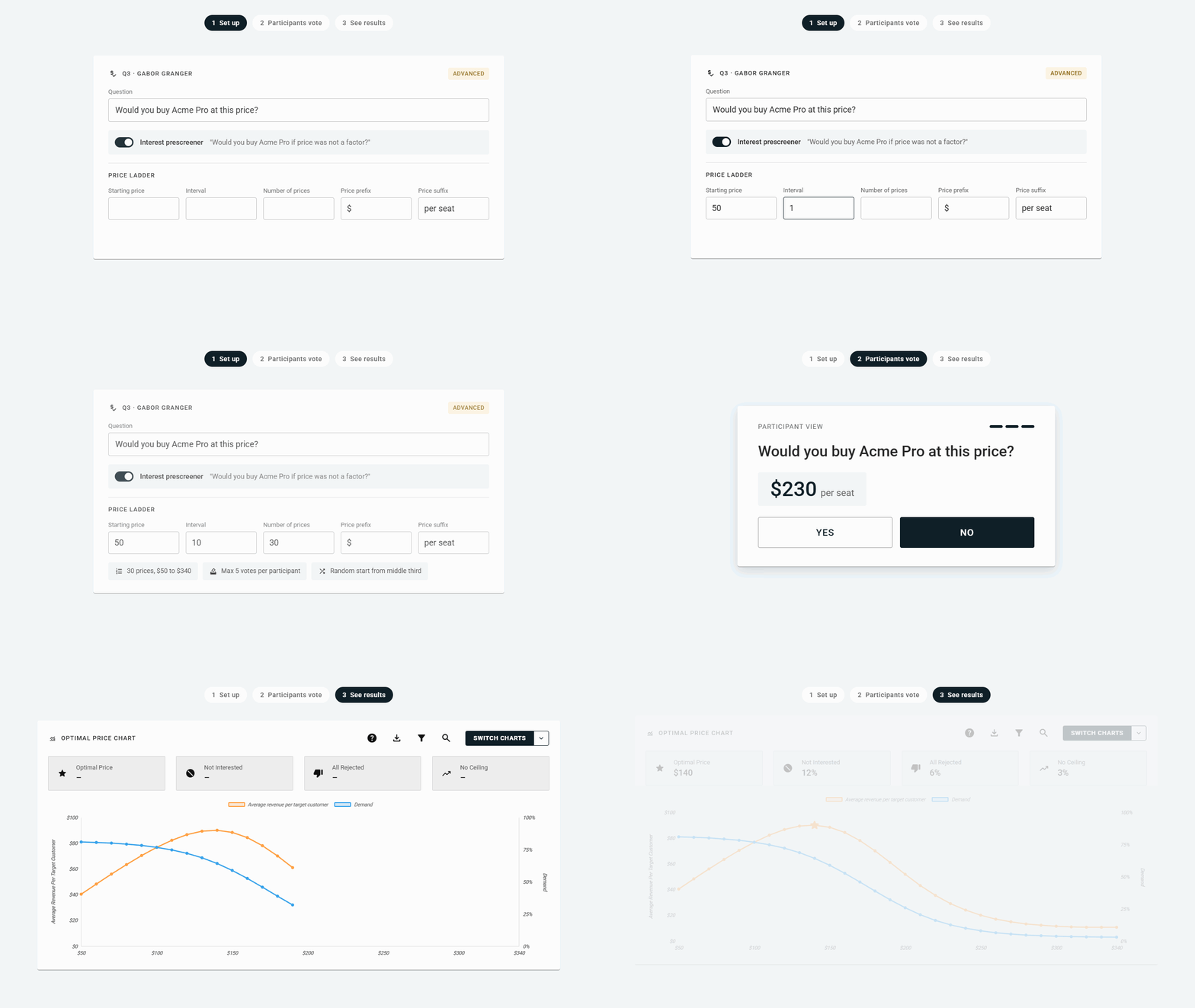
Simply pick your starting price (eg. $50) and interval number ($10), and number of prices in the range (30). Customise currency ($) and unit price (per seat). OpinionX handles all the branching logic for you.
Randomised starting price for robust results
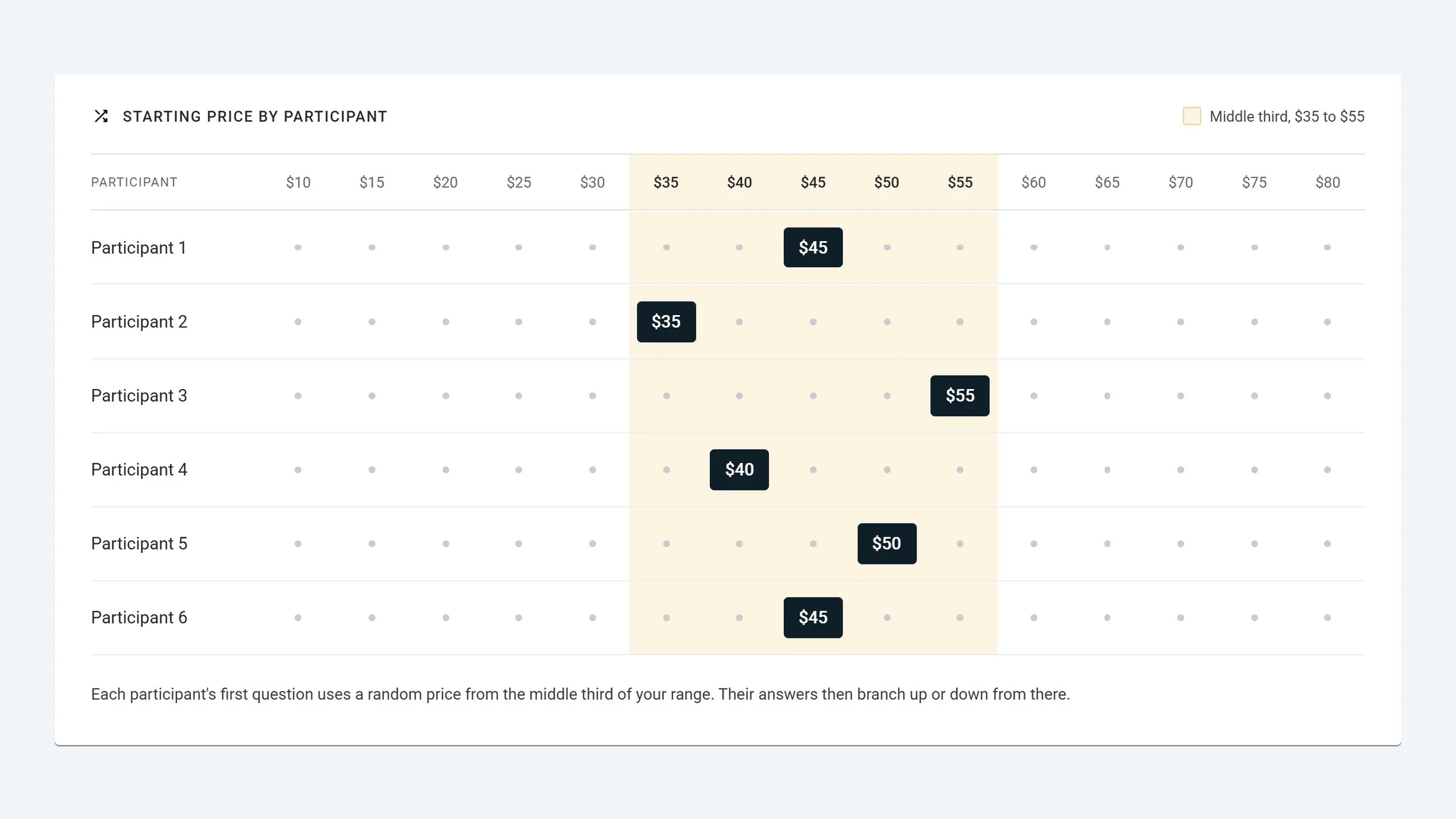
OpinionX picks a different starting point for each participant to avoid biasing the results. It automatically randomises this start price from the middle-third range, ensuring relevancy.
Powered by a smart voting model to keep surveys quick
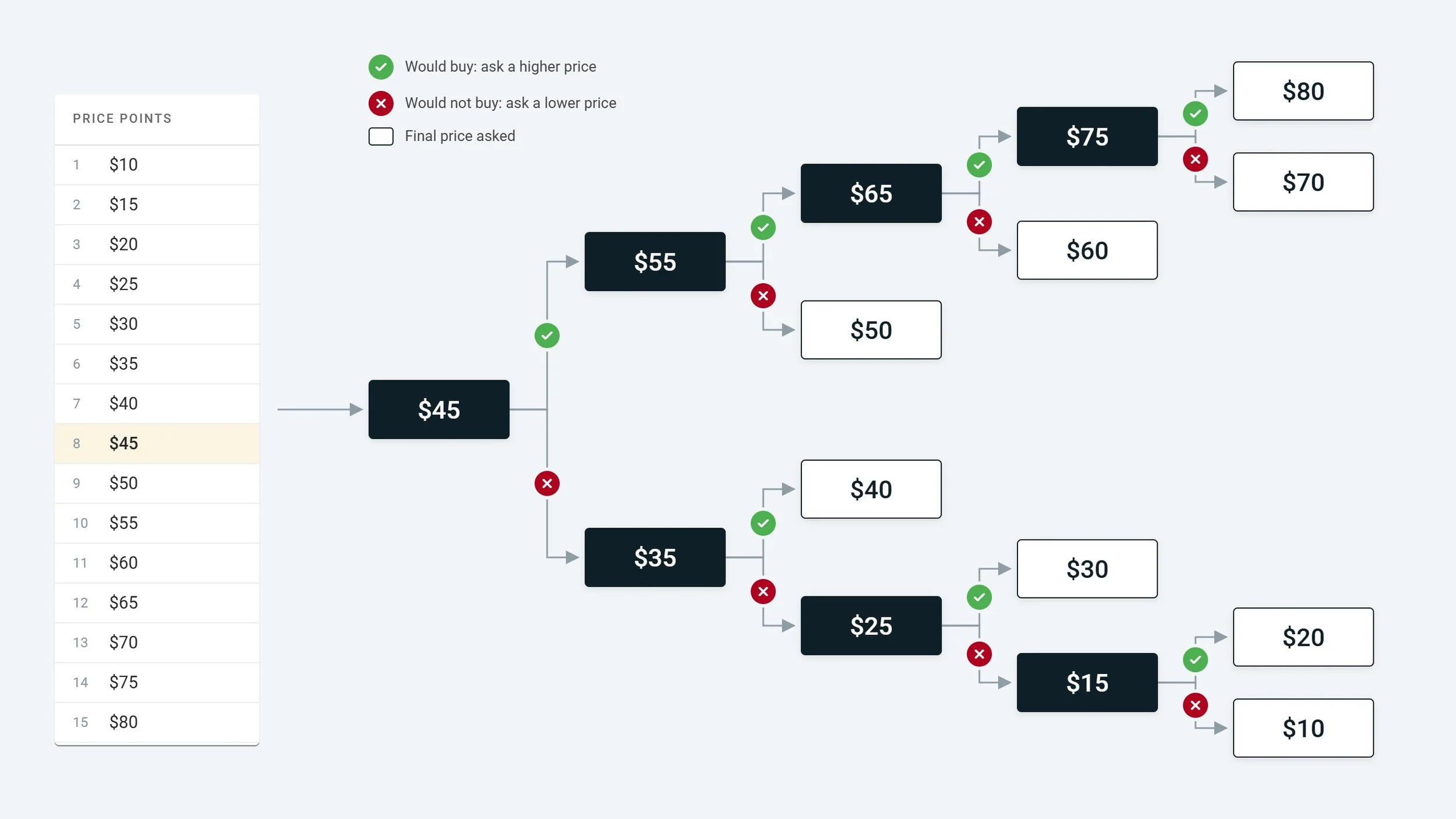
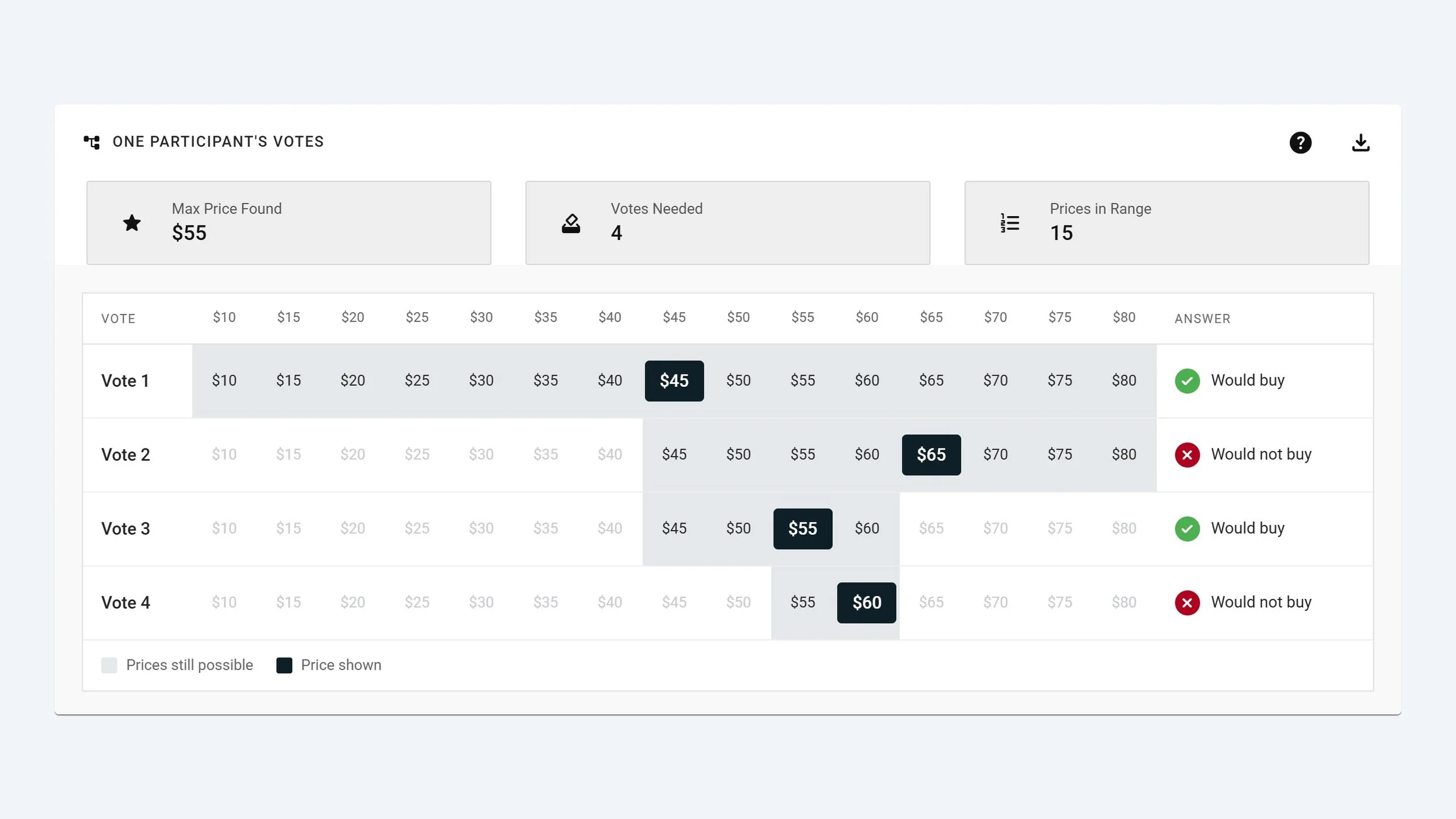
After each yes/no vote, OpinionX uses a binary search model to select which price to show next. It prioritises maximising learning each person’s max price from the fewest votes possible, ensuring surveys stay short.
Screen out people who aren’t interested in buying
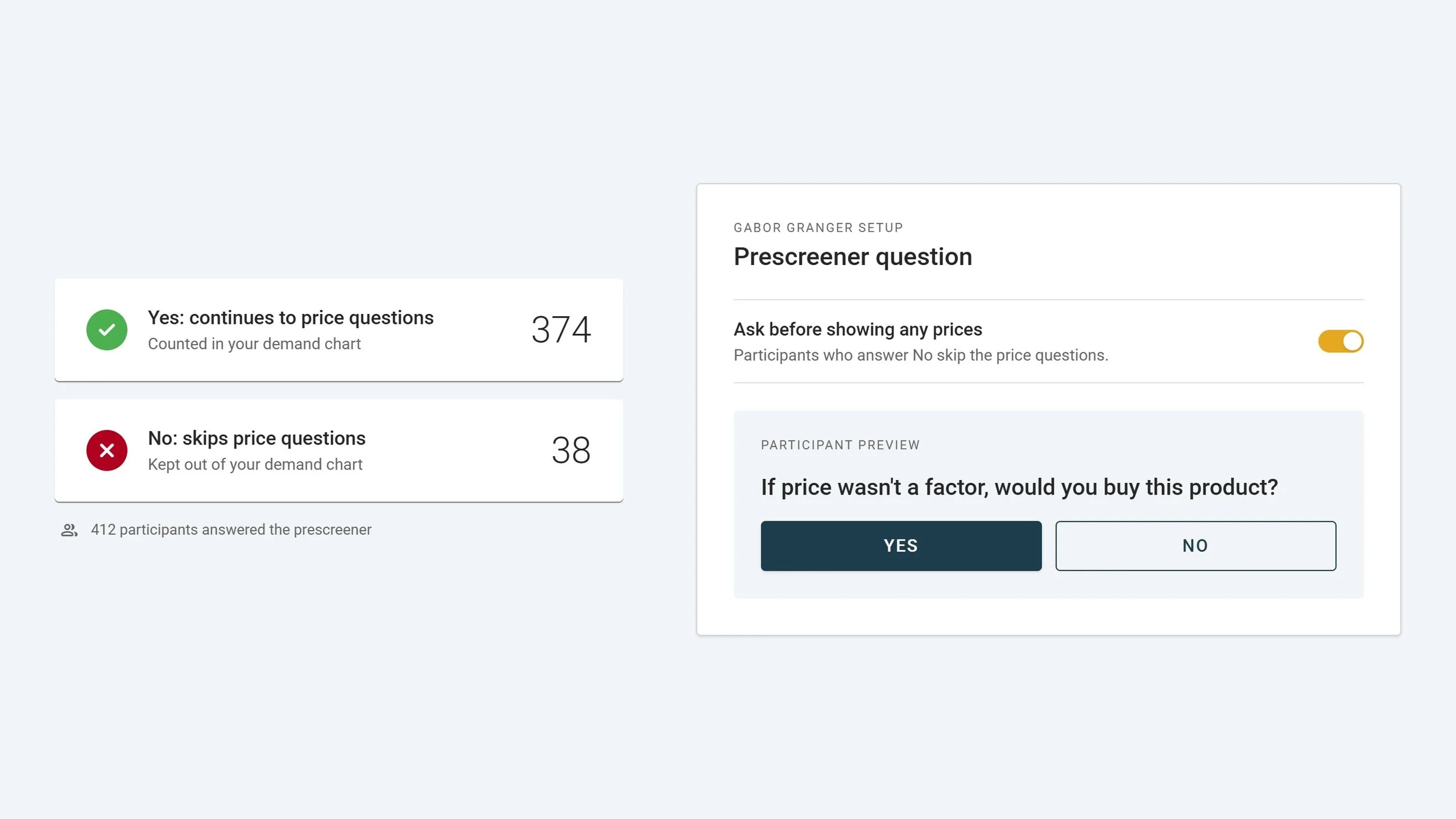
Enable OpinionX’s prescreener question to gauge whether each respondent would buy your product if price was not a factor. No interest means they’re skipped and produces a more realistic chart.
Find your customer segment who will pay the most
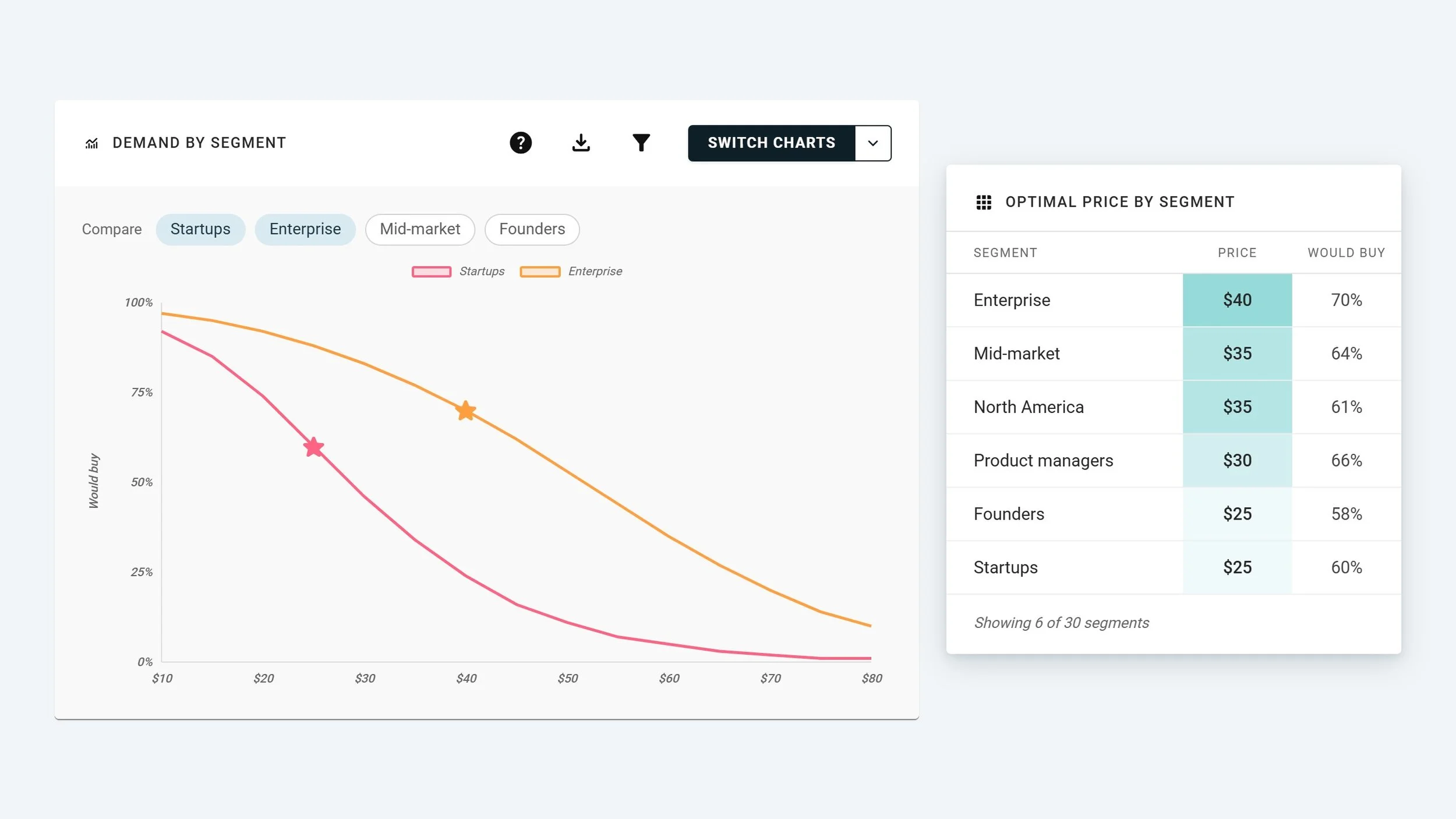
OpinionX segments your results for you, so you can filter by customer type and compare groups side by side. You can also view up to 30 segments at once in a colour-coded table to see who values your product most.
Try a Gabor Granger survey
Complete the sample survey below to see the interactive results dashboard.
What you get back from a Gabor Granger survey

Optimal Price chart
Demand at every price on one axis, average revenue per target customer on the other, the revenue peak starred as the Optimal Price.

Four callouts
Optimal Price, Not Interested, All Rejected and No Ceiling: the answer, and whether your price range was set right, in one glance.

Above-max answers
Participants who said yes to your top price are asked what they'd realistically pay; the answers sit on the Participants Tab, off the chart.

Segments Tab
The Optimal Price and demand curve for every customer group in one crosstab, so a segment that pays double stops hiding in the average.
Considering a pricing change?
Derisk it with real robust data.
Run Gabor Granger surveys for free
✓ 25 participants per survey
✓ Unlimited surveys
✓ Unlimited researcher seats
✓ Full analysis & exports
✓ Unlimited participants per survey
✓ Unlimited researcher seats
✓ Advanced analysis & data enrichment
✓ Custom exports
✓ SAML SSO & MFA
✓ Private team folders
✓ White-labelling
✓ Procurement & prepaid experts
Learn more about Gabor Granger
Gabor Granger FAQs
-
More than you'd think. Because OpinionX uses a binary search model for selecting the next price to show after each yes/no vote, the number of votes required from each participant barely increases if you add more prices. For example, a Gabor Granger with 15 prices is finished in 5 yes/no votes, 100 prices require only 8 votes, and 1,000 prices result in just 11 votes. Unlike other survey tools that use a random selection approach, OpinionX’s binary search model means you have flexibility to test much more prices without impacting survey experience or completion rate.
-
Reaching approximately 100 participants gives a directional read, 300 a confident Optimal Price, and 500+ is recommended if you plan to split results by segment, since each segment needs enough answers of its own. If No Ceiling or All Rejected passes 10%, your price range used on the survey setup is probably wrong and should be adjusted (ask us, we can help!).
-
A good principle to decide is that Gabor Granger works well when you already have a price range and want the revenue-maximising number inside it, while Van Westendorp is the one for a blank page when you want to understand price perceptions without a reference point. While both can often be used interchangeably, plenty of teams run Van Westendorp first, then Gabor Granger inside the acceptable price range that VW finds.
Put a number on what the market will actually pay
A yes-or-no question, a few prices per participant, and a revenue curve with the peak marked, split by the customers you're pricing for.