SurveyMonkey LaunchPad vs OpinionX: pay per study or one annual plan?
Choosing between SurveyMonkey LaunchPad and OpinionX as your platform of choice for market research surveys comes down to how often you run research.
LaunchPad, which SurveyMonkey launched in June 2026, sells ten ready-made studies one at a time with no subscription, and two of them overlap with OpinionX: a MaxDiff Analysis survey and a Van Westendorp pricing study.
LaunchPad has a built-in panel of more than 335 million people but doesn't offer conjoint analysis, Gabor Granger or needs-based segmentation, while OpinionX offers MaxDiff, Van Westendorp, Conjoint Analysis, Gabor Granger and needs-based segmentation on one plan, the Analyze tier, at a flat rate of $900 per year for unlimited studies.
LaunchPad's pay-per-study model only makes sense in a few narrow cases, such as needing TURF analysis or a very large international panel. For everything else, a full year of unlimited surveys with unlimited respondents on OpinionX costs less than just one LaunchPad study and gives your team a platform it can use for research every month.
This article compares the methods each platform offers, what one study costs on each, what LaunchPad does better and who should pick which.
What research methods does SurveyMonkey LaunchPad offer?
SurveyMonkey LaunchPad is a set of ten automated research studies, each sold as a single purchase: product concept testing, feature prioritisation, price optimisation, idea screening, packaging testing, image ad testing, video ad testing, message testing, name testing and logo testing.
Each study comes with pre-written questions, automated analysis and the option to buy responses from SurveyMonkey's panel, which covers 130+ countries with 200+ targeting options. You can also send a LaunchPad study to your own customers through a link, at no extra charge for recruitment.
Two of those ten studies use the advanced methods OpinionX is built around:
Feature Prioritization is a MaxDiff study. MaxDiff (maximum difference scaling) takes a long list of options and breaks it down to show each participant small sets of 3-6 items at a time, asking them to pick the most and least important in each set. MaxDiff’s voting format forces a ranking instead of letting people say that everything is equally as important to them. LaunchPad adds TURF analysis (total unduplicated reach and frequency), which finds the combination of items that appeals to the largest share of people. Our guide on how MaxDiff analysis works explains the scoring in detail.
Price Optimization is a Van Westendorp study. Van Westendorp asks four questions about which prices feel too cheap, a bargain, getting expensive and too expensive, and plots the answers to show the price range your market accepts. Our Van Westendorp pricing guide walks through the four questions and the chart.
Three key market research methods are missing from LaunchPad entirely:
Conjoint Analysis. Conjoint surveys show participants complete product profiles (a price, a plan length, a set of features) and ask them to choose their preferred profile, which measures how much each feature is worth relative to the others and to price. SurveyMonkey doesn't currently offer conjoint analysis, and none of the ten LaunchPad studies is a conjoint study. Our page on whether SurveyMonkey has conjoint analysis covers the self-serve plans as well.
Gabor Granger. Gabor Granger shows each participant one price at a time and asks whether they'd buy at it, which produces a demand curve and the price that earns the most revenue. LaunchPad's pricing study uses Van Westendorp only, and our guide to the Gabor Granger method explains how the two pricing methods differ.
Needs-based segmentation. Needs-based segmentation groups participants by what they rank as most important, instead of by age, job title or company size. LaunchPad describes segment results in terms of the demographic targeting you buy, and none of its ten studies is a segmentation study. Our needs-based segmentation guide shows why those groups often cut across demographics.
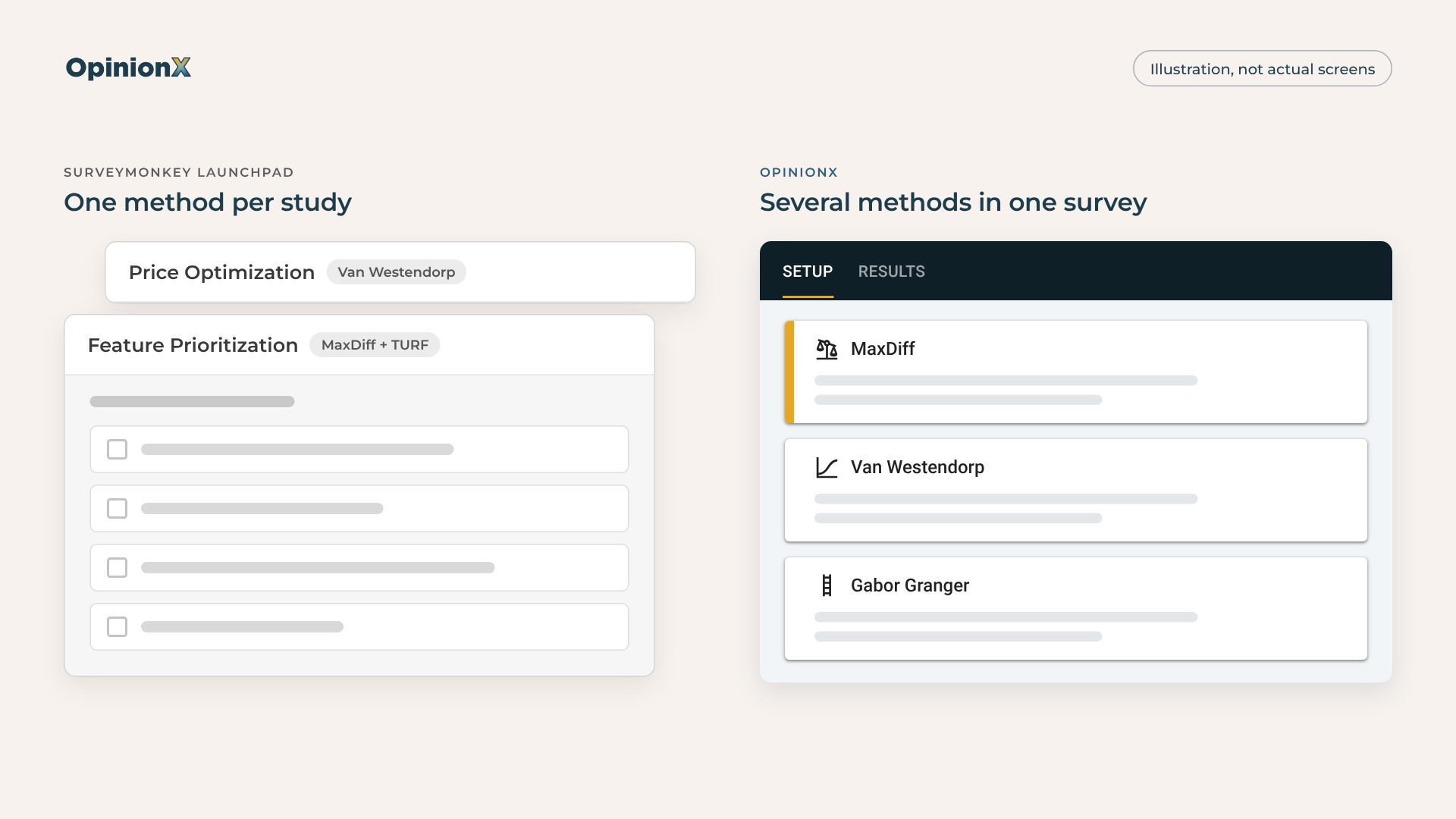
Underneath all of this, each LaunchPad study uses one method, so a MaxDiff and a Van Westendorp are two separate purchases and two separate surveys. On OpinionX you can put several advanced methods in the same survey, for example Van Westendorp and Gabor Granger in one survey, so the same people answer both and you can compare their answers person by person.
And OpinionX's Analyze plan gives you unlimited researcher seats, unlimited surveys and unlimited participants per survey for $900 per year, which is less than the starting price of one SurveyMonkey LaunchPad study.
How does pay-per-study billing compare with one annual plan?
Pay-per-study billing means every study is a separate purchase, so the second, third and tenth study each cost the same as the first. LaunchPad has no subscription, annual commitment or minimum spend, and the cost of a LaunchPad study has two parts: a base price for the study itself, and an optional charge for panel responses that depends on how many people you need and how narrowly you target them. OpinionX's Analyze plan costs $900 per year and covers unlimited studies, participants per survey and researcher seats, with no per-study charge at any point.
SurveyMonkey lists a starting price for every LaunchPad study on its solution pages. A Feature Prioritization study, which is LaunchPad's MaxDiff, starts at $2,500 per study, and a Price Optimization study, which is LaunchPad's Van Westendorp, starts at $1,250 per study. Both prices cover the study itself, before you buy any panel responses.
That makes the cost comparison short. One year of OpinionX Analyze costs $900, so a single LaunchPad MaxDiff study costs $1,600 more than a full year of unlimited studies on OpinionX, and a single LaunchPad Van Westendorp study costs $350 more. Run one of each on LaunchPad and you've spent $3,750, which is more than four years of OpinionX’s premium Analyze tier for unlimited surveys with unlimited respondents (just $900 per year).
Panel responses sit on top of both LaunchPad prices. On OpinionX you either survey your own customers at no extra cost or pay a third-party panel separately, so keep the participant cost apart from the platform cost when you compare.
How many studies you plan to run decides how much the annual plan saves you, and most teams underestimate it. User Interviews surveyed 485 researchers for its State of User Research 2025 report, and the median researcher completed one quantitative study and two mixed-methods studies in six months, which works out at around six studies per researcher per year before anyone else on the team runs one. Product teams that follow Teresa Torres's continuous discovery model aim for "weekly touch points with customers by the team building the product", which pushes the count higher again.
The billing model also changes how many studies a team ends up running. Behavioural economists Drazen Prelec and George Loewenstein found in 1998 that people prefer flat-rate pricing even when it costs more overall, because use that's already paid for feels free, while paying per use makes every use feel like a cost. Anja Lambrecht and Bernd Skiera called this the taxi meter effect in their 2006 study in the Journal of Marketing Research, where customers enjoyed their usage more on a flat rate than on a pay-per-use tariff. For a research team, pay-per-study pricing turns every follow-up question into a budget decision, so nobody runs the study that would've checked a surprising result.
A flat rate doesn't always win, though. The same study found that up to 46.4% of the customers Lambrecht and Skiera tracked over five months picked a flat rate when paying per use would've cost them less, so it's worth checking the numbers rather than assuming. Against LaunchPad the check is short: one year of OpinionX Analyze costs less than one LaunchPad study, so the flat rate costs less from the very first study.
Not sure how many studies your roadmap needs, or which method each decision calls for? A free 30-minute setup call with a research expert can map your next few decisions to methods, and look over the first survey before you send it.
What are OpinionX's limitations next to SurveyMonkey LaunchPad?
SurveyMonkey LaunchPad does four things better than OpinionX, and two of them are big ones on a feature-by-feature comparison.
The first is automated TURF analysis. LaunchPad's MaxDiff study includes TURF, which tells you which combination of features or messages reaches the largest share of your audience. OpinionX doesn't offer TURF: our MaxDiff results include a scenario simulator that shows which option each participant would most likely pick from a set you choose, but that measures preference share rather than unduplicated reach.
The second is panel size. SurveyMonkey's own panel has 335 million+ people across 130+ countries, with 200+ targeting options, and you buy responses inside the same purchase as the LaunchPad study. SurveyMonkey also screens its panel for bots, duplicate submissions and inattentive participants automatically, and says studies can return results within hours. OpinionX's panel offering is much smaller than that, so if you need responses from a narrow audience in many countries at once, SurveyMonkey has the bigger pool to draw from.
The other two are smaller. LaunchPad writes the questions for you and runs AI-powered analysis, while OpinionX has no AI study builder, and SurveyMonkey is a brand most procurement teams have already approved, which shortens the path to a first study inside a large company.
Fair, LaunchPad's MaxDiff isn't a weak point, since MaxDiff is a well-established method, so the difference between the two platforms lies in what surrounds it: TURF and a panel on LaunchPad, and segmentation, other methods in the same survey and unlimited repeat studies on OpinionX.
Where does OpinionX do better than SurveyMonkey LaunchPad?
OpinionX does better on method range, combining methods in one survey, segmentation and repeat research.
Conjoint analysis is the clearest gap. If the decision involves trading features off against price, such as which features go in which pricing plan, MaxDiff can rank the features but can't tell you what each one is worth in money. Conjoint analysis on OpinionX scores each option with hierarchical Bayes, a statistical model that estimates scores for each individual participant as well as for the whole group, and OpinionX also calculates marginal willingness to pay, meaning how much extra a participant would pay for one specific feature. Read our guide on when not to use conjoint analysis first though, because MaxDiff is the better choice for plenty of decisions.
OpinionX offers two pricing research methods instead of one. Van Westendorp shows the range of prices your market accepts, while Gabor Granger shows which price inside that range earns the most revenue, so the two answer different questions about the same product.
Several methods fit in one survey. On OpinionX you can add MaxDiff, conjoint, Van Westendorp and Gabor Granger questions to the same survey, alongside ordinary questions like job role or company size. A pricing study might open with a MaxDiff question that ranks 20 features, then ask the four Van Westendorp price questions, then finish with a Gabor Granger question that asks whether each participant would buy at one price at a time, all in one sitting. Because the same people answer every question, you can compare answers person by person, for example checking whether the people who ranked one feature highest also accept a higher price. On LaunchPad, each study uses one method, so the MaxDiff and Van Westendorp parts of that study are two separate purchases starting at $3,750 in total, their answers can't be matched person by person, and the Gabor Granger part isn't available at all.
Segmentation works on your own customer data. On OpinionX every answer becomes a tag you can filter by, so you can recalculate a MaxDiff ranking or a conjoint result for one group with one click, or compare groups side by side in a crosstab, a table showing each group's scores for each option. On top of that, you can import data you already hold about participants, such as their current plan or company size, and split results by it. Our segmentation features page shows the full set, including the cluster tab that groups participants who answered in similar ways.
Every extra study is included in the annual plan. On LaunchPad, each study is a new purchase, so a team that runs one MaxDiff study every quarter pays at least $2,500 four times, which is $10,000 per year before it buys a single panel response. On OpinionX Analyze, the same team pays $900 per year whether it runs 4 studies or 40, and every researcher on the team can create their own surveys under that one plan, because researcher seats are unlimited. That's what lets research spread across a company instead of being rationed by budget. PicPay shows what that looks like: in its first year on OpinionX, 100+ researchers ran over 350 surveys and collected answers from 350,000+ participants across product, design and research teams, all from one workspace. On a per-study model, 350 surveys would have meant 350 separate purchases.
Want to see a conjoint result recalculate for one customer segment, and how a MaxDiff and a pricing question sit in the same survey? A demo walks through an actual results dashboard.
How do SurveyMonkey LaunchPad and OpinionX features compare?
The table compares the two platforms on the points that decide a purchase. 🟢 means the platform covers it, 🟡 means it covers it with a catch, and 🔴 means it doesn't. We checked SurveyMonkey details on SurveyMonkey's LaunchPad pages, and OpinionX details on our pricing page, on 28 October 2026.
| What you need | SurveyMonkey LaunchPad | OpinionX |
|---|---|---|
| Billing model | Pay per study, from $1,250 (Van Westendorp) or $2,500 (MaxDiff), no subscription | Free plan, or Analyze at $900 per year for unlimited studies |
| Cost of a second study | 🟡 The full study price again | 🟢 Nothing extra |
| MaxDiff | 🟢 Feature Prioritization study | 🟢 On every plan |
| TURF analysis | 🟢 Included with MaxDiff | 🔴 Not offered |
| Conjoint analysis | 🔴 Not offered | 🟢 Hierarchical Bayes scoring, simulator, marginal willingness to pay |
| Van Westendorp | 🟢 Price Optimization study | 🟢 On every plan |
| Gabor Granger | 🔴 Not offered | 🟢 On every plan |
| Several advanced methods in one survey | 🔴 One method per study | 🟢 Yes |
| Segmenting by answers and customer data | 🟡 By the demographic targeting you buy | 🟢 Any answer, imported customer data, crosstabs, clusters |
| Built-in panel | 🟢 335M+ people, 130+ countries, charged per response | 🔴 Your own participants, or a third-party panel billed separately |
| AI study builder | 🟢 Pre-written questions and AI-powered analysis | 🔴 Not offered |
| Trying it before paying | 🟡 Set up a study free, pay to collect responses | 🟢 Every method on the free plan, up to 25 participants per survey |
Which one should you pick?
For almost every team, OpinionX is the better choice when picking between SurveyMonkey LaunchPad and OpinionX, and that includes teams with only one study to run. One year of OpinionX Analyze costs $900, which is less than a single LaunchPad Van Westendorp study (from $1,250) and about a third of the price of a single LaunchPad MaxDiff study (from $2,500).
If you only need one study, you can still pay once. Subscribe to Analyze, run your study, and cancel, which stops the plan from renewing at the end of the year. For that $900 you get unlimited researcher seats and unlimited studies for the whole year, the same MaxDiff and Van Westendorp methods LaunchPad sells, plus conjoint analysis, Gabor Granger and segmentation by your own customer data, none of which LaunchPad offers.
SurveyMonkey LaunchPad makes sense in two narrower cases. The first is when you need a TURF result, because OpinionX doesn't offer TURF analysis. The second is when you need responses from a large, specific audience across many countries within a few hours, because SurveyMonkey's 335 million+ person panel is far bigger than OpinionX's panel offering. Our full SurveyMonkey vs OpinionX comparison covers SurveyMonkey's self-serve survey plans as well.
Frequently asked questions
Does SurveyMonkey LaunchPad offer conjoint analysis? No. SurveyMonkey LaunchPad doesn't offer conjoint analysis, and SurveyMonkey's own MaxDiff page states that SurveyMonkey doesn't currently offer it. LaunchPad's advanced methods are MaxDiff, sold as Feature Prioritization, and Van Westendorp, sold as Price Optimization, while OpinionX offers conjoint analysis on every plan, including the free plan.
How is SurveyMonkey LaunchPad priced? SurveyMonkey LaunchPad charges per study, with no subscription. A Feature Prioritization (MaxDiff) study starts at $2,500 per study and a Price Optimization (Van Westendorp) study starts at $1,250 per study, plus an optional charge for panel responses based on volume and targeting. Every new study is a separate purchase.
Does SurveyMonkey LaunchPad include TURF analysis? Yes. SurveyMonkey LaunchPad's Feature Prioritization study uses MaxDiff and includes TURF analysis, which finds the combination of features or messages that appeals to the largest share of your audience. OpinionX doesn't offer TURF analysis, so LaunchPad is the better fit when you need a reach result.
Is SurveyMonkey LaunchPad cheaper than OpinionX for one study? No. One year of OpinionX Analyze costs $900, which is less than one SurveyMonkey LaunchPad study. LaunchPad's Van Westendorp study starts at $1,250 per study and its MaxDiff study starts at $2,500 per study, before panel responses. Analyze includes unlimited studies, researcher seats and participants for the whole year.
For a closer look at the methods LaunchPad doesn't offer, our guide to conjoint analysis explains how it measures the value of each feature, and our review of the most popular conjoint analysis tools compares the platforms that do. If pricing is your next decision, our comparison of Van Westendorp survey tools shows which platforms offer both pricing methods. And if you need participants without a built-in panel, our guide on how to find free survey participants covers three ways to recruit them.
Every method in this article is available on OpinionX's free plan, up to 25 participants per survey, no credit card required.