Van Westendorp survey tools: 6 platforms compared (2026)
There are six popular survey platforms that have Van Westendorp built in as a question type or a ready-made study: OpinionX, Conjointly, SurveyMonkey, Qualtrics, QuestionPro and SurveyKing.
Van Westendorp, also called the Price Sensitivity Meter, is a four-question pricing survey that finds the range of prices your market accepts, first published by Peter van Westendorp in 1976 (ESOMAR).
All six survey platforms ask the same four questions, so the differences that decide which one you should pick come down to what each tool does with respondents’ answers and how expensive each platform is to use.
This guide covers what separates a good Van Westendorp survey tool from a basic one, compares all six in one table, then gives a short review of each platform with its price and billing model, the tools without Van Westendorp built in, and who should pick which.
What should a Van Westendorp survey tool do?
Van Westendorp survey tools differ on five things, and each one changes how much work you do after the survey closes.
1. Prevents contradictory answers. Each participant's four prices have to rise in order, from too cheap to too expensive. A tool that doesn't check this lets someone say $40 is a bargain but $30 is too expensive, forcing you to find and delete those junk answers manually before the chart can be used for anything. In a test Van Westendorp study run by OpinionX without this contradiction-prevention enabled, 9 of the 143 people who answered all four questions gave prices out of order.
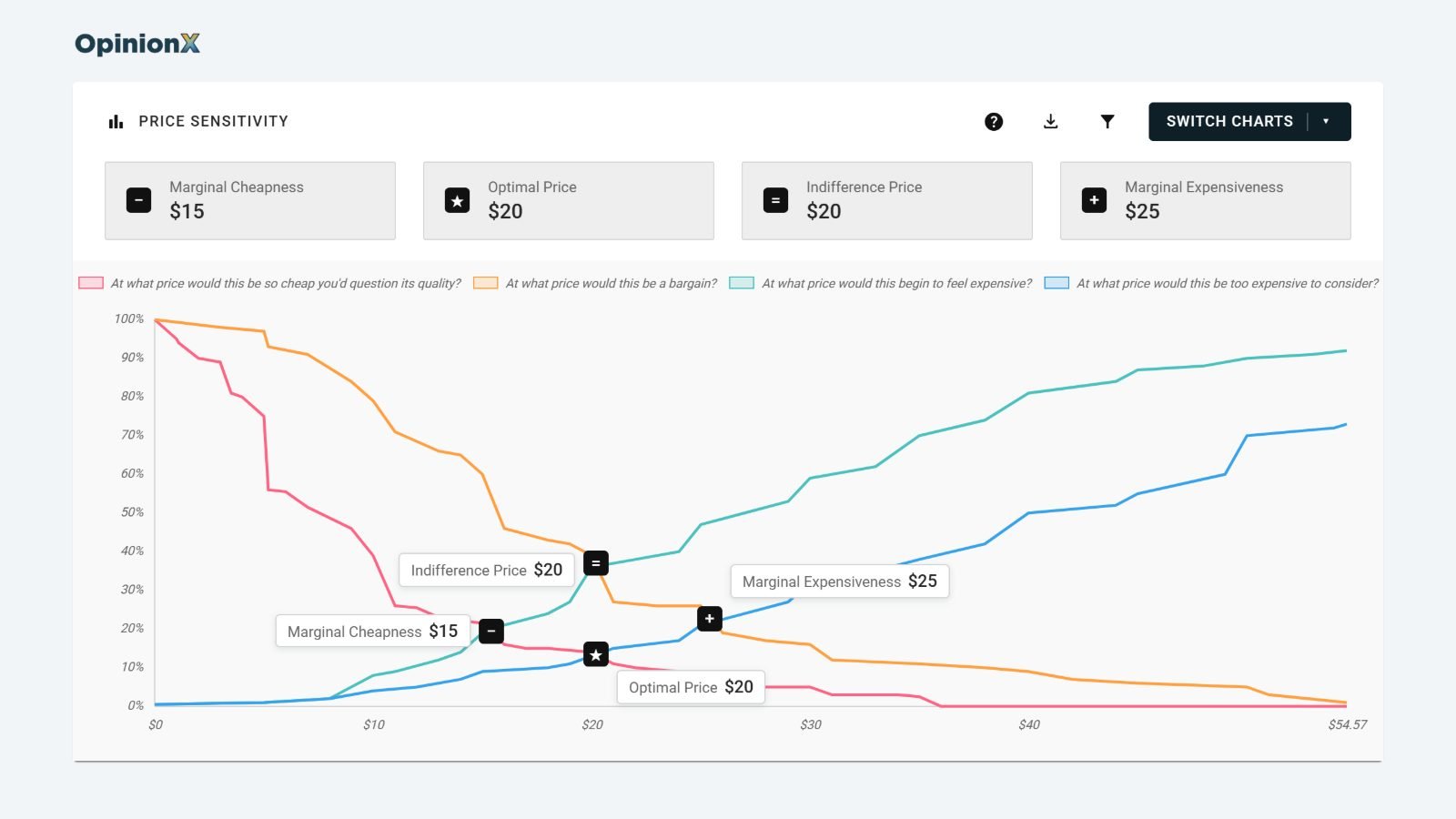
2. Automatically draws the chart and finds the four key prices for you. The Van Westendorp chart has four lines, and the points where they cross give you the optimal price point and the edges of the acceptable price range. If the tool only exports the raw answers, you have to rebuild that chart in a spreadsheet every time, and filtering to compare customer segments becomes technical and time consuming work.
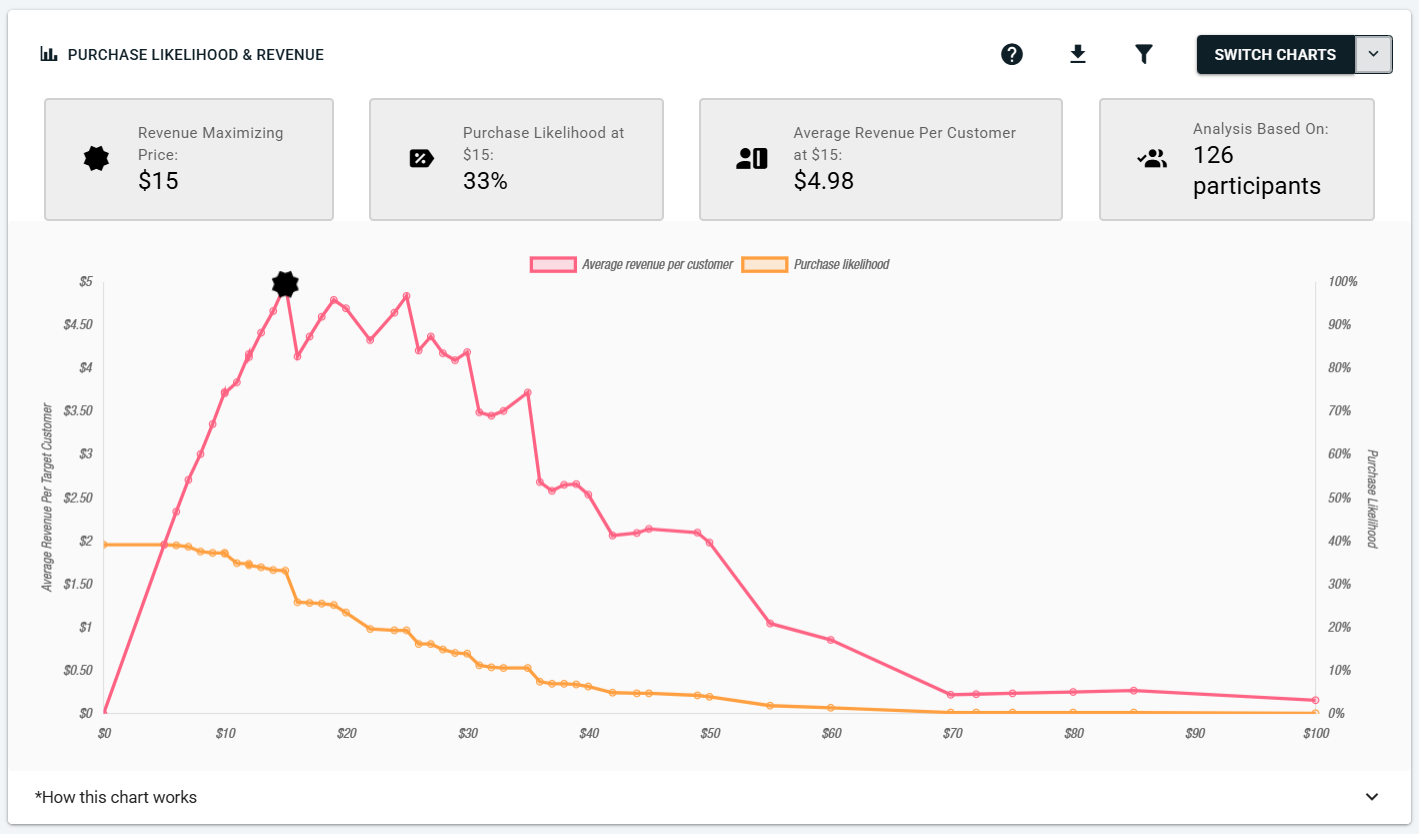
3. Offers the Newton-Miller-Smith extension. The Newton-Miller-Smith (NMS) extension, first published in 1993 (method notes), adds two "how likely are you to buy?" questions after the four price questions, which turn the acceptable price range into a demand line and a revenue estimate at every price. You have to decide on it before the survey goes live, because you can't add the questions afterwards. Our guide to the Newton-Miller-Smith extension shows the calculation with a worked example.
4. Splits the results by customer segment. A customer segment is a group of participants you want to look at on its own, such as people on your free plan versus your paid plan. Different segments often accept very different prices, and one combined chart hides that. Our guide on how to segment Van Westendorp results shows what to compare.
5. Charges in a way that fits your research needs. Van Westendorp needs enough participants to be stable, and the pricing consultancy 5 Circles Research suggests at least 200 participants for a business product and 400 for a consumer product. That means a free plan capped at 20 or 25 responses is for testing your survey, not for running the study. Past that, most tools charge per year, with some adding per researcher fees on top. This is one of the biggest differences between the platforms reviewed in this guide.
Setting up your first Van Westendorp survey and want a research expert to check your product description, price settings and whether you need the Newton-Miller-Smith questions before it goes out? Book a free 30-minute setup call, with no obligation.
Van Westendorp survey tools compared
Here's how the six platforms compare on the five criteria listed above, checked for accuracy as of 14 October 2026:
| Tool | Prevents illogical answers | Van Westendorp survey format | Newton-Miller-Smith extension | Segmentation analysis | Gabor Granger | Billing model | Published price |
|---|---|---|---|---|---|---|---|
| OpinionX | 🟢 Yes | 🟢 Ready-to-go question type | 🟢 Yes, with revenue chart | 🟢 Filters, comparison, crosstabs | 🟢 Yes | Annual subscription, unlimited seats | Free (25 participants per survey), $900 per year |
| Conjointly | 🟢 Yes | 🟢 Ready-to-go question type | 🟢 Yes, with revenue chart | 🟢 Crosstabs and weighting | 🟢 Yes | Annual subscription per team | Free (20 responses), $2,895 per year |
| SurveyMonkey | 🟢 Yes | 🔴 Market research service | 🔴 No | 🟢 Filters | 🔴 No | Pay per study, panel on top | Starts from $1,250 per study, excluding participant fees |
| Qualtrics | 🟡 Not stated | 🟡 Guided solution | 🟡 Not stated | 🟡 Not stated | 🟢 Yes | Annual subscription | Median enterprise contract is $30,000 per year |
| QuestionPro | 🔴 No (min and max only) | 🟢 Ready-to-go question type | 🟡 Not stated | 🟡 Not stated | 🟢 Yes | Annual per user, 10+ users | From $10,000 per year |
| SurveyKing | 🟢 Yes | 🟢 Ready-to-go question type | 🔴 No | 🟢 Crosstabs | 🟢 Yes | Monthly per user, no contract | Free (view 30 responses), $19 per user per month |
"Not stated" means the vendor's own pages don't say either way, so ask before you buy.
OpinionX
OpinionX has Van Westendorp as a built-in question type. Its VW question type stops each participant from entering a price lower than their previous answer, so contradictory answers can't get in. The chart labels all four key prices automatically, and the optional Newton-Miller-Smith Extension questions are enabled by default to create a Purchase Likelihood & Revenue chart that marks the revenue-maximising price for your product.
On OpinionX, you can filter your Van Westendorp results to focus on one specific group of respondents, compare two customer segments’ results side by side, or lay them out in a crosstab (a table with one column per segment) with up to 30 groups visible at once, helping you identify the customers with the highest willingness to pay for your product.
You can run Van Westendorp together with other advanced survey methods like Gabor Granger, conjoint analysis and maxdiff studies, all in the same survey, so the same participants can price the product and rank its features too.
What are OpinionX's limitations?
OpinionX has three limitations a buyer should weigh. The free plan stops at 25 participants per survey, which is enough to test a survey but not to run a Van Westendorp study. Billing is annual only, with no monthly plan for a one-off project. And OpinionX has no data weighting (adjusting results so the participant mix matches your market), no AI survey builder and no SOC 2 certification yet, which some procurement teams ask for.
💰 Price: Free tier at $0 allows up to 25 participants per survey. The Analyze plan costs $900 a year for unlimited participants per survey and unlimited researcher seats – making it ideal for teams of any size.
🔍 Trial: The free plan offers all question types, including Van Westendorp surveys, the Newton-Miller-Smith questions, and segment analysis, all with no time limit.
☑️ Conclusion: OpinionX is the most complete Van Westendorp tool for teams that run pricing research and advanced market research surveys. It has a user interface that is noted for its ease of use and accessibility, making advanced market research projects easy to run.
Conjointly
Conjointly runs Van Westendorp as a standalone study or as an extra question added to a conjoint, Gabor Granger or MaxDiff study. It offers the Newton-Miller-Smith extension as an option, with a demand curve and a revenue chart, and its report names all four key prices. Weighting and crosstabs come with every plan, including the free one. It also sells access to survey participants, with an average bid of $1.55 per completed response.
💰 Price: Basic is free with Van Westendorp analysis for up to 20 responses, Professional is $2895 per team per year, and Ultimate starts at $10,000 per year for no limits on users per team.
🔍 Trial: The free Basic plan on Conjointly offers Van Westendorp for up to 20 responses.
☑️ Conclusion: Conjointly is a strong option for teams that specifically need data weighting or managed fieldwork for their Van Westendorp surveys, although Conjointly ($2895/year) comes in at triple the price of OpinionX ($900/year).
SurveyMonkey
SurveyMonkey offers Van Westendorp through LaunchPad, its pay-per-study research product, as a ready-made study with pre-written questions that you can't edit. Answer validation is on by default, so participants can't give prices that contradict each other, and the results chart shows the four key prices as answers come in.
SurveyMonkey’s big advantage is a built-in panel of more than 335 million people in over 130 countries, so you can buy targeted participants in the same place. Sadly though, there's no Newton-Miller-Smith calculation: you can add your own purchase-intent questions, but revenue modelling means exporting the data. SurveyMonkey also has no Gabor Granger product, and Van Westendorp studies have to store data in its US data centre.
💰 Price: Pay per study starting from $1250, with no subscription option for running multiple surveys, plus panel responses are sold on top.
🔍 Trial: You can build a study for free and pay only when you start collecting responses.
☑️ Conclusion: SurveyMonkey fits a single pricing study where you need to buy a targeted audience quickly and don't need revenue analysis, however even a yearly subscription with OpinionX ($900/year for unlimited surveys and unlimited researcher seats) costs less than one Van Westendorp survey on SurveyMonkey LaunchPad.
Qualtrics
Qualtrics offers a guided "Pricing Study (Van Westendorp Model)" solution, which is a pre-built template of normal question blocks with survey logic that functions like a Van Westendorp survey. It delivers you a report that shows the optimal price point and the acceptable price range. Qualtrics also runs Gabor Granger as a separate guided solution with demand and revenue curves, however you cannot mix these two methods together in one survey. Qualtrics’ Van Westendorp pages don't mention the Newton-Miller-Smith extension, answer-order checks or segment breakdowns.
💰 Price: Qualtrics does not state what plan their Van Westendorp solution is available on. We checked the $5040/year "Research Core" plan but it was not available there. It is likely only available on an enterprise contract, which has a median starting price of $30,000 per year, plus respondent fees.
🔍 Trial: Qualtrics does not have any free trial available for Van Westendorp surveys.
☑️ Conclusion: Qualtrics makes sense when your company already pays for an enterprise subscription, as it is hard to justify buying a $30,000/year plan for Van Westendorp alone when cheaper tools exist, like OpinionX.
QuestionPro
QuestionPro has Van Westendorp and Gabor Granger as question types under its "Pricing Analysis" menu, with an editable question template and a chart that shades the acceptable price range. Validation is off by default and only limits prices to a minimum and maximum, so QuestionPro doesn't stop a participant from answering out of order. Its help pages don't mention the Newton-Miller-Smith extension.
💰 Price: Van Westendorp needs QuestionPro's Research Edition licence, which isn't priced on its public pricing page, and the research tier shown there is "contact sales" for 10 or more users.
🔍 Trial: The free plan (1 user, 200 responses per survey) doesn't include Van Westendorp, because the question type needs the Research Edition licence.
☑️ Conclusion: QuestionPro suits large teams that already use it for general surveys and want pricing questions in the same place.
SurveyKing
SurveyKing has a native Van Westendorp question with slider inputs that stop inconsistent answers, automatic calculation of the key prices, and a crosstab report that gives each segment its own price chart. It doesn't offer the Newton-Miller-Smith extension and sends readers who need a demand or revenue curve to its Gabor Granger question instead.
💰 Price: Free lets you view 30 responses, and Pro costs $19 per user per month to view view 2,000 responses. SurveyKing's pricing page doesn't say which plan includes Van Westendorp.
🔍 Trial: The free plan lets you view 30 responses.
☑️ Conclusion: SurveyKing is the cheapest option for a one-off Van Westendorp study that does not require significant analysis, customisation, or research functionality.
What about tools without a Van Westendorp question type?
Sawtooth Software, a specialist platform for conjoint analysis, offers no Van Westendorp question type. It offers a downloadable template that includes the Newton-Miller-Smith questions, written for version 9.3 of Lighthouse Studio, its Windows desktop application. Versions 9.0 to 9.8.1 of Lighthouse Studio stop being supported on 15 November 2026, so the template needs a newer version, and Sawtooth's own template page says it prefers conjoint analysis for measuring price sensitivity.
Alchemer lists conjoint and MaxDiff among its question types but no Van Westendorp question, so you'd build the four questions yourself as number questions.
Google Forms works for collecting the four answers with four short-answer questions, but it can't check that each answer is higher than the one before, and all the analysis happens in a spreadsheet. Thinking of going for a manually-run Van Westendorp survey? Our Google Sheets template for Van Westendorp surveys turns your exported survey answers into the chart and finds the key prices for you.
Which Van Westendorp tool should you pick?
OpinionX is the best all-round Van Westendorp survey tool for product and research teams that price things regularly, because it combines answer-order checks, the Newton-Miller-Smith revenue chart, automated results charts, easy survey setup, segment crosstabs, and other advanced research methods like Gabor Granger, all in one survey. With unlimited seats, an entire research team can run pricing studies and market research experiments without any extra platform fees. For just $900 per year, OpinionX has the lowest published annual price of the tools that offer Van Westendorp together with the Newton-Miller-Smith extension, and OpinionX’s free plan lets you build and test the whole study first. And even better, all paid plans on OpinionX include prepaid consulting, ensuring you can get the hands-on support you need for designing, distributing, or analysing your Van Westendorp pricing study.
If your project requires specialist functionality like data weighting and you're willing to pay $2895 per year for it, Conjointly is worth giving a try. SurveyMonkey suits a one-off study where buying a targeted audience from a giant global panel is more important than the survey analysis itself, although you give up editable questions and the Newton-Miller-Smith extension, plus it is comparatively a lot more expensive even for one survey than a platform like OpinionX.
Qualtrics and QuestionPro make sense only if your company already has an enterprise license for them, while SurveyKing is the low-cost option that lacks some customisation and sophistication but makes up for it with an affordable price.
New to Van Westendorp surveys? Our Van Westendorp pricing guide covers how the four questions work and how to choose participants, and our guide How to read a Van Westendorp chart walks through each line and crossing point with actual survey data. Still deciding between pricing methods? Our comparison of Van Westendorp vs Gabor Granger explains which question each one answers, and our review of conjoint analysis tools compares platforms for pricing individual features.
