
OpinionX vs. Conjointly: Product Comparison
Comparing features, limitations, and pricing plans to determine whether Conjointly or OpinionX is the better survey tool for your specific project needs.

This page was last updated in April 2026. Pricing and features change frequently. We recommend verifying current details directly with each provider mentioned on this comparison page. Tool comparisons inherently involve subjective judgment; the opinions expressed are those of the author based on firsthand testing.
Summary
Free Version
OpinionX and Conjointly both offer generous free plans that allow you to test advanced methods like MaxDiff Analysis and Conjoint Analysis, with no credit card required. The main differences appear in their paid tiers and feature sets, where OpinionX offers more affordable pricing, a more user-friendly experience, and better flexibility in how you can use different research methods together.
Specialism
OpinionX: Built for research teams who want advanced methods (Conjoint, MaxDiff, Ranking, Segmentation) without needing any research experience, education, or background. Modern, flexible, automated, and easy to learn.
Conjointly: An enterprise-grade research platform with a wide breadth of tools. Powerful, but the scope and interface can be overwhelming. More limited flexibility in survey setup compared to OpinionX’s survey builder.
Pricing
OpinionX: Premium plans for expanded participant limits start from $360/year and include unlimited survey creator seats.
Conjointly: Professional license starts at $2895/year for expanded participant limits.
Support
Both OpinionX and Conjointly offer live chat and email support, with consulting support expanded on Conjointly’s higher-tier plans.
Who is OpinionX for?
OpinionX is a research tool built specifically for ranking people's preferences and priorities. It offers a free survey tool and premium segmentation analysis features for understanding the differences between groups of respondents.
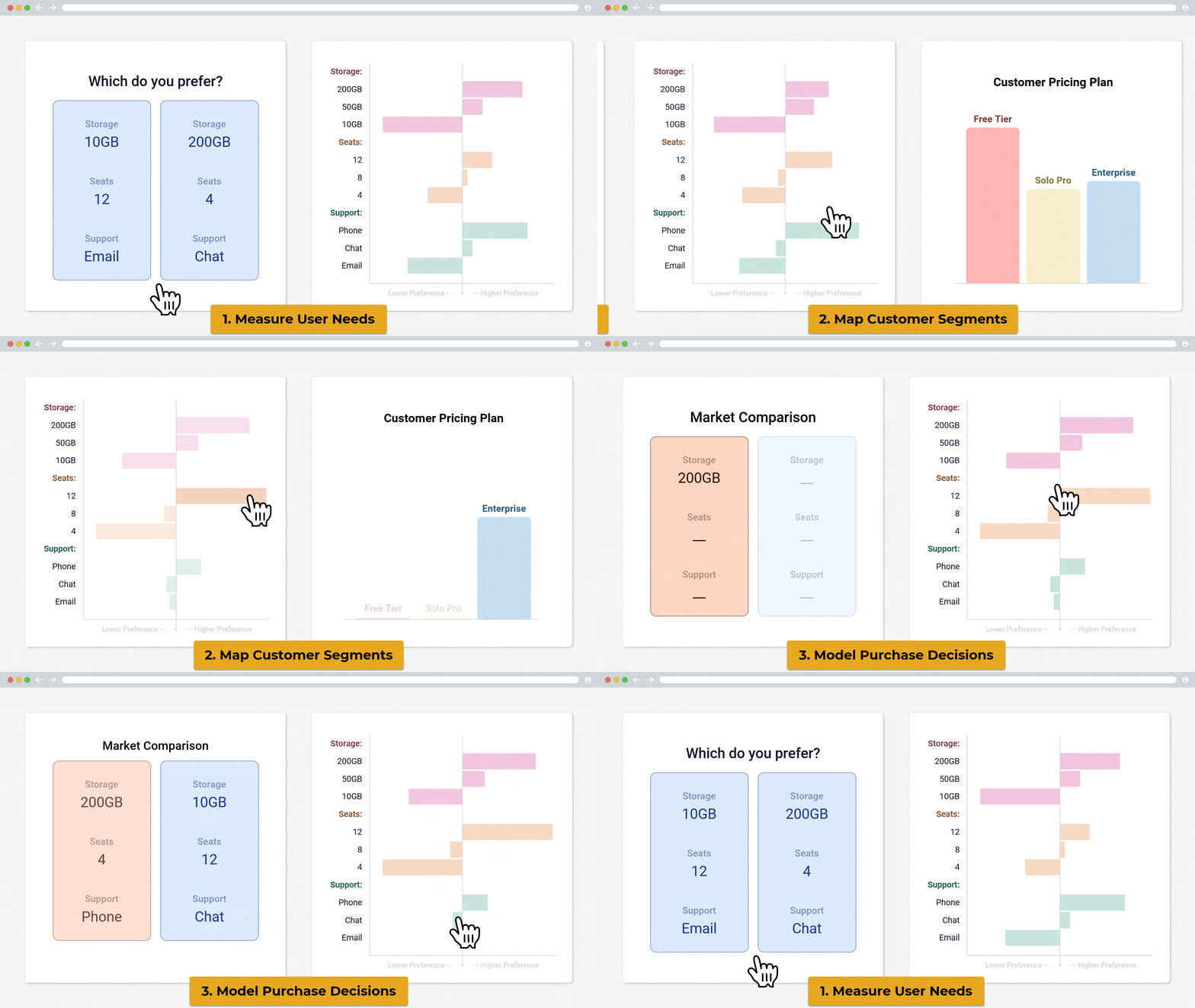
Where OpinionX really shines is in the depth of its ranking formats, offering a full suite of methods designed to capture how people genuinely make decisions, including:
Pairwise Ranking — breaks a long list into a series of head-to-head votes to surface true preferences without list-order bias.
Points Rank / Constant Sum — allocates a fixed budget of credits for respondents to distribute across options, simulating real trade-off decisions.
MaxDiff Analysis — identifies what matters most by forcing respondents to choose the most and least important from rotating sets.
Conjoint Analysis — models how people trade off between attributes like price, features, and brand to estimate willingness to pay.
Once you've collected results, OpinionX's segmentation features allow you to filter, compare, and map differences between groups — such as free users vs. paying customers, or one region vs. another. This kind of analysis is invaluable for product and research teams making prioritization decisions backed by real data.
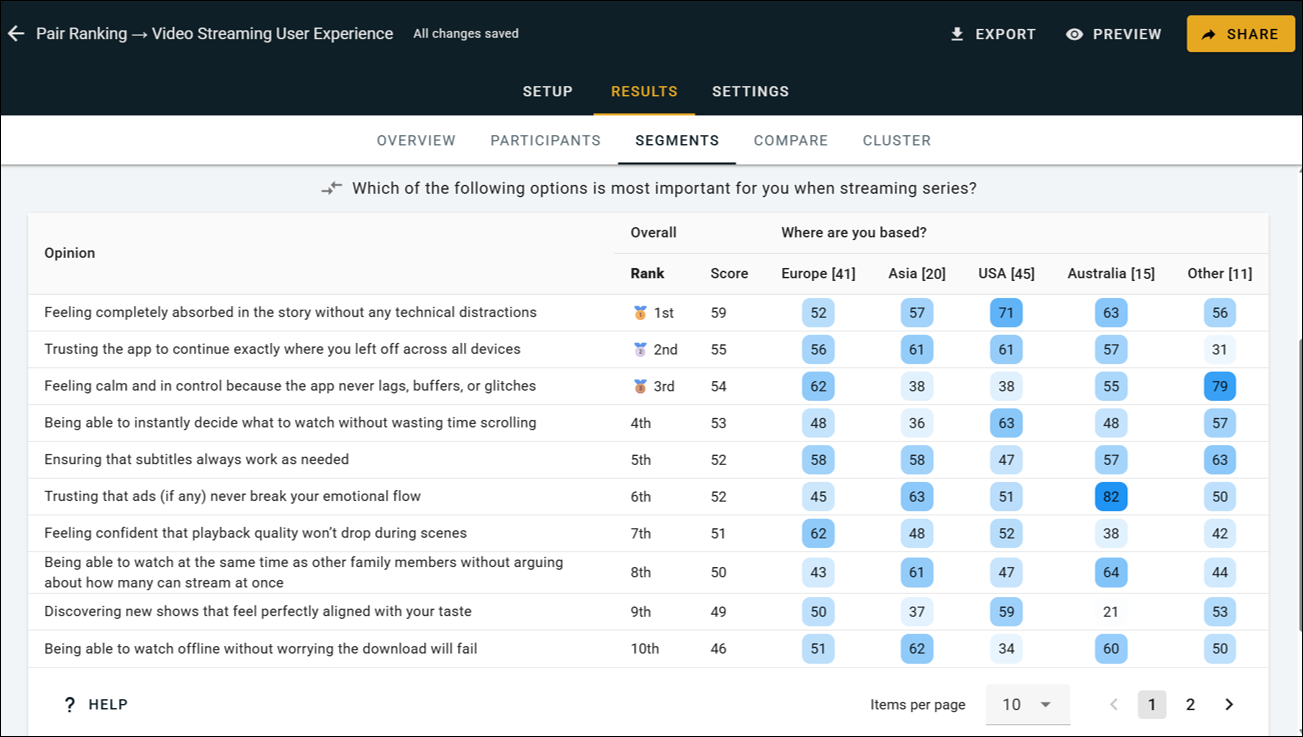
While OpinionX offers advanced survey question types not found in most survey tools, it retains a simple, intuitive user experience. Combined with automated analysis and ready-made visualizations, this makes insights feel easy to access—ideal for researchers who are new to quantitative research or who value speed and ease of use.
OpinionX paid plans also include prepaid time with an expert researcher who can guide you through survey design, participant distribution, and results interpretation. This support helps ensure you’re asking the right questions and drawing the right conclusions, making advanced methods like MaxDiff and Conjoint approachable even if you don’t have deep research expertise.
— — —
Who is Conjointly for?
Conjointly is a market research platform with a wide breadth of tools such as monadic concept testing, ad pretesting, brand tracking, and claims testing. It serves agencies, consultants, and enterprise insights teams who need a single platform to run diverse, complex research programs.
Conjointly's strongest differentiator is its built-in panel access and full-service option. You can source respondents directly through Conjointly, have their team manage fieldwork for you, and receive analysis reports built for presenting to senior stakeholders. For teams that don't have in-house research expertise and need managed research end-to-end, this is a meaningful advantage.
The trade-off is cost and accessibility. Conjointly's Professional tier starts at approximately $2,895 (check for latest pricing here), with panel costs charged on top. And while its Basic tier is technically free, the 20-response cap on advanced methods means you can't run a statistically useful study without upgrading.
UX Differences
Conjointly's interface reflects its breadth — with dozens of tool types and research methods available in an extensive suite of study options:
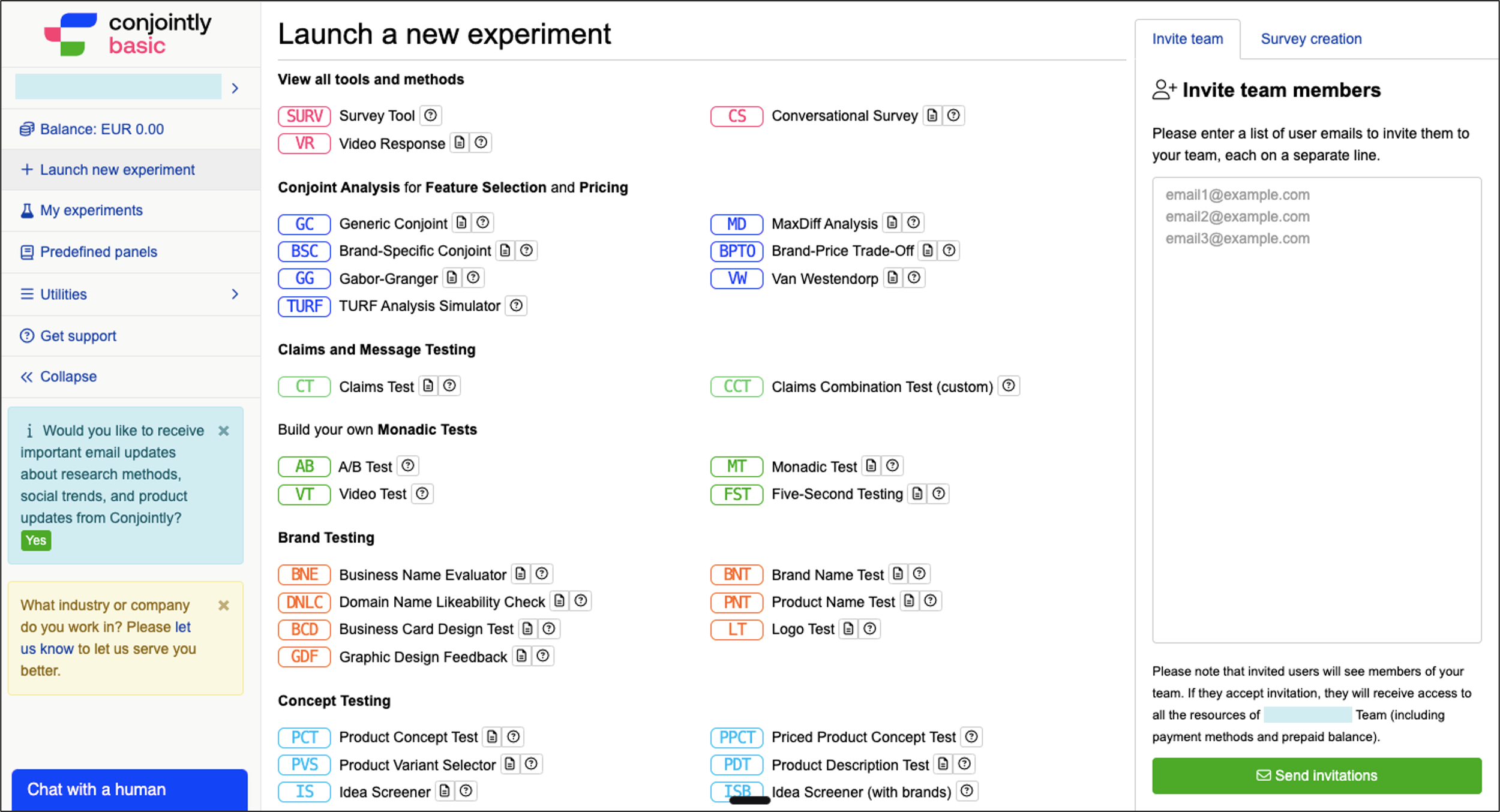
OpinionX is narrower in scope and built with that focus in mind: a cleaner, more intuitive interface where setting up a conjoint study takes minutes rather than hours. For teams new to advanced research methods, OpinionX also backs this up with a deep resource library and expert consulting hours included in paid plans, making methods like Conjoint and MaxDiff approachable even without a background in research science.

Survey Flexibility: OpinionX vs. Conjointly
On Conjointly, a questionnaire is built around a single study type, which means you can run a conjoint analysis or a maxdiff analysis, but not both in the same survey. You're also limited to a single block of that study type, so if your research calls for two separate conjoint sections (for example, to test different product categories), that isn't possible within one project. Standard survey questions like multiple choice and rating scales can be added around the study, but the advanced method itself is treated as a fixed, central component rather than a flexible building block.
OpinionX works differently. Every question type, regardless of whether that’s a simple rating scale or an advanced conjoint analysis section, is treated as a modular component you can arrange freely within your surveys. If you want to run a conjoint and a maxdiff in the same study, just add those two blocks to your survey. Need two separate conjoint blocks targeting different product attributes? Stack them one after another or even branch respondents to the right one based on their previous answers. On OpinionX, there are no structural restrictions on how you combine methods.
In practice, this means that a survey design which would require multiple separate Conjointly projects (and all the coordination overhead that entails) can be built as a single OpinionX survey in a fraction of the time.
Enrichment (Bringing external data into your analysis)
When you're running advanced research like conjoint or MaxDiff, you often already know a lot about the people taking your survey, their pricing plan, their company size, their industry, and their job role. The question is how to get that context into your analysis without making your survey longer.
OpinionX's Enrichment Tab lets you import external data about your participants and associate it directly with their survey answers. Instead of asking "What plan are you on?" or "How large is your company?", you upload a CSV with that data beforehand, or pass it dynamically via URL parameters using Hidden Fields, and OpinionX automatically links it to each respondent's results. That data then becomes available throughout the analysis dashboard for filtering and segmentation, exactly like any other question in your survey.
This has a practical benefit: it keeps your surveys shorter. Every question you don't need to ask is friction you don't create for your participants, which tends to improve completion rates and response quality. For teams surveying their own customers, where CRM, product, or billing data already exists, enrichment means you can run a tightly focused study on the decision or preference you actually care about, without padding it out with classification questions.
Conjointly doesn't offer an equivalent enrichment feature. Segmentation in Conjointly relies on data collected within the survey itself, which means longer surveys or separate data collection steps if you want to analyse results by customer attributes you already hold.
The Enrichment Tab is available to all OpinionX users, including on the free tier.
Comparing Free Versions 🆓
Conjointly Basic → Free with hard limits on advanced methods
Conjointly's Basic tier is free and allows you trial advanced methods like Conjoint and MaxDiff, up to 20 responses per survey.
OpinionX Free → Generous baseline for real research
All survey methods unlocked.
All analysis features enabled, including filtering, segmentation, and clustering.
Unlimited studies with up to 10 respondents in each to test all functionality.
Team workspace with unlimited survey creator seats.
Export your results to Google Sheets, .CSV, or Excel in multiple formats.
Publish your interactive results online and share them with anyone, no login/sign-up required.
The 10-participant cap makes it ideal for internal pilots, team prioritization exercises, or testing your survey design before scaling up. Crucially, every method — including Conjoint and MaxDiff — is available with full analysis on the free plan. You can see exactly what results will look like before committing to a paid tier.
Additionally, OpinionX’s free plan offers a 30-minute survey setup advisory call to all users, including those on the free tier, without any requirement to commit to a premium upgrade beforehand.
Comparing Paid Versions 💲
Conjointly Professional → Powerful, but expensive to scale
Conjointly's Professional license includes access to all advanced methods, up to 2 hours of annual consulting, and quality-checked panel access. Premium plans on Conjointly start at $2,895 (five times more than OpinionX). Panel responses are purchased separately on top of the licence fee.
Conjointly also offers a Ultimate tier for enterprise teams starting from $10,000 who need a dedicated researcher on retainer and managed research services, but pricing is custom and requires direct engagement with their team.
OpinionX Paid → Clear, self-serve tiers
OpinionX has three straightforward plans:
Ask: $360/year. All survey methods, all analysis features, unlimited surveys, team workspace with unlimited researcher seats, custom survey URLs, and 100 participants per survey. This is the cheapest premium plan for conjoint analysis and maxdiff surveys on the entire internet.
Analyze: $900/year. Everything in Ask, plus 1,000 participants per survey, 90 minutes of prepaid consulting, and the ability to remove OpinionX’s branding. For a team, this option is half the price of Conjointly's Professional plan.
Accelerate: Contact Sales. Everything in Analyze, plus unlimited participants, an expert researcher on retainer, advanced security (SAML SSO, 2FA), and external collaborator access.
OpinionX vs Conjointly: Feature Comparison
| Feature | OpinionX | Conjointly |
|---|---|---|
| Mixed-method surveys (Conjoint + other question types) | ✅ Combine conjoint with multiple choice, ratings, open text in one survey | ❌ Advanced methods can only be run as standalone studies, not within surveys |
| Segment conjoint results by survey questions | ✅ Filter conjoint results by any multiple choice answer | ⚠️ Subgroup analysis available but less flexible |
| Ease of setup for non-researchers | ✅ Simple UI, blog guides, expert hours included in paid plans | ⚠️ Steeper learning curve; better suited to experienced researchers |
| Interface design | ✅ Clean, modern, intuitive | ⚠️ Feature-dense interface can feel complex to navigate |
| Free Plan | ✅ Unlimited surveys, all methods | ✅ Unlimited surveys, all methods |
| Conjoint Analysis | ✅ Free, self-serve | ✅ Free, self-serve |
| MaxDiff Analysis | ✅ Free, self-serve | ✅ Free, self-serve |
| Pairwise Ranking | ✅ | ❌ |
| Points Rank / Constant Sum | ✅ | ❌ |
| Segmentation Analysis | ✅ Built-in | ⚠️ Available via crosstab / subgroup analysis |
| Enrichment | ✅ | ❌ |
| Pricing Research (Van Westendorp, Gabor-Granger) | ⚠️ Manual Analysis | ✅ Dedicated tools for both |
| Built-in Panel Access | ⚠️ Via third-party panel partners | ✅ Native panel recruitment |
| Expert Hours / Consulting | ✅ 90 minutes | ✅ 2 hours |
| Live Chat Support (all users) | ✅ | ✅ |
| Transparent Self-Serve Pricing | ✅ | ✅ |
| Affordable Premium Plan | ✅ $360/year | ❌ $2895/year |
| Excel Export | ✅ | ✅ |
| Learn More | Learn More |
Summary
Conjointly suits teams running diverse research programs — pricing studies, ad pretesting, brand tracking, concept testing — who want built-in panel access and managed research support. Its PowerPoint reporting is a genuine plus for teams presenting to senior stakeholders. The catch is cost and complexity. Per-seat pricing makes it expensive to scale, and the breadth of tools comes with an interface that takes time to learn.
For product and research teams focused on priorities, trade-offs, and segment differences, OpinionX is the sharper tool. The free Ask plan includes full Conjoint, MaxDiff, and analysis features from day one. OpinionX’s Ask plan is five times cheaper than Conjointly entry level premium plan. And unlike Conjointly's standalone studies, OpinionX gives you greater research design flexibility and segmentation functionality. For teams without a dedicated research scientist looking to bring more advanced market research work in-house, OpinionX’s easy to use interface, automated results, and in-depth library of guides, sample surveys, and one-click templates make it easier than ever to accomplish your research goals.
Create Unlimited Ranking Surveys
Join thousands of teams using OpinionX to measure user needs, map customer segments, and model pricing decisions.