Alchemer vs OpinionX for Conjoint, MaxDiff, Pricing Research
Alchemer and OpinionX are two of the most popular platforms for running advanced market research surveys using methods like Conjoint Analysis, MaxDiff Analysis, pricing studies, and more.
However, both tools differ significantly in price, who they have built their platforms for, and how easy they are to test out before buying.
This guide offers an in-depth view of these two tools to help you determine which is a better fit for your research needs.
Alchemer vs OpinionX in a nutshell
Alchemer is a broad survey platform built as an alternative to tools like Qualtrics and SurveyMonkey. While market research is one of the many areas it covers, it is primarily positioned as a tool for gathering feedback.
OpinionX on the other hand is purpose-built for running advanced market research surveys, which it offers in an accessible interface that feels like the forms and survey tools people are already familiar with, strips out unnecessary specialist jargon, and adds helpful automations that make running advanced market research feel easy.
Now that we’ve covered the basics of both tools, let’s dig a little deeper into each to understand how they differ in price, functionality, limitations, and pros/cons.
But first, what are advanced market research methods?
This post uses the term ‘advanced market research surveys’ a lot throughout. You’re likely reading this because you care about these survey formats, but just to be sure we’re all on the same page, here’s what we mean by that:
Examples of advanced market research methods
Conjoint analysis measures which product attributes are most important to a buyer by asking them to pick the profile with the best combination of features from sets of 2-5 profiles at a time.
MaxDiff Analysis ranks a list according to relative importance by asking participants to pick the most and least important option from sets of 3-6 options chosen at random from the total list.
Van Westendorp gives you the acceptable price range your market accepts for your product by asking target customers to state price points that feel too cheap, a bargain, getting expensive and too expensive.
Gabor Granger shows participants one price at a time and asks if they'd buy at that price, to identify the price point that generates the most revenue overall.
Segmentation Analysis lets you see the differences between groups of people, using filters that isolate one group, head to head comparisons, crosstabulation, or clustering analysis.
All of these survey and analysis methods fall under the category of ‘advanced market research’. Typically they are not found on form builder tools like Typeform or Google Forms. In the past, they were considered specialist quantitative methods with considerable complexity, although platforms like OpinionX now make it more accessible for teams to utilise these survey methods for customer research.
Comparing Alchemer and OpinionX survey platforms in detail
Alchemer
🎯 Target Customer: Alchemer is primarily built for large Customer Experience (CX) teams who have outgrown SurveyMonkey’s limitations but reject Qualtrics as overly complex and expensive alternative. Additionally, it works towards serving high-volume, distributed businesses like franchises with thousands of locations.
✨ Differentiator: What makes Alchemer unique is its ability to manage feedback for multi-location businesses where they can use Alchemer to efficiently collect, organise, and compare feedback based on its source.
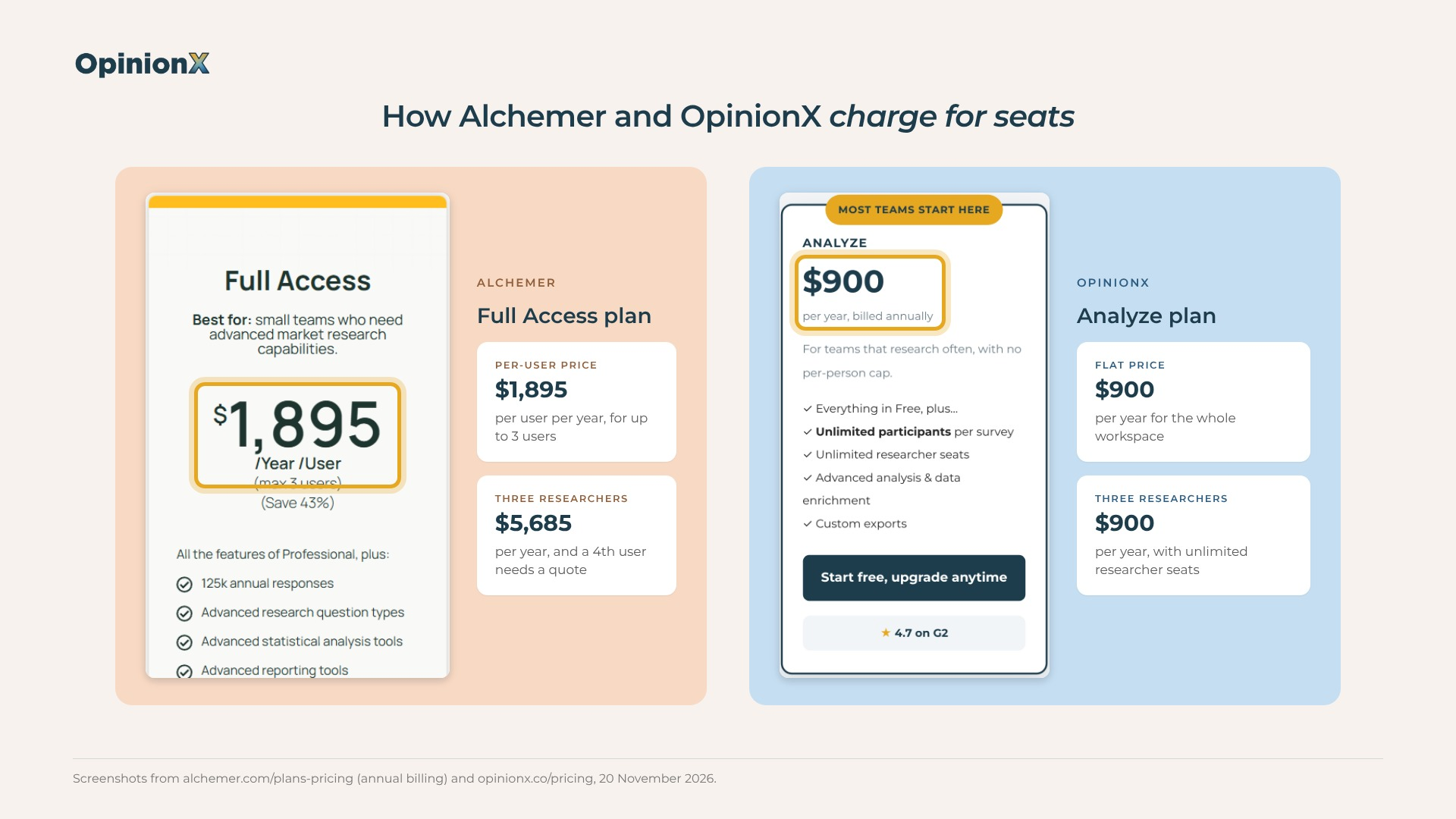
💰 Price: The cheapest pricing plan on Alchemer that offers advanced market research methods like Conjoint and MaxDiff is the Full Access tier, which costs $1,895 per user per year, limited to a max of 3 users (as of 19 November 2026).
🔍 Trial: There is no free version or free trial of Alchemer’s Full Access pricing plan, so there is no way to test their Conjoint or MaxDiff Analysis survey formats without either paying upfront or contacting their sales team.
☑️ Conclusion: Alchemer’s pricing is not designed to facilitate easy testing of Conjoint or MaxDiff Analysis before buying because Alchemer is not primarily focused on facilitating advanced market research surveys.
OpinionX
🎯 Target Customer: OpinionX is primarily built for product teams and UX researchers. These teams frequently run customer surveys but often aren’t expert quantitative researchers with much experience with these advanced question types, meaning they require a survey platform that combines robust statistics with an accessible, easy to use interface.
✨ Differentiator: Unlike almost every other survey platform, OpinionX treats advanced research methods as normal question types, giving teams the ability to design whatever survey structure they need using flexible conjoint and MaxDiff “blocks”. Additionally, every survey is automatically set up for segmentation, so that teams can compare differences by customer segment without requiring complex configuration or any manual formulas.
💰 Price: OpinionX's premium plan is the Analyze tier, which costs $900 per year for a team workspace with unlimited researcher seats that can create unlimited surveys with unlimited participants per survey. All survey and analysis methods are included.
🔍 Trial: OpinionX’s free plan lets you use all survey methods and analysis tools upfront – including Conjoint, MaxDiff, Van Westendorp, and Gabor Granger – so you can figure out if it will meet your research needs without needing to pay, talk to sales, or even input a credit card. OpinionX’s free tier allows unlimited surveys where each survey on the free tier is limited to 25 participants.
☑️ Conclusion: OpinionX is the better fit for teams looking for a platform they can use to run surveys using advanced market research methods, whether that means a UX researcher team of one or a large insights team. Its free tier, cheaper and more flexible pricing, and being purpose-built for this type of research gives it significant advantages over a more generalist CX platform like Alchemer.
Note: We last updated this page on November 19th 2026. Pricing and features change often, so check current details with each company before you buy.
Which plan includes Conjoint and MaxDiff Analysis on each survey tool?
This is one of the most immediate and significant differences between OpinionX and Alchemer. While OpinionX offers all survey methods upfront on its free plan, Alchemer locks question types like Conjoint and MaxDiff Analysis under the "Market Research Questions" feature that is only available on their Full Access tier for $1895 per user per year.
| Method | OpinionX plan that includes it | Alchemer plan that includes it |
|---|---|---|
| Conjoint analysis | Every plan includes it, the free plan too. | Only Full Access ($1,895 per user per year), the top plan you can buy online, includes it. |
| MaxDiff | Every plan includes it, the free plan too. | Only Full Access ($1,895 per user per year), the top plan you can buy online, includes it. |
| Van Westendorp | Every plan includes it, the free plan too. | Alchemer has no question type for it on any plan. |
| Gabor Granger | Every plan includes it, the free plan too. | No plan has a question type for it. |
| Entry plan with every method the tool offers | The free plan has all four OpinionX methods for 25 participants per survey, and Analyze at $900 per year removes that limit. | Full Access, at $1,895 per user per year, has every method Alchemer offers on this list. |
On OpinionX you can design and send a conjoint analysis survey to a test batch of your colleagues or customers today and read the full results before making any decision about paying for a premium plan. This gives you room to figure out if conjoint analysis is the right research method for your project before you even need to worry about which platform to buy.
On the other hand, Alchemer’s free 7-day trial only covers its Professional pricing plan, which does not include pricing methods or survey formats like conjoint or MaxDiff analysis. That means you need to pay upfront before you’ve even validated whether you’ve picked the right survey method or if Alchemer’s functionality meets your needs.
How do OpinionX and Alchemer compare for conjoint analysis surveys?
Alchemer and OpinionX both offer choice-based conjoint surveys, which is the most common type of conjoint analysis. Choice-based conjoint measures which product attributes are most important to a customer by asking them to pick the profile with the best combination of features from sets of 2-5 profiles at a time. There are many types of conjoint analysis, but choice-based conjoint is by far the most popular format used in survey research.
Both tools use the same type of underlying statistical model, which is called Hierarchical Bayes, to turn respondents’ votes into scores. Hierarchical Bayes works out a separate set of scores for each participant while also using information from the whole group, so each person's scores stay stable even though they only voted on a handful of different sets of profiles.
Alchemer uses ChoiceModelR to calculate these scores, which is a package for the R statistics language that applies Hierarchical Bayes to a multinomial logit; a standard model of how people pick between options.
OpinionX's conjoint analysis surveys also uses a Hierarchical Bayes multinomial logit (HB-MNL) as well, built in PyMC (python instead of R) and sampled with nutpie (a fast NUTS sampler).
So while the underlying model works largely the same way, the two conjoint tools differ in what each one shows you after calculating the scores and in how much of that work happens inside the tool.
Four outputs decide what a conjoint tool can tell you:
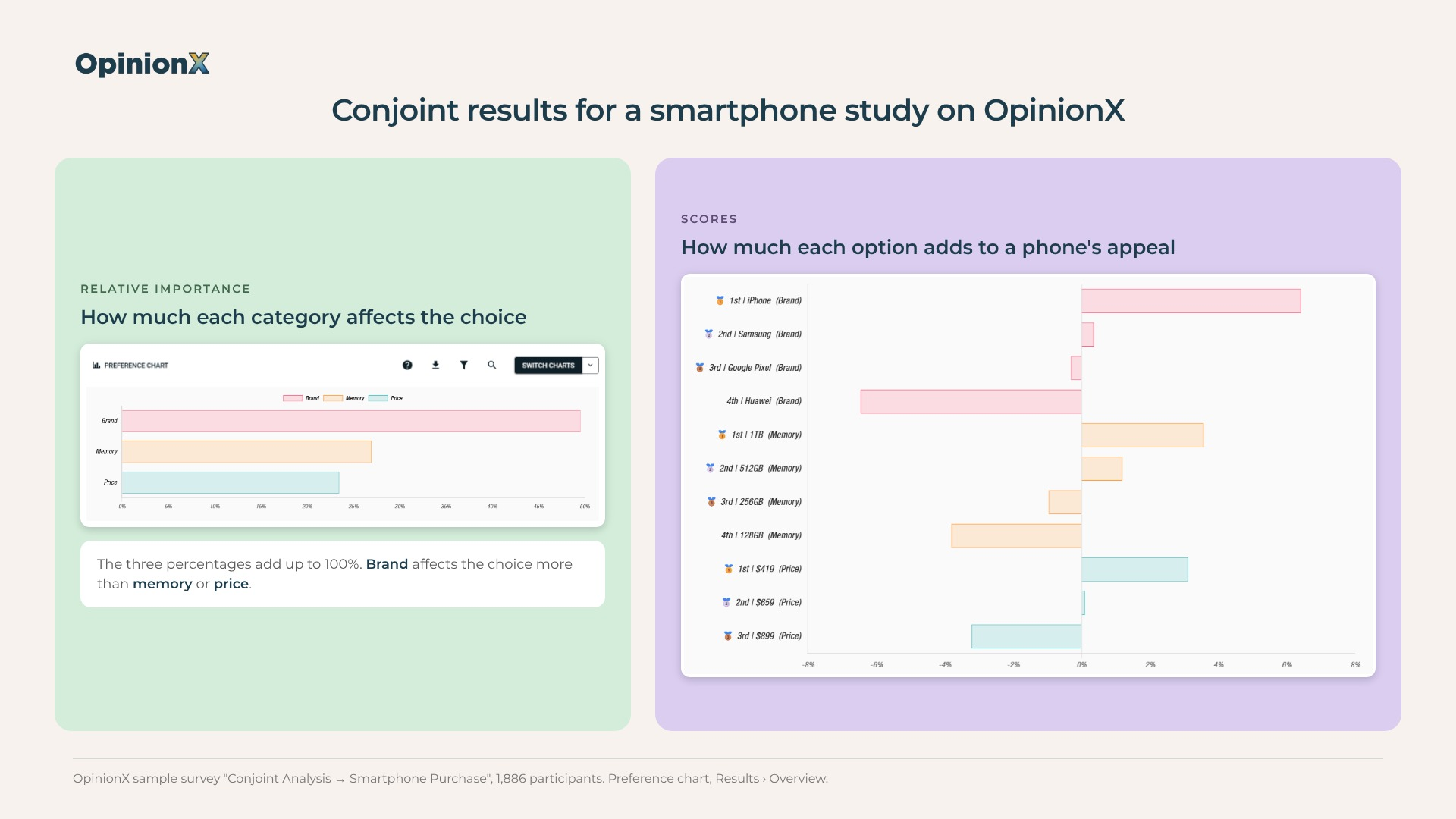
Scores, also known as part-worth utilities, show how much each level adds to a product's appeal. Levels are the possible options that the survey can show for each product attribute, for example the attribute ‘storage size’ could include levels like 512GB, 256GB and 128GB.
Relative importance shows how much each category, such as price or storage space, affects the choice overall. Each category gets a score that together adds up to 100%.
A market simulator lets you build two or more product versions and then runs these versions against respondents’ votes to predict things like the share of people who would pick each one, revenue generated, and rejection rate.
Marginal willingness to pay turns the differences in importance scores into financial terms, letting you compare options and see how much more a customer would pay to switch from one option to another (eg. to upgrade from 128GB of storage to 256GB).
Alchemer
Alchemer’s results for conjoint analysis only include a visual chart or a data table with relative importance scores, as shown below.
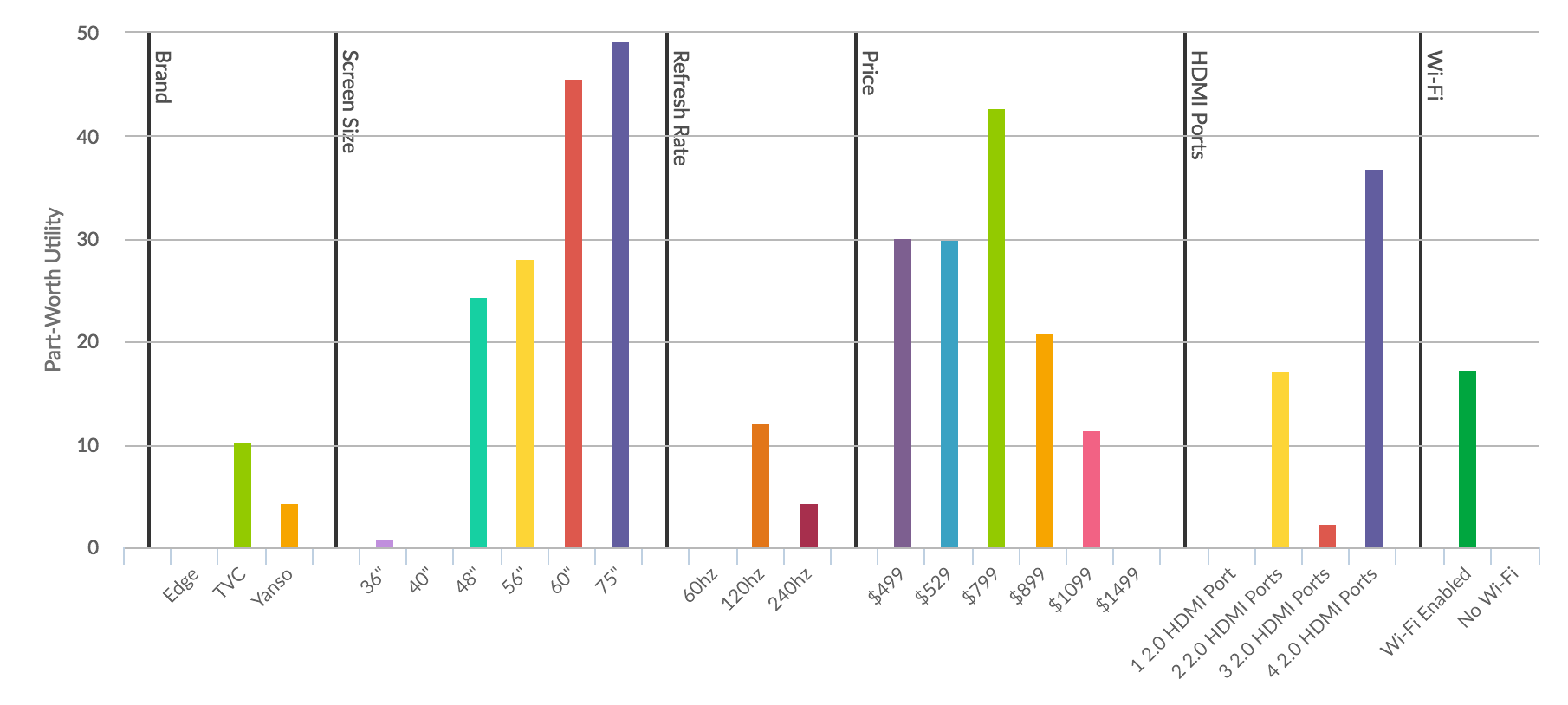
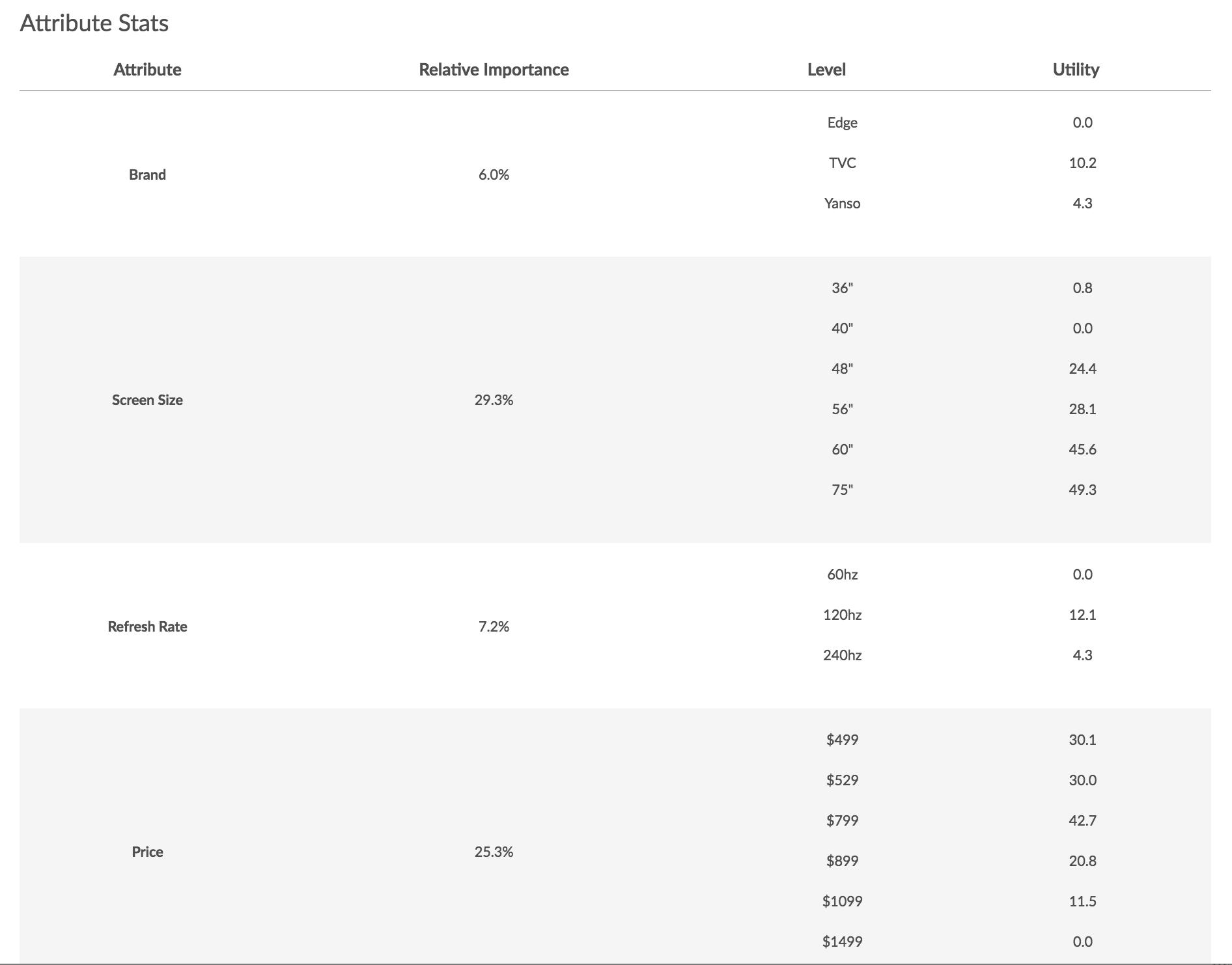
According to Alchemer’s product documentation, relative importance scores for conjoint analysis can change each time the report refreshes. That happens even when no new answers have come in, because the report uses a random sample of the answers so far and that sample differs a little each time. If you copy relative importance into a slide on Monday and a colleague refreshes the report on Tuesday, the two figures may not match.
Alchemer does not offer a market simulator for conjoint analysis surveys inside its platform. Instead, you can export your results from Alchemer to an Excel spreadsheet template that you fill in yourself which can be turned into a simulator. Alchemer’s documentation doesn't describe a willingness-to-pay report and it treats price as a standard category, unlike OpinionX.
Before you build, check the limits that Alchemer's documentation sets. It recommends at most 6 categories with 6 options each, and Alchemer's support team won't help with builds above 6 options. It also recommends at least 334 responses for each customer group you plan to analyse separately, regardless of survey design.
Alchemer does offer two conjoint voting formats that OpinionX doesn't: best versus worst conjoint, where participants pick the most and least appealing version in each set, and continuous sum conjoint, where they split points between versions. If your study design needs one of those less common conjoint analysis formats, that's a reason to look at Alchemer.
OpinionX
OpinionX comes with a significantly more expanded range of automated results reports, charts, and analysis methods for conjoint surveys.
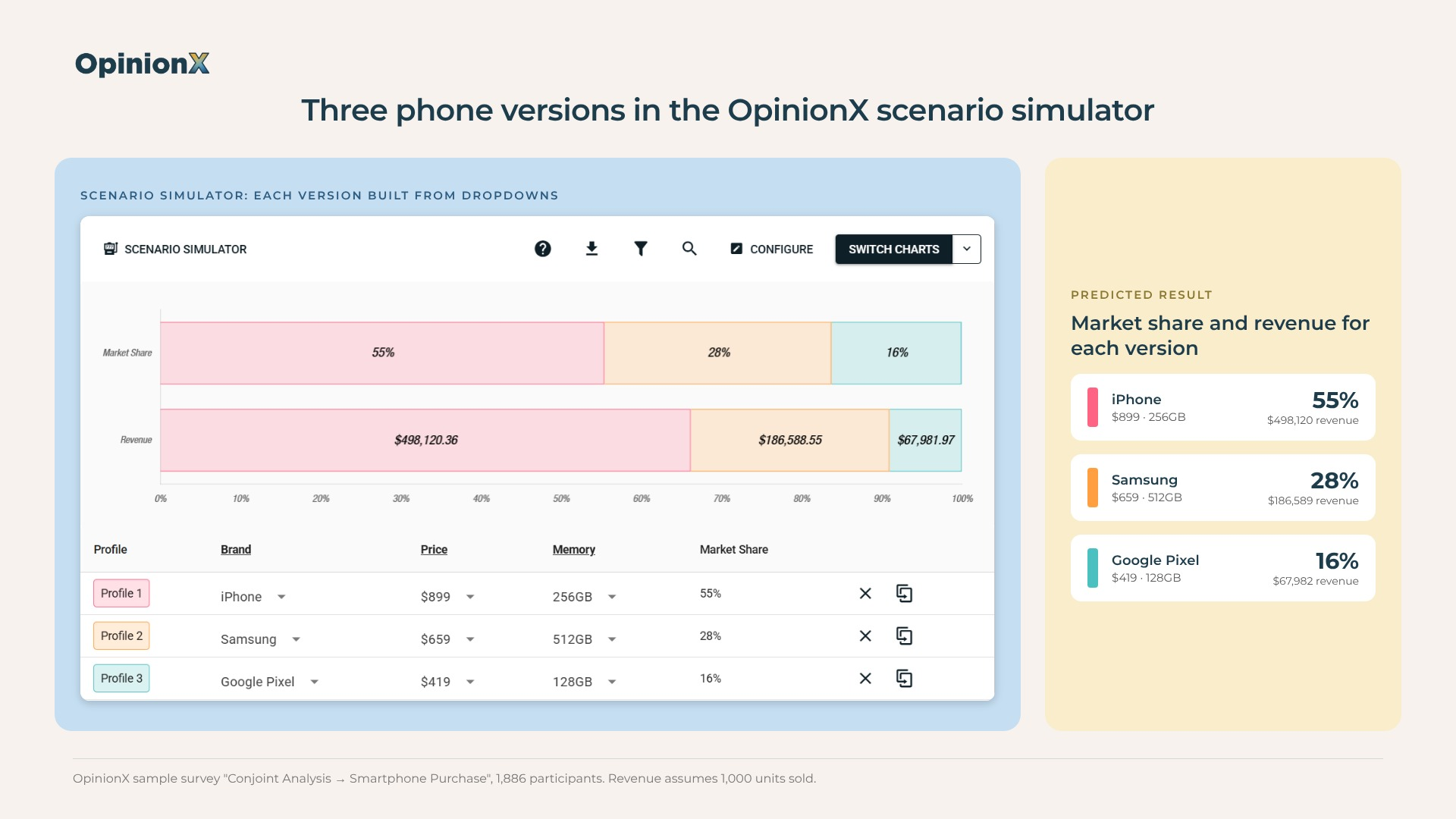
Alongside a visual chart and data table, OpinionX also offers an interactive scenario simulator with market share, revenue forecast, and rejection rate predictions built in automatically. Scenario configurations can be named and saved for easier future use.
OpinionX has an automated Marginal Willingness To Pay report for conjoint analysis which shows you how much someone would pay to upgrade between different options in the same attribute, alongside a price/utility chart that demonstrates the basis for those calculations.
OpinionX gives you a Ranked Concepts report, showing you every possible combination of options ranked from most to least preferred, plus ARPU and churn predictions for every concept.
Additionally, OpinionX offers a unique conjoint analysis report format that no other platform has called Rejection Rate Analysis. This shows you the percentage of rejected profiles each level appeared in, helping you understand what causes a customer to say “none of the above” during voting and measure potential churn influence.
Unlike Alchemer, OpinionX calculates stable results that won’t change due to a simple page refresh. This is because OpinionX recalculates the entire conjoint results minutes after each new batch of responses are received, it uses every response rather than a random subsample, and it uses a fixed random seed that embeds random draws while enabling consistency in how the numbers are produced.
Because OpinionX is designed to make segmentation analysis as easy as possible, conjoint analysis results can be compared by group in a number of ways on OpinionX:
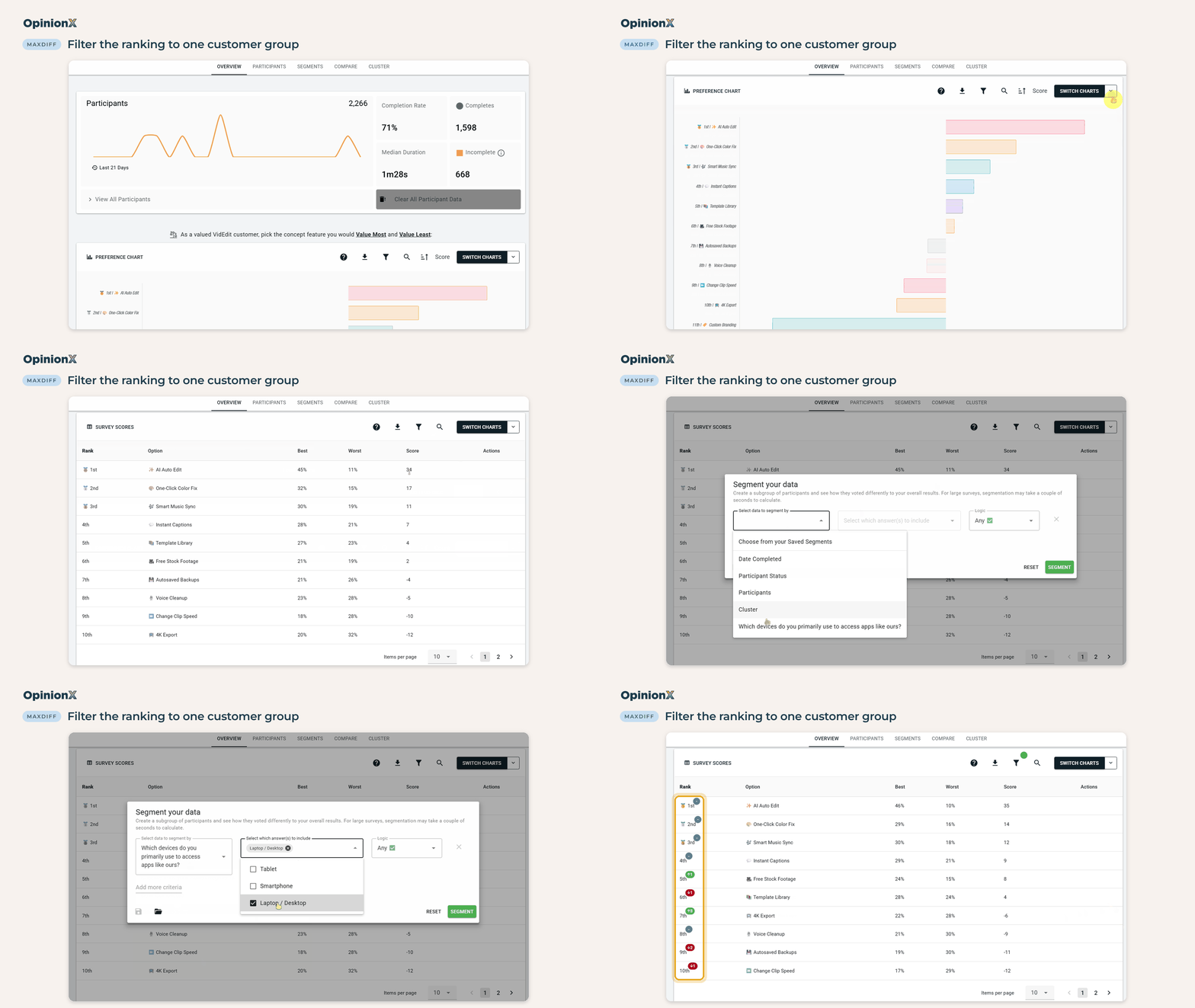
You can filter your overall results in a single click to see how one participant group or type voted.
Compare two groups side by side with visual results charts.
Put up to 30 segments into one crosstab table with colour coding to help you spot groups with uniquely strong opinions in the conjoint data.
Filter any of the unique conjoint reports, like Marginal Willingness To Pay, to look at one customer segment in isolation.
Are you planning your first conjoint study and not sure which attributes and options to test? Book a free 30-minute survey setup call and one of our research experts will help you design your survey, check your sample size, and avoid the most common pitfalls in conjoint research.
How does MaxDiff compare?
Alchemer and OpinionX calculate MaxDiff scores the same way, with count-based scoring.
Count-based scoring gives each option a score between -100 and +100 using the formula (best-worst)/appearances, ie. number of times it was picked as best minus number of times it was picked as worst, divided by the total number of appearances.
Say participants saw an item 20 times, and they picked it as most important 11 times and as least important 3 times. That item scores 11 minus 3, divided by 20, which is 0.4. Alchemer shows that score as 0.4 and OpinionX shows it as +40 on a possible range of -100 to +100. Both rank the list from highest score to lowest score.
The benefit of count-based scoring is that you can easily explain to any colleague exactly how you got every score, which is vital when it comes to defending your research. Our guide to how MaxDiff analysis works covers the method and how to size a study.
OpinionX and Alchemer differ significantly when it comes to actually building and analysing a MaxDiff Analysis survey study.
Alchemer's help documentation says a MaxDiff question needs a dedicated page to itself and doesn't work with page repeating. The export to SPSS, a statistics program, leaves MaxDiff out entirely, so researchers who analyse in SPSS export MaxDiff through a separate raw data file. Alchemer's MaxDiff help page doesn't describe a way to recalculate the ranking for one customer group and MaxDiff isn’t supported in its crosstab report, so there are no ways to filter or compare results by group using any segmentation analysis methods like OpinionX offers.
On OpinionX's MaxDiff Analysis method, filtering the results is as easy as one click of a bar chart to automatically recalculate the entire results page for a MaxDiff survey instantly. OpinionX includes a MaxDiff preference simulator, which shows what share of participants would pick each item from a set you put together, if they could only have one – Alchemer's documentation doesn't list a simulator for MaxDiff at all. OpinionX also offers crosstab analysis for MaxDiff results and the ability to view survey results charts for two segments side by side.
But most importantly, OpinionX treats MaxDiff Analysis like it is a normal survey question, no different to a multiple-choice question or an input field asking for someone’s name. Your survey on OpinionX can have multiple different MaxDiff sections, you can branch people to different MaxDiff questions based on their past answers, and you can mix MaxDiff together with other advanced methods like conjoint or Van Westendorp in the same survey. OpinionX gives you full flexibility, unlike most other platforms that treat these methods like special formats that come with a bunch of frustrating limitations.
OpinionX vs Alchemer for pricing surveys like Van Westendorp and Gabor Granger?
Alchemer doesn't offer a Van Westendorp or Gabor Granger question type, so a team that wants either method on Alchemer will need to build it by hand using basic text-response questions and advanced branching logic. Then, when it comes to analysing the results, you'd need to export your VW data to a spreadsheet, reformat the results manually, and plot line charts yourself. For every customer segment you want to compare, you’ll need to rebuild that line chart again using Alchemer data.
Running a Gabor Granger survey by hand on Alchemer takes even more work, because you need a complex branching web of yes-or-no questions for every price plus logic that decides which price each person sees next. After that, you need a spreadsheet that works out demand and revenue at each price, which is no easy feat to build yourself.
OpinionX includes both Van Westendorp and Gabor Granger as purpose-built question types available on every plan. It analyses participant answers automatically, delivering you charts and reports that update instantly. Van Westendorp on OpinionX includes the Newton-Miller-Smith extension, two extra questions that turn the acceptable price range into purchase likelihood and a revenue-maximising price. Gabor Granger on OpinionX uses each participant's last answer to pick the next price they see using the most efficient selection method of any Gabor Granger survey tool (a binary search algorithm), meaning you can test 100 prices by asking every respondent to vote yes/no on just 8 questions maximum.
You can pull Van Westendorp and Gabor Granger results into any of OpinionX’s segmentation features too, letting you see your product’s optimal price for up to 30 groups at once so that you can instantly spot which customer segment is willing to pay the most.
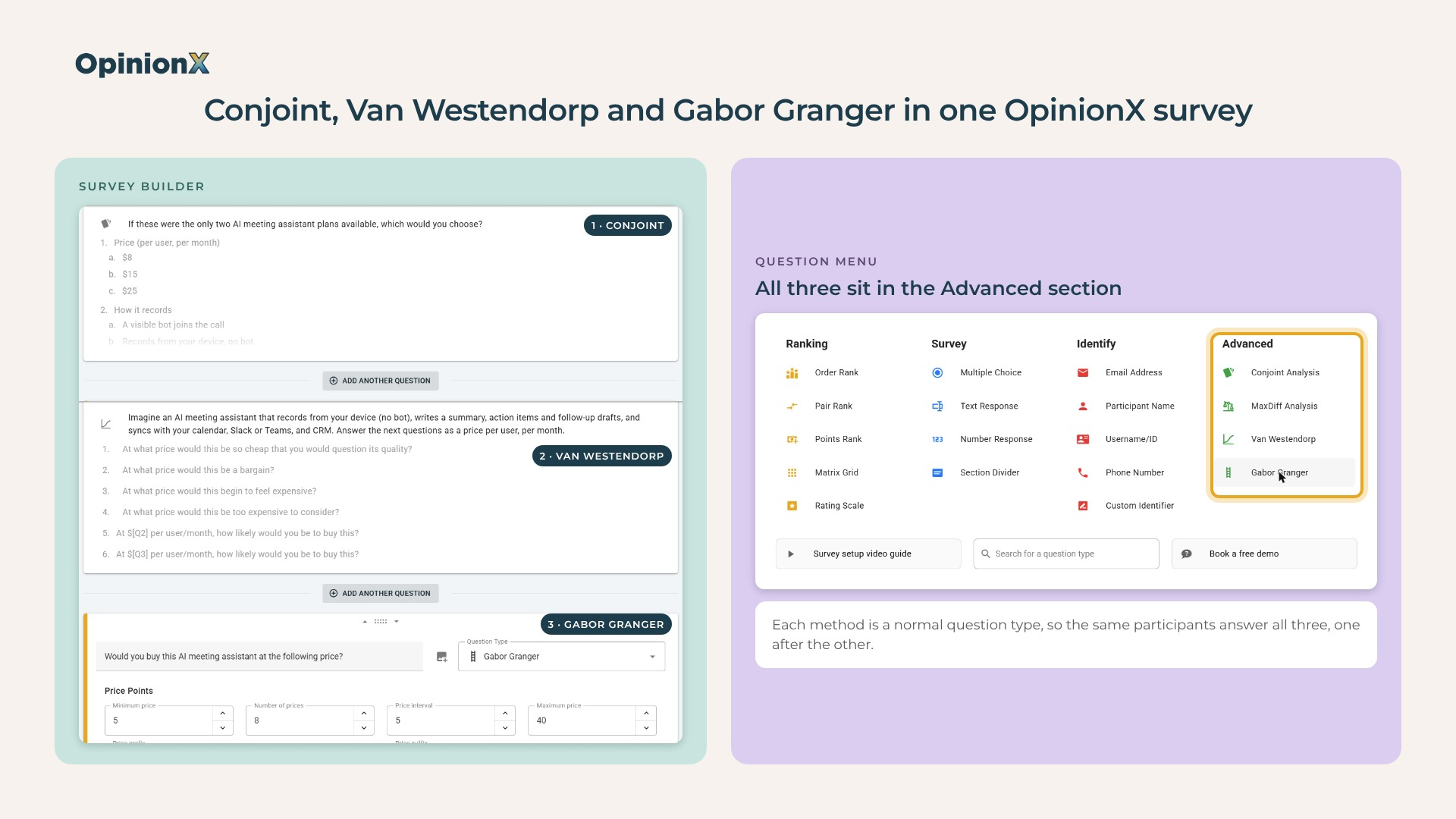
OpinionX also lets you put pricing studies into surveys alongside question types like conjoint and MaxDiff analysis, so that you can tackle multiple objectives in one project and keep everything together as one dataset for deeper analysis. For example, a pricing study for a phone plan might go like this:
A conjoint question measures how much each feature is worth.
The four Van Westendorp questions find the price range people accept.
Gabor Granger shows prices inside that range to find the price that earns the most revenue.
Because one participant record holds every answer, segmentation filters apply to every method at once. Ask "what do enterprise customers accept?" and one filter will show you feature importance from conjoint scores, their acceptable price range from Van Westendorp, and the revenue-maximizing price point from Gabor Granger – all automatically. Our guide to running Van Westendorp and Gabor Granger in one survey explains how to set a survey like this up.
How do segmentation and customer data compare?
Segmentation means splitting your results into customer groups, such as groups by company size or by job role, to see whether each group wants something different. Alchemer and OpinionX both let you look at results for one group. They differ on which methods that works for, and on where the group data comes from.
Alchemer includes crosstab reports on its Full Access tier, and the crosstab shows each group's answers next to each other. Its help documentation lists the question types the crosstab supports, such as radio buttons, checkboxes, dropdowns, rating questions and NPS (Net Promoter Score), but neither conjoint analysis nor MaxDiff are on that list. With Alchemer's minimum of 334 responses per group for conjoint analysis, splitting a conjoint study into three groups means planning for more than 1,000 responses.
OpinionX's segmentation applies to every method in the survey at once, without limits or restrictions. There are four main ways you can segment your results on OpinionX:
Filter By Segment recalculates every result or chart in your survey for one group in just one click, alongside a detailed popup menu you can alternatively use to create more advanced filters using AND/OR logic.
Compare Tab shows the full survey results for two groups side by side.
Segments Tab shows up to 30 groups in one colour-coded crosstab heatmap, helping you spot outlier opinions quickly.
Cluster Tab uses k-means clustering analysis to group participants who voted in similar ways, helping you discover customer segments that you may not have even been aware of.
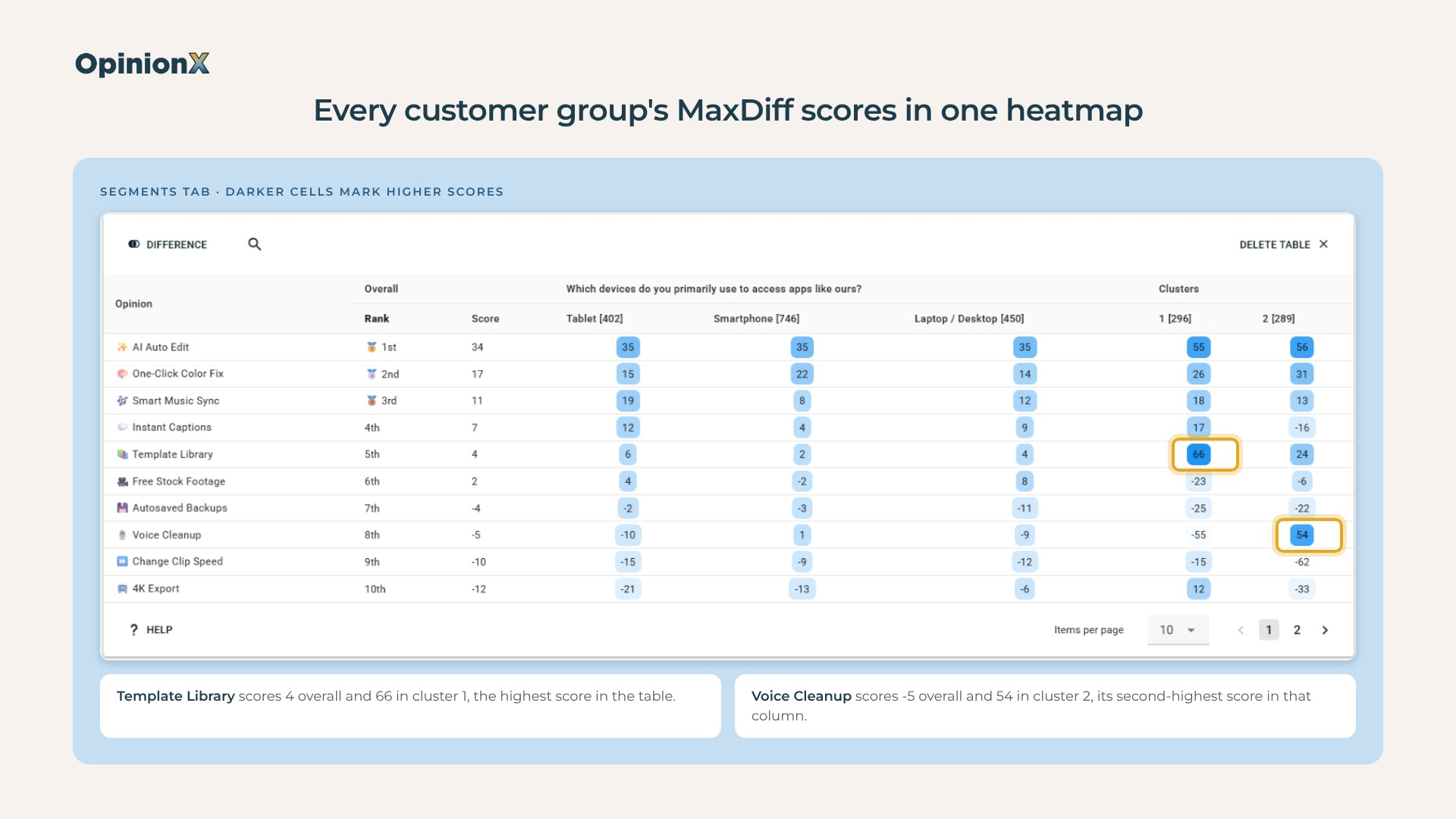
Segments on OpinionX can come from survey answers or from customer data you already hold that you’ve passed through OpinionX’s enrichment functionality. Hidden fields lets you pass data such as a pricing plan or region into OpinionX through the survey’s participation link, or import a file into OpinionX directly to create unique invite links for every participant. Enriching like this with your existing data keeps surveys shorter for participants, because every question about the participant that you don't ask is one less reason for a participant to quit before the conjoint questions. Needs-based segmentation uses exactly this approach to compare what each customer group cares about.
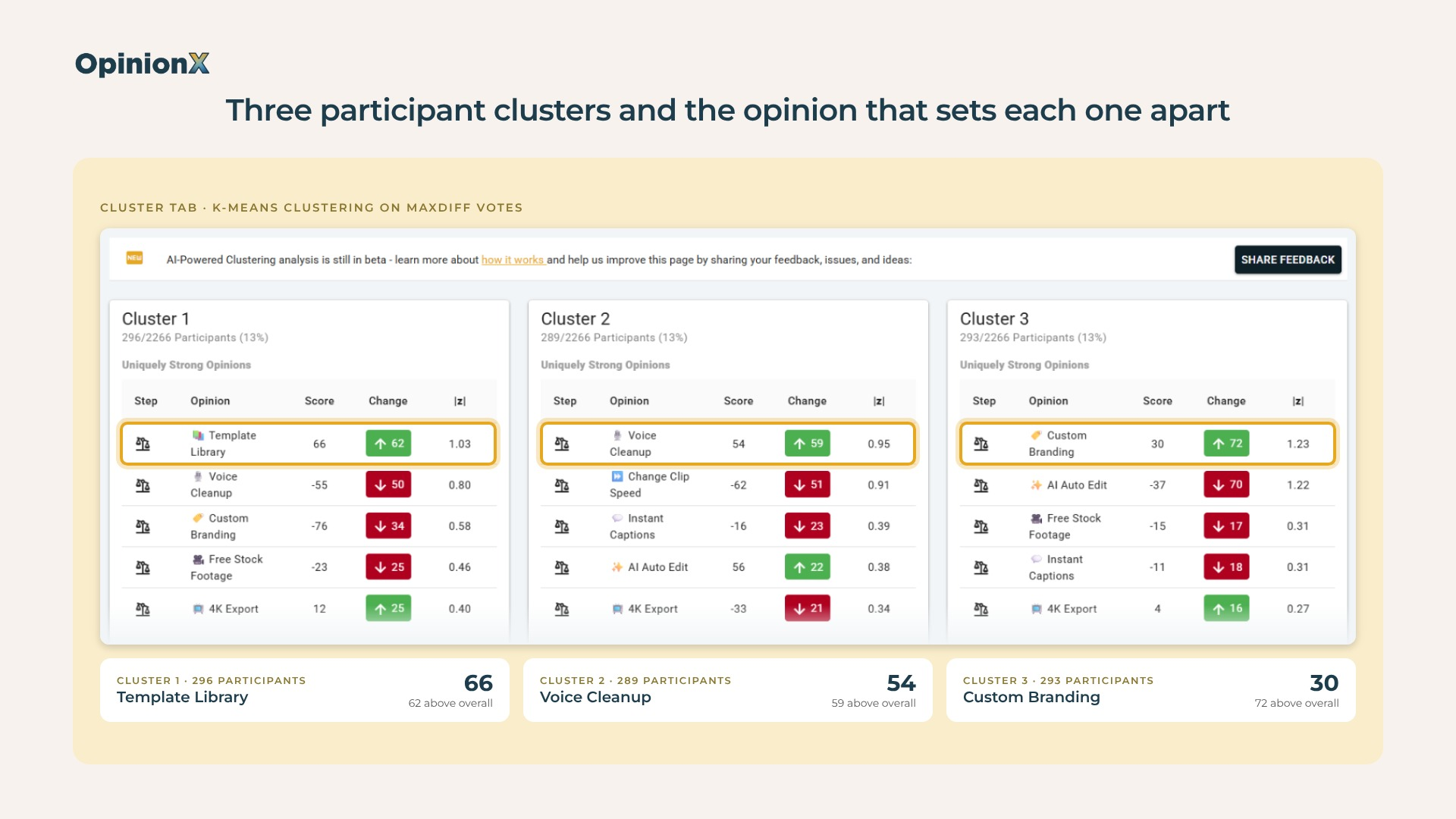
Do you want to see segment filters and clusters on an actual study? Book a personal demo of OpinionX where we can show you a real results dashboard, including features like willingness to pay, crosstab heatmaps, and survey setup.
Do OpinionX and Alchemer charge per seat or price team workspaces differently?
Alchemer’s Full Access plan, where its Conjoint Analysis and MaxDiff Analysis plans live, charges $1895 per user per year, up to a max of 3 researchers which would cost $5685 per year. Alchemer's pricing changes at the fourth researcher, because Full Access allows at most 3 users. Alchemer's pricing FAQ says a larger team has to move to a Business Platform account, which Alchemer prices by quote.
OpinionX includes all research methods in its free plan, and all workspaces are team plans by default with unlimited researcher seats for creating unlimited surveys. Even on the premium Analyze plan, three researchers would pay $900 per year in total, which would remain $900 even if they invited 100 other research colleagues to join and use their workspace too.
PicPay, a Brazilian bank, is a good example of the benefits of OpinionX’s unlimited seats model for a large team. In their first year on OpinionX, over 100 researchers at PicPay filled seats on OpinionX, and ran a combined 350 surveys with 350,000+ participants across PicPay's product and design teams (and its research team), all from one workspace. On a plan like Alchemer’s Full Access tier with its 3-user cap, most of those researchers would've needed an alternative tool or someone else to run their survey for them.
What do the free plans include? 🆓
Alchemer
Alchemer does offer a 7-day free trial of its Professional tier, but methods like Conjoint Analysis and MaxDiff Analysis aren’t included in that trial because they are only available on the Full Access tier.
OpinionX
OpinionX's free plan includes every method and allows for unlimited surveys each with up to 25 participants maximum. Once you hit 25 participants, your survey will continue collecting data, but no additional participants will be shown to you on your results dashboard.
OpinionX’s free tier includes the same advanced versions of Conjoint, MaxDiff, Van Westendorp, Gabor Granger and every analysis feature, such as segmentation and cluster analysis.
Every account gets unlimited surveys and unlimited researcher seats. You can export results as Excel or CSV files, and a live Google Sheets export updates a sheet as answers come in.
You get a free setup call to check your study design before launch. The free plan has no time limit, so it doesn't expire after 7 days.
Upgrading to OpinionX’s Analyze tier for $900 per year unlocks unlimited participants per survey, the ability to remove OpinionX branding from inside surveys, and 90 minutes of prepaid research consulting. OpinionX’s enterprise plan is called the Accelerate and adds on private team folders, advanced security (SAML SSO, MFA, compliance reviews), custom contracts and payment terms, and deeper whitelabelling functionality including custom domains for surveys.
How do Alchemer and OpinionX compare feature by feature?
The table compares the two tools on the points that decide a purchase. In the table, 🟢 means the tool covers it and 🔴 means it doesn't. A 🟡 means the tool covers it with a limit. We checked every Alchemer detail on Alchemer's own website and every OpinionX detail on our pricing page, on 19 November 2026.
| What you need | Alchemer | OpinionX |
|---|---|---|
| Entry plan with Conjoint and MaxDiff | 🟡 Full Access costs $1,895 per user per year up to a limit of three seats. | 🟢 Free plan up to 25 participants per survey, Analyze tier for unlimited participants at $900 per year. |
| Free trial before buying? | 🔴 No, Full Access tier is pay upfront or talk to sales. | 🟢 All question types and analysis methods for free. |
| Seat limit | 🔴 Full Access allows 3 users max before enterprise pricing. | 🟢 Every plan has unlimited researcher seats, including the free tier. |
| Cost for three researchers | 🟡 Three researchers pay $5,685 per year. | 🟢 Three researchers pay $900 per year. 30 researchers pay $900 total too. |
| Conjoint scoring | 🟡 It uses Hierarchical Bayes (ChoiceModelR), but relative importance can change when the report refreshes due to sampling approach. | 🟢 It uses Hierarchical Bayes (HB-MNL). |
| Market simulator | 🔴 Manual setup in an Excel spreadsheet template, not available inside the product. | 🟢 Automated results chart, with market share, revenue prediction, and churn report included, plus a MaxDiff simulator too |
| Marginal Willingness to pay | 🔴 Alchemer has no marginal willingness to pay report. | 🟢 The results for Conjoint Analysis include a marginal willingness to pay report. |
| MaxDiff Analysis | 🟢 Available on the Full Access tier. | 🟢 Available on all plans, including the free tier. |
| Van Westendorp | 🔴 No purpose-built question type offered. | 🟢 Yes, including the Newton-Miller-Smith extension. |
| Gabor Granger | 🔴 No purpose-built question type offered. | 🟢 Yes, OpinionX has an automated Gabor Granger template and purpose-built question type. |
| Segmenting by answers and customer data | 🔴 No filtering, comparison, or crosstabs available for Conjoint or MaxDiff. | 🟢 Yes, segment every question type using filters, side-by-side comparison, or crosstab tables. |
| Cluster analysis | 🔴 Alchemer’s documentation doesn’t state anything about offering clustering analysis. | 🟢 Every OpinionX plan includes k-means clustering analysis. |
| Panels | 🟢 Alchemer sells access to a survey panel (people who take surveys for pay) that reaches 100 million+ people in 100+ countries, and it prices this by quote. | 🟡 OpinionX connects to Prolific (300,000+ participants that Prolific screens) and has setup guides for platforms like Cint, Respondent.io, and more. |
| AI features | 🟡 Enterprise plans include text analysis and AI-powered insights. | 🟡 OpinionX offers machine-learning clustering analysis, but not generative AI features (as of November 2026). |
| SOC 2 or ISO 27001 security check | 🟢 Alchemer has an ISO 27001 certificate and a SOC 2 Type 2 examination from January 2022. | 🔴 OpinionX doesn't currently hold either yet. Its security documentation is publicly available for review. |
| HIPAA | 🟢 You can build surveys on Alchemer that comply with HIPAA and FERPA (FERPA covers US student records) when you turn on the right settings. | 🔴 OpinionX doesn't offer HIPAA-ready surveys currently. |
| Connections to other business tools | 🟢 Alchemer connects to 400+ business systems. | 🟡 OpinionX connects through a live Google Sheets export, hidden fields, Prolific and Cint. |
When is OpinionX a better choice than Alchemer?
Pick OpinionX if:
You are a research team that will benefit from unlimited seats, folders, collaboration features, survey access roles, and more, compared to Alchemer’s 3-researcher limit for Full Access.
You need Van Westendorp or Gabor Granger, which OpinionX offers as purpose-built question types and Alchemer doesn't offer.
Your team wants automated interactive reports for market simulators and marginal willingness to pay inside your results, without relying on manual Excel templates.
You want several advanced methods in one survey, so the same participants answer every method and one customer group filter applies to all of them.
You would benefit from an accessible, familiar user interface for running more advanced research methods.
You want access to research experts who can help you through survey design, distribution, and analysis, as OpinionX’s premium plans come with prepaid research consulting time.
Your team wants to try out advanced survey methods for free before paying, which OpinionX offers but Alchemer doesn't allow.
Frequently asked questions
Does Alchemer have Van Westendorp or Gabor Granger? No. Alchemer doesn't offer a Van Westendorp or Gabor Granger question type on any plan, so teams build those pricing surveys by hand from separate questions and analyse them in a spreadsheet. OpinionX includes both methods on every plan, and it analyses the answers for you.
How many users can Alchemer Full Access have? Alchemer Full Access allows up to 3 users, and Alchemer charges each one $1,895 per year. OpinionX includes unlimited researcher seats on every plan, including the free one.
Is there a free Alchemer alternative with conjoint? Yes. OpinionX is a great free alternative to Alchemer for conjoint and MaxDiff surveys. The free plan includes all survey methods for free for up to 25 participants per survey, with no time limit. Alchemer’s Full Access tier has no free trial option, the 7-day free trial Alchemer offers for its ‘Professional’ tier does not include conjoint or MaxDiff analysis surveys.
Are you comparing more than two tools? Our review of conjoint analysis software compares 10 platforms on functionality, price, and unique features. Our QuestionPro comparison covers another research platform that sells conjoint surveys on a per seat basis. If you need MaxDiff on its own, the MaxDiff analysis tools review covers 9 survey platforms. For pricing research, start with the Van Westendorp survey tools review, which compares 6 platforms. Our guide to conjoint analysis explains how to run your first study.
Ready to get started with your own advanced market research surveys. Create a free OpinionX account and set up your first conjoint or maxdiff survey in under 5 minutes.