
“Written in February 2021, this piece named seven UX research trends reshaping the field: mixed methods, new specialist roles, integrated surveys, social research, co-creation at scale, owned research panels, and discovery research. It’s kept as published, as a record of what the field looked like at the start of the decade.”
Most lists of UX research trends will tell you about the move to remote research. This is not one of those.
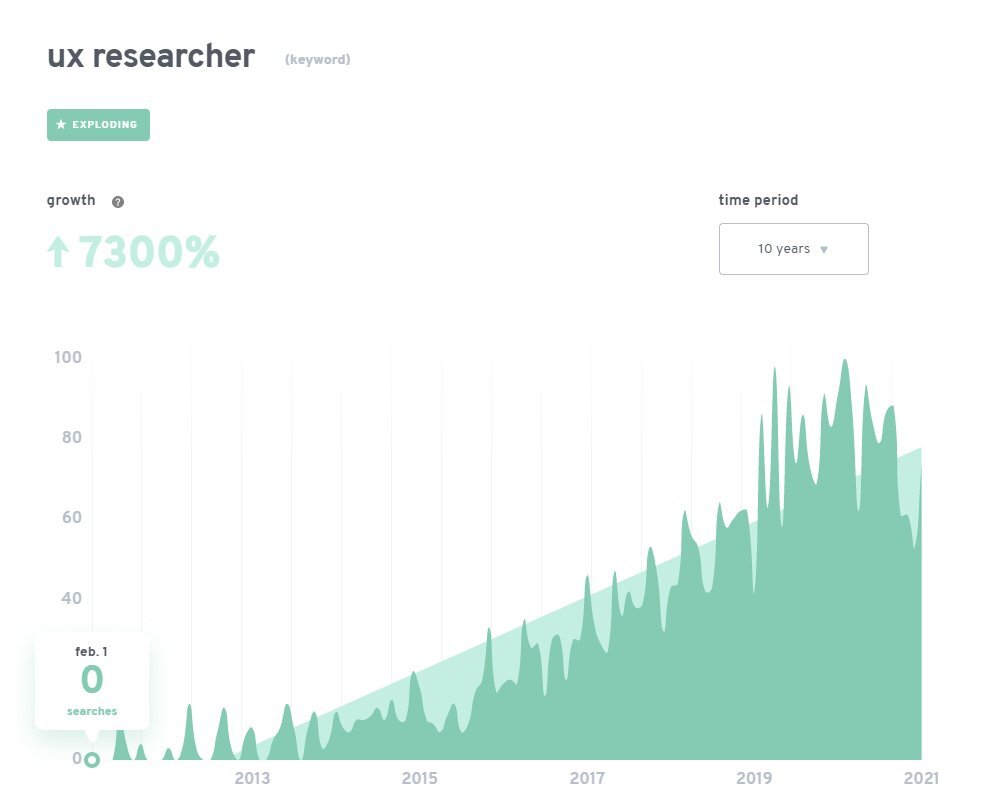
UX research is itself a large trend. Searches for the term grew enormously across the 2010s, and most posts on the subject fail to look past the surface at how the practice is actually changing. As the field grows, the industry keeps segmenting into new specialisms and areas of interest.
This post covers seven of the less obvious UX research trends reshaping the field.
1. Mixed methods research
Mixed methods is user research that blends qualitative and quantitative data inside a single project. It lets researchers answer the big why questions alongside what, who, where and how. The output is a fuller and more credible picture of user behaviour.
Product leaders are no longer interested in hearing a researcher say "that's not my speciality". They want people with both a qualitative and a quantitative toolkit who can take on any research problem.

Many UX researchers already work this way. What's changing is that the demand is turning mixed methods into its own field of expertise, which makes it the biggest of these UX research trends.
For a sense of the scale: in early 2021 there were more jobs open for mixed methods research than there were people with mixed methods in their LinkedIn titles. Companies listing openings for mixed methods user researchers at the time included Facebook, Instagram, Microsoft, Amazon, Twitter, Square, Cash App, Crunchbase, Upwork, Duolingo, Verizon, Etsy, Calendly, Tableau, eBay, Ford, Asana and Salesforce.

Further reading: what is mixed methods research, how to do mixed methods research without being a quant expert, and why mixed methods is the most important research skillset of the 2020s.
2. New UX roles and specialisms
Two of these UX research trends are one trend in two parts. The number of UX jobs has grown steadily and is forecast to keep growing, which is driving the emergence of new specialisms and titles.

Research operations
UX research is demanding. It usually means collaborating across several departments while juggling multiple projects at once. Between recruiting participants, screening them, handling incentives and scheduling, researchers give up a substantial share of their time to operations alone.
Companies are recognising that work and creating independent ResearchOps positions to take it off researchers' hands. Once a team reaches around eight researchers, a dedicated research operations function starts to become necessary, and plenty of companies are on their way to that threshold.
Ambitious junior researchers often jump at these roles, because they give first-hand exposure to every part of the research process. ResearchOps takes the lead on building processes that scale, so research works consistently across the whole organisation. The role is new and worth watching.

Full-stack researcher
Full-stack researchers are experienced across every stage of the research process. They run mixed methods projects comfortably, combining qualitative and quantitative work into single studies to produce more reliable findings, and they use that dataset to carry the voice of the user across sales, marketing, product and engineering.
An experienced full-stack researcher might spend a morning interviewing app users to understand their motivations and unmet needs, then spend the afternoon designing a survey based on those interviews and on in-app behavioural data, to see whether the findings hold at scale.
The role goes further than that. With ResearchOps giving them their operations time back, full-stack researchers focus on upskilling the rest of the company on research and engagement practice. They turn research into a continuous function instead of something confined to project timelines, working proactively to find unmet needs and becoming the internal consultant everyone goes to for advice.
We believe in this enough that we named our newsletter after it.

3. Integrated surveys
The third of these UX research trends is a change in where surveys live. They're increasingly embedded in websites and apps instead of sent by email.
The response rates aren't close. Email surveys typically return single-digit response rates, where micro-surveys embedded inside a product or website return several times that. An integrated survey is far less hassle for the participant: people expect an email survey to take a while and to come with an incentive like a voucher or cash, and the same rules don't apply to a two-question prompt inside the product.
Integrated surveys also support continuous research. Instead of a project running over days or weeks, studies are designed to monitor behaviour, perceptions and opinions over a much longer period. That longitudinal data is useful for measuring how new product work affects user experience, such as whether a new feature increased satisfaction.
There's a second advantage. An integrated survey can ask the question while someone is using the product, instead of relying on them to recall a past experience, which improves the quality and reliability of what you get back.
4. Social research
User researchers worry about bias constantly, and they should. Left unchecked, bias can wreck a study.
That fear has pushed the field towards sterilising its methods, separating participants from each other and handing responsibility for objectivity entirely to the researcher. Looking back, research was never meant to be this isolating. The profession is rooted in interaction, community and collaboration. Some of my own favourite moments have come from focus groups where participants built on each other's experiences towards a shared insight.
This decade will see a return to social research, with community-oriented tools surfacing findings through collaboration, an idea with a long lineage in participatory design. Participants will increasingly set the agenda, instead of researchers restricting the scope of engagement.
Bias is a risk across all research, however much control the researcher keeps. Giving up even a small amount of that control is often rewarded with findings you wouldn't otherwise get. Users working together are better placed to articulate something intuitive about their collective experience than any of them would be alone.
Social research used to be an enormous undertaking, needing days or weeks to analyse unstructured forums and community discussions. Newer tools make it possible to let people generate ideas together without that analysis burden or participant fatigue. It's also more enjoyable for everyone involved.
Social + 🍔 = 🤩
— D’Arcy Coolican (@DCoolican) December 7, 2020
Social + 💵 = 🤩
Social + 💪🏽 = 🤩
Social + 🎶 = 🤩
Social + 🎮 = 🤩
Social + 🛍 = 🤩
Social + 🏘 = 🤩
Social + __ = 🤩
The best product in a category is one with real community & social interaction
I call them social+ products
More👇https://t.co/eLIWtoozYV
5. Co-creation 2.0
Co-creation has been a buzzword for a long time. It means developing products collaboratively with customers, and many people consider it one of the better routes to innovation.
Traditional co-creation doesn't scale. It usually means taking a handful of customers and workshopping ideas with them, engaging with their concerns and perceptions directly. That format misses the best ideas because it never includes enough participants. Price's Law holds that a small minority of people generate half the value in any community. The smaller your sample, the less likely you are to catch the genuinely creative contributions.
Online research platforms are starting to unlock co-creation at scale, which lets researchers move past transactional methods and use their community's collective intelligence properly.

6. Owned panels and community
Recruitment is one of the most expensive parts of research. Paying incentives on every project turns into a substantial budget line quickly.
To avoid that, many companies are getting closer to their users and building genuine communities. They engage users in dialogue, offer something worth having on an ongoing basis, and share their members' interests. Users become far more willing to help with research when they feel part of something.
OneFootball is one of my favourite examples. They built one of the most popular media platforms for this generation of football fans, with a fully personalised home stream for your club and live matches in-app on a pay-per-view basis. Marco, their senior user researcher, told us their users are keen to give feedback because of the continual engagement they feel with the company. The result is that OneFootball doesn't need to pay research participants at all.

7. Discovery research
Long treated as a luxury, discovery research has become a priority.
Difficult periods create openings. The COVID-19 pandemic caused the most dramatic global change in human behaviour in decades. It shook up the landscape and made room for new companies to thrive, and it introduced a serious threat to anyone slow to adapt.
Behind the pandemic sits a longer shift towards a new-power mindset. Consumers are redefining themselves as citizens capable of forcing change in private markets as much as in public systems, and brands face scrutiny from media and public on every decision.
Long-standing institutions are being rocked overnight by outsiders, decentralisation keeps spreading from the growth of cryptocurrencies, and new products are released and adopted at a speed that is genuinely startling.
Keeping on top of that needs a proactive mindset. Discovery research is how companies stay close to those shifts and design features and marketing with their users' values in mind. Product-led growth is putting end users at the centre of company strategy, and the organisations that understand user needs are the ones that will navigate what comes.
Of all the UX research trends here, this is the one with the most immediate commercial consequence. Discovery research is no longer a nice-to-have. In our own conversations with over 100 product and UX teams during 2020, scaling companies reported spending the majority of their research resources on discovery. Companies claiming they have no time for generative research are in survival mode.

Frequently asked questions
Which UX research trends from 2021 held up?
Mixed methods was the clearest hit. The prediction that it would become its own field of expertise, instead of a technique some researchers happened to use, held up: the job titles now exist in volume where in 2021 they barely did. ResearchOps also established itself as a standard function at scale. The social research and co-creation predictions moved more slowly than this piece expected.
What is mixed methods research?
User research that combines qualitative and quantitative data within one project, so you can answer why something is happening as well as what, who and how many. It's the skillset behind most of the roles described in this piece.
What does a ResearchOps role do?
It takes the operational load off researchers: recruiting and screening participants, handling incentives, scheduling, and building repeatable processes. Teams typically start needing a dedicated function at around eight researchers.
What is a full-stack researcher?
A researcher practised across every stage of the process, comfortable running qualitative and quantitative work inside a single study, and acting as the internal consultant carrying user understanding into product, engineering, sales and marketing.
Why do embedded surveys get better response rates than email?
Because they cost the participant almost nothing. An email survey is a separate task people expect to be long and incentivised. A two-question prompt inside a product they're already using is answered in the flow of what they were doing, and it captures the experience while it's happening instead of relying on recall.
What is discovery research?
Generative research aimed at finding unmet needs before you decide what to build, as opposed to evaluative research that tests something you've already made. It's what keeps a roadmap connected to what users actually want.
Over 42,000 researchers and product people get one breakdown like this each week in The Full-Stack Researcher.
OpinionX helps research teams rank customer problems and see which ones matter most to which segments. Every question type and every analysis feature is unlocked on the free tier, capped at 25 participants per survey.