
Why you should never use traditional surveys for idea validation
“Traditional surveys are cheap, familiar and wrong for validating a product idea. They can’t tell you which problem matters most, they lock in whatever blind spots you had when you wrote the questions, and they can’t change once the first responses land. Here’s what goes wrong with each, and what to use instead.”
One of the best ways to guarantee product failure is using a traditional survey tool like SurveyMonkey, Typeform or Google Forms to validate your product idea.
They're cheap, easy to use and widely known. They also send product builders the wrong way time and time again, for three reasons.
Traditional surveys can't tell you which problems matter most
People are bad at knowing what they need.
The best product builders know this and never use feature requests to inform product decisions. They understand that feature requests are just problems wrapped up as answers by customers, which is why problem brainstorming starts from the pain, not the ask. Dig into the request to find the problem underneath and you're far more likely to build something that fixes it for everyone, not just the person who asked.
Identifying and solving the biggest problem for the largest group of customers is the heart of product management. Working out which problems are the most important is much harder than it sounds.
A multiple choice question asking people to tick the problems they have won't get you there. You need the relative importance of each problem, which means comparing them against each other.
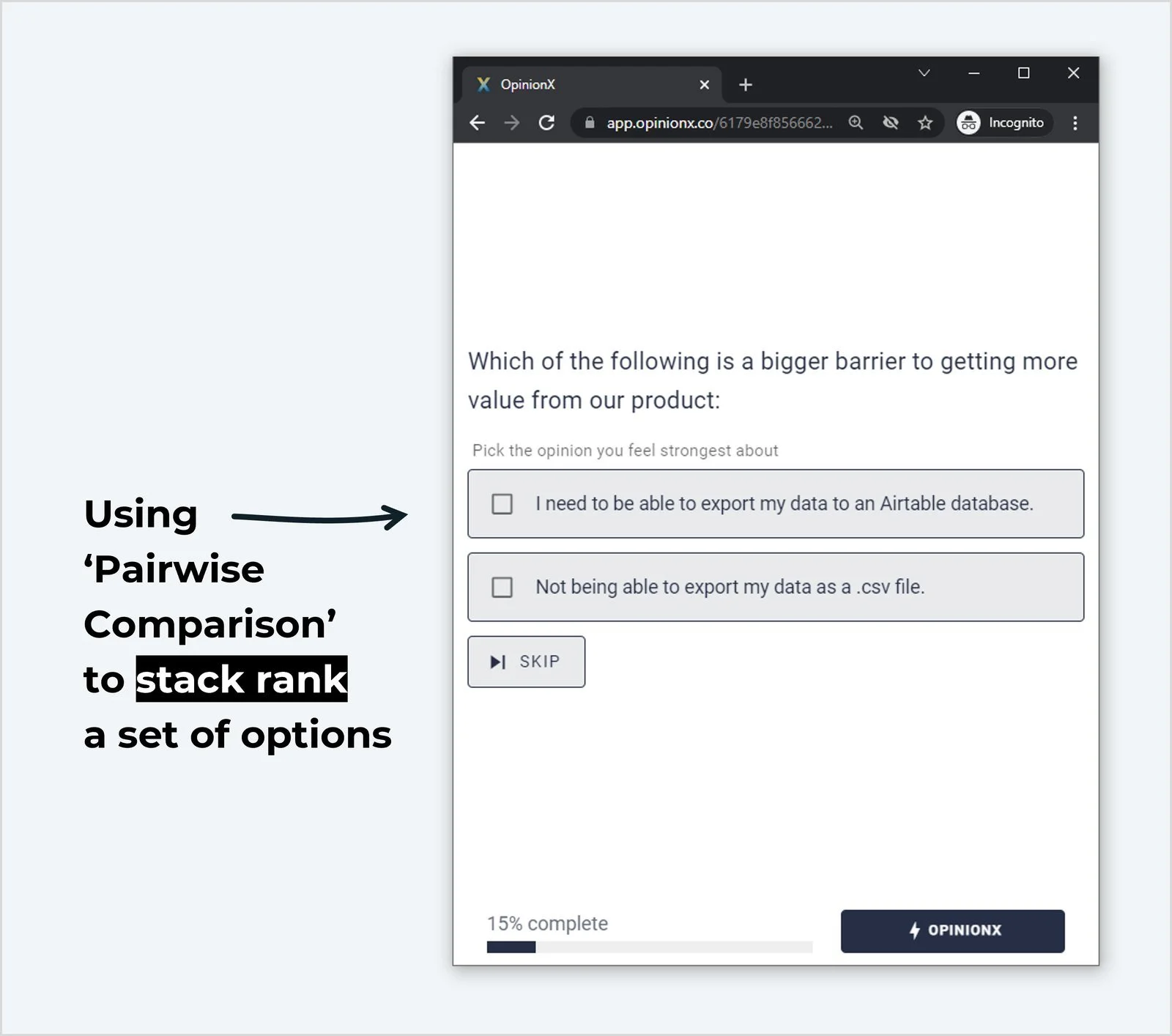
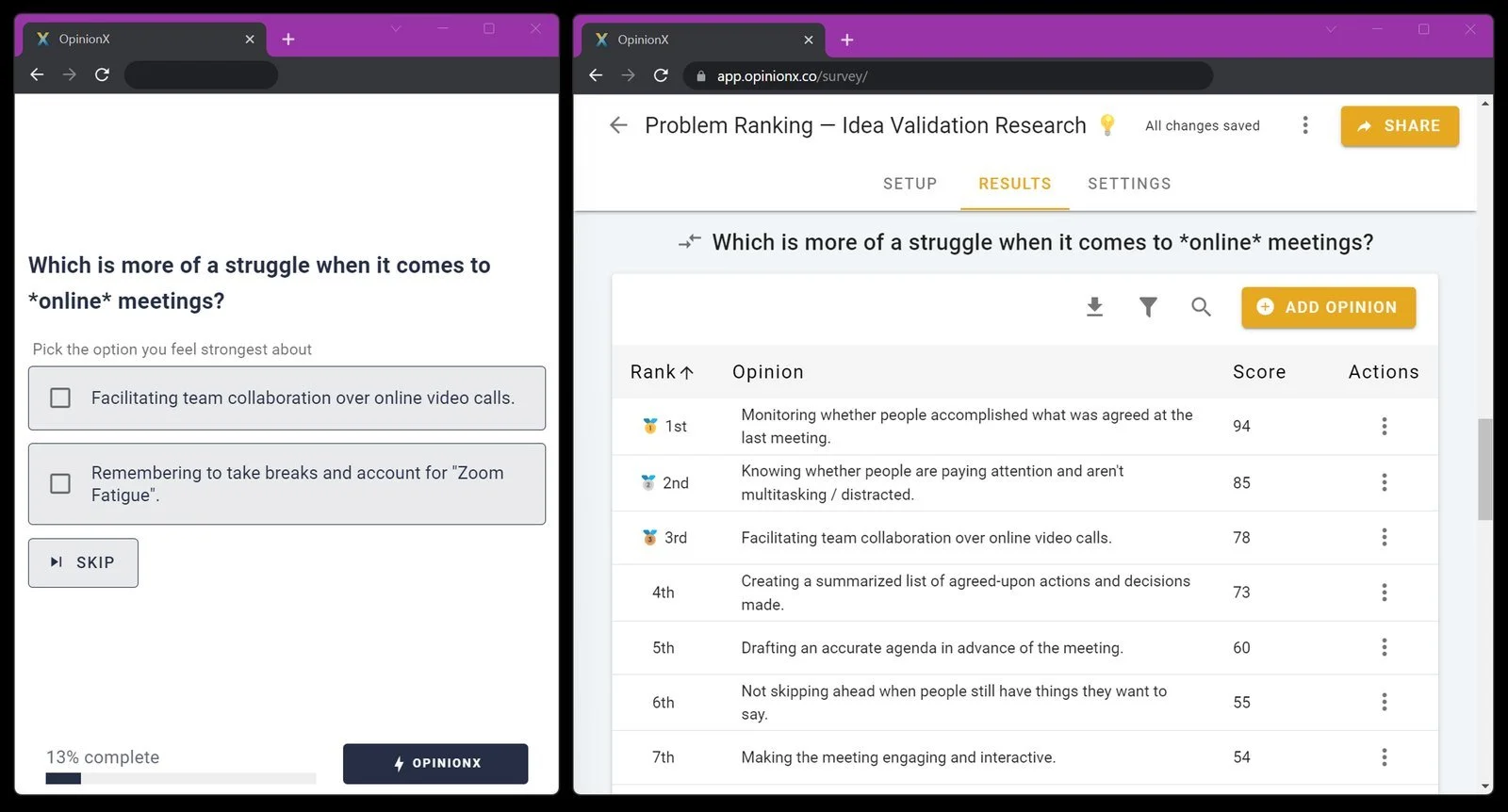
That's the difference between a burning problem and a mild inconvenience, and it's exactly what comparison-based voting is built for. Instead of ticking boxes, participants stack rank every candidate problem by importance, so you know which pain to go after.
Traditional surveys lock you in with your blind spots
Quantifiable data is key to good decision-making. When you're building something new, you have blind spots in what you know and biases in what you think you know. Research exists to fill those gaps, and assumption mapping is how most teams accidentally seal them shut instead.
With a traditional survey, filling them usually means an open-ended question gathering written responses. For decision-making, that misleads you fast: instead of finding the most impactful problem your users face, you end up chasing the most common answer submitted.
Frequency and importance aren't the same, and an open-text box only measures the first.
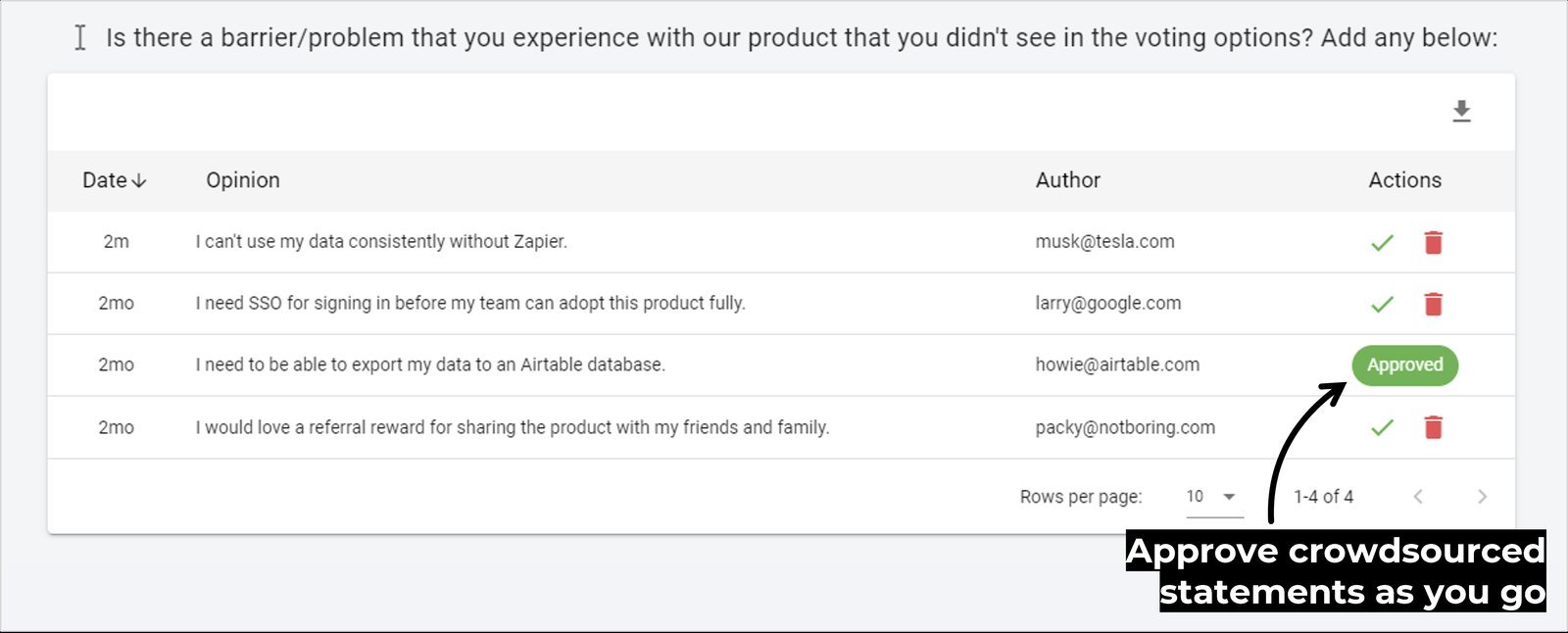
The fix is a survey participants can add to. When people submit new problem statements mid-survey, they fill the gaps you missed when you wrote the list. On OpinionX, the large majority of stack ranks finish with at least one participant-submitted opinion in the top 3 most important problems.
Read that again. The problem that mattered most was usually one nobody on the team had thought to include.
Traditional surveys can't adapt once you learn something
Building a product is an iterative process. Run an experiment, learn from the result, update the hypothesis. The faster you close that loop, the better your odds.
Anyone who has used traditional surveys for product development knows the frustration of reading the first batch of responses and realising the hypothesis is wrong, or that the survey is missing a key topic. With a traditional survey there's nothing you can do except start again.
Participants aren't the only ones who can add options mid-survey. You can too, which makes the survey dynamic: as the data comes in, you test emerging hypotheses inside the same survey instead of running three of them.
What to use instead
| Traditional survey | What you actually need |
|---|---|
| Tick the problems you have | Rank the problems against each other |
| Fixed list written before you learned anything | A list participants can add to |
| Open text, measuring how often something is said | Comparison voting, measuring how much it matters |
| Start again when the hypothesis changes | Add options mid-survey |
Customer Problem Stack Ranking is the version of this pointed specifically at validating an idea, and the data-driven approach to idea validation covers the wider process.
Frequently asked questions
Why are traditional surveys bad for idea validation?
Three reasons. Tick-box questions measure whether a problem exists, not how much it matters, so everything looks important. The option list is fixed at the moment you know least about the topic. And once responses arrive there's no way to test a new hypothesis without starting a fresh survey.
What's wrong with using feature requests to decide what to build?
A feature request is a problem the customer has already tried to solve for you. Build the request and you fix it for the person who asked. Find the problem underneath and you often fix it for everyone, sometimes in a way nobody requested.
Why doesn't an open-text question solve this?
Because counting answers measures frequency, not importance. The problem mentioned most often is rarely the problem that costs people the most, and open text gives you no way to tell the two apart.
What should you use instead of a traditional survey?
A comparison-based ranking method. Pairwise comparison shows two options at a time, MaxDiff shows three to six, and both force a trade-off that produces a ranked list you can act on.
Discover your users' biggest problems
Use OpinionX to stack rank your customers' biggest unmet needs, pains and desires so you can reach product-market fit faster.
Every question type and every analysis feature is unlocked on the free tier, capped at 25 participants per survey. No credit card required, and it takes less than 5 minutes to get started.