
“A product/market fit (PMF) survey asks your active users one core question: “How would you feel if you could no longer use our product?” with three answers, very disappointed, somewhat disappointed, not disappointed. If 40% or more say very disappointed, you have product/market fit. This is Sean Ellis’s 40% test. But the real value isn’t the score, it’s the segmentation: figure out what makes your “very disappointed” users love the product, and what’s stopping everyone else from getting there. This guide gives you three templates (basic, advanced and expert), the eight most common mistakes in the PMF templates floating around online, and all 104 questions transcribed from 18 real PMF survey templates so you can see what to copy and what to avoid.”
I analysed 104 questions from PMF survey templates, here's what I learned
While testing tools that run PMF surveys, I realised something surprising: a lot of the PMF survey templates on Google really aren't good, and the majority actively promote harmful advice. So I transcribed every PMF survey template I could find into one list (all 104 questions from 18 templates are at the end of this post) and set out to build a better version based on a real understanding of what the survey is for.
Here's what the analysis turned up.
A startling number of templates clearly just copied blindly from other blog posts. Most seem to have been created by people who aren't researchers and don't understand the purpose of the PMF survey. Be careful who you trust as a source of expertise.
There's no point asking users who they think would benefit from the product. That's your job to figure out, not theirs, and the survey results answer it anyway (through segmentation analysis).
It isn't useful to know whether users have recommended your product. In most cases that data just mirrors the PMF score as a secondary satisfaction metric. Instead, ask how they described your product when recommending it: the value, purpose or core differentiator they reached for.
Adding extra text to the PMF question skews your results. Changing "Not Disappointed" to "Not Disappointed (it isn't really that useful)" just adds guilt and discourages honest answers.
PMF surveys shouldn't be 12 questions long. Limit open-ended questions by using branching to ask targeted follow-ups. Don't ask "Not Disappointed" users to explain why your product is valuable to them; they don't think it is.
Cut unnecessary questions. Don't ask for things you should already know (how often they use the product), things that are unreliable to self-report (how they originally found you), or things you won't use in analysis (gender, employment status).
You don't need NPS or CSAT questions in a PMF survey. Those formats all measure general satisfaction and deliver similar results.
If you have to include an "N/A, no longer use" option in your PMF question, you're targeting the wrong people. The "Not Disappointed" option works perfectly well for churned users.
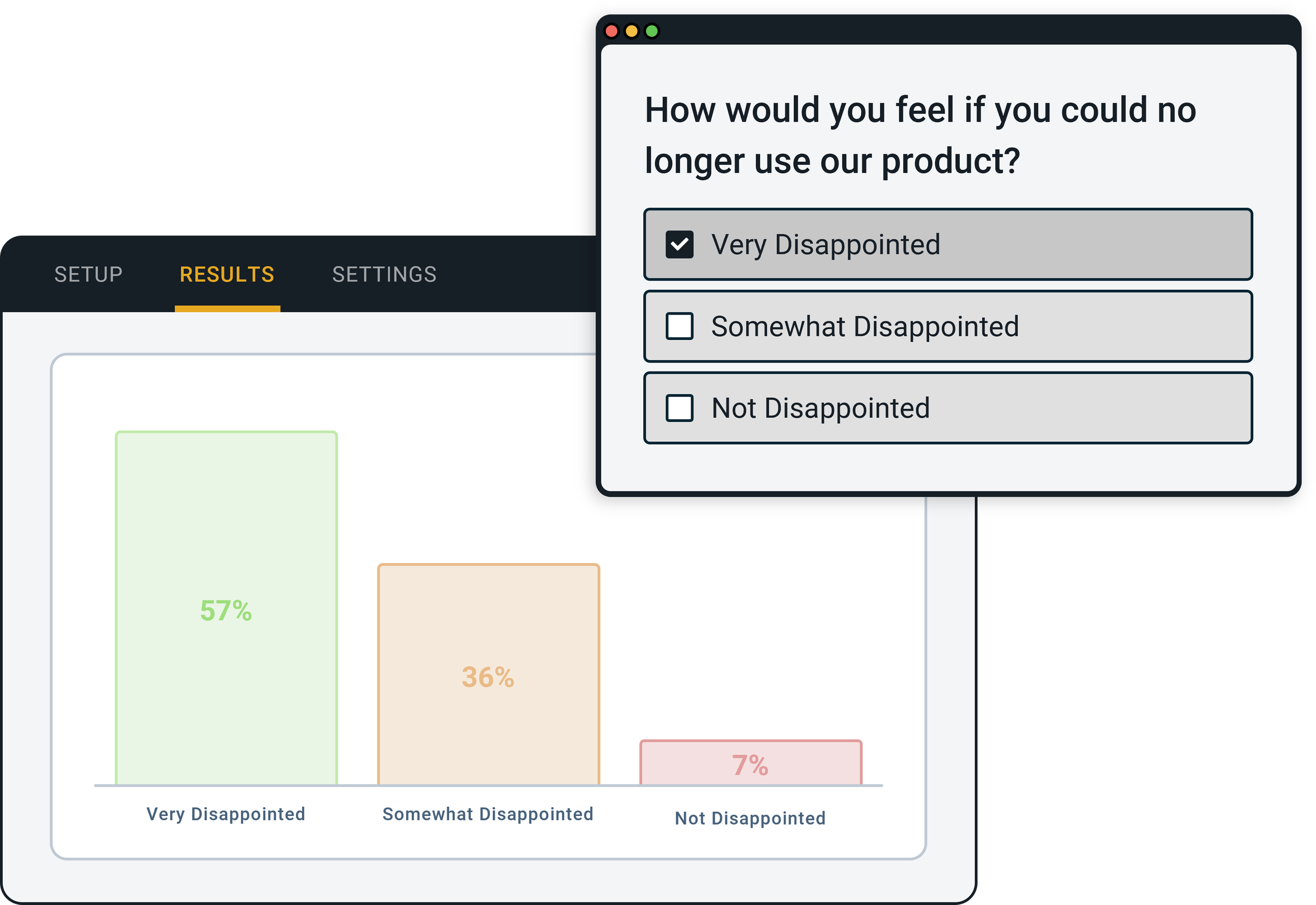
What is a PMF survey actually for?
The PMF survey started as a way to measure Sean Ellis's 40% test: ask users how they'd feel if they could no longer use your product, and if 40% or more choose "very disappointed", you've got product/market fit.
But a black-or-white reading of your current fit isn't what people actually get out of it. It works far better as a customer segmentation study: figure out what makes "very disappointed" users such big fans, and what's stopping the rest from becoming fans too.
Once you look at the PMF survey this way, a lot of the template questions are obviously bad. Asking for a user's gender, employment status and acquisition channel won't help you understand what turns new users into big fans. Let's use that clarified purpose to build a better template.
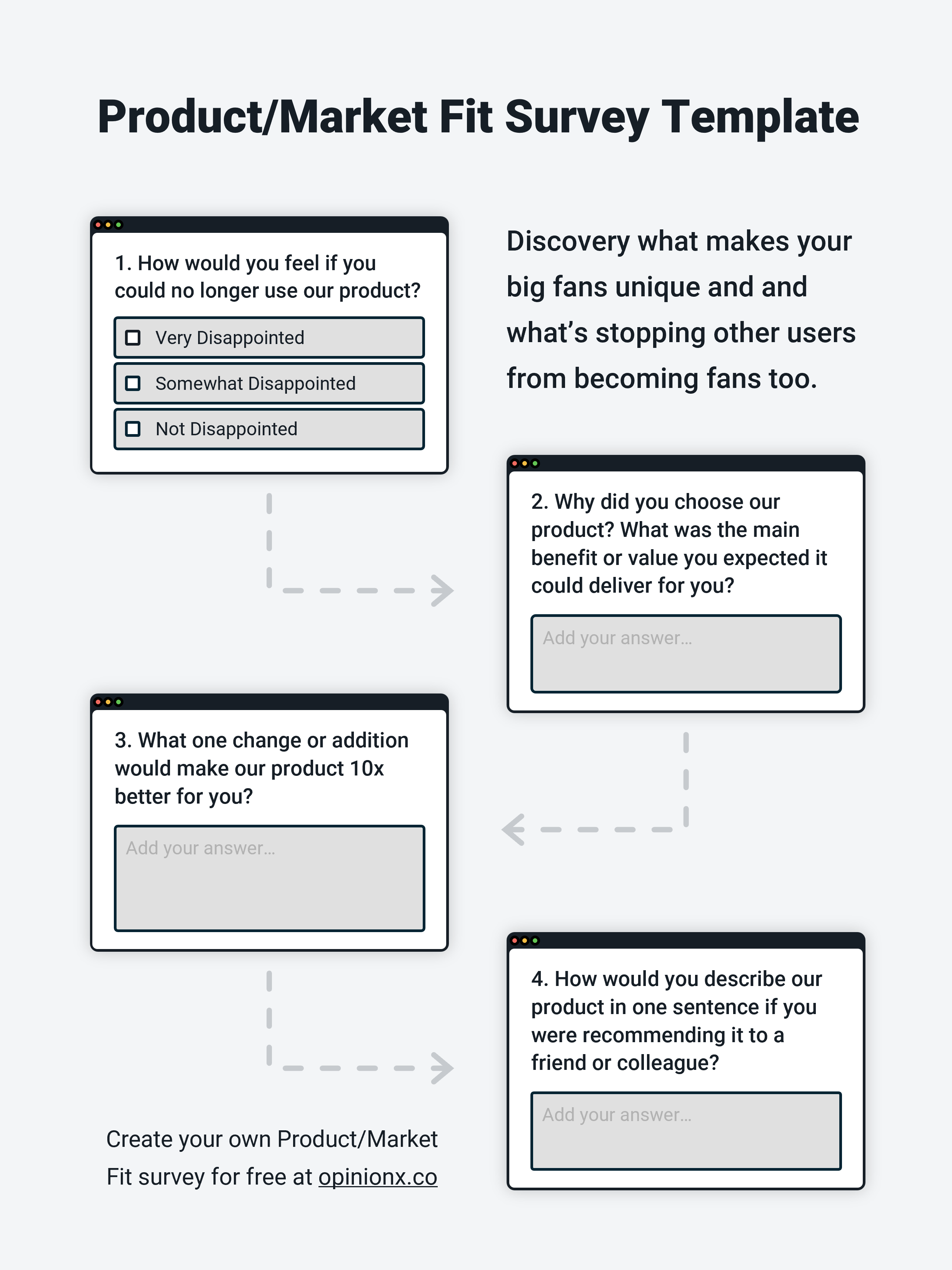
PMF survey template (basic version)
The basic version is a simple four-part poll with no branching. It's for teams on survey platforms with limited functionality, or free tools that don't offer branching logic. The first question has to be the PMF one.
1. How would you feel if you could no longer use our product?
a. Very Disappointed
b. Somewhat Disappointed
c. Not Disappointed
Your product has clicked for the "Very Disappointed" users: they understand and appreciate the value it offers. Work out what specifically drives that value for them and you can focus your messaging there, guide more users toward those features during onboarding, and align pricing with how customers perceive the value.
This question is worded in a way to elicit benefits from happy users while better understanding what unhappy users expected of the product that it failed to deliver for them.
2. Why did you choose our product? What was the main benefit or value you expected it to deliver? (Open-ended)
This is worded to draw out benefits from happy users while revealing what unhappy users expected that the product failed to deliver. Without branching, the next question has to stay relevant to all three groups, so it switches from what the product does well to what it could do better.
3. What one change or addition would make our product 10x better for you? (Open-ended)
The final question looks outward, at how users interpret the difference between your product and the alternatives competitors offer. Like question 2, this helps you tighten positioning and stand out against the competition.
4. How would you describe our product in one sentence if you were recommending it to a friend or colleague? (Open-ended)
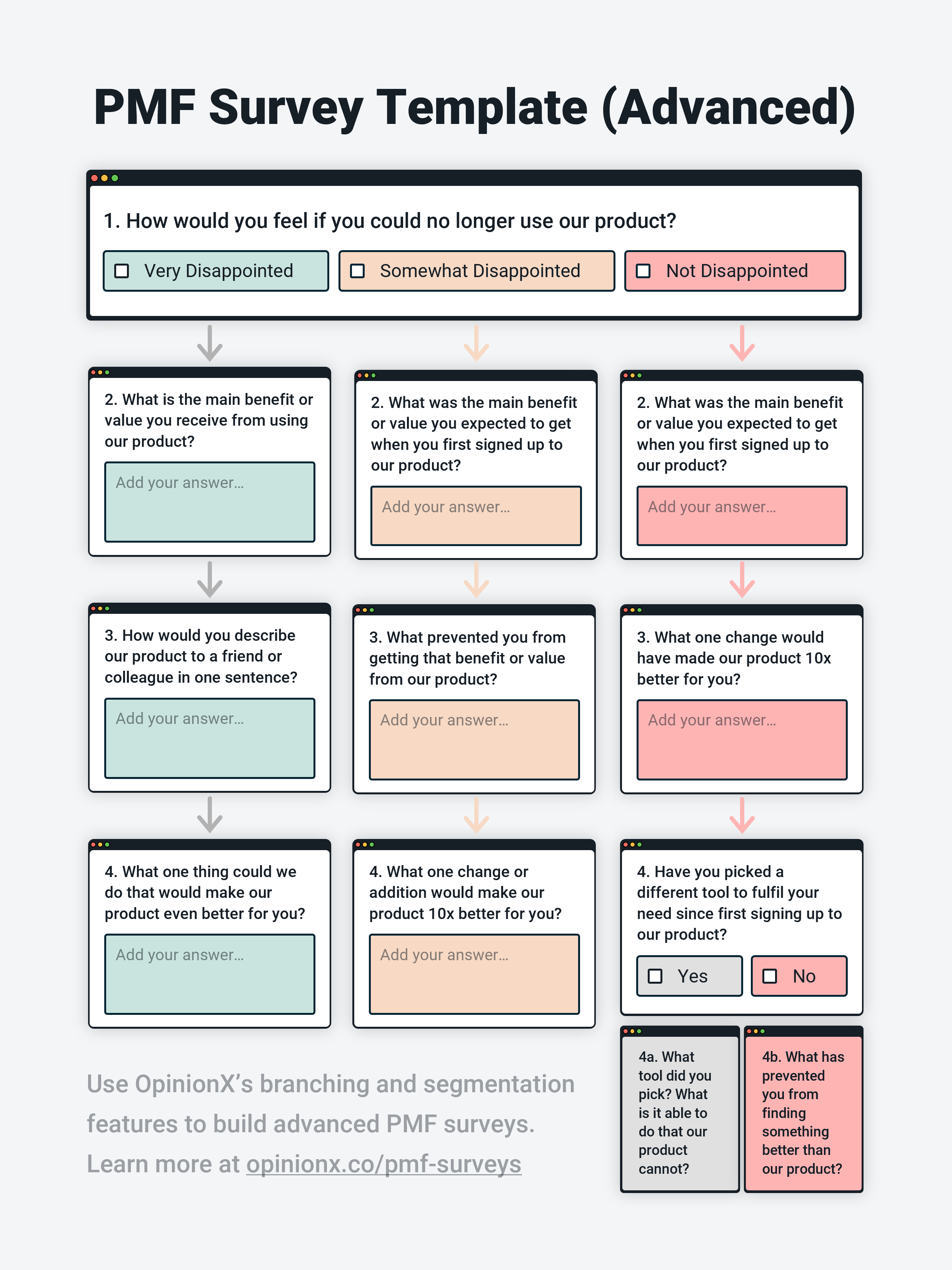
PMF survey template (advanced version)
If your tool has branching logic (see our review of the best tools for PMF surveys), tailor the three follow-up questions specifically to each of the three PMF groups. A "very disappointed" user and a "not disappointed" user should get different follow-ups, because you want different things from each. From the fans, what makes the product click. From everyone else, whatever's stopping it.
PMF survey template (expert version)
The PMF question is a quick way to filter users into three segments: activated fans, potential fans, and lost causes. When you're researching user needs, pains or preferences to inform decisions like roadmap planning, filtering your data by those three segments is where the survey earns its keep.
For example, you can run a survey that includes both the PMF question and a feature-upvoting poll, then use the PMF question to compare how each segment voted differently. You can play with that survey in the Sample Survey Gallery on OpinionX.
Some similar surveys where the PMF question is used to create segments for deeper analysis:

Measuring feature importance
Upvoting a list of feature ideas
Preference testing design concepts
Creating ideal customer personas
The shared ingredient in all these use cases is comparative ranking: a voting format that forces users to compare a set of options and pick the one they feel more strongly about. The most-used comparative ranking formats are pairwise comparison, points allocation and ranked choice voting, all available on OpinionX.

104 questions from 18 PMF survey templates
To research this guide, I tested a range of PMF survey tools, worked out the real purpose of the survey, and transcribed 18 PMF survey templates I found online. The full transcripts are below. Read them with caution, because the eight mistakes above show up constantly. Some templates have been lightly edited for readability.
Superhuman
How would you feel if you could no longer use our product? Very Disappointed, Somewhat Disappointed, Not Disappointed
What type of people do you think would most benefit from Superhuman? Open
What is the main benefit you receive from Superhuman? Open
How can we improve Superhuman for you? Open
Learning Loop
How would you feel if you could no longer use our product? Very disappointed, Somewhat disappointed, Not disappointed, N/A, I no longer use it
Please help us understand why you selected this answer. Open ended question
Have you recommended this product to anyone? No, Yes: ___
What type of person do you think would benefit most from the product? Open ended question
How can we improve the product to better meet your needs? Open ended question
How often do you use our product? Never, Once a year, A couple of times a year, Once a month, A couple of times a month, Once a week, Every day
How would you feel if you could no longer use our product? Very disappointed, Somewhat disappointed, No reaction / neutral
Have you ever recommended us to friends or family? Yes, No
What do you think sets us apart from our competitors? Open ended question
What could we improve on? E.g. Customer Support, Reliability of Service, Design, Functionality, Other
Could you tell us a bit about yourself? What’s your employment status? Open ended question
How did you discover/come across this product? Blog, Google/Search, Twitter, LinkedIn, Facebook, Word of mouth, other
What would you likely use as an alternative if this product were no longer available? I probably wouldn’t use an alternative, I would use an alternative: ___
Would it be okay if we followed up by email to request a clarification of one or more of your responses? Yes - enter email, No
Typeform
How often do you use our product? Never, Once a year, couple times a year, once/m, couple times/m, once a week, every day
How would you feel if you could no longer use our product? Very disappointed, Somewhat disappointed, No reaction/neutral
Have you ever recommended us to friends or family? Yes, No
What do you think sets us apart from our competitors? Open
What could we improve on? Customer Support, Reliability, Design, Functionality, Other
What's your employment status? Dropdown list
How do you identify? Male, Female, Non Binary, Other
Usersnap
How would you feel if you could no longer use our product or service? Very disappointed, Somewhat disappointed, Not disappointed, I’m no longer using it
How could we improve our offering for you? Open
Zonka Feedback
How did you discover our product? Blog, Friend/Colleague, Google, LinkedIn, Twitter, Facebook, Others
How would you feel if you could no longer use our product? Very disappointed, Somewhat disappointed, Not disappointed (it really isn’t that useful), N/a - I no longer use it
Please help us understand why you selected this answer. Open
What would you likely use as an alternative if our product was no longer available? I probably wouldn’t use an alternative, I would use an alternative
If “would use” → Please enter the name of the alternative you're likely to use if our product was not available. Open
What is the primary benefit that you have received from our product? Open
Have you recommended our product to anyone? If yes, please explain how you described it. Open
What type of person do you think would benefit most from our product? Open
How can we improve our product to better meet your needs? Open
Would it be okay if we followed up by email to request a clarification to one or more of your responses? Yes (Please enter the best email for contacting you), No
Delighted
How would you feel if you could no longer use our product? Not disappointed, Mildly disappointed, Very disappointed
Tell us more about why you chose your answer? Open
Refiner
How disappointed would you be if you could no longer use our service? Very disappointed, Somewhat disappointed, Not disappointed
Formbricks
How disappointed would you be if you could no longer use our product? Very disappointed, Somewhat disappointed, Not at all disappointed
What is your role? Founder, Executive, Product Manager, Product Owner, Software Engineer
What type of people do you think would most benefit from our product? Open
What is the main benefit you receive from our product? Open
How can we improve our service for you? Please be as specific as possible. Open
Ballpark
How would you feel if you could no longer use our product? Very disappointed, Somewhat disappointed, Not disappointed, I no longer use our product
Would you like to share any details about why you chose this answer? Open
Tally
How would you feel if you could no longer use our product? Very disappointed, Somewhat disappointed, Not disappointed (it isn't really that useful)
Have you recommended our product to anyone? Already recommended, Wouldn't recommend
How did you discover our product? Twitter, Google, Community or forum (e.g. Indie Hackers, Product Hunt, Reddit...), Colleagues/Friends, Other
What would you likely use as an alternative if our product were no longer available? Open
What type of people do you think would most benefit from our product? Open
What is the main benefit you receive from our product? Open
How can we improve our product for you? Open
Formsicle
How would you feel if you could no longer use our product? Very disappointed, Somewhat disappointed, Not disappointed, N/A - No longer use
How often do you use our product? Never, Once a year, A couple times a year, Once a month, A couple times a month, Once a week, Every day
Have you ever recommended us to friends or family? Yes / No
What sets us apart from our competitors? Open
What could we improve on? Customer Support, Reliability of Service, Design, Functionality, Other
Any additional comments? Open
SatisMeter
How would you feel if you could no longer use our service? Very disappointed, Somewhat disappointed, Not disappointed, I do not use this service anymore
Have you recommended our service to anyone? Already recommended, Would recommend, Would not recommend
What is the primary benefit that you have received from our service? Open
What type of person do you think would benefit most from our service? Open
How can we improve our service to better meet your needs? Open
Florm
How would you feel if you could no longer use our product? Very disappointed, Somewhat disappointed, Not disappointed, I do not use this service anymore
Have you recommended our product to anyone? Already recommended, Would recommend, Would not recommend
What is the primary benefit that you have received from our product? Open
What type of person do you think would benefit most from our product? Open
How can we improve our product to better meet your needs? Open
SurveyMonkey
How would you feel if you could no longer use our product? Very disappointed, Somewhat disappointed, Not disappointed (it isn’t useful), N/A
What would you use if our product was not available to you? I wouldn’t use an alternative product, I would use an alternative product (please indicate the product)
Alternative product name: Open
SurveySensum
How would you feel if you could no longer use our product? Very disappointed, Somewhat disappointed, Not disappointed, I do not use this service anymore
How did you first hear about our product? Open
What challenges were you facing before using our product? Open
On a scale of 1-10, how would you rate your overall satisfaction with our product? Open
Would you recommend our product to your friends and colleagues? Open
Which specific features of our product do you find most valuable? Open
Have you encountered any issues while using our product? Open
How frequently do you use our product? Open
What made you choose our product over alternatives in the market? Open
How likely are you to continue using our product in the future? Open
Is there anything else you would like to share about your experience with our product? Open
QuestionPro
How would you feel if you could no longer use our product? Very disappointed, Somewhat disappointed, Not at all disappointed
Why did you choose to use our product/service? Open
In your opinion, what is one thing we could do to make our product/service even better? Open
Are there any specific issues or challenges you encounter when using our product/service? Open
Have you tried similar products/services from our competitors? If so, how does our product/service compare? Open
How likely are you to recommend our product/service to a friend or colleague? Open
On a scale of 1 to 10, how satisfied are you with your experience using our product/service? Open
PMFSurvey.com
How would you feel if you could no longer use our product? Very disappointed, Somewhat disappointed, Not Disappointed, N/A - No longer use
Have you recommended our product to anyone? Already recommended, Wouldn’t recommend
How did you discover our product? Friend, Blog, Twitter, Google, Facebook, Other
What would you likely use as an alternative if our product was no longer available? Possible alternatives, No alternatives
What is the primary benefit that you have received from our product? Open
What type of person do you think would benefit most from our product? Open
How can we improve our product to better meet your needs? Open
Retently
How would you feel if you could no longer use our product? Not disappointed, Somewhat disappointed, Very disappointed
What type of people would benefit most from using our service/product? Open
What is the main benefit you get from our product? Speed, easy navigation, reliability, or customisation options.
How can we improve our product? Open
OpinionX
1) How would you feel if you could no longer use our product?
a. Very Disappointed
b. Somewhat Disappointed
c. Not Disappointed
2) Why did you choose our product? What was the main benefit or value you expected it could deliver for you?
Open-ended response.
3) What one change or addition would make our product 10x better for you?
Open-ended response.
4) How would you describe our product in one sentence if you were recommending it to a friend or colleague?
Open-ended response.
Frequently asked questions
What is a PMF survey? A product/market fit survey that asks active users "How would you feel if you could no longer use our product?" with three answers: very disappointed, somewhat disappointed, not disappointed. The share who answer "very disappointed" is your PMF score.
What is a good PMF survey score? 40% or more answering "very disappointed" is the benchmark for product/market fit, from Sean Ellis's 40% test. Below that, the product needs more iteration before you scale. Superhuman famously reached 58% by narrowing its audience and rebuilding for power users.
What is the main PMF survey question? "How would you feel if you could no longer use our product?" It's the one question every PMF survey must include, and adding extra wording to the answer options skews the result.
How many questions should a PMF survey have? Short. One PMF question plus a few targeted open-ended follow-ups, ideally branched so each PMF segment gets relevant questions. Twelve-question PMF surveys are a common mistake.
Is a PMF survey just for measuring the score? No, and treating it that way wastes it. The bigger value is segmentation: understanding what makes "very disappointed" users love the product, and what's stopping everyone else, so you can act on it.
A PMF survey is only as good as the questions around the core one. Get your 40% score, then mine the three segments it creates for what turns a lukewarm user into one who'd hate to lose you. That second part is what nearly every template online forgets to help you do.
Want more like this? Over 42,000 researchers and product people get The Full-Stack Researcher in their inbox. Subscribe for the next one.
You can build any of these PMF templates on OpinionX for free: $0, unlimited surveys, unlimited researcher seats, capped at 25 participants per survey, then $900 a year to lift the cap (full pricing). The segmentation analysis that makes the PMF question worth running is included.