
The Opportunity Signal: How to Pick the Right Customer Segment
“An Opportunity Signal is a segment already searching for the thing you do, so the higher the pain your product solves, the less convincing they need and the more likely they’re already looking for you. OpinionX learned this the hard way: after a viral Reddit post in April 2021 sent a wave of founders and PMs signing up for the same use case, we lumped them into one vague “Product Builders” segment, which was a mistake. The two groups differed in the thing that matters most: founders were problem-reactive (they didn’t know they needed us), while PMs were proactively searching for a way to prioritise their roadmap. The lesson: pick the segment whose pain is high enough that they’re already hunting for a solution, and meet them where they’re already searching, rather than educating a segment that doesn’t yet know it has the problem.”
Like most startups, we made a lot of pivots in the early days of building OpinionX.
Back in early April 2021, we were targeting Product Managers as our key customer segment when a viral Reddit post unexpectedly sent a wave of early-stage founders our way. Our response? We instantly pivoted our positioning to merge PMs and founders into one vague segment we called "Product Builders".
In hindsight, that "Product Builders" mega-segment was obviously a silly mistake. But it had been 6 months since launch and this was our first big sign of traction; we were desperate and couldn't afford to ignore it. A few weeks later, trying to fix that mistake, we discovered a concept that completely changed how we think about picking the right customer segments and matching them to the right acquisition channels. It all revolves around a simple idea: the Opportunity Signal.
When different customer segments share the same use case

^ Our viral Reddit post drove a wave of sign-ups that lasted for about 3 months.
So it's April 2021 and we've just gone viral on Reddit. A bunch of PMs and founders are signing up to OpinionX for the same use case: getting their users to stack rank lists of problem statements. But how each group used their stack-ranked data was slightly different. Founders wanted to figure out which new product idea to build, while PMs used it to decide which features to build next. That difference sounded trivial to us at first, so we ignored it and focused on keeping our newfound traction alive.
Because all these sign-ups came from the viral Reddit post, they all shared the same context. But once that post dried up and we had to find new acquisition channels, founders and PMs suddenly looked like two very distinct segments.
The first signs of our impending mega-segment schism
The features new users requested were the first sign our "Product Builders" mega-segment was falling apart. Founders were loudly asking for ways to recruit survey participants from inside OpinionX. Product Managers already had users to engage, so they didn't care about recruitment and wanted us to keep adding analysis functionality and question types.
Integrating a participant recruitment provider would have been a huge project, demanding our full development resources for 3-6 months, so we couldn't just keep appeasing both segments. It was time to decide: were we building OpinionX for founders or PMs?
To work out which segment was the better customer, we made a list of every successful project on OpinionX and asked those users for 10 minutes on a video call. During those calls, founders talked about how our viral Reddit post had opened their eyes to a big gap in their thinking about idea validation and product building. PMs didn't seem enlightened in the same way. They were already trying to find ways to prioritise customer problems; OpinionX just offered an easy tool for doing it reliably at scale. We didn't realise it right away, but this was our first big discovery.
The right customer segment is already out there looking for you
Because PMs and founders were using OpinionX for the same type of research, we hadn't considered there'd be a big difference in why they gave OpinionX a try. Each product cycle, PMs had to justify their roadmap decisions to their leadership team. The stress of nailing that presentation kept them up at night, so they were proactively searching for a way to prioritise better.
Founders were problem-reactive. They were often months, or even years, into building a product before realising they were addressing a need their customers didn't care about. Most hadn't even diagnosed that as the cause of their problems, so OpinionX didn't seem like an obvious solution unless we educated them about idea validation and user research.

The tricky part was that when we asked all these successful users whether our product solved their problem, both segments said yes. It was only when we looked at founders and PMs outside our user base that it became clear only the PMs were doing anything to address the need.
If a customer segment sees a problem as a mild inconvenience (like the founders in our case), you've got an uphill battle to make them care about the problem your product solves. Otherwise they'll do nothing; nobody has time to solve their mild inconveniences. A segment that sees the problem as a high priority, on the other hand, will go searching for a solution. They're basically emitting a big bright Opportunity Signal: "I'm desperate to solve this problem, can someone PLEASE give me a good solution?!". That's how we worked out PMs made more sense for us to focus on.
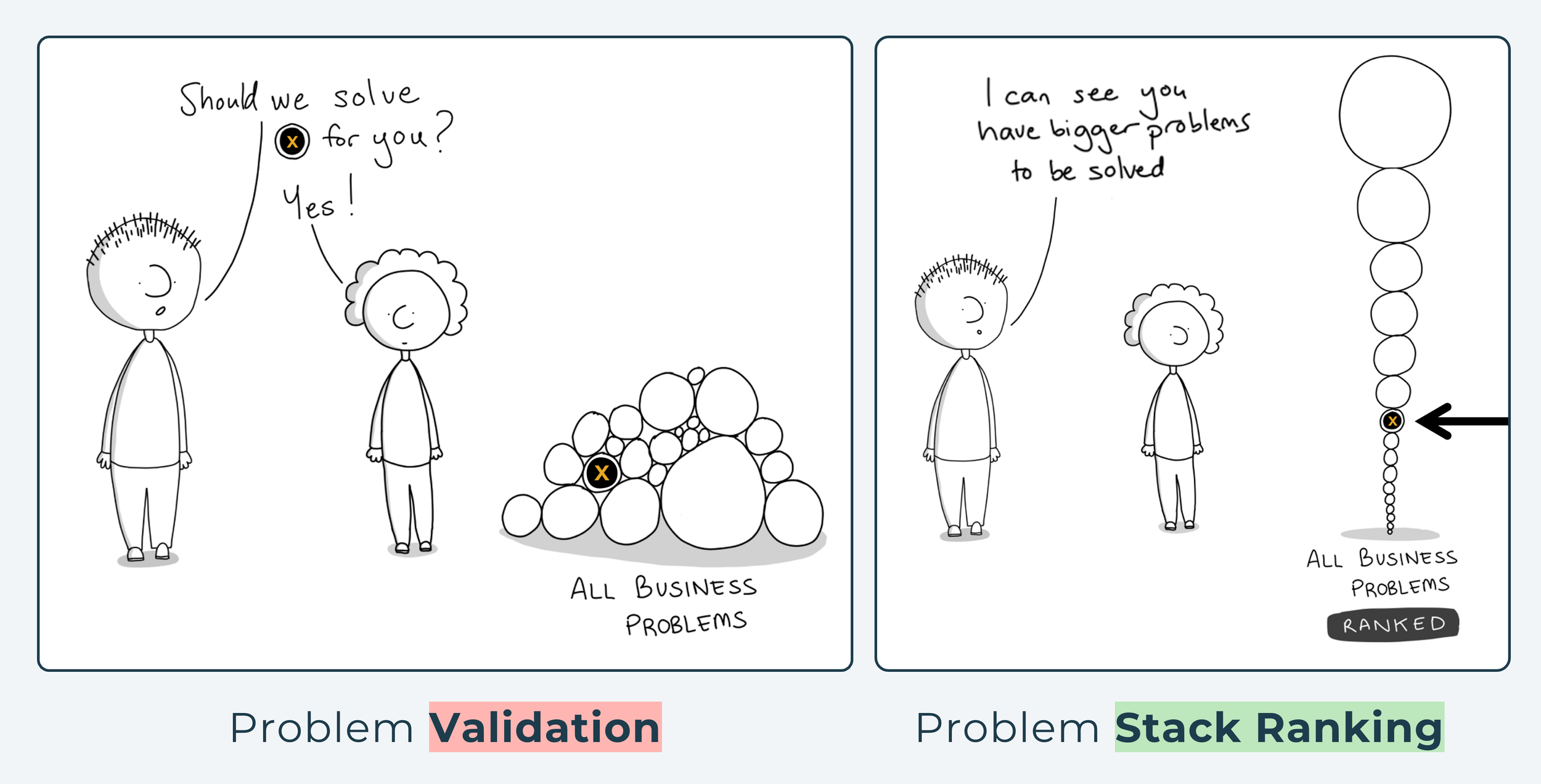
^ Validating that a customer experiences a problem doesn’t mean they care about finding a solution.
We didn't realise it at the time, but this Opportunity Signal concept had implications well beyond the problem and segment we'd build OpinionX for.
The best Opportunity Signals are big and easy to intercept
When that wave of founder sign-ups started in April 2021, we went looking for more acquisition channels to keep the top-of-funnel tap flowing. Because founders didn't understand this should be a priority for them, our strategy was to "educate and intervene": giving workshops at accelerator programs, partnering with startup communities, speaking on podcasts, and getting on stage at founder conferences.
Founders were always happy to chat, but they rarely turned into good customers. PMs, on the other hand, wouldn't give us 5 minutes for a Zoom call, but they were organically finding OpinionX on Google or through word-of-mouth.

More importantly, they were launching successful stack ranking projects without needing any help from us. It seems obvious now, but it took a while to click: the best way to acquire customers depends on what stage of Opportunity Signal they're at. The higher the pain of the problem you solve, the less you need to convince them to try your product, and the more likely they're already searching for a solution like yours.
The idea here isn't just "build it and they will come", it's "build it and put it where they're already searching for a solution". So let's break down the five stages of problem consideration and see how each shapes the acquisition channels available to you.
1. OVERLOOK. Status: unaware of problem/goal. People often say educating customers is expensive without explaining why. To "educate and intervene" means changing your target customers' priorities, which requires holding their attention for a considerable amount of time (and therefore money). Matt Lerner, CEO of Startup Core Strengths, hits the nail on the head on targeting problem-unaware customers: "As an unknown startup, it's hard enough to even get people to read or click on your ads, let alone rewrite their beliefs or change habits." If you value your sanity, don't target customers with an undetectable Opportunity Signal. There's probably a different segment with the same problem that cares far more about solving it; spend your time finding and serving them instead.
2. SEE. Status: aware of problem/goal. Once your customer is aware of the problem, traditional channels like outbound sales and display advertising start to become relevant. The big trap here is assuming they care about solving the problem just because they're aware of it. In my opinion, you shouldn't target these customers for any new product or feature. Focus on THINK and ACT groups who already care about solving your problem, then expand to SEE-stage customers once you've exhausted the low-hanging fruit.
3. THINK. Status: researching solutions. Only once the problem becomes a high priority will your target customers start emitting an Opportunity Signal you can easily intercept. This is when scalable channels like SEO and search ads become truly effective. But THINK-stage customers aren't always ready to solve the problem right away; most are looking for informative content to better understand their problem or knowledge gap, not to buy a solution immediately. We target PMs in the THINK stage by writing informative blog posts about problems our product could solve. Instead of immediately positioning OpinionX as the answer, we first give them the information they came looking for. Some examples of high-converting THINK-oriented posts:
4. ACT. Status: comparing solutions. The difference between THINK and ACT customers is search intent. THINK-stage people are looking for informative content, while ACT customers search with much higher commercial intent. They don't just want to learn about a topic; they want to compare the features, benefits and pricing of the best products for solving their problem. An example of a well-performing piece I've made for ACT-stage customers: Comparing the 7 Best Free Online Ranking Survey Tools in 2023.
5. REFLECT. Status: recurring impact. Once your customer successfully implements a solution, they move into the REFLECT stage. As long as you keep the problem at bay (and don't create new pains), their perceived pain stays low and they'll retain you as their solution of choice. But retention isn't the only ingredient in this final stage. There are three objectives to aim for once you start delivering value:
Retain: how can you keep delivering value to hold this pain at bay? How do you communicate the value you're delivering now that the pain is no longer top of mind?
Refer: who else do they know that feels this pain, and how do you encourage them to share the solution with others like them?
Upsell: how do you expand on the value you're delivering to grow the size of their account over time?
Target customers in the THINK/ACT stages wherever they're already searching for your solution
For most unmet needs, there's a perfectly reachable segment of potential customers who are not just problem-aware but actively searching for a good solution like yours. Sometimes they're just using different terminology to describe the problem, so they fly under your radar. To target customers in the THINK and ACT stages, you'll need to understand:
The high-priority problem your target customer is trying to solve.
The language they use to describe that problem.
The product categories where they expect to find a solution.
Where they look for THINK and ACT information.
The best founders take the time to research and articulate these four ingredients, because at the end of the day, solving the right problem for the wrong customer segment is the same as being wrong overall.
About the author: Daniel Kyne is the Co-Founder and CEO of OpinionX, a research tool for stack ranking people's priorities. OpinionX helps teams understand what's most important to their customers, colleagues or community, informing key strategy and prioritisation decisions with real data instead of internal assumptions and politics. Create unlimited stack ranking surveys for free at app.opinionx.co.
Frequently asked questions
What is an Opportunity Signal? A sign that a customer segment is actively looking for the kind of solution you offer. The stronger the pain your product solves, the more likely that segment is already searching for something like it, which makes them far cheaper to reach than a segment you'd have to educate first.
How do you pick the right customer segment? Look for the segment whose problem is painful enough that they're proactively searching for a fix, not the one you'd have to convince the problem exists. Two segments can share the same use case but differ completely in how actively they're looking, and that difference decides which one is worth targeting.
Why is a proactive segment better than a reactive one? A proactive segment already knows it has the problem and is searching for a solution, so you intercept demand that exists. A reactive segment hasn't diagnosed the problem yet, so you have to spend time and money educating them before they'll even consider you, which rarely pays off.
What does "big and easy to intercept" mean? The best Opportunity Signals are both large (enough people share the pain) and reachable (they're already searching somewhere you can show up). A segment that's searching on Google or asking in a community is easy to intercept; a segment you have to chase at conferences usually isn't.
How does this connect to customer segmentation research? Once you spot an Opportunity Signal, needs-based segmentation helps you confirm which segment cares most about which problem, so you can target the one that's both high-pain and reachable rather than guessing.
Want more like this? Over 42,000 researchers and product people get The Full-Stack Researcher in their inbox. Subscribe for the next one.