
The segmentation survey VEED used to refine their Ideal Customer Profile definition
“VEED, an AI video creation platform used by over 10 million people a month, ran a customer segmentation survey in OpinionX to refine its Ideal Customer Profile (ICP). Senior UX Researcher Maedhbh Greene needed three things the team’s existing Typeform subscription couldn’t do: MaxDiff, CRM data enrichment, and automated segmentation analysis.”
She built a 34-question survey that combined MaxDiff, Points Ranking, and Ranked-Choice Voting, pulled in CRM data with hidden fields, and collected 205 participants at a median completion time of 13 minutes 12 seconds, using a $10 gift card as the incentive.
What VEED had treated as one Ideal Customer Profile turned out to be two distinct segments with different needs. That updated VEED's company-wide ICP definition, and Maedhbh ran more than 90% of the analysis inside OpinionX with its Compare Segments tool.
VEED is an AI video creation platform used by over 10 million businesses, content creators, and educators each month to make professional videos.
In early 2025, VEED's team realised their read on their main customer segments was going out of date. They had plenty of qualitative insight from user interviews, but not the hard data to drive decisions like the product roadmap or marketing.
What challenge was VEED trying to solve?
Maedhbh Greene, Senior UX Researcher at VEED, wanted to understand how use cases vary across VEED's main customer segments. After reading up on how to run a project like this, she realised she needed three features:
MaxDiff → a method for measuring the relative importance of different customer needs and use cases.
Enrichment → a way to attach existing CRM data (pricing plan, email address) to survey responses.
Segmentation → an automated way to compare customer groups (by pricing plan, job title, or industry) and see how their needs differ, without manual spreadsheet work.
VEED already paid for Typeform, but Maedhbh soon saw it wouldn't work here. Typeform has no MaxDiff question type and no segmentation analysis. No surprise, really, since it's built for data-collection forms, not user research!
Here's how the two tools lined up against what the project actually needed:
| What the project needed | Typeform | OpinionX |
|---|---|---|
| MaxDiff question type | 🔴 Not available | 🟢 Built in |
| CRM data enrichment | 🔴 Not available | 🟢 Via hidden fields |
| Automated segment comparison | 🔴 Not available | 🟢 Compare Segments tool |
| Built for | Data-collection forms | Advanced market research |
Instead of cutting parts of the project to fit Typeform, Maedhbh went looking for a platform built for this work: measuring user needs, ranking features by value, and comparing needs across segments. That's how she found OpinionX.
How did VEED build its customer segmentation survey?
OpinionX is a survey platform built for product teams running advanced market research, so they can measure what matters most to their most important customers. When Maedhbh went looking for a tool with MaxDiff, OpinionX was the obvious pick.
Maedhbh built a 34-question customer segmentation survey with three sections: users' professional context, their process when making videos, and their experience with VEED.
Just four open-text boxes collected unstructured opinions. Most of the survey was single- or multiple-choice questions, gathering segmentation data VEED didn't already hold, such as:
Which social media platforms do you share to most often? (Select 1-3 options only)
What's your typical turnaround time from video concept to publication?
How confident do you feel about creating and editing videos?
Each of these gave participants a list of options and a rule for how many they could pick. When someone answers, OpinionX tags them into a group you can later filter or compare across segments.
Alongside the multiple-choice questions sat voting blocks that measure preferences and priorities. Maedhbh mixed a few types:
MaxDiff, also called best-worst scaling → measure which challenges and frustrations matter most to customers.
Points Ranking → give people 100 points to split by how they spend their time.
Ranked-Choice Voting → ask people to rank existing features from most to least important.
Here's an example of the MaxDiff voting section in Maedhbh's segmentation survey:
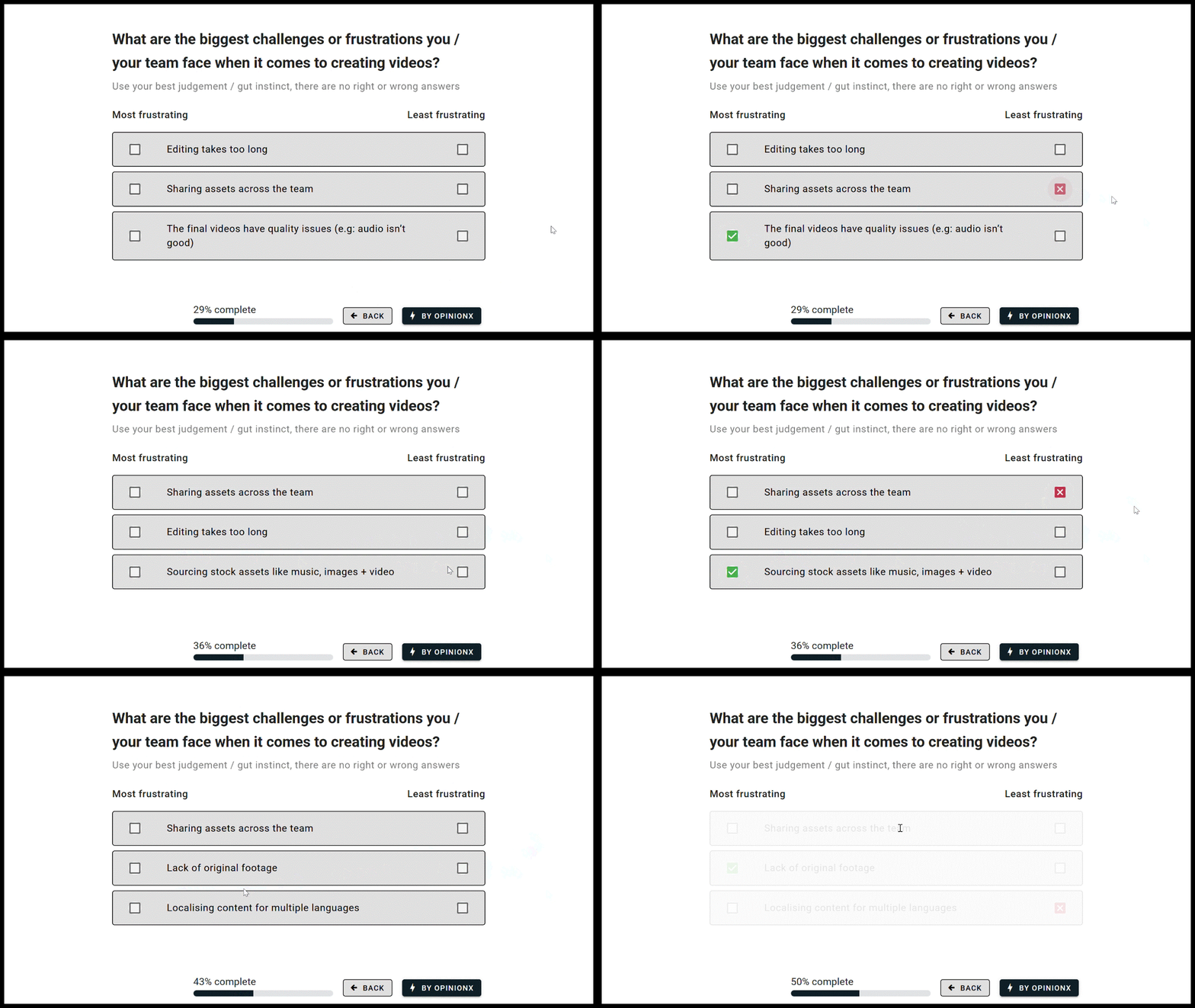
Screenrecording of a maxdiff analysis survey hosted on OpinionX
With the survey built, Maedhbh moved to distribution.
With hidden fields (survey links carrying custom URL parameters per participant), Maedhbh pulled VEED's CRM data into OpinionX and matched it to each person's answers. That let her enrich the results with what VEED already knew, like user IDs and pricing plans, and cut the number of questions she had to ask. That enriched data mattered later, in the segmentation analysis.
A $10 gift card brought people in. 205 VEED users completed the survey, at a median time of 13min 12sec.
Running a customer segmentation study of your own and want a hand designing it? Book a free 30-minute setup call and a research expert will help you shape your questions, segmentation and MaxDiff design, no cost, no obligation.
What did VEED's segmentation survey reveal?
Maedhbh later admitted it took running this survey to see how limited Typeform's analysis is for work like comparing results by segment:
“We came to OpinionX because it offered maxdiff surveys, but it was the analysis functionality that really surprised me — I did 90% or more of my analysis work within the tool for the first time maybe ever. OpinionX’s ‘Compare Segments’ tool in particular was great because our analysis ended up being framed around comparing two subsets of our Ideal Customer Profile against each other. This made life so much easier for me and involved a lot less time spent on importing, exporting, and organising data in spreadsheets compared to what I would usually spend in a research project like this.”
The survey showed Maedhbh that their old Ideal Customer Profile actually held 2 distinct segments with different needs. She could see how each segment gets value from VEED, what they made of its current features, and how they felt about AI in video editing.
Maedhbh's work updated VEED's internal definition of its ICP segments. That definition reaches every team, shaping how they acquire users and how they set success metrics. It also gave her a clean way to pick users for follow-up interviews and dig deeper into the segments.
What can other researchers take from VEED's approach?
What would Maedhbh recommend to other user researchers thinking of running a similar customer segmentation survey?
“If Typeform is too limited for your research needs and Qualtrics is too expensive to consider, then OpinionX is the one for you! It took the pain out of adopting a new research method like maxdiff analysis with segmentation automations that saved me a lot of hassle, plus amazing customer service that made us feel like we were in safe hands the whole way through.”
User researchers often just get handed whatever form builder or survey tool the company already pays for, with little thought for the research and analysis methods their work actually needs.
As AI pushes user researchers toward more strategic work, you need the right toolkit for it. OpinionX helps product teams pick up advanced market research methods, with analysis automations, a clean interface, and expert researchers on hand.
For another worked example of the same method, see how Airbnb used MaxDiff to measure customer concerns.
Create a free OpinionX account and start building your own customer segmentation survey just like Maedhbh's, or book a personal demo so we can help you turn your research objective into a well-made survey.
Frequently asked questions
What is a customer segmentation survey? A customer segmentation survey measures how needs, priorities and behaviour differ across groups of customers, so a team can define its segments from data instead of assumption. VEED used one to split a single Ideal Customer Profile into two distinct segments.
Which survey method did VEED use to segment its customers? MaxDiff was the core method, used to rank challenges and use cases by importance. Maedhbh combined it with Points Ranking and Ranked-Choice Voting, then compared results across segments using enriched CRM data.
How big was VEED's segmentation survey? 34 questions, answered by 205 VEED users at a median completion time of 13 minutes 12 seconds, with a $10 gift card as the incentive.
Why didn't VEED use Typeform for this? Typeform is built for data-collection forms, not research. It has no MaxDiff question type and no segmentation analysis, so it couldn't measure relative importance or compare needs across customer groups.
What did VEED learn from the survey? That its single Ideal Customer Profile was really two segments with different needs. VEED updated its company-wide ICP definition, which now shapes everything from user acquisition to success metrics.
Did you enjoy this case study? Over 42,000 Product Managers, UX Researchers, and Startup Founders subscribe to our newsletter The Full-Stack Researcher for actionable user research advice.
About The Author:
Daniel Kyne is the Founder & CEO of OpinionX, the platform for advanced market research surveys. Hundreds of the world’s top product teams use OpinionX to measure their customers needs, map customer segments, and model purchase decisions — all in one easy-to-use survey platform.
→ Try OpinionX for free today