121 European alternatives to American user research tools
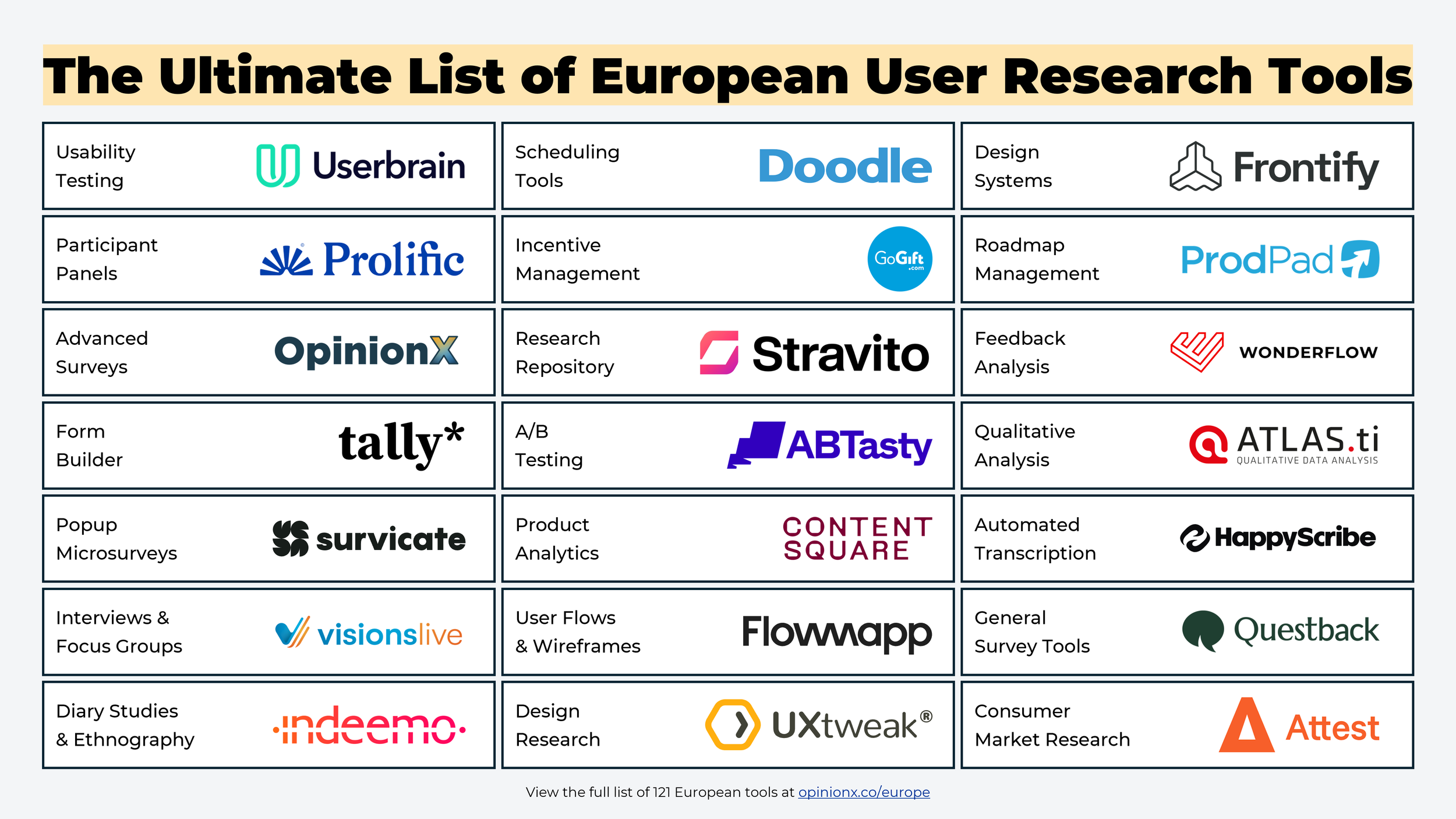
“This is a catalogue of European research tools across 21 product categories, mapped against the 157 American platforms they can replace. The categories run from usability testing, participant panels and advanced survey research through form builders, microsurveys, interviews, diary studies, scheduling, incentives, repositories, A/B testing, product analytics, wireframing, design research, design systems and roadmap management, to feedback analysis, qualitative analysis, transcription, general surveys and consumer research.”
Every European tool listed is headquartered in Europe or the UK, and every entry names the country. Roughly 83% of European software and cloud spending goes to American companies, and a run of politically driven service disruptions since 2025 has pushed European teams to look at what the alternatives actually are.
Why are teams switching to European research tools?
In February 2025, the US administration sanctioned ICC Chief Prosecutor Karim Khan over the court's arrest warrants relating to the war in Gaza. That May, Khan lost access to his Microsoft email account and moved to a Swiss provider, which set off an urgent reassessment of digital dependence inside the Dutch government (NL Times, May 2025). Microsoft disputed the account, with president Brad Smith stating that the company had at no point ceased or suspended its services to the ICC.
Disputed or not, the effect was immediate. On 31 October 2025 the ICC confirmed it was replacing Microsoft Office with openDesk, an open-source suite built by the German government's Centre for Digital Sovereignty (The Register, October 2025). Denmark's digitisation ministry had already announced in June 2025 that it would move its own machines off Windows and Microsoft 365. The German and Austrian armed forces went the same way.
A European Parliament study puts North America's share of the European software and cloud market at roughly 83% (European Parliament, 2025), a finding matched by CIGREF's assessment of technological dependence for French enterprises. If four fifths of your stack sits in one jurisdiction, a policy decision made in that jurisdiction is a decision about your business.
You don't have to agree with any particular reading of the politics to think a research stack concentrated in one country is a concentration risk worth pricing. Data residency under GDPR is the other half of it, and it's a question procurement will ask you regardless of what you think about Washington.
So here are the alternatives. If you're a product manager, UX designer, UX researcher or founder, these are the European research tools worth putting on the list the next time renewals come round.

1. Usability testing
Usability testing tools let you watch how people use a product, website or prototype, so you can find where friction and confusion happen. Tests can be moderated, with someone asking questions live, or unmoderated, with self-directed tasks and screen recording.
US tools in this category → Applause, EthOS, Great Question, Hubble, Lookback, Maze, MUIQ, PlaybookUX, Trymata, UserTesting, Userlytics, UserZoom, WEVO
Note: UserZoom is now part of UserTesting following the Thoma Bravo acquisition, so those two entries are one vendor.
Userbrain (Austria) → Specialist unmoderated testing platform with a participant pool of 150,000-plus, AI-generated tasks and results inside 24 hours. Popular with UX agencies for quick prototype and website validation.
Useberry (Greece) → Unmoderated testing with Figma integration, click and scroll tracking, and preference tests.
UXTweak (Slovakia) → Full suite: tree testing, first-click, preference and five-second tests, with a global participant pool.
More European options → Userfeel (UK), odaptos (France)
This is the most crowded category on the list, and also the one where the American incumbents are consolidating fastest, which is worth factoring into a three-year view.

2. Participant panels
Participant recruitment panels are pre-screened, verified communities of people available for studies, surveys and usability tests. They give you faster recruitment, demographic targeting and built-in incentive handling compared with cold outreach.
US tools in this category → Mechanical Turk, Respondent.io, User Interviews
Note: User Interviews was acquired by UserTesting in January 2026.
Prolific (UK) → Global participant platform with roughly one million users across 40-plus countries. Self-service setup is better than any other panel I've used: you set your own targeting and incentives and launch without manual approval or hand-holding.
Cint (Sweden) → Data and research network connecting more than 10 million participants through 2,000-plus partners, built for scalable recruitment, panel management and multi-market studies.
TestingTime (Switzerland) → Specialist UX recruitment service with close to a million participants and strong coverage in Switzerland, Germany, the UK, France, the Netherlands and Austria.
More European options → BilendiUX (France), Crowst (Finland), inamo.ai (Sweden), Researchbods (UK)
Panels are the category where European research tools are strongest, since Prolific and Cint are both genuinely category-leading rather than merely local alternatives.
If budget is the constraint rather than the panel, we've written up where to find free survey participants.

3. Advanced survey research
Advanced survey platforms run methods you won't find in a basic questionnaire tool: preference measurement like conjoint analysis and MaxDiff, segmentation through filters, crosstabs and clustering, and pricing studies like Van Westendorp and Gabor Granger. These get filed as market research, and they're increasingly run in-house for strategic decisions.
US tools in this category → Fuel Cycle, GroupSolver, Hubble, Medallia, Qualtrics, Suzy
OpinionX (Ireland) → Runs the full advanced method library in-house rather than through an agency, using automated analysis and plain-language terminology so researchers who aren't quant specialists can set the studies up themselves. Free tier is $0 with every method unlocked and a cap of 25 participants per survey; Analyze is $900 a year with unlimited participants and unlimited researcher seats. Written by me, so weigh it accordingly, and there's a live demo you can judge for yourself.
Forsta (UK) → Enterprise full-suite experience research platform for large organisations needing end-to-end insights infrastructure. Effectively a European Qualtrics, with the enterprise sales cycle to match.
More European options → EPIC Conjoint (Ireland), FlexMR (UK), Quantilope (Germany)
This is the category where the gap between European research tools and the American incumbents is narrowest, because the methods are settled and the differences are packaging. If you're comparing properly, we've done the work on conjoint analysis software, MaxDiff platforms, which of them survive a phone screen and needs-based segmentation.
4. Form builders
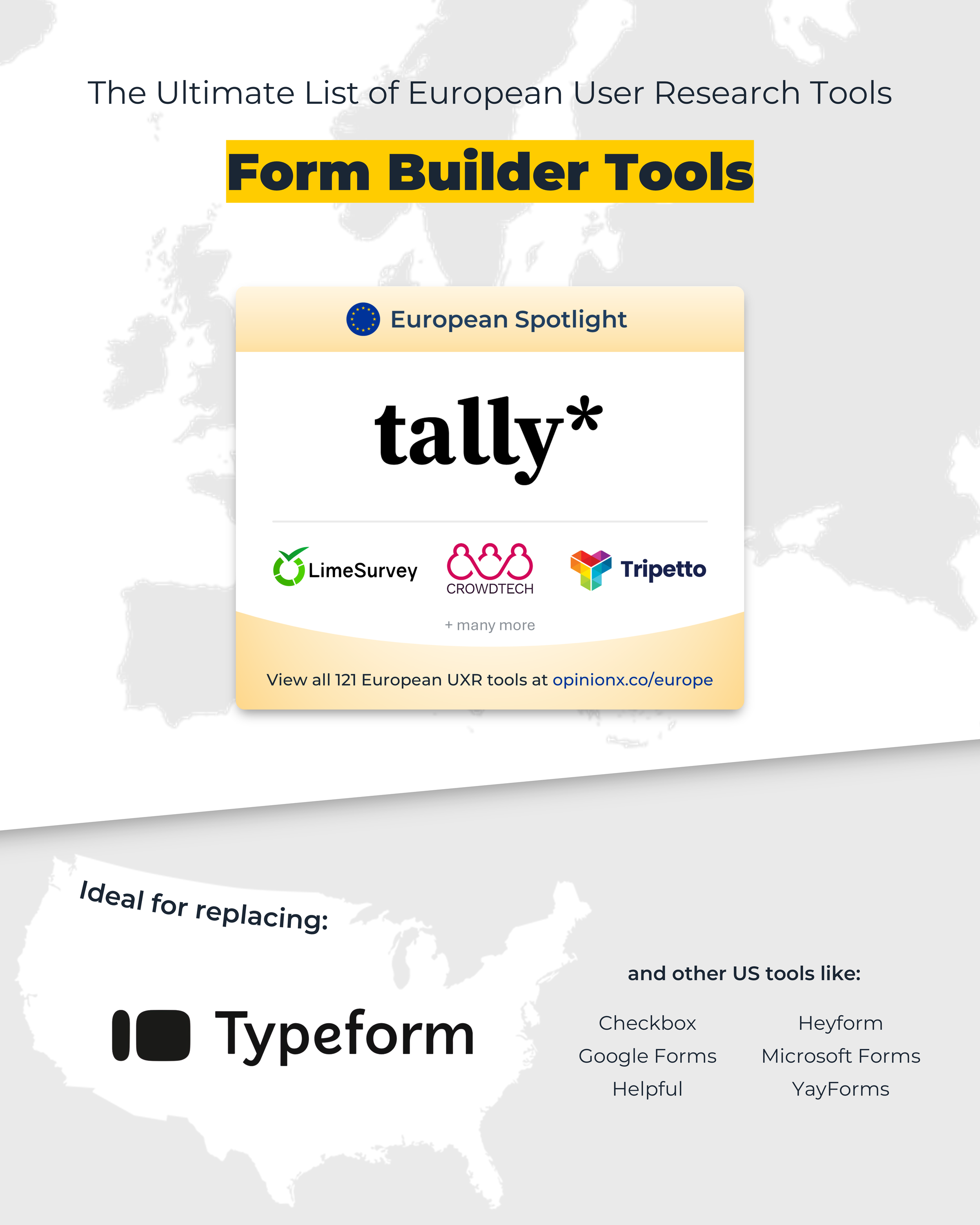
Form builders let anyone create and embed questionnaires and feedback forms without code. They run from simple drag-and-drop builders to platforms that handle NPS and in-product research.
US tools in this category → Checkbox, Google Forms, Helpfull, Heyform, Microsoft Forms, Typeform, YayForms
Tally (Belgium) → The Typeform killer. Bootstrapped since 2020 and still customer-funded, with a Notion-style editor that makes survey creation quick and a pricing plan that's clear about what you get and doesn't take you for a ride.
LimeSurvey (Germany) → Open source, used by governments, NGOs and enterprises in 80-plus countries, with self-hosted options for teams that need full data control.
More European options → Crowdtech (Netherlands), Deeptrue (Switzerland), EasyFeedback (Germany), Tripetto (Netherlands)

5. Popup microsurveys
Popup microsurveys are feedback forms embedded in websites and apps, triggered by behaviour: after a purchase, on exit intent, after time on page. They capture satisfaction, referral intent or feedback in the moment. Typically one to four questions, in basic formats.
US tools in this category → 1Flow, Appcues, Chameleon, Delighted, GetFeedback, Hubble, Maze, NativeForms, Pendo, Qwary, Qualaroo, SightX, Simplesat, Sprig, Thermostat, UserPilot, User Vista, Wootric
Survicate (Poland) → Market-leading integrated microsurvey platform used by thousands of companies for NPS, CSAT, feature feedback and exit-intent surveys, with AI-assisted targeting and multi-language support.
Usersnap (Austria) → Product and website feedback platform with in-app microsurveys, NPS and CSAT widgets, visual bug reporting and session replays. GDPR and SOC 2 compliant.
Netigate (Sweden) → Enterprise customer and employee experience platform combining surveys, microsurveys and AI-driven feedback analysis.
More European options → Jimo (France), Nicereply (Slovakia), Onepulse (UK), Opinyin (UK), Refiner (France), Responsly (Poland), Saber Feedback (Spain), Satismeter (Czechia), Screeb (France), TruRating (UK), UserReport (Denmark)
6. Interviews and focus groups
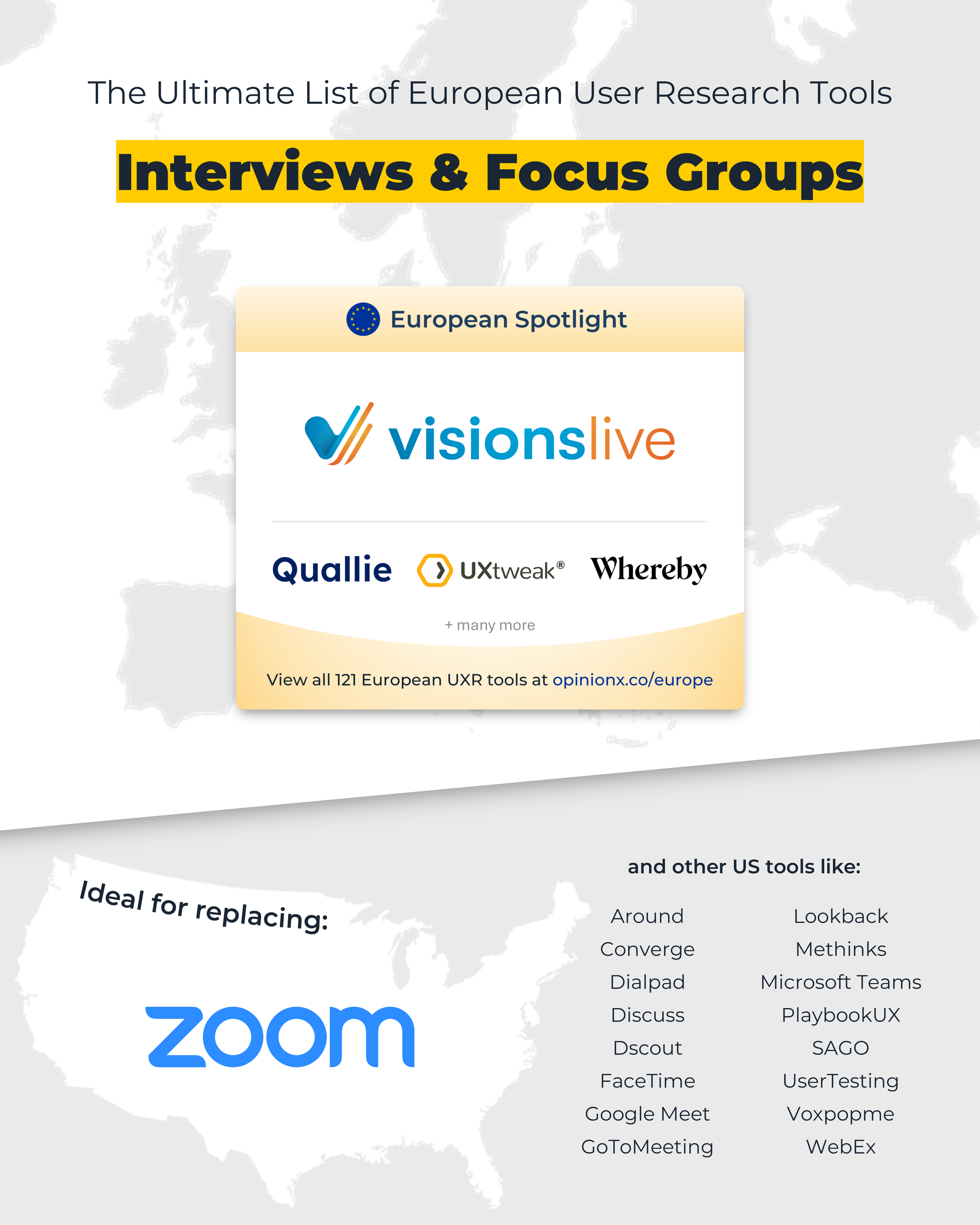
Interview and focus group tools handle real-time research with participants one-to-one or in groups, covering recruitment, recording, moderation, transcription and increasingly AI note-taking.
US tools in this category → Around, Converge, Dialpad, Discuss, Dscout, FaceTime, Google Meet, GoToMeeting, Lookback, methinks, Microsoft Teams, PlaybookUX, SAGO, Signal, Suzy, UserTesting, Voxpopme, WebEx, WhatsApp, Zoom
VisionsLive (UK) → Live focus group and interview platform with integrated recruitment, moderation tools, real-time analytics and secure video recording for enterprise research teams.
Whereby (Norway) → Video meeting and interview platform with recording, transcription and collaboration built in, for distributed research teams.
More European options → inamo.ai (Sweden), Quallie (Czechia), TheyDo (Netherlands), UXTweak (Slovakia)
Whatever you use to run them, the interviews are only the first layer. Our Discovery Sandwich framework covers what to do with them afterwards, and the guide to customer discovery covers running the interviews themselves.
7. Diary studies and ethnography
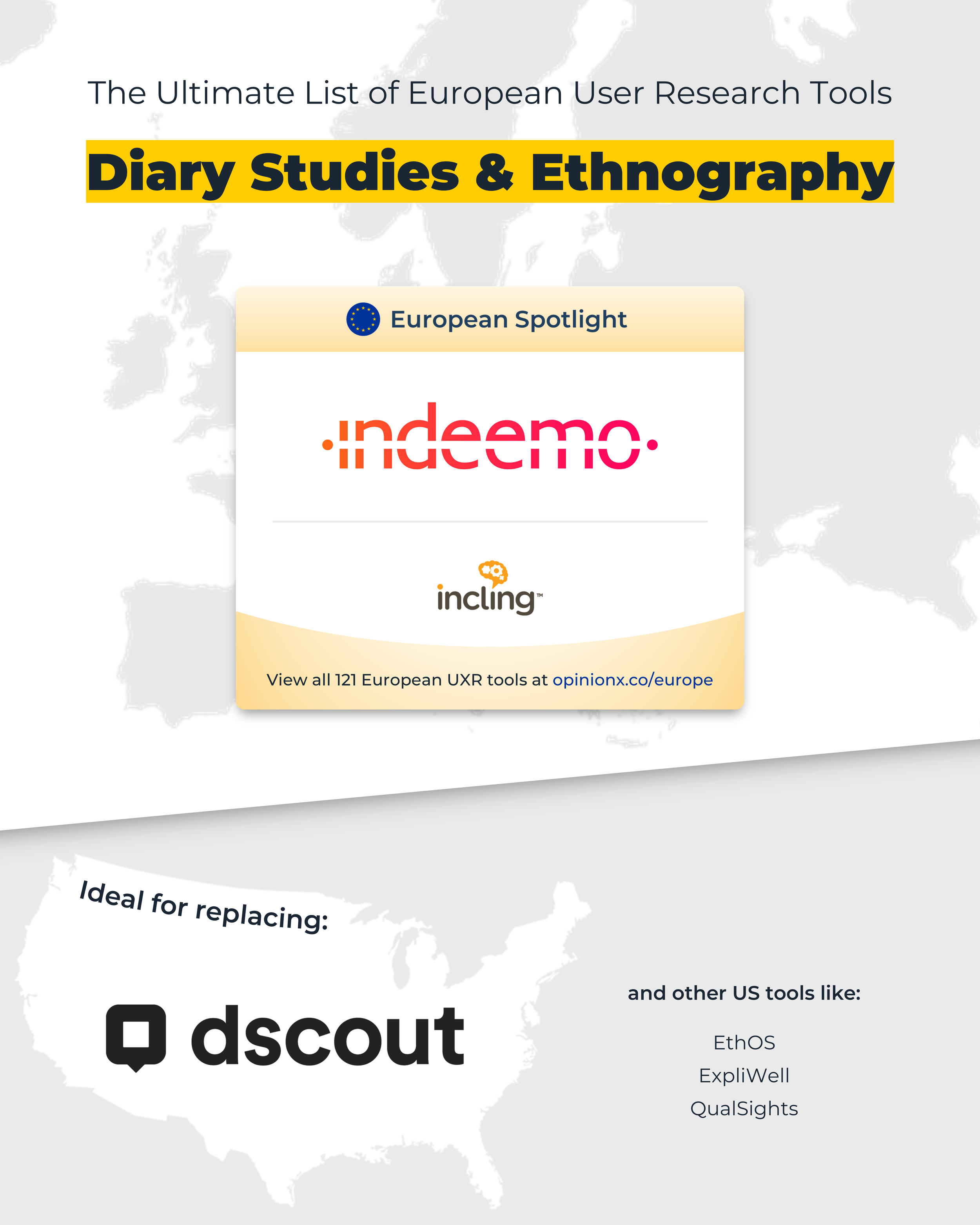
Diary study and mobile ethnography tools capture longitudinal, in-context data over days or weeks. Participants document daily experiences, behaviours, photos and videos from their phones, which gives you real-world usage patterns rather than recalled ones.
US tools in this category → Dscout, EthOS, ExpiWell, QualSights
Indeemo (Ireland) → Mobile ethnography platform for recruiting participants and collecting diary entries, photos, videos and real-time responses over days or weeks. Used for consumer behaviour, product research and cultural insight work.
Incling (UK) → Longitudinal research platform for diary studies, experience sampling and mobile ethnography, with automated scheduling, participant engagement features and AI-assisted qualitative analysis.
8. Scheduling
Scheduling tools handle the logistics of research coordination: recruiting, booking interviews, coordinating focus groups and managing researcher calendars. They cut the back-and-forth, send the reminders, and connect to whatever you run calls on.
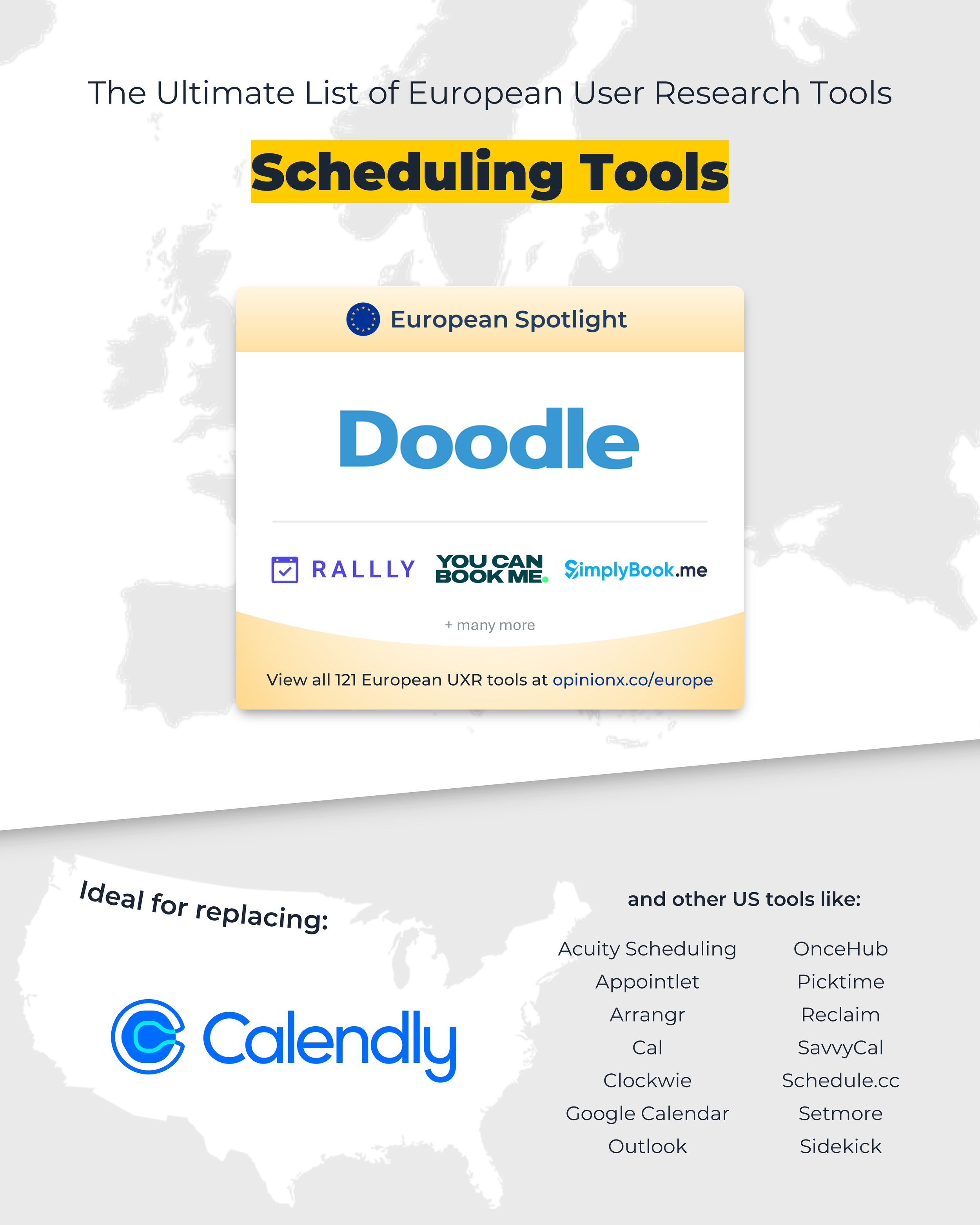
US tools in this category → Acuity Scheduling, Appointlet, Arrangr, Cal, Calendly, Clockwise, Google Calendar, Outlook, OnceHub, Picktime, Reclaim, SavvyCal, Schedule.cc, Setmore, Sidekick
Doodle (Switzerland) → Better known as a polling tool for picking meeting dates, Doodle has quietly become a market-leading scheduler used by millions for managing calendar availability.
More European options → Rallly (UK), SimplyBook.me (Cyprus), YouCanBookMe (UK)
9. Incentives
Research incentive platforms manage participant rewards: gift cards, vouchers, cash payouts or charitable donations. They handle multi-currency payments, budget tracking and research ethics compliance.
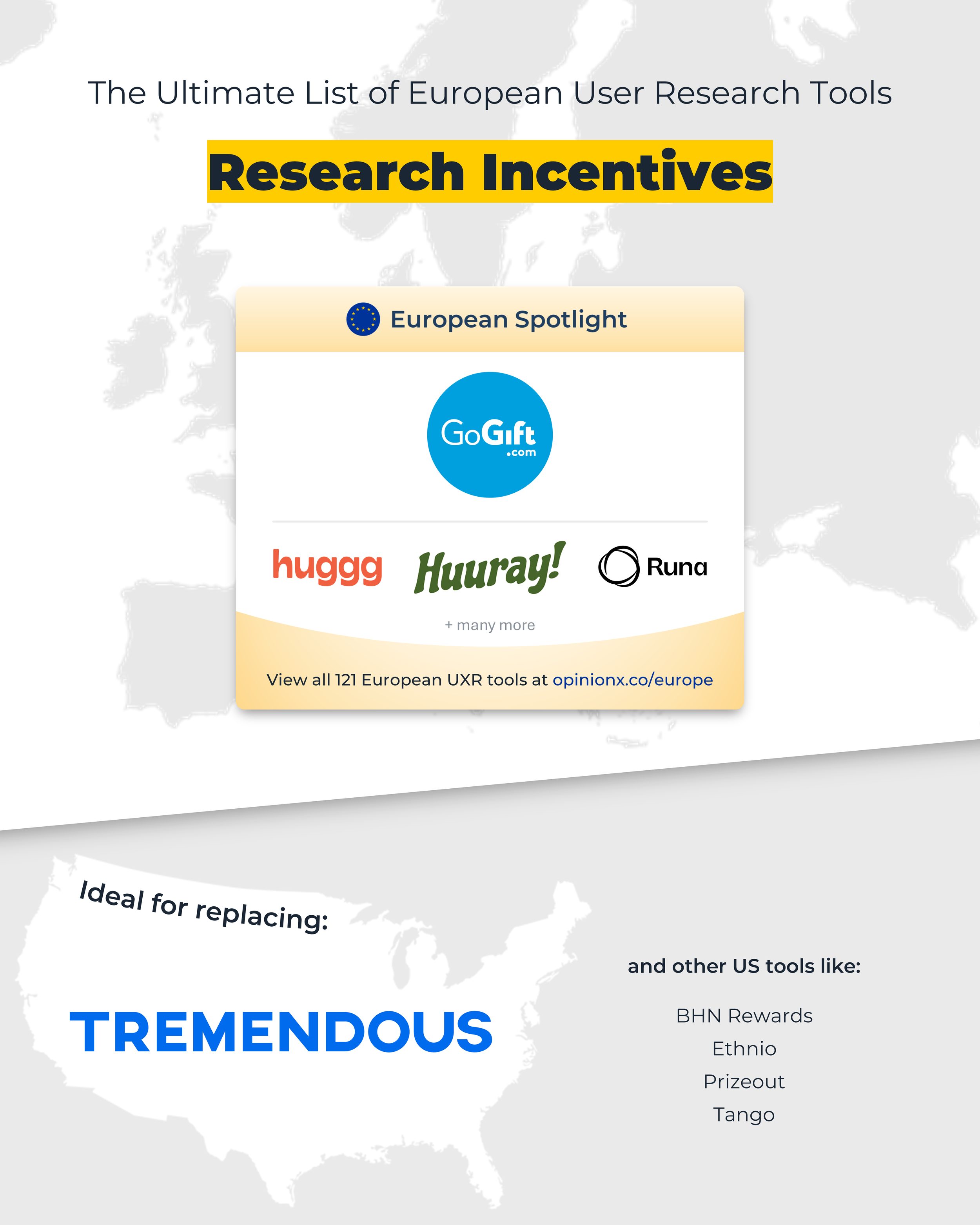
US tools in this category → BHN Rewards, Ethnio, Prizeout, Tango, Tremendous
GoGift (Denmark) → Global digital gift card and rewards platform reaching 150-plus countries, supporting multiple currencies, instant delivery and white-label customisation for research platforms.
Huuray (Denmark) → European rewards provider offering digital gift cards and vouchers for incentives, loyalty and employee programmes, with broad catalogue coverage across EU markets.
Runa (UK) → Global digital rewards infrastructure providing gift cards, vouchers and payouts via API.
More European options → &Open (Ireland), Giftcampaign (Spain), Huggg (UK), Prolific (UK)

10. Research repositories
Research repositories are centralised platforms for storing, organising and sharing findings across teams. Most focus on insights, meaning coded themes, patterns, quotes and evidence, rather than raw transcripts and recordings. The job is making research discoverable and traceable across the company.
US tools in this category → Aurelius, Great Question, Marvin, mTab, Notably, UserBit, EnjoyHQ by UserTesting
Stravito (Sweden) → Enterprise insights hub built for org-wide visibility, with weekly digests, curated collections and AI auto-tagging aimed at getting non-researchers to actually use the repository.
Condens (Germany) → Research-focused platform with automated transcription, AI-assisted tagging and affinity mapping. The easiest starting point for a qual team building its first repository.
More European options → Dualo (UK), Glean.ly (UK)

11. A/B testing
A/B testing tools run controlled online experiments to measure the impact of design or feature changes on behaviour and business metrics, handling setup, traffic allocation, statistical analysis and reporting.
US tools in this category → Adobe Target, Apptimize, CrazyEgg, GrowthBook, Inspectlet, Optimizely
AB Tasty (France) → Full-stack enterprise platform for web and mobile with a visual editor, personalisation, feature flagging and AI-assisted recommendations.
Kameleoon (France) → Experimentation platform with advanced segmentation, behavioural targeting and real-time analytics for conversion optimisation and product experimentation.
12. Product analytics
Product analytics platforms track behaviour, interactions and engagement across websites and apps: clicks, scrolls, feature usage, funnels and conversion paths. They show how people navigate a product, where they get stuck, and what a release changed.
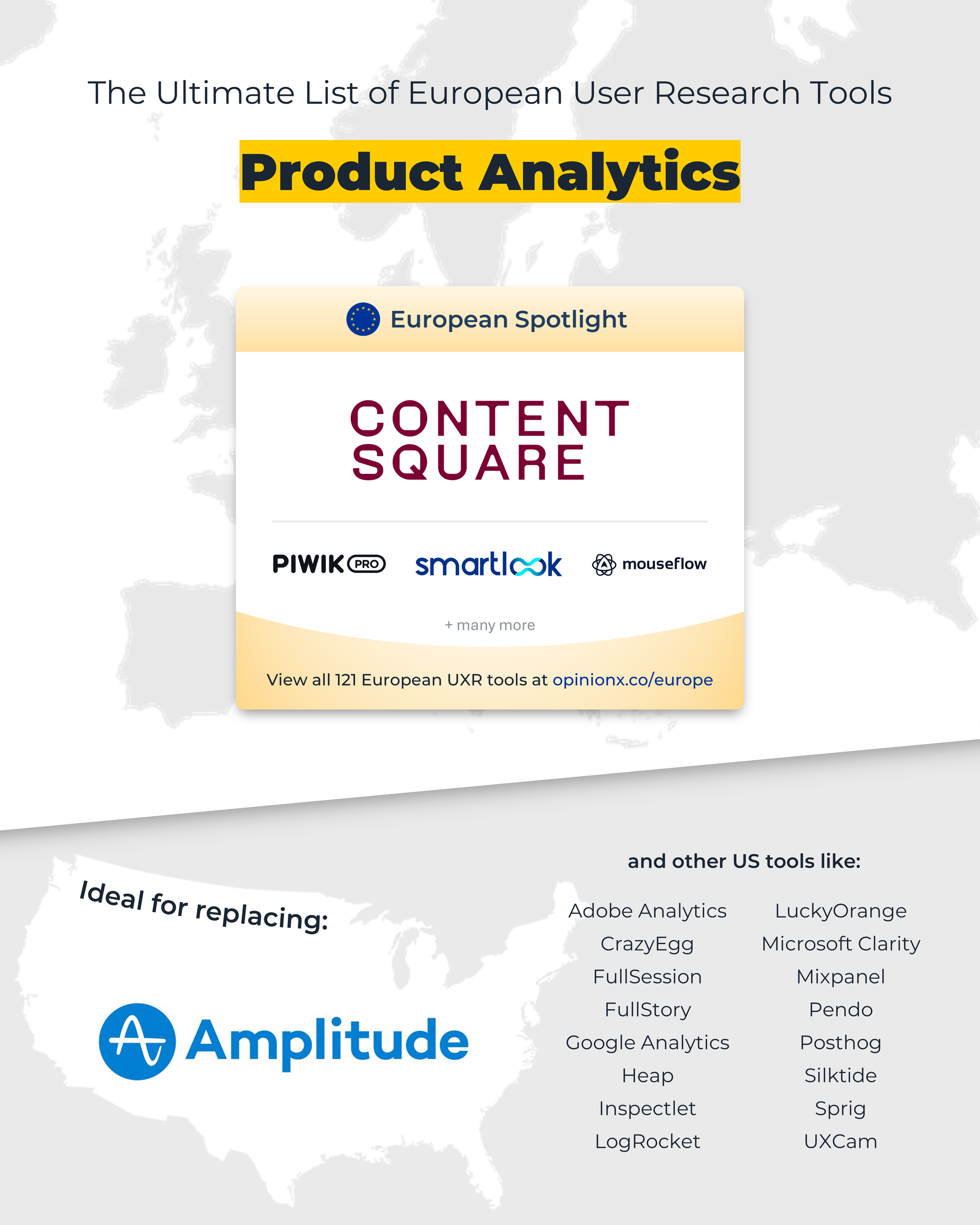
US tools in this category → Adobe Analytics, Amplitude, CrazyEgg, FullSession, FullStory, Google Analytics, Heap, Inspectlet, LogRocket, Lucky Orange, Microsoft Clarity, Mixpanel, Pendo, Posthog, Silktide, Sprig, UXCam
Contentsquare (France) → Full-suite digital experience analytics for large organisations needing comprehensive behaviour tracking and CX optimisation at scale.
Piwik PRO (Poland) → GDPR-compliant analytics suite popular in regulated industries needing EU data residency, with cookieless tracking, consent mode and server-side tagging.
Smartlook (Czechia) → Product analytics with AI-assisted session analysis and automated friction detection for visual debugging.
More European options → Countly (UK), Fullview (Denmark), LiveSession (Poland), Mouseflow (Denmark), Plausible (Estonia), Screeb (France), SessionStack (Bulgaria)
13. User flows and wireframes
User flow and wireframing tools help teams visualise journeys, map interactions and build low-fidelity prototypes, documenting navigation paths, decision trees and screen layouts.
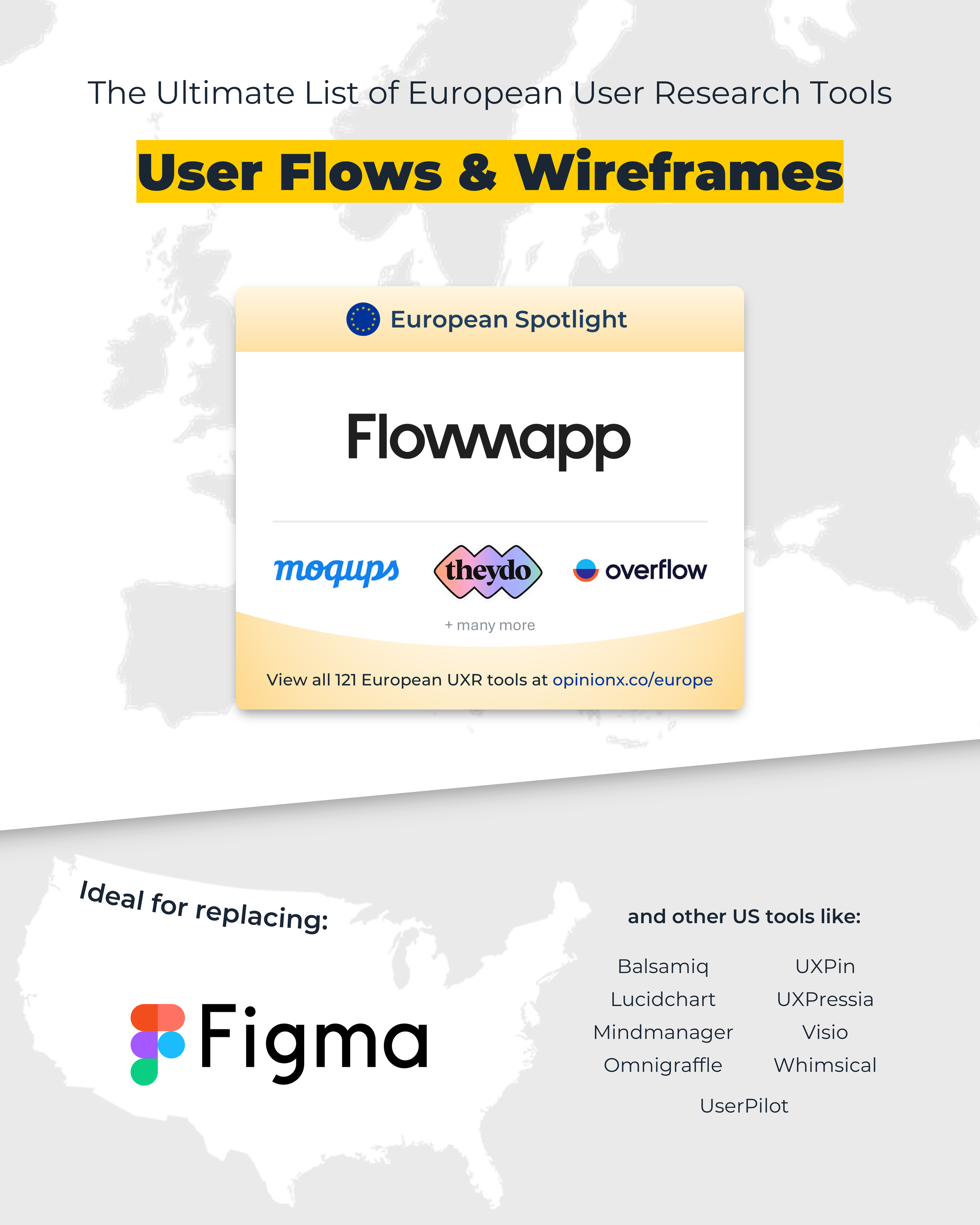
US tools in this category → Balsamiq, Figma, Lucidchart, Mindmanager, Omnigraffle, UserPilot, UXPin, UXPressia, Visio, Whimsical
FlowMapp (Ukraine) → User journey and information architecture mapping with visual flow creation, user story integration and persona-driven documentation. Its collaborative journey mapping ties decisions back to research insights, which most tools in this category don't do.
TheyDo (Netherlands) → Business process and journey mapping built around stakeholder alignment, orchestrating complex multi-actor journeys and process documentation.
More European options → Moqups (Romania), Overflow (Cyprus), Smaply (Austria)

14. Design research
Design research tools offer survey methods aimed specifically at designers: validating concepts, gathering feedback on particular decisions, testing prototypes. They streamline remote testing and let design teams measure performance before development starts.
US tools in this category → Maze, PickFu, PlaybookUX, UXmetrics, Wynter
UXTweak (Slovakia) → Click tests, preference tests and five-second tests for rapid design validation, built for teams needing quick, cheap feedback on visual concepts and UI variations.
Ballpark (UK) → Task-based prototype and copy testing, video and audio feedback capture, and an AI interviewer that runs qualitative sessions at scale, with reports generated automatically from the results.
15. Design Systems
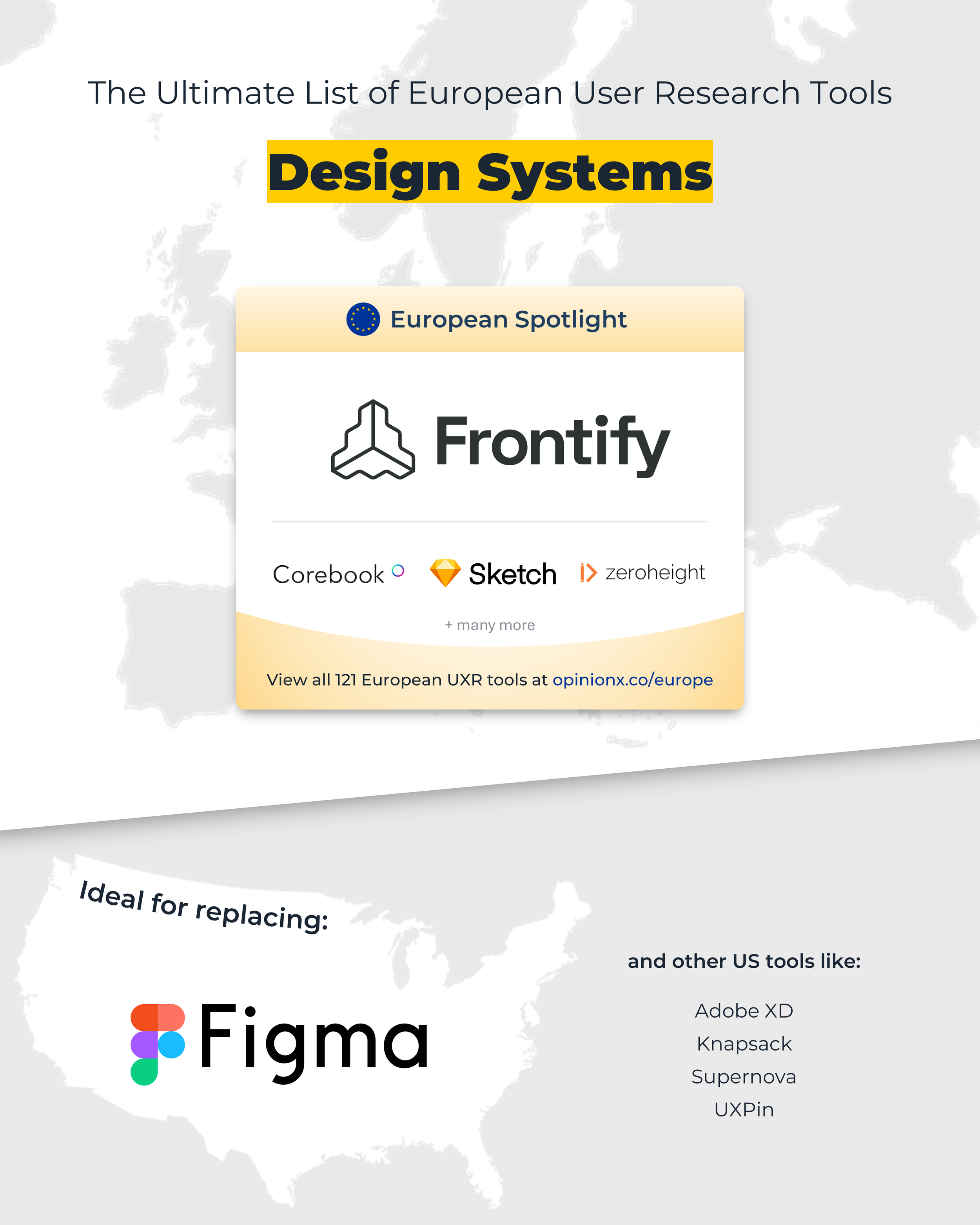
Design system platforms help teams build and maintain centralised repositories of design tokens, components, patterns and documentation, so designers and developers work from shared libraries.
US tools in this category → Adobe XD, Figma, Knapsack, Supernova, UXPin
Frontify (Switzerland) → Design system and brand management combining component documentation, design tokens, asset management and collaboration, with an emphasis on governance and brand consistency at enterprise scale.
Sketch (Netherlands) → Design and prototyping platform with native design system capabilities through shared libraries, components and tokens, plus design-to-code workflows.
More European options → Corebook (Latvia), Zeroheight (UK)

16. Roadmap management
Roadmap management platforms capture user feedback, prioritise features and communicate direction internally and externally, centralising requests and making the roadmap visible.
US tools in this category → Beamer, Canny, FeatureOS, Gainsight, Productboard, UserVoice
ProdPad (UK) → Product management and roadmap platform combining idea capture, feedback integration and prioritisation frameworks. Suits teams running lean product development and data-driven roadmap planning.
Airfocus (Germany) → Roadmap and prioritisation platform with multiple framework options including RICE, Value vs Effort and Kano, plus cross-department collaboration.
Upvoty (Netherlands) → Customer feedback and feature voting with public roadmaps and transparent prioritisation.
More European options → Featurebase (Estonia), FeedbackFish (Austria), FeedBear (Germany), Hark (UK), Harvestr (France), LoopedIn (UK), Productlane (Germany), ProductLift (Netherlands), Usersnap (Austria)
Feature votes tell you what people want. If you want to know which problem to solve first, that's a stack ranking question rather than a voting one, and roadmap prioritisation is where the two meet.

17. Feedback analysis
Feedback analysis tools automate theme discovery, sentiment analysis and insight generation across large text datasets like support tickets and product reviews, without manual coding.
US tools in this category → Birdie, Canvs AI, Enterpret, FindOurView, Forelight.ai, Idiomatic, Insight7, Kraftful, Lexalytics, Tetra Insights, Thematic, UnitQ, Viable
Wonderflow (Netherlands) → Multi-channel feedback aggregation combining reviews, social mentions, support tickets and survey responses into one theming and sentiment engine.
ChatterMill (UK) → Enterprise feedback analytics with advanced NLP for automated insight discovery and business impact scoring, focused on tying feedback to business outcomes.
More European options → Caplena (Switzerland), ClientZen (Romania), Coloop (UK), GetWhy (Denmark), HelloCustomer (Belgium), InsightLab (Czechia), Sentisum (UK), Symanto (Germany)

18. Qualitative analysis
Qualitative analysis tools help researchers code, organise and analyse interviews, focus groups and open-ended responses, supporting thematic coding, memo writing, relationship mapping and team collaboration on unstructured data.
US tools in this category → Dedoose, NVivo
ATLAS.ti (Germany) → Qualitative data analysis with visual networking for mapping relationships between codes and themes, built around interpretive analysis and theory building.
MaxQDA (Germany) → Comprehensive qual analysis with coding, memo writing, visualisation and team collaboration, plus strong features for combining qualitative and quantitative analysis in one project.
More European options → codeit (UK), Infranodus (France), Quirkos (UK), Relative Insight (UK)
If you're doing this by hand, our guides to thematic analysis and mixed methods research cover the methods themselves.

19. Transcription
Transcription tools convert audio and video into text using AI, with multi-language support, speaker identification and collaborative editing for interviews and testing sessions.
US tools in this category → Descript, Konch, Reduct, Rev, Simon Says, Sonix, TranscribeMe, verbit
Happy Scribe (Spain) → Transcription combining AI and human review with fast turnaround, covering multiple languages and output formats.
Trint (UK) → AI transcription with collaborative editing, speaker identification and publication-ready outputs, built around professional media and research workflows with precise timestamping.
More European options → Gladia (France), Cockatoo (Netherlands)
20. General survey tools
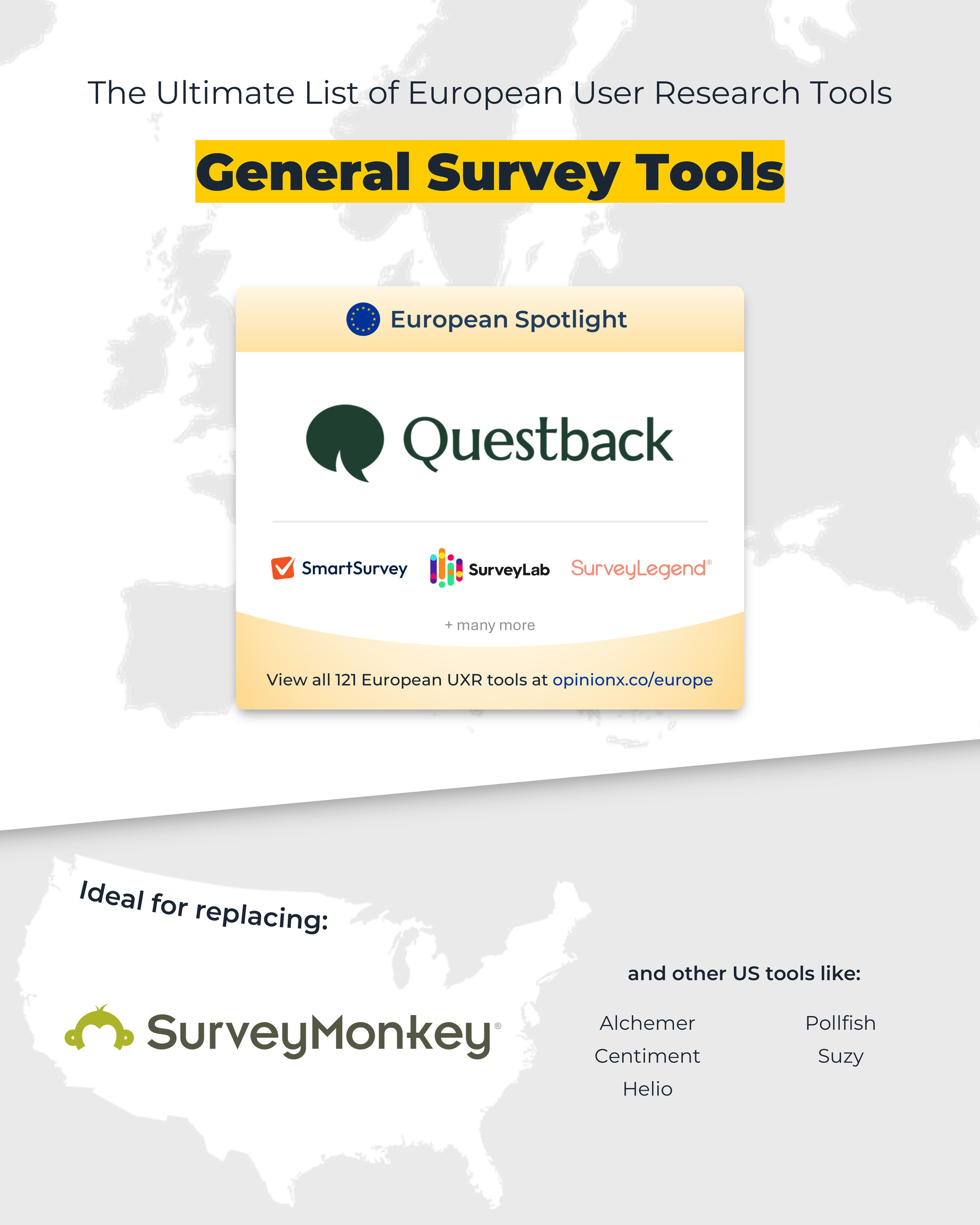
General survey tools are broad-purpose platforms running surveys across channels, use cases and departments. They lack the advanced methods that make a research platform useful, so researchers usually adopt them as a secondary tool rather than procuring them for research.
US tools in this category → Alchemer, Centiment, Helio, Pollfish, SurveyMonkey, Suzy
QuestBack (Norway) → Enterprise survey platform with advanced logic, multi-channel distribution and strong analytics, also covering large-scale CX and employee engagement programmes.
SmartSurvey (UK) → Mid-market platform balancing accessibility with feature depth, with an intuitive builder, large template library and integrated reporting.
More European options → Resonio (Germany), Survey Legend (Sweden), SurveyLab (Poland)

21. Consumer market research
Consumer market research platforms let brands gather insight quickly through surveys, polls and panels. They emphasise speed to insight and agile cycles, validating concepts, messaging and positioning without the methodological weight of an advanced research platform.
US tools in this category → Great Question, Instapanel, Pollfish, UserTesting
Attest (UK) → Rapid surveys with automated sample management, for teams iterating quickly on consumer concepts and message testing.
Appinio (Germany) → Consumer research with AI-assisted survey creation and a behavioural psychology focus. Known for fast turnaround, with an average field time of 23 minutes, and 1,200-plus psychographic targeting characteristics across 190-plus markets.
More European options → Bulbshare (UK), Make Opinion (Germany)
How should you evaluate a switch to European research tools?
Swapping tools for political reasons alone gets expensive fast. A few things worth checking before you move anything.
Check where the data actually sits, not where the company is registered. A European company running on American cloud infrastructure has the same jurisdictional exposure you were trying to avoid. Ask which regions the data is stored and processed in, and get it in writing.
Look past the headquarters to the ownership. Plenty of European tools have American investors or American parent companies. That may not matter to you, but it should be a known fact rather than a surprise during a security review.
Price the switching cost honestly. Historical data, integrations, team retraining and the studies already in flight all have a cost. For a repository or an analytics platform, that cost can exceed several years of licence fees.
Start with renewals. The cheapest time to switch anything is the month before it auto-renews. Work through your stack by renewal date rather than by how much you'd like to move.
Test with a real study. A demo tells you what the sales team wants you to see. Run something small and real, on the tool, with your own participants, before you commit to a year. Most European research tools in this list have a free tier or a trial, so this costs you an afternoon.
When the results come back, participant-level data is the thing to check for. If you can't export it, you can't take your history with you when you leave.
Frequently asked questions
What are the best European research tools? It depends entirely on the category. For advanced survey research, OpinionX (Ireland) and Forsta (UK). For participant panels, Prolific (UK), Cint (Sweden) and TestingTime (Switzerland). For usability testing, Userbrain (Austria), Useberry (Greece) and UXTweak (Slovakia). For product analytics, Contentsquare (France), Piwik PRO (Poland) and Smartlook (Czechia). This article covers European research tools across 21 categories.
Why are European companies switching to European research tools? Two reasons. Roughly 83% of European software and cloud spending goes to American companies, which concentrates a lot of operational risk in one jurisdiction, and a series of politically driven service disruptions since 2025 has made that risk visible. Data residency requirements under GDPR are the second driver and often the more immediate one.
Are European research tools GDPR compliant by default? No. Being headquartered in Europe makes compliance easier and doesn't guarantee it. Check where data is stored and processed, which sub-processors are used, and whether the vendor's own infrastructure sits with an American cloud provider.
Which European research tools replace Qualtrics? For enterprise-wide experience management, Forsta (UK) is the closest equivalent. For the advanced research methods specifically, meaning conjoint, MaxDiff, Van Westendorp and Gabor Granger, OpinionX (Ireland) covers those on a self-serve platform.
How often is this list of European research tools updated? Every listing was re-checked on 25 August 2026, and the next review is scheduled for January 2027. Tool markets move fast, so verify anything you're about to buy.
None of this says American software is bad; plenty of it is the best in its category. The point is narrower. Working out which European research tools exist costs you an afternoon now, and considerably more when a renewal date or a policy decision forces the question for you.
Want more like this? Over 42,000 researchers and product people get The Full-Stack Researcher in their inbox. Subscribe for the next one.
If advanced survey research is the category you're looking at, OpinionX is Irish, runs every method on the free tier at $0 with a 25-participant cap per survey, and costs $900 a year to lift it (full pricing). Try it before you talk to anyone.