
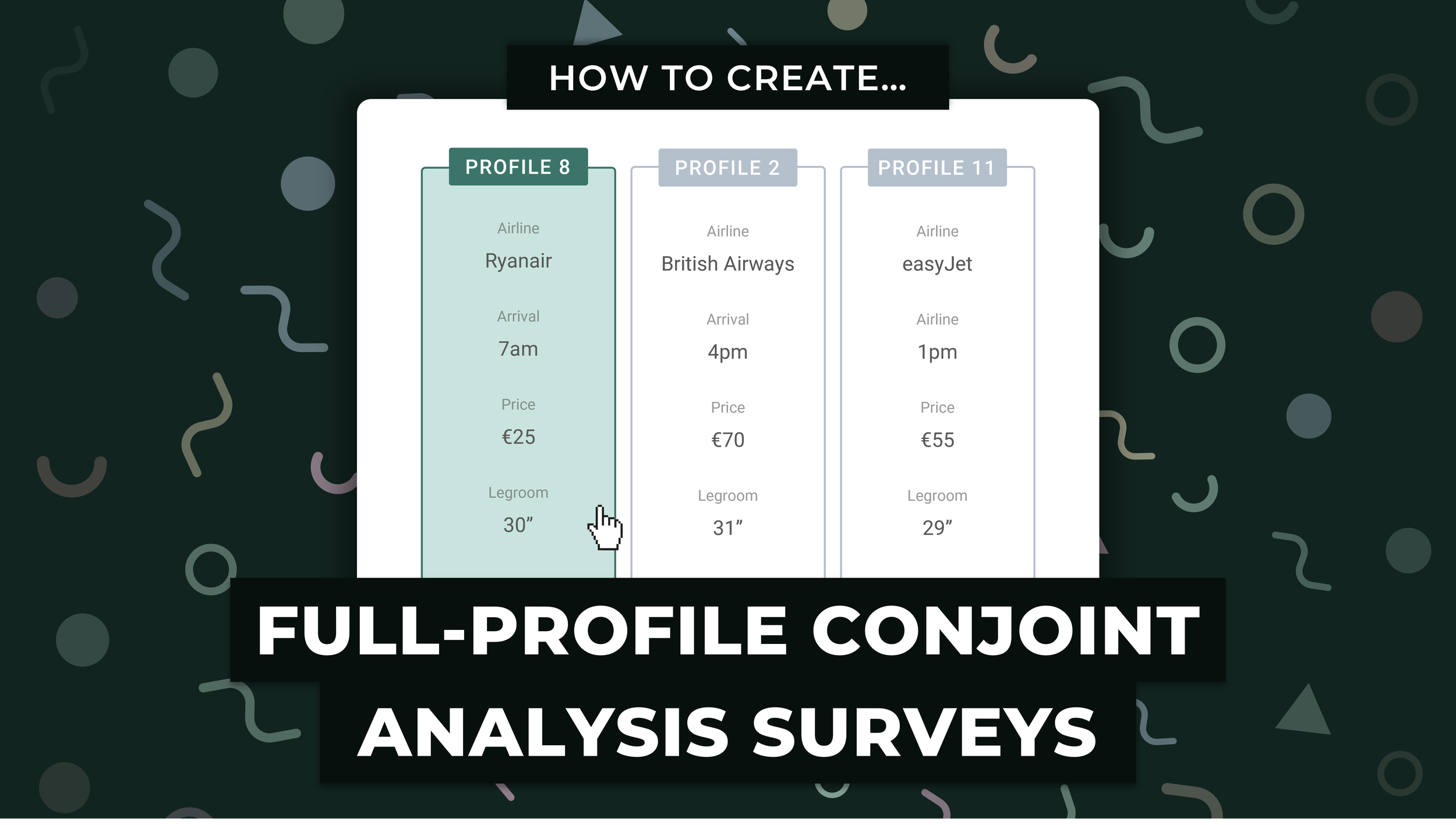
“Full-profile conjoint analysis shows people a set of fixed, pre-built product profiles and measures which ones they prefer, rather than randomising the attributes on each profile the way modern choice-based conjoint does. It’s one of 13 types of conjoint analysis and one of the oldest. Because the profiles are fixed, you can run it with ordinary ranking methods, pairwise comparison, MaxDiff or ranked choice voting, which makes it simpler to build and analyse than a true choice-based design. It’s genuinely useful in one situation: when your profiles have to represent real, existing products (actual phone models with their real specs) rather than every possible combination of attributes.”
What is conjoint analysis?
Conjoint analysis is a survey method that measures how important different attributes (price, brand, features) are when people compare products. It typically shows two to five profiles at a time, each with a set of attribute options, and works out which options tend to appear on the profile people pick as their favourite.
What is full-profile conjoint analysis?
Full-profile conjoint analysis is a form of conjoint where a set of fixed profiles is built in advance, instead of letting the attribute options be randomly combined, and the results show which whole profiles were most and least likely to be chosen.
The difference from a standard choice-based conjoint is simple: in choice-based conjoint the options on each profile are randomised, while in full-profile conjoint the profiles are fixed. That makes both the survey design and the analysis simpler.
It's worth being upfront about where this sits. The method is one of the oldest of the 13 conjoint types, and for most research today choice-based conjoint has replaced it. This guide covers it because there's one situation where fixed profiles are exactly what you want, and because if you do need it, it's easier to run than people expect.
That situation is when your profiles must represent real products. Here's a full-profile conjoint for a set of actual smartphone models, where the levels on each profile are the phones' true specifications. A randomised choice-based design would be wrong here, because it would generate profiles describing phones that don't exist.
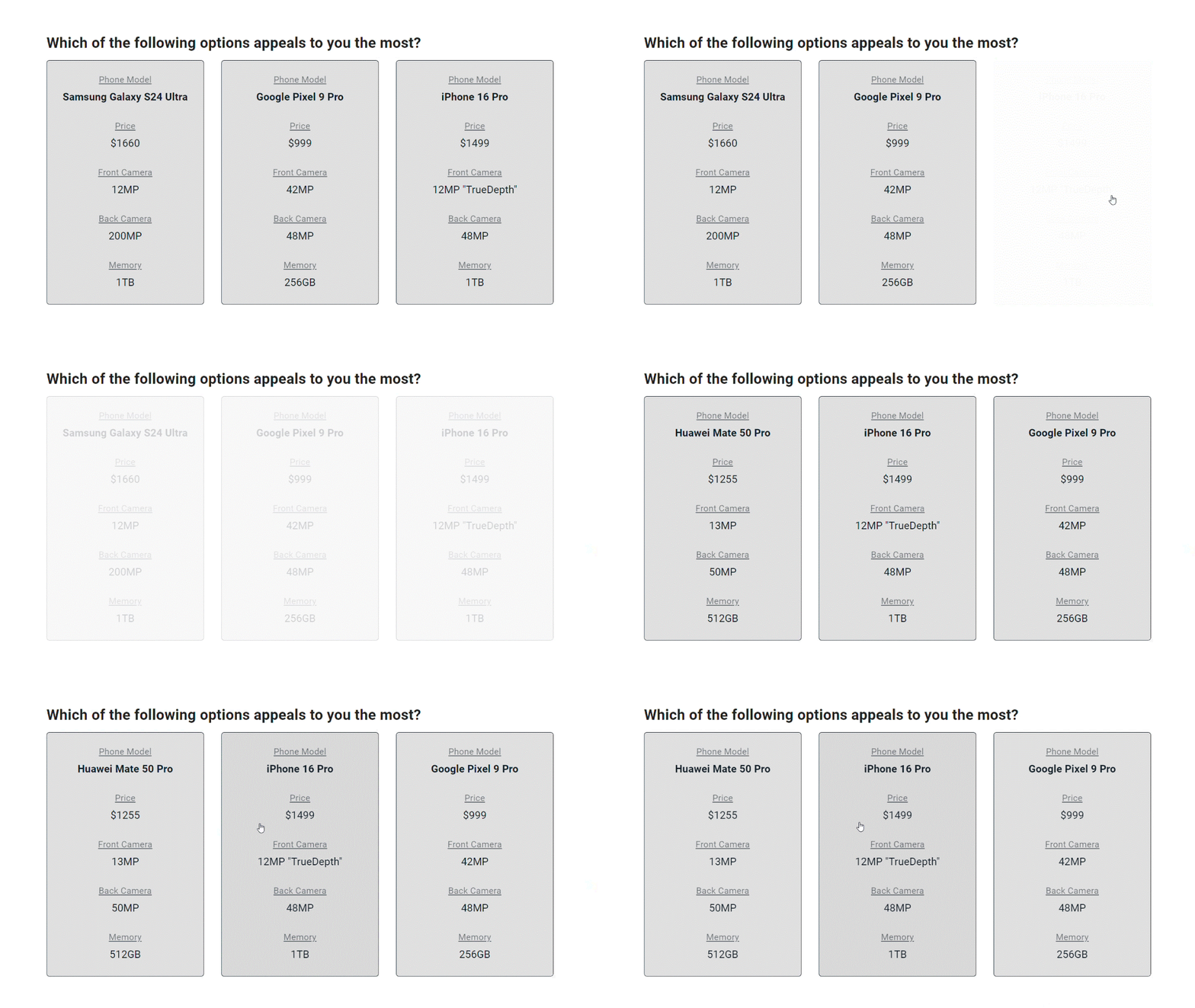
4 voting formats for fixed profiles
Because the profiles are fixed, you can run it with ordinary single-list ranking methods: MaxDiff, pairwise comparison and ranked choice voting. That's the practical appeal: no specialist conjoint software needed.
1. Pairwise ranking
Pairwise comparison turns your list of profiles into a series of head-to-head votes. Profiles are ranked by the percentage of pairs they win, on a 0 to 100 scale.
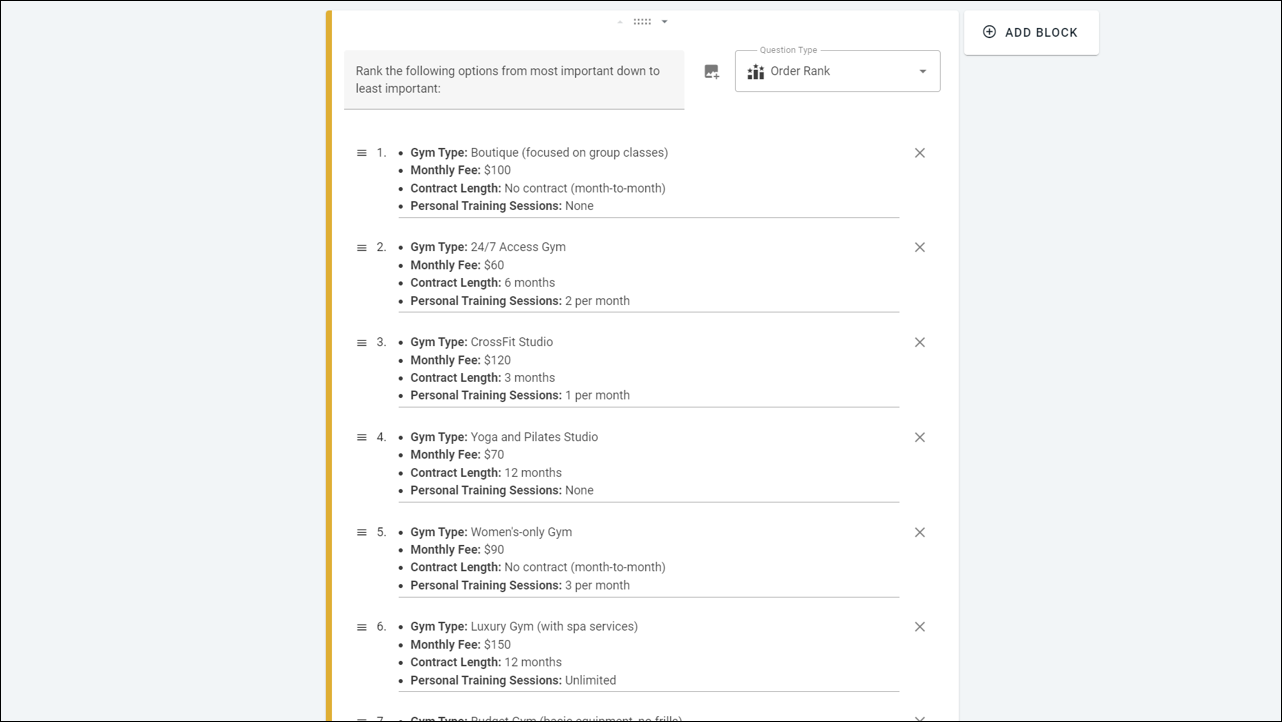
To build it, add each profile as a single ranking option in a pairwise comparison survey, using line breaks to separate the attributes within each profile.

2. Best/worst scaling
Best/worst scaling, also known as MaxDiff, shows 3 to 6 profiles at a time and asks people to pick the best and worst in each set, rather than the two-at-a-time of pairwise.
MaxDiff is usually scored with a simple formula, (best% − worst%) ÷ appearances, giving each profile a score from −100 to +100. As with pairwise, paste each profile in as a single option on a best/worst ranking survey.

3. Ranked choice
Ranked choice voting is the format most people already know: each participant ranks the profiles from most to least preferred. Paste your profiles into a ranking survey as options.
Scores use the Dowdall count, where each profile gets 100 divided by its rank position, so 4th place scores 100/4 = 25. This lets participants leave out irrelevant options without skewing the result, since exclusions count as zero, and each profile's final score is the average across participants on a 0 to 100 scale.
4. A true choice-based version
The first three formats show that a fixed-profile design runs fine on ordinary ranking methods. That raises an honest point: because the levels on each profile are fixed, this isn't really conjoint analysis at all. Conjoint rests on multi-variable discrete choice, and a fixed profile is effectively a single variable.
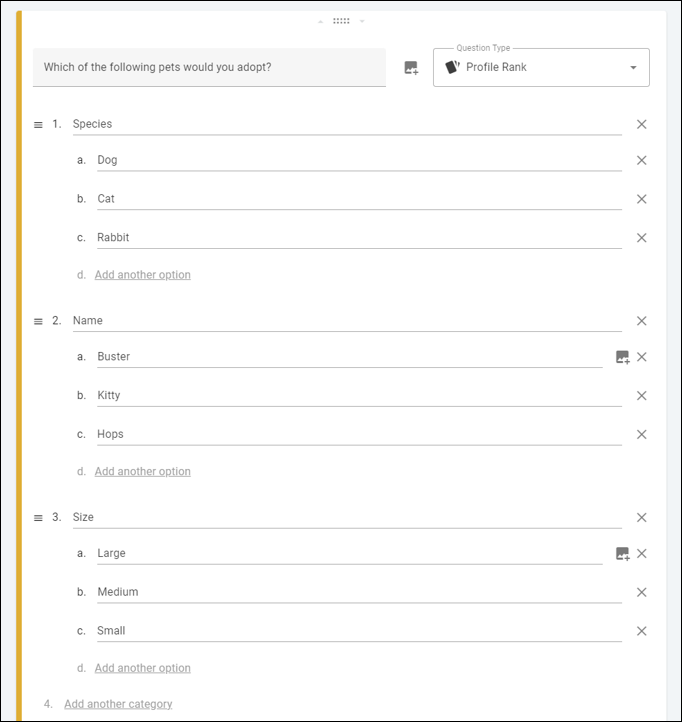
If you do want to run it as an actual conjoint format, you can. Build your categories and profiles, then use the prohibited pairs feature to set up a conditional design that stops options appearing together when they shouldn't. You set up "tiers", each representing one full profile, and specify which options are allowed to appear when that tier is used. A "Dog" tier might allow only "Dog", "Buster" and its matching attributes, so you never generate a nonsensical combination.
When should you use full-profile conjoint instead of choice-based conjoint?
Rarely. The answer is to use it only when your profiles must represent specific real products.
A fixed-profile conjoint is an old-fashioned approach, and as a general default it isn't the one to reach for. For nearly all studies, a standard choice-based conjoint gives you more, and where you need to stop nonsensical combinations appearing (a dog named Hops), conditional configuration through prohibited pairs handles that inside a normal choice-based design.
So the decision is narrow. If your profiles are real, fixed things you want ranked, a full-profile approach run through pairwise, MaxDiff or ranked choice is simple and works. If your profiles are combinations of attributes you want to decompose, which is the usual case, use choice-based conjoint. If conjoint turns out to be more than you need at all, the alternatives guide covers simpler methods.
Frequently asked questions
What is full-profile conjoint analysis? It's a form of conjoint that shows people a set of fixed, pre-built profiles and measures which they prefer, rather than randomising the attributes on each profile. It's one of the oldest of the conjoint types, largely superseded by choice-based conjoint for modern research.
How is it different from choice-based conjoint? In choice-based conjoint the options on each profile are randomised, so you can decompose which individual attributes drive choice. In full-profile conjoint the profiles are fixed, so you learn which whole profiles are preferred but not as cleanly which attributes did the work.
When should you use full-profile conjoint? When your profiles need to represent real, existing products, like actual phone models with their true specs, so a randomised design would generate combinations that don't exist. For most other studies, choice-based conjoint is the better fit.
Do you need special software for this method? No. Because the profiles are fixed, you can run it with ordinary ranking methods: pairwise comparison, MaxDiff or ranked choice voting. That's one of its few practical advantages over choice-based conjoint.
Is this method still worth using? For most researchers, rarely. It's an older framing that choice-based conjoint has largely replaced. It earns its place only in the narrow case of ranking fixed real-world products.
Full-profile conjoint is a legacy method with one good modern use: ranking fixed, real products where a randomised design would invent combinations that can't exist. Outside that, reach for choice-based conjoint. And when your profiles are fixed, you don't need conjoint software at all; pairwise, MaxDiff or ranked choice will do the job.
Want more like this? Over 42,000 researchers and product people get The Full-Stack Researcher in their inbox. Subscribe for the next one.
You can run any of these formats on OpinionX for free: $0, unlimited surveys, unlimited researcher seats, capped at 25 participants per survey, then $900 a year to lift the cap (full pricing). Create a ranking survey, or read the complete guide to conjoint analysis first.
About The Author:
Daniel Kyne is the Co-Founder of OpinionX, a free research tool for stack ranking people’s priorities — used by thousands of product teams to better understand what matters most to their customers. OpinionX comes with a bunch of research methods for measuring people’s preferences, including free MaxDiff and conjoint analysis surveys. Try it now!