
Never Say Usually: How To Ask Questions In User Interviews
And other tips for discovering your customer's detailed, messy reality, featuring Teresa Torres, The Mom Test, and Indian Matchmaking.
“In user interviews, “usually” questions like “How do you usually…?” feel safe but pull vague, idealised answers, and vague answers are no use in discovery research. Better questions anchor the person to a specific, recent moment: “When was the last time you…?” instead of “What do you usually do?”. The change is small, but it changes what you learn.”
Once someone reveals their messy, specific reality, the only question left is "Why?", asked many times and without judgement. Learning which questions to avoid is the easy part. Earning enough trust that people share their real needs, pains, and desires is the hard part.
Why do "usually" questions produce vague answers?
"How do you usually … ?"
Hypothetical questions like this are easier for everyone in a research interview. Asking someone what they "usually" do removes any pressure to reveal personal details. You want your interviewee at ease, and that's exactly what a "usually" question does.
But "usually" questions also encourage people to present the ideal version of themselves: the person who goes to the gym at least 3x/week, rarely procrastinates, always gets out of bed after their first alarm, and is never influenced by ego, corporate politics, or pettiness.
This "ideal" profile isn't useful for researchers, but that's not the real issue. The bigger problem is that hypothetical questions push participants toward vagueness, and vagueness is the enemy of discovery research.
Discovery research is about uncovering the unmet needs, pains, and desires that drive behaviour. Those aren't "ideal". They're often a little embarrassing to admit, like wasting an hour browsing Netflix and never picking anything to watch.
What does a specific question look like? The Netflix example
Imagine you're a Product Manager at Netflix trying to grow hours watched per user (their North Star Metric). To find product opportunities, you interview some Netflix users about how they use it.
In the hypothetical approach, I ask Sam how he tends to use Netflix, and he says he recently finished Love is Blind, Too Hot To Handle, and Indian Matchmaking. My takeaway is that Sam loves reality dating shows, so Netflix should suggest more of them.
In the specific approach, I ask Sam about the last time he used Netflix. He tells me he finished Indian Matchmaking two nights ago, and that last night he spent longer hunting for something new than actually watching. My takeaway is that Sam has a content-discovery problem, and I need to dig into where the recommendation features are failing him.
A tiny change to the question, and the research tells you something completely different.
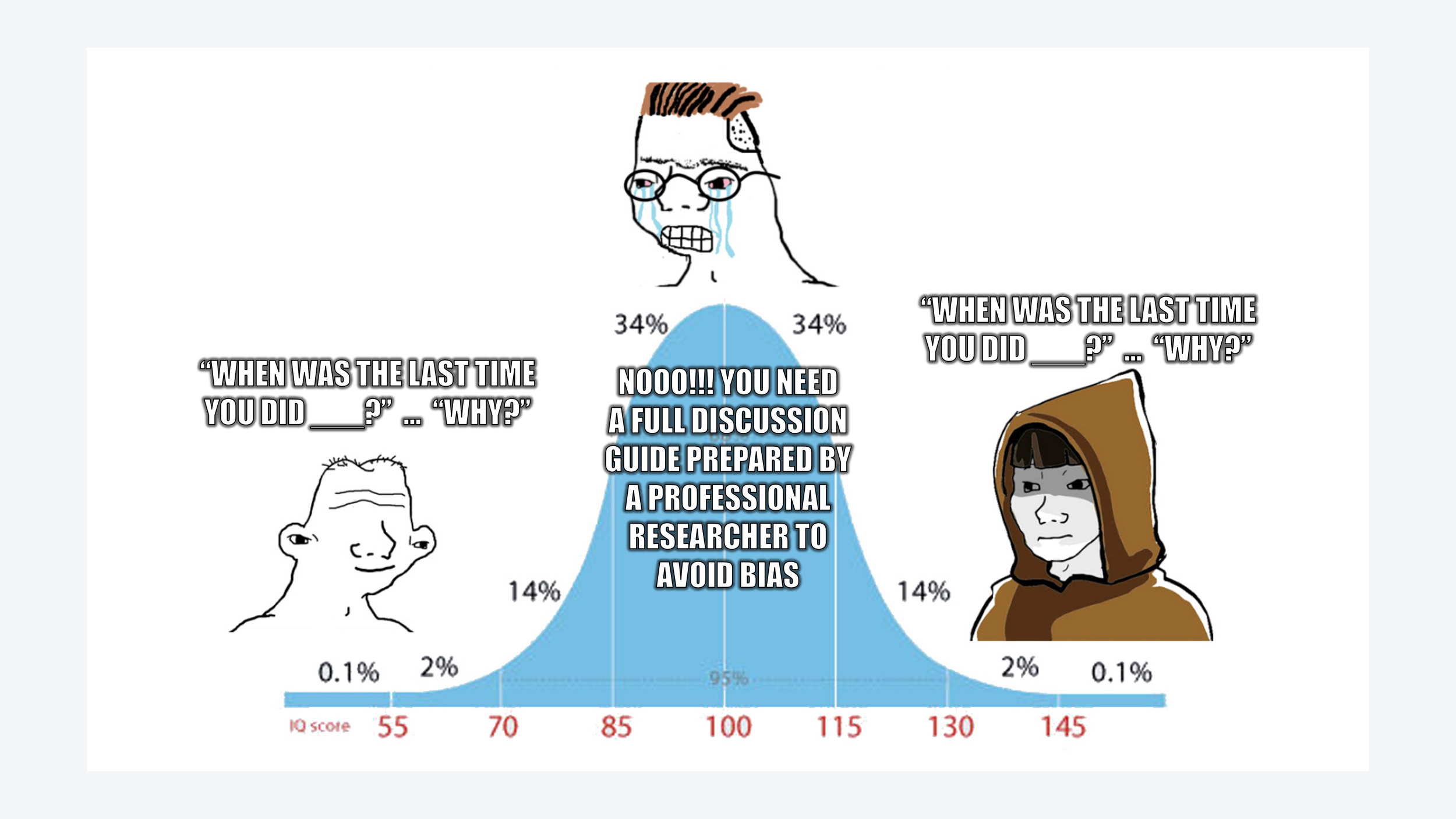
How do you avoid vague user interview questions?
A few fluffy question types lead to vague answers:
Generic: usually, always, never…
Hypothetical: might, could…
Future-tense: would, will…
Indirect: Do you ever…, Have you considered…
Good questions do the opposite: they anchor the person to something concrete. When you catch yourself reaching for a fluffy one, swap in a specific question. Here are the swaps that turn a vague question specific:
| Vague question to avoid | Specific question to ask instead |
|---|---|
| Generic (usually, always, never) | When was the last time you …? |
| Hypothetical (might, could) | Can you tell me more about your most recent … project? |
| Future-tense (would, will) | What was a memorable time that you tried to …? |
| Indirect (Do you ever…, Have you considered…) | What were you doing right before you decided to …? |
You're after a loose thread, an answer that opens something up and lets you dig into their experience. Once you're through, there's only one question you really need.
What's the most important question in a user interview?
Opportunities don't live in what someone "usually" does. They live in the specific. You're trying to uncover the person's messy, awkward reality in all its detail, and when they (very generously) reveal it, your job is to understand why it's like that.
From there, the only move is to ask "Why?", again and again, in a way that keeps the other person comfortable sharing their needs, pains and desires. For that, they need to trust you won't judge them, won't out their answer, and won't use it against them later.
Learning which questions not to ask is the easy part. Building trust in a user interview is the real challenge.
Specificity in discovery research is covered in two books: The Mom Test by Rob Fitzpatrick (customer discovery) and Continuous Discovery Habits by Teresa Torres (product discovery). The difference between customer and product discovery is explained in this post. The Netflix example comes from Teresa's book.
Once your interviews have turned up the specific problems people actually have, the next step is measuring which ones matter most. That's where a qualitative technique like this pairs with a quantitative one: see the Discovery Sandwich for how the two layers fit together, and customer problem stack ranking for turning a messy list of problems into a ranked one.
Frequently asked questions
What is a specific question in user research? A specific question anchors someone to a real, recent moment ("When was the last time you…?") instead of a general habit ("What do you usually do?"). Specific questions show what people actually did, not the idealised version of themselves.
Why are "usually" questions bad in user interviews? They feel comfortable, so people answer with an idealised, vague version of their behaviour. Vague answers hide the real needs, pains and desires that discovery research exists to find.
What questions should you ask in a user interview? The best user interview questions anchor to a concrete instance: "When was the last time you…?", "Tell me about your most recent … project", "What were you doing right before you decided to…?". Then follow the interesting threads with "Why?".
What is the most important question in customer discovery? "Why?", asked repeatedly once someone reveals a specific, messy detail. The technique is easy; the hard part is building enough trust that people answer honestly.
What's the difference between customer discovery and product discovery? Customer discovery (The Mom Test) is about understanding customer problems; product discovery (Continuous Discovery Habits) is about deciding what to build. The full distinction is here.
Subscribe to The Full-Stack Researcher newsletter, where we share research strategies for founders and product teams.