
Cobria was ready to launch their new AI app for contractors, but they had no idea what the price should be. They decided to partner with pricing consultancy Jeanny Consulting who designed a two-step study on OpinionX that would engage construction business owners and managers to uncover which Cobria features target customers valued most and how to charge for them.
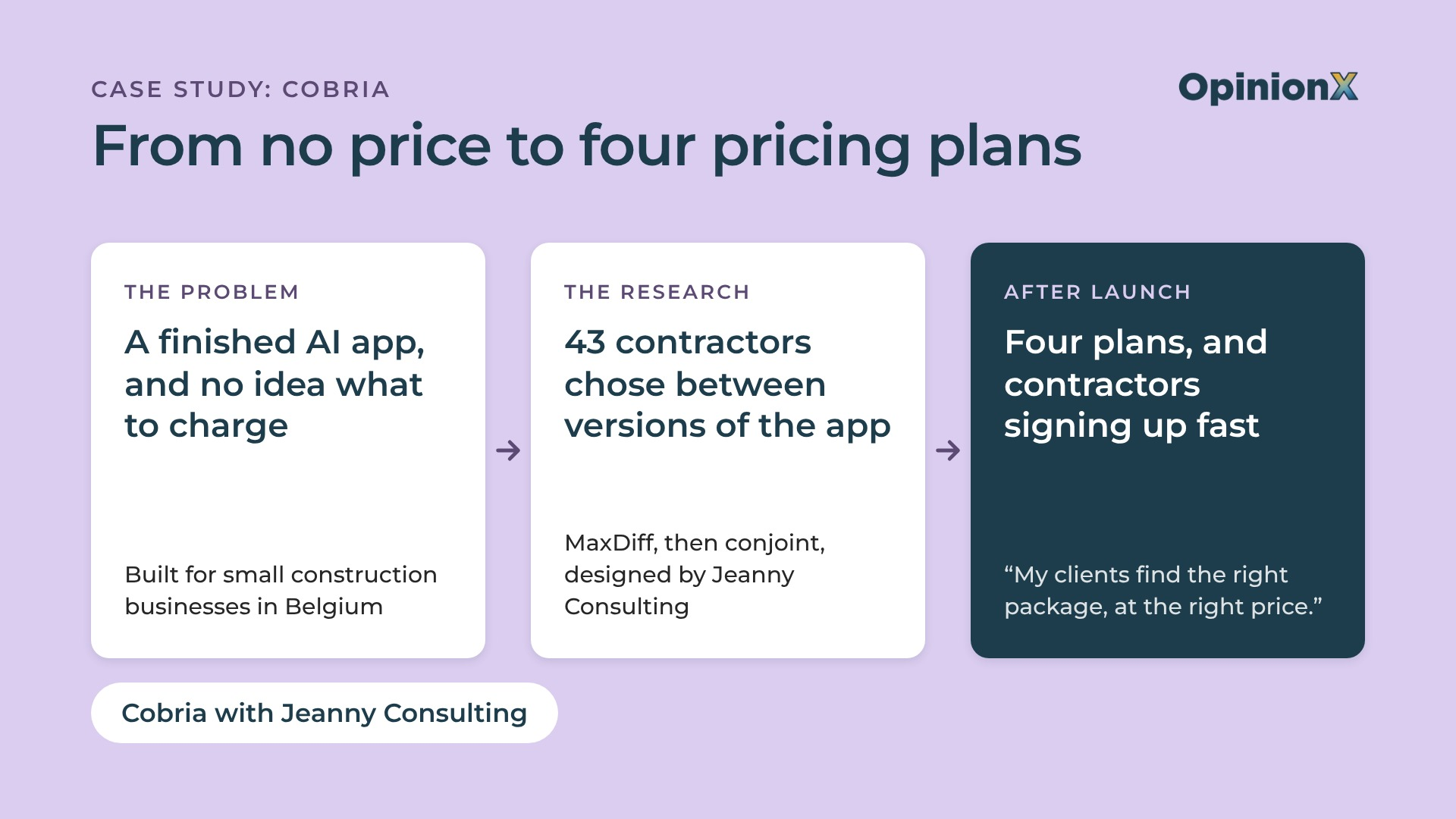
A polished product, but no idea what to charge for it
Cobria is an all-in-one app for small construction businesses. Originally launched in Belgium, it has since expanded into France, the Netherlands, Luxembourg and Germany. Contractors use Cobria to write quotes and invoices, to manage clients, and to plan their teams. Cobria’s secret sauce is their AI assistant, which lets users work in their own language, for example, a Romanian builder can create a quote in Romanian and their client in Paris will receive it in French.
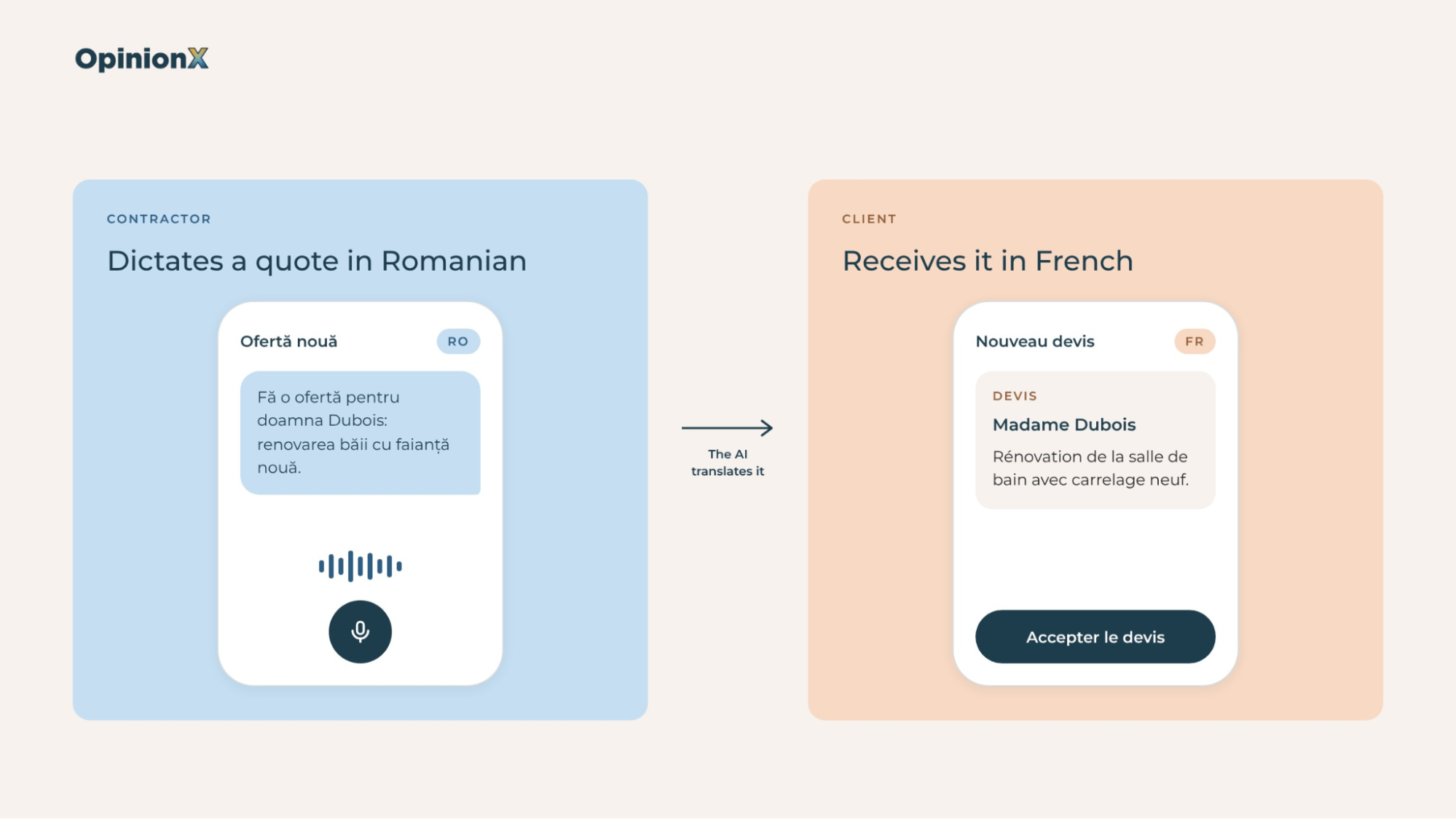
Illustrative image
The app worked wonders, but the team at Cobria had no plans, packages, or pricing model. When its founder sat down with pricing consultant Georges Copetinas, he started off by saying:
“Georges, I think our idea is brilliant, but honestly, I have no clue how much I can charge for this service.”
There was no product like it to copy either; the big construction software companies were adding AI to established SaaS tools, while Cobria put AI at the centre of the product from day one.
Without research, Georges believes Cobria would've launched with one price for everyone, leaving loads of potential revenue on the table. Plenty of startups price with a number that feels about right with plans to optimise it later, but later becomes never despite not knowing just how much money they’re leaving on the table.
Charting a path to an evidence-based pricing strategy
With more than 20 years of pricing experience, Georges saw Cobria as part of a familiar pattern. Today, he is managing partner at Jeanny Consulting, a Belgian pricing and revenue growth consultancy that's part of Cronos Group.
To show Cobria's founders what research could tell them, Georges walked them through results from a demo conjoint survey Jeanny Consulting had built on OpinionX. Andreas said this demo showed exactly the kind of information they needed to build better pricing and product strategy for Cobria.
Jeanny Consulting's plan for Cobria had two steps:
A MaxDiff Analysis survey to cut their long list of possible key features down to a shortlist of the most important ones.
A Conjoint Analysis survey to measure what each of those features is worth to contractors and how much they’re willing to pay for them.
Michelle Bex, Jeanny Consulting's data and pricing analyst, built both surveys on OpinionX.
Step 1: Cutting 15 ideas down to a shortlist
Two workshops with Cobria produced a list of 15 possible features that pricing plans could be built around. These included Cobria’s mobile app, its AI assistant with its translation capabilities, as well as things like technical support and training.
A list of 15 features, each with different potential configurations, is far too many to test in one conjoint analysis survey. That’s why Michelle at Jeanny Consulting decided the first step should be to create a shortlist using a MaxDiff Analysis ranking survey.
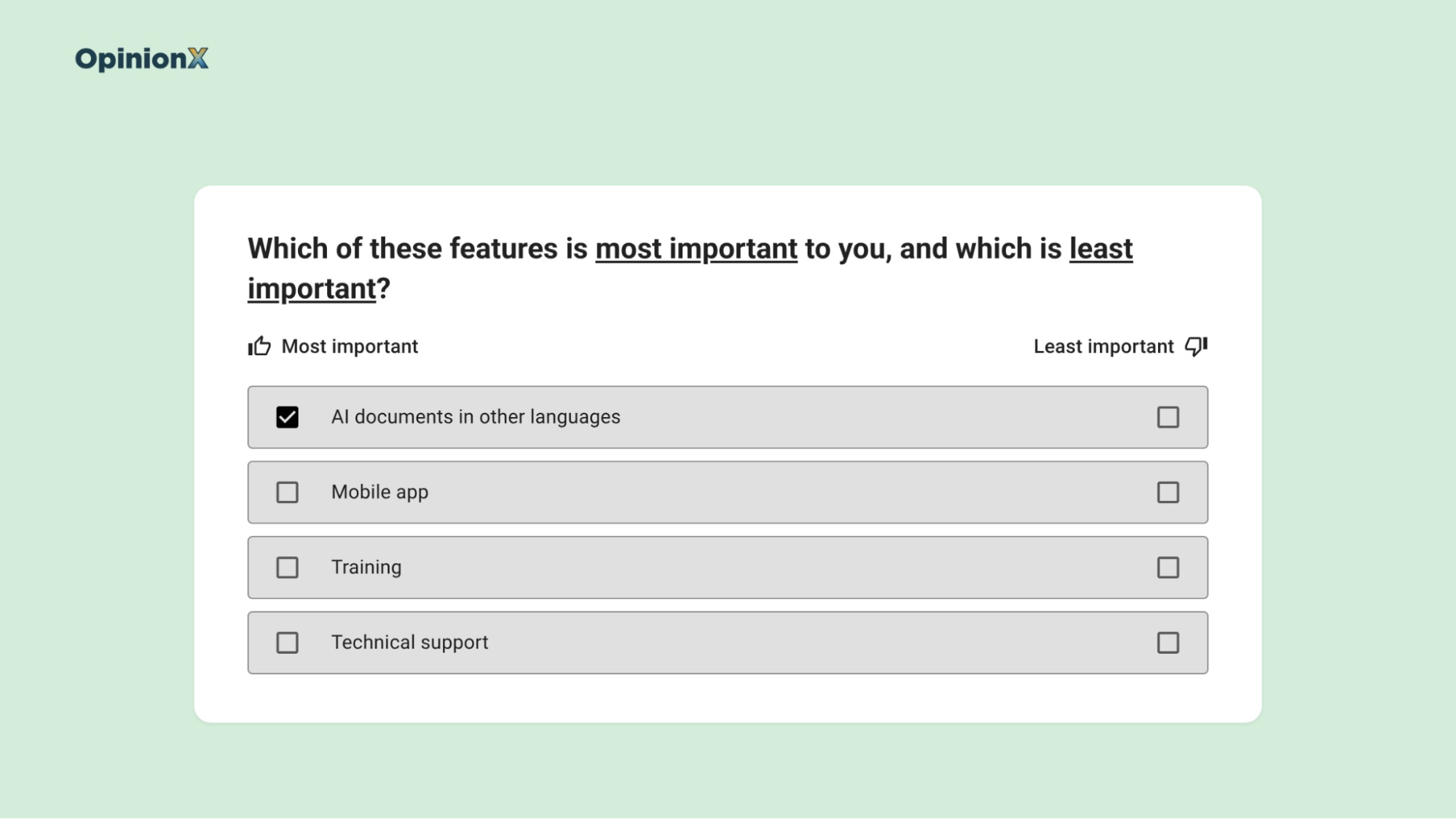
MaxDiff Analysis is a survey method that ranks a long list of options by relative importance. It works by showing people just 3-6 options at a time and asking them to pick the most and least important option from each set. The survey tool then calculates a score for every option based on these votes.
MaxDiff votes turn into ranked results automatically in real time, so Michelle could see right away that ‘AI document translation’ was ranking in the top three alongside ease of use and price top priorities.
Step 2: Testing potential pricing plans with contractors
Now that Michelle had measured which features were most important to target customers, it was time to test different pricing plans using those features. To run those tests, Michelle created a conjoint analysis survey.
Conjoint analysis is a survey method that shows people sets of profiles where each one contains a different combination of features and price. Each time participants pick their preferred profile, the survey tool saves their vote and creates a new set for them to vote on next. By analysing their choices, the survey tool can figure out which feature and price combinations make someone more likely to buy your product.
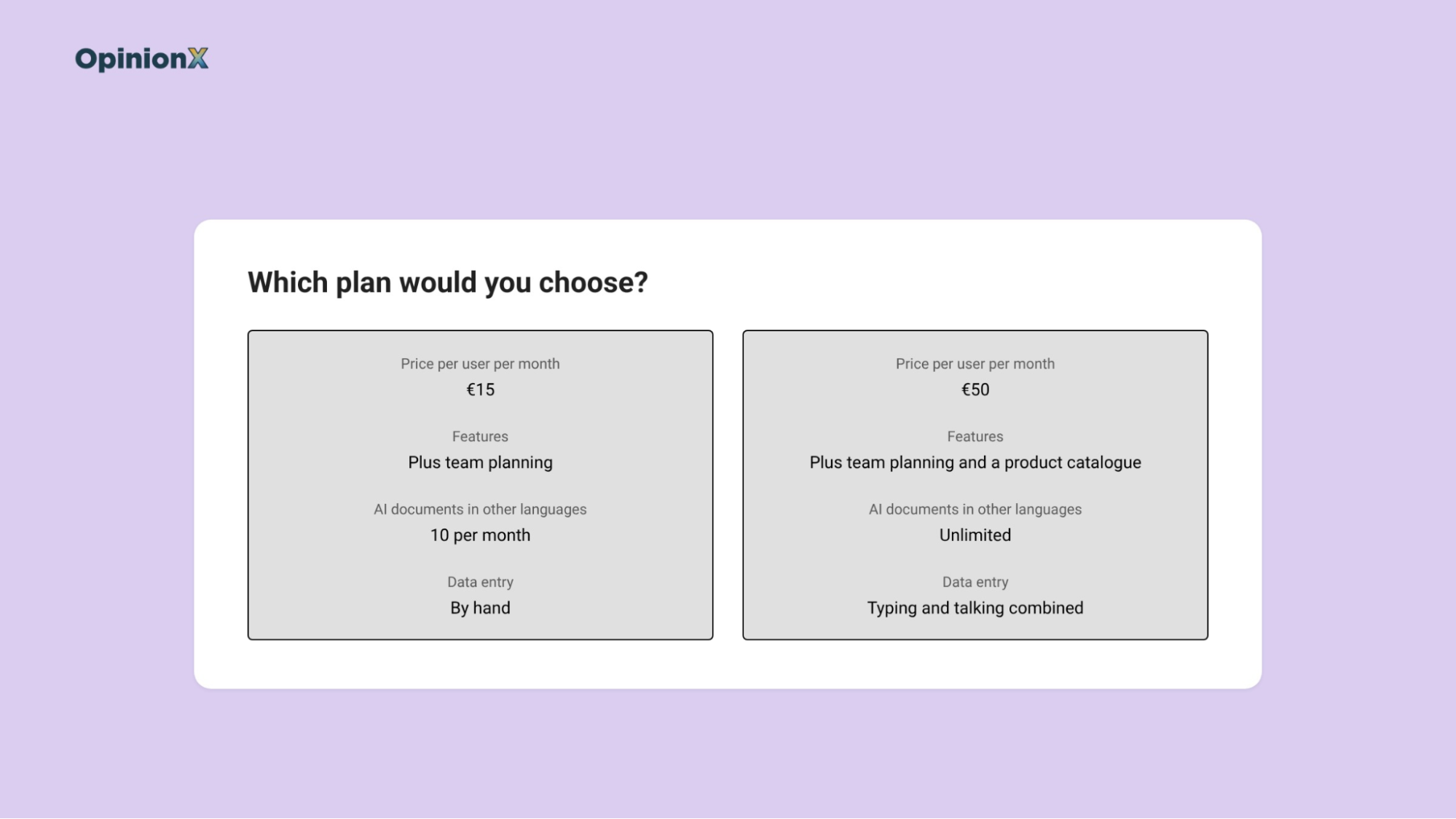
When you’re designing a conjoint survey, you need to decide two things: (1) what categories should appear on every voting profile, and (2) what list of options should be available within each of those categories.
While Cobria wanted to test a lot of features, Michelle was keen to ensure that the cards were easy for people to read and understand, especially on mobile phones. Conjoint analysis can quickly become overwhelming to respondents if too much information is included.
In the end, Michelle chose four categories: Price, Feature Bundle, AI Documents Limit, and Data Entry Method. For each of those categories, a list of options were added that the conjoint survey could select from during its automated voting setup for each person.
| Categories | Options |
|---|---|
| Price per user per month | Free, €15, €50, €90 |
| Features | Quotes and invoices with contacts; plus team planning; plus team planning and a product catalogue |
| AI documents in other languages | None, 10 per month, 50 per month, unlimited |
| How contractors enter data | By hand, typing to the AI, talking to the AI, typing and talking combined |
Recruiting conjoint survey participants
To source respondents for the survey, they partnered with a Belgian construction union and offered a prize draw to incentivise people to participate. Using OpinionX’s multi-language functionality, they sent the survey in Dutch, French and English, fielding it across June and July 2025. In total, the survey engaged 223 respondents.
The survey asked every participant to rate their involvement in writing quotes and picking software on a scale of 1 to 10, so Jeanny Consulting could filter the results down to the people who decide what a construction business pays for. In the end, 74% of contractor respondents rated their involvement in procurement as 7/10 or higher, giving Michelle a solid sample to draw conclusions from.
What was most important to contractors
With voting complete and results calculated automatically, Michelle set out to gather the most important insights from their conjoint analysis.
Free was the strongest draw by far. The largest drop in preference was in the jump from the free offer to €15/month. Beyond that, the results showed barely any difference in preference between €15 and €50, which suggested room for a paid plan in the middle.
Unlimited AI documents was a key reason to upgrade. Capped allowances of 10 or 50 AI-translated docs per month unsurprisingly appealed less than unlimited docs, and people really didn’t like losing this feature entirely too.
Team planning and the product catalogue were worth paying for. On its own, the basic features version of the product put people off, while adding planning and the catalogue made pricing plans considerably more appealing.
Contractors split on AI. On average, entering data by hand scored about the same as the AI options, apart from voice on its own, which came dead last.
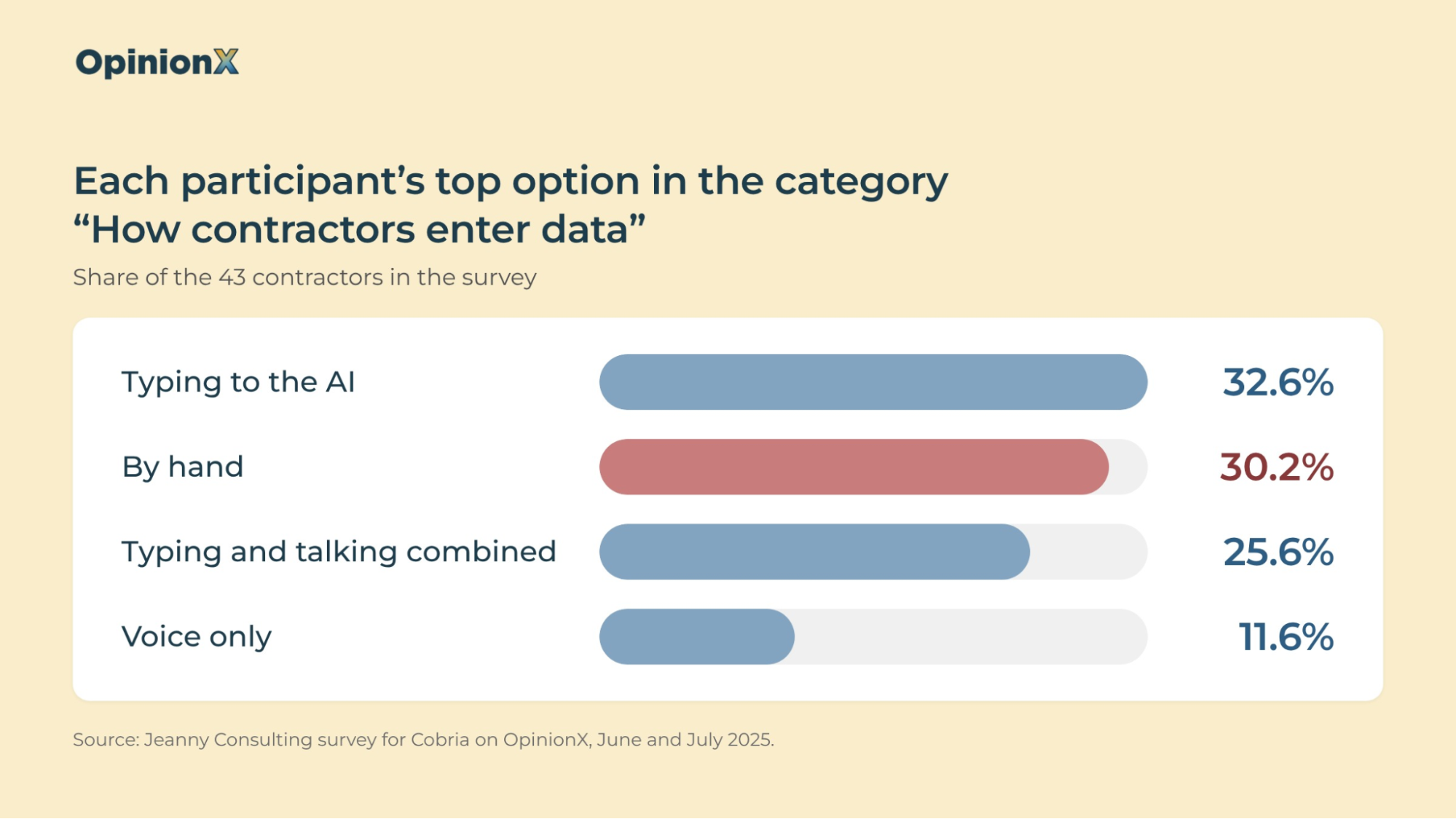
This hid the most important finding, though. Each contractor's own scores show that 14 of them preferred typing to the AI, 13 working by hand, 11 typing and talking combined, and only 5 voice alone.
Almost a third of the market would rather work by hand than use any AI option, which went straight against Cobria's AI-first plan, since an AI-only product would've shut those contractors out. Jeanny Consulting could see the split because OpinionX gives you each participant's results, not just the average.
Turning survey results into four pricing plans
Before jumping straight to recommending changes to Cobria pricing, Michelle ran some pricing experiments using her conjoint data in OpinionX’s scenario simulator. The scenario simulator allowed Michelle to create 2 or more hypothetical pricing plans and then see the percentage of contractors that would pick each plan and the revenue each would generate.
| Plan | Features | AI documents | Data entry | Price per user per month | Share of users | Share of revenue |
|---|---|---|---|---|---|---|
| 1 | Core product | None | By hand | Free | 40% | 0% |
| 2 | Planning + catalogue | 10 per month | By hand | €15 | 28% | 20% |
| 3 | Planning + catalogue | 50 per month | Typing and talking to the AI | €50 | 5% | 12% |
| 4 | Planning + catalogue | Unlimited | Typing and talking to the AI | €50 | 28% | 68% |
No plan won on both adoption and revenue, unsurprisingly. The free plan and cheapest entry price were the preferred profiles for over two thirds of respondents, benefiting from people’s preference for lower prices despite these plans offering fewer features. While the conjoint data showed a clear aversion to expensive plans, balancing those higher prices with more AI access drove 33% selection of two €50 premium plans in the simulator results. These two €50/month plans together created 4x more revenue than the free and cheap plan, despite being the preferred choice of only a third of respondents.
The simulator made it clear that the team at Cobria would have to balance trade-offs between price aversion and functionality demand to design pricing plans that generated the adoption and revenue targets they had in mind.
In the end, Michelle’s recommendations centred around a simple principle: the free plan will aim to acquire contractors while paid plans monetise Cobria’s highly sought after AI capabilities.
| What the research found | What Cobria launched |
|---|---|
| A free plan with minimal features still won 40% of simulated users | Solo, free forever, with just quotes, invoices, and contacts as the feature set |
| Planning and catalogue features showed much higher willingness to pay than the core product | Essential plan at €24.90 per user per month unlocks team scheduling and the product catalogue |
| Unlimited AI documents earned 67% of simulated revenue | Monthly allowance of AI credits rises with each plan, from 1,000 per month on Essential (€24.90) to 2,500 credits on the Pro tier (€49.90) and 7,500 on Ultimate (€89.90). |
| Almost a third preferred working by hand rather than using AI input | The AI assistant is optional in every plan, next to the familiar ways of working |
Cobria solidified their final plans in a pricing workshop with Jeanny Consulting, where they compared the survey results with business goals and everything they knew about the market.
“Pricing should follow strategy, and not the other way around.”
Cobria went one step further than the research and included a small daily allowance of AI credits in the free plan, so contractors who work by hand can discover the value of Cobria’s AI before paying. Georges also suggested free one-hour sessions on using Cobria's AI to move them towards the paid AI plans, and the survey backed this idea: two thirds of contractors said they'd pay €150 for training in a quick Gabor Granger section at the end of the questionnaire.
What happened after Cobria launched their new pricing strategy
Contractors signed up fast. Georges says the team at Cobria was delighted with how quickly they won clients, and puts that success down to pricing that truly fit the customer. The founders at Cobria even turned down an acquisition offer just a few months after launch, showing just how well the market regarded their new offering.
Around the same time, Andreas from Cobria told Georges that his clients were finding the plan they needed:
“Our clients find the right package at the right price now.”
Measure what users think is most valuable in your pricing plans
If you're launching a new product without an obvious industry standard pricing model, or deciding which features belong in which plan, a conjoint analysis survey lets you understand how your target customers make trade-off decisions between price and functionality.
OpinionX offers conjoint analysis surveys on every plan, including on our free tier for up to 25 participants per survey. Create a free survey in minutes to see first-hand the kind of insights conjoint analysis can deliver for you.
Not sure where to start with a pricing study like this? We offer a free 30-minute consultation with a research expert where they’ll help you shortlist your features, write survey questions, plot your price range, and demonstrate how the analysis delivers actionable insights.
