
How a Gabor Granger survey picks the next price (sequential, random or binary search)
Gabor Granger is a pricing survey that shows each person one price and asks if they'd buy a given product or feature at that price. The method dates back to André Gabor and Clive Granger's work in the 1960s (Applied Statistics, 1961).
After every answer, the survey has to choose which price to show next. The rule for that choice is the price search. Most people never think about it, but it decides how many questions each person answers, and that decides how many prices you can afford to test.
This guide compares the three kinds of Gabor Granger price search, shows how many questions each one takes, and explains why the first price counts too.
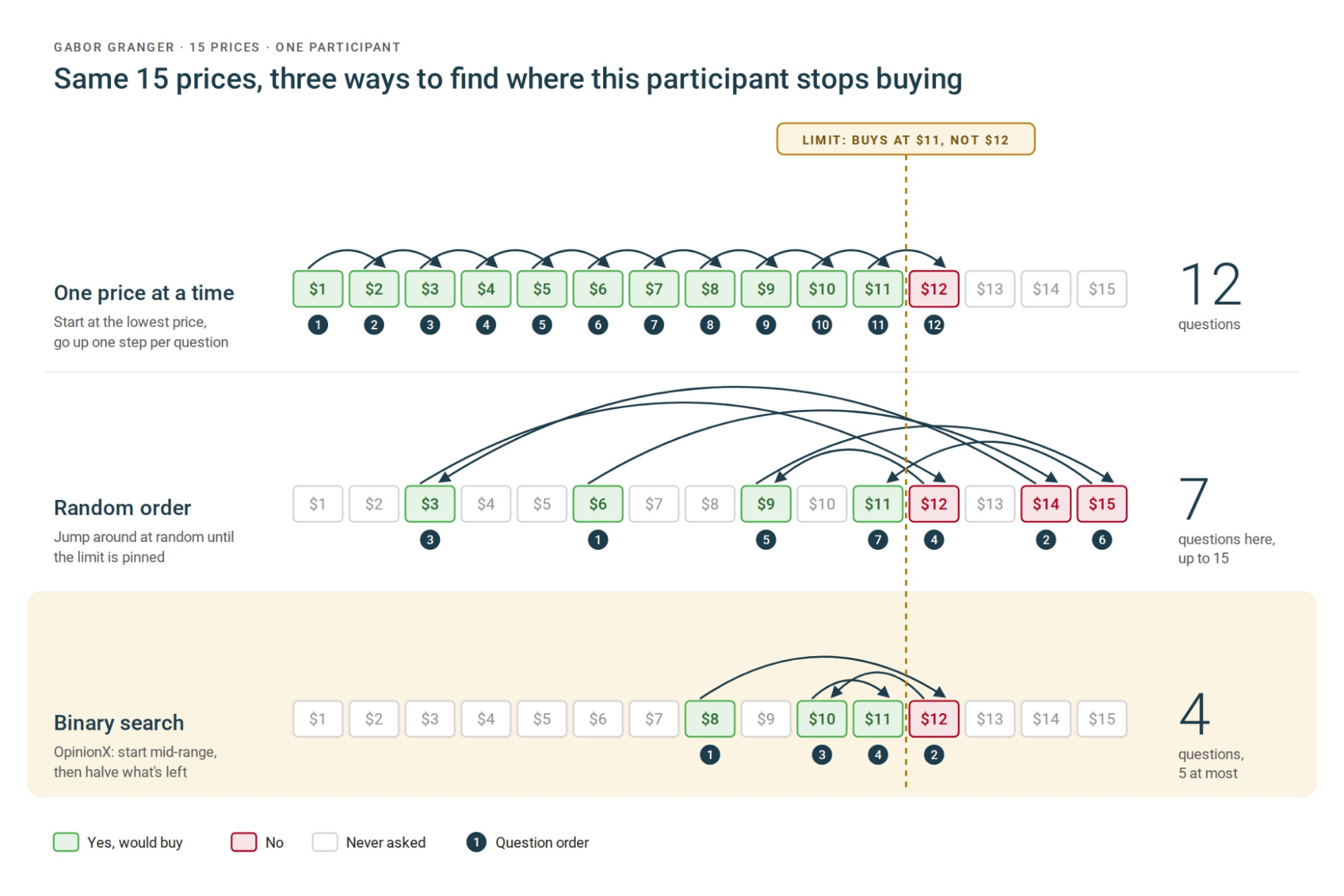
What are the three ways to pick the next price?
Take a survey that tests 15 prices, from $10 to $38 in $2 steps. One person would pay up to $15, so the highest price they'd say yes to is $14. Each search below starts at $24, the middle price, and has to find that $14.
Sequential. The survey moves one price at a time. After a no, it shows the next price down. After a yes, it shows the next price up. For this person, that's $24, $22, $20, $18, $16 and $14. It takes 6 questions.
Random. The survey jumps to any price that could still be the answer. After a no at $24, it might show $20, then $12, then $16, then $14. That's 5 questions, but the path changes every time, so the question count does too.
Binary search. The survey jumps to the middle of the prices that could still be the answer. Each answer rules out half of them. For this person, that's $24 (no), $16 (no), $12 (yes) and $14 (yes). It takes 4 questions.
How many questions does each one take?
Here are the question counts for 15 prices and for 100 prices. In every case, the survey picks the first price at random from the middle third of the prices, which the section below explains.
| Price search | 15 prices: average | 15 prices: most | 100 prices: average | 100 prices: most |
|---|---|---|---|---|
| Sequential | 5.6 | 🔴 11 | 27.6 | 🔴 67 |
| Random | 4.5 | 🟡 No fixed limit (10 in testing) | 8.1 | 🟡 No fixed limit (20 in testing) |
| Binary search | 4.1 | 🟢 5 | 6.7 | 🟢 8 |
These figures come from working through every possible answer for each method. The random method changes each time, so its figures come from millions of simulated runs.
Sequential grows with the number of prices. Every extra price can add another question. Going from 15 to 100 prices takes the average from about 6 questions to about 28, and one person could need 67.
Binary search grows much more slowly. Each answer cuts the remaining prices in half. Halving 100 prices goes 100, 50, 25, 13, 7, 4, 2, 1. That's 7 halvings, so 7 questions settle it, plus at most one more for the random first price. This slow growth is called logarithmic growth.
Random sits in between. On average, it isn't far behind binary search: 8.1 questions against 6.7 on 100 prices, but it has no fixed limit. On 100 prices, about 1 person in 4 needs 10 or more questions, which is more than binary search ever asks.
What does that let you test?
The Gabor Granger price search decides how many prices you can test before people get tired of answering.
With sequential ordering, 100 prices would average about 28 questions. That's why so many studies stop at 5 prices. But 5 prices give you a chart with only 5 points. If those prices are $20, $45, $70, $95 and $120, the answer can only be one of them, so it could be off by as much as $25.
With binary search, you can test 100 prices from $20 to $119 in $1 steps, and each person still answers only 8 questions at most. The optimal price is then accurate to within $1, where the 5-price version could only get within $25. That’s the power of binary search, and why every researcher should be picking a survey tool like OpinionX that offers this type of Gabor Granger survey.
Testing more prices doesn't need more participants either. Each person's answers show whether they'd buy at every price on the list, including the ones they never saw. The sample size calculator shows how many people you need.
How to choose your Gabor Granger price points shows how to set a wide price range. How to read a Gabor Granger chart explains the optimal price.
What does the first price change?
The first price someone sees pulls their later answers towards it. The effect has a name, anchoring (Tversky and Kahneman, Science, 1974), and researchers have seen it with random prices too. In one experiment, each person's first price came from their own social security number, so it meant nothing. Yet people who started high still said they'd pay more for the same items (Ariely, Loewenstein and Prelec, Quarterly Journal of Economics, 2003).
Now imagine every person in your survey starts at $30. Each answer gets pulled towards $30 in the same way. That pull is built into every response, and you can't see it or remove it afterwards, because there's nothing to compare it with.
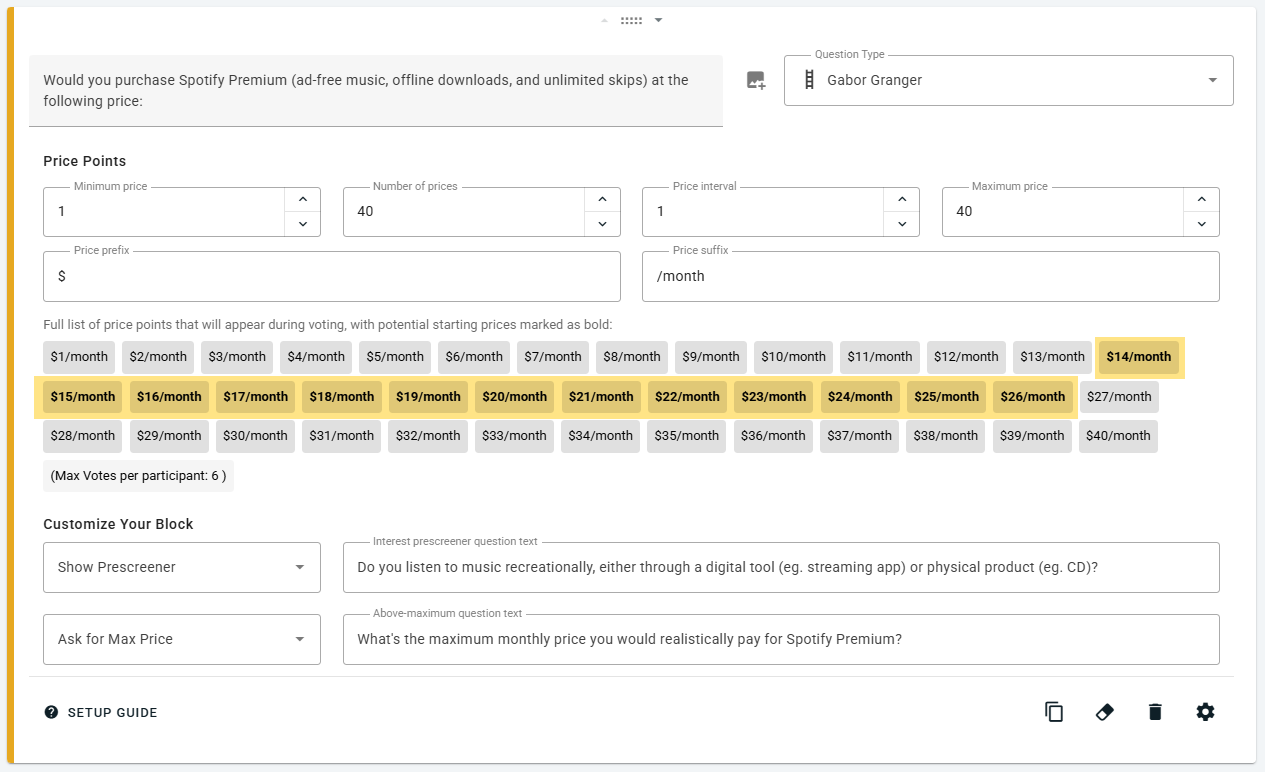
A random first price changes this. OpinionX picks each person's first price at random from the middle third of your prices. With the 15 prices from $10 to $38, that means a first price of $18, $20, $22, $24, $26 or $28. Some people get pulled up and some get pulled down, so the pulls tend to cancel out across your sample.
What are the limitations of a random start?
A random start costs at most one extra question. Starting from the exact middle, binary search needs at most 4 questions for 15 prices. Starting from a random price in the middle third, it needs at most 5. On average, the difference is tiny: 4.00 questions against 4.09.
That extra question is why OpinionX's limits are 5 questions for 15 prices, 8 for 100 and 11 for 1,000. Pure halving from the exact middle would need 4, 7 and 10.
A random start doesn't remove anchoring, though. It only spreads it across your sample, so each person is still pulled towards whatever price they saw first. Researchers also disagree about how strong the pull is: when some re-ran that kind of experiment, it came out far smaller (Maniadis, Tufano and List, American Economic Review, 2014). Either way, spreading the pull costs almost nothing, while a fixed start pushes every answer the same way.
The Gabor Granger guide covers the full method, and common mistakes in Gabor Granger studies covers what else can go wrong. If you'd like to see binary search in action, every method is on OpinionX's free tier.
