
The history of the Van Westendorp method (1976 to today)
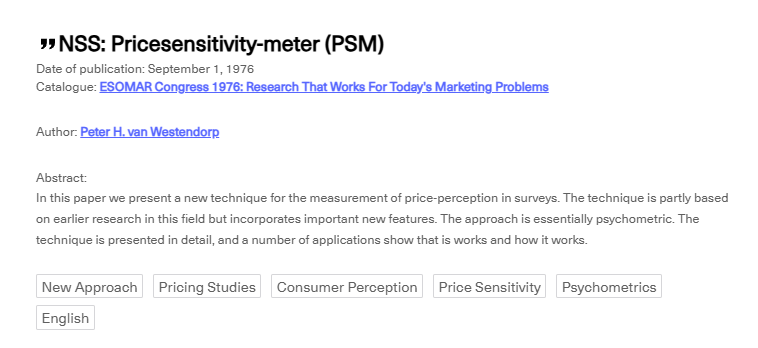
In September 1976, Peter H. van Westendorp presented a paper at the ESOMAR Congress in Venice that opened with a plain promise: "a new technique for the measurement of price-perception in surveys". ESOMAR is the global association for market and social research, and its library lists the paper as "NSS: Pricesensitivity-meter (PSM)" (ESOMAR). Fifty years later, pricing surveys still ask the four questions from that paper, and six survey platforms have them built in.
This short history of Van Westendorp pricing surveys covers where the method came from, how it changed after 1976, where the Newton-Miller-Smith extension fits, why a 50-year-old survey technique is still in use, and the limitations that come with it.
Van Westendorp history at a glance
The table below sets out the Van Westendorp history in order, from the research it built on to the tools that run it now:
| Year | What happened |
|---|---|
| 1954 | Jean Stoetzel publishes "Le prix comme limite" ("Price as a limit"), often cited alongside Van Westendorp |
| 1961 | André Gabor and Clive Granger report on how well Nottingham shoppers know the prices of 15 grocery products |
| 1966 | Gabor and Granger present two techniques for measuring the prices consumers will pay for new products at ESOMAR, and publish "Price as an indicator of quality" in Economica |
| 1976 | Peter H. van Westendorp presents the Price Sensitivity Meter at the ESOMAR Congress in Venice |
| 1993 | Newton, Miller and Smith add two purchase-likelihood questions that turn the method into a revenue estimate |
| 2020 | A review of willingness-to-pay studies finds people overstate what they'd pay in surveys by about 21% |
| 2026 | Six survey platforms offer Van Westendorp as a built-in question type or study |
Where did the Van Westendorp method come from?
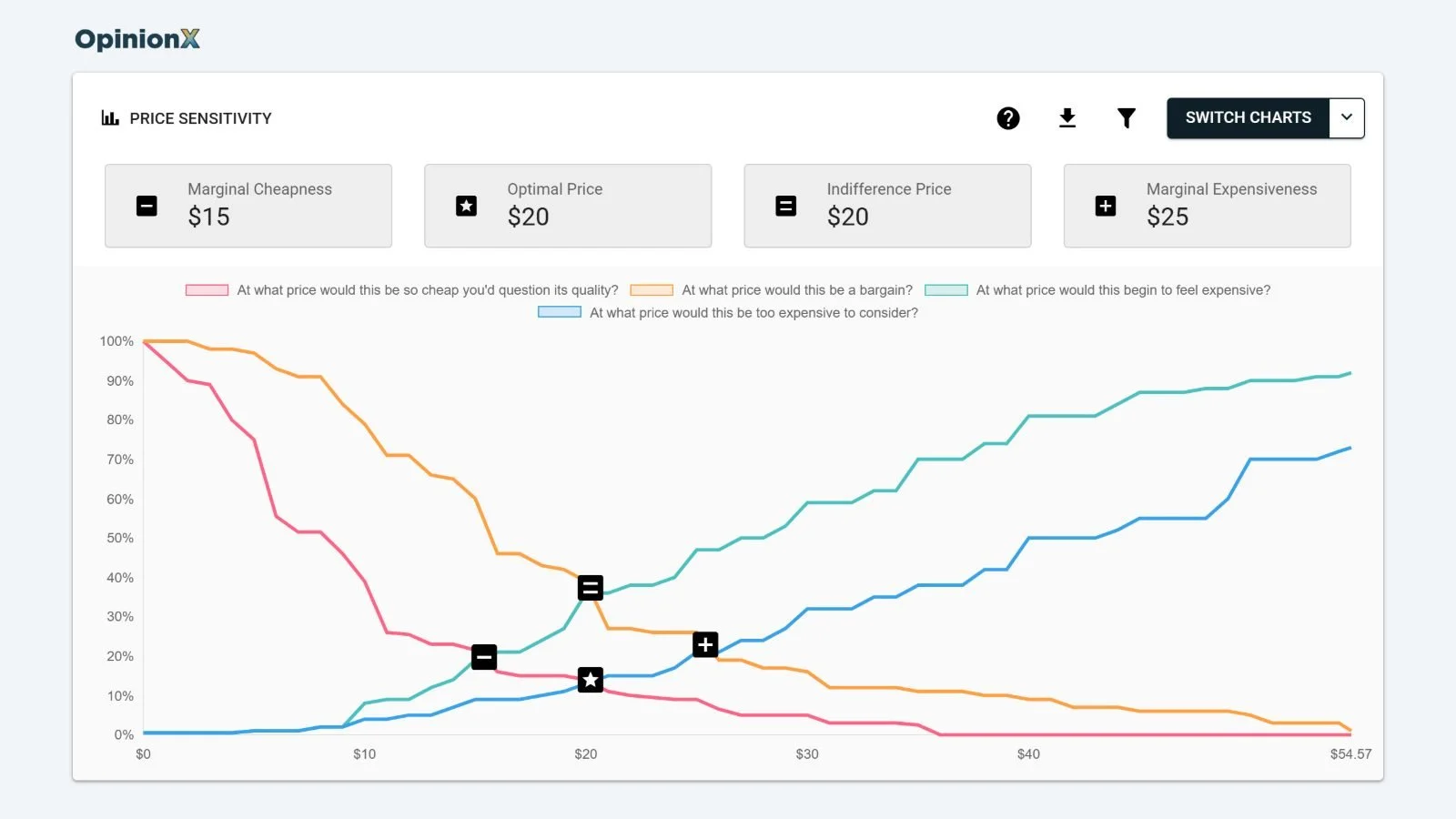
The Van Westendorp method, also called the Price Sensitivity Meter, asks each participant four price questions about one product: at what price it would be so cheap they'd doubt its quality, a bargain, starting to get expensive, and too expensive to consider. The answers turn into four lines on a chart, and the points where the lines cross give you the range of prices most people accept and the price the fewest people reject.
Van Westendorp's abstract says the technique "partly builds on earlier research" and calls the approach "essentially psychometric", meaning it measures how people perceive prices rather than what they say they'd pay. Two bits of that earlier research stand out.
The first is the idea that every shopper has a price limit. Pricing research papers that cite Van Westendorp often cite Jean Stoetzel's 1954 French paper "Le prix comme limite" ("Price as a limit") alongside it (Intelligent Information Management, 2011), and both treat price as a range with edges, not a single figure.
The second is the economists André Gabor and Clive Granger's work on how shoppers think about prices. In 1961 they reported asking shoppers in Nottingham whether they knew the prices of 15 grocery products (Journal of the Royal Statistical Society, 1961), and in 1966 they presented two techniques for measuring the prices consumers are willing to pay for new products (ESOMAR, 1966). That same year they published "Price as an indicator of quality: report on an enquiry" (Economica, 1966), which describes the idea behind Van Westendorp's first question: a price can be so low that buyers doubt the product, and that loses sales just like a price that's too high. Gabor and Granger also gave their names to a second pricing survey, which our comparison of Van Westendorp vs Gabor Granger puts side by side with this one.
How did the Van Westendorp method change after 1976?
The four questions haven't changed in 50 years, but what researchers do with the answers has.
Revenue, in 1993. The original method shows which prices people accept, but it never asks whether anyone would buy. In 1993, Newton, Miller and Smith presented "A market acceptance extension to traditional price sensitivity measurement" at the American Marketing Association's Advanced Research Techniques Forum (method notes). Their extension adds two questions after the original four, asking how likely each participant would be to buy at their own "bargain" and "getting expensive" prices, and those two answers turn the acceptable price range into a demand line and a revenue estimate at every price. Our guide to the Newton-Miller-Smith extension works through the calculation with an example.
Two ways to draw the range. Analysts find the edges of the acceptable price range in one of two ways: the original version flips two of the four lines before crossing them, while the "narrower" version crosses them as they are. The open-source R package pricesensitivitymeter offers both (package documentation). The choice changes the result a lot: on 134 answers from a practice survey OpinionX ran about a 30oz Stanley Cup, the original version gives a range of $10 to $35 and the narrower version gives $15 to $25.
Software. For most of its history, Van Westendorp meant four number questions and an evening in a spreadsheet, and that route still works with our free Van Westendorp Google Sheets template. More recently the method has moved into survey tools as a ready-made question type, and our comparison of Van Westendorp survey tools counted six platforms with it built in as of October 2026.
Why has the Van Westendorp method lasted so long?
The Van Westendorp method has lasted because it answers the question most pricing decisions start with, using a survey anyone can run.
It needs no starting price. Most pricing surveys ask you to choose the prices to test, which assumes you already know roughly where the price should be. Van Westendorp lets participants type their own prices, which makes it the natural first study for a new product, service or feature with nothing to compare against.
It's short. Four questions keep a Van Westendorp section small enough to sit inside a larger survey without adding much to its length.
It covers both ends of the price. Thanks to the "too cheap" question, the method shows the lowest price before a low price starts to hurt how people judge the product, as well as the highest price before people stop considering it.
And its main output is a range, not a single price. Most pricing decisions involve things a survey can't see, such as costs, competitors and positioning, so a range of accepted prices with a few key prices inside it is often more useful than one precise figure.
What are the limitations of the Van Westendorp method?
The Van Westendorp method has limitations that 50 years of use haven't removed, though each one has a known workaround.
It measures perception, not buying. The four questions ask how prices feel, so the optimal price point is the price the fewest people reject, not the price that earns the most revenue. The Newton-Miller-Smith extension or a separate Gabor Granger survey fills that gap.
People overstate what they'd pay. Every survey-based pricing method shares this one: people say in surveys that they'd pay about 21% more than they really do when money is on the line (Journal of the Academy of Marketing Science, 2020). That makes a Van Westendorp result a strong starting point to confirm with your sales or a live price test.
It prices one product on its own. Participants judge the product without seeing competitors or other versions, so the method can't tell you how much each feature is worth or how to build pricing tiers. That job belongs to conjoint analysis, which our comparison of Van Westendorp vs conjoint analysis explains.
One range can hide very different groups. In the Stanley Cup survey, everyone together accepted $15 to $25, while people who cycle to work accepted $25 to $35 and people who take public transport accepted $10 to $18. Our guide on how to segment Van Westendorp results shows how to find splits like this.
Want to run the method yourself? Our Van Westendorp pricing guide covers the four questions, the chart and how many participants you need, step by step.
Thinking about testing your own prices with your customers? Book a free 30-minute setup call and a research expert will help you set up your first Van Westendorp survey, with no obligation.
The Van Westendorp question type is on OpinionX's free plan with up to 25 participants per survey.
