
Van Westendorp vs Conjoint Analysis: when a price range is enough (and when it isn't)
Van Westendorp and conjoint analysis are both survey methods for setting a price, but they answer different questions and take very different amounts of work. Van Westendorp asks people four questions about how prices feel and gives you the range of prices your customers will accept for one product.
Conjoint analysis asks people to choose between versions of a product that combine different features and prices, and tells you how much each feature is worth to them in money. Choosing between Van Westendorp vs conjoint analysis? It comes down to whether you're pricing one fixed offer, or also deciding what goes into the offer.
This guide covers what each method measures, how much work each one takes, when a Van Westendorp price range is enough, and when conjoint's extra depth pays for itself.
What does Van Westendorp measure?
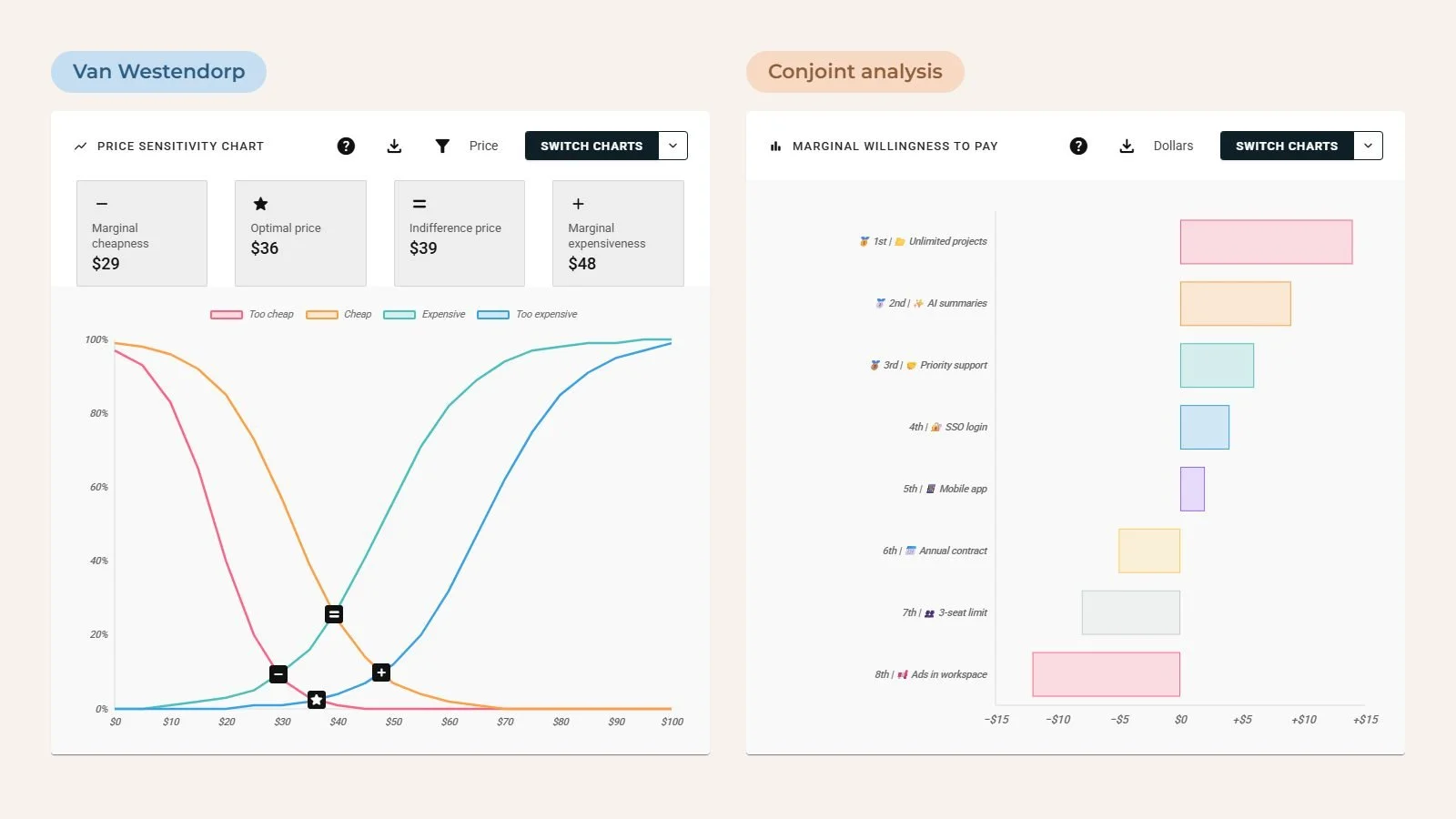
Van Westendorp, also called the Price Sensitivity Meter, is a pricing survey that asks participants four questions about one product. The questions ask at what price the product would be so cheap they'd question its quality, a bargain, starting to get expensive, and too expensive to consider. Dutch economist Peter van Westendorp introduced the method in 1976 at the ESOMAR Congress in Venice, and researchers still use the same questions today.
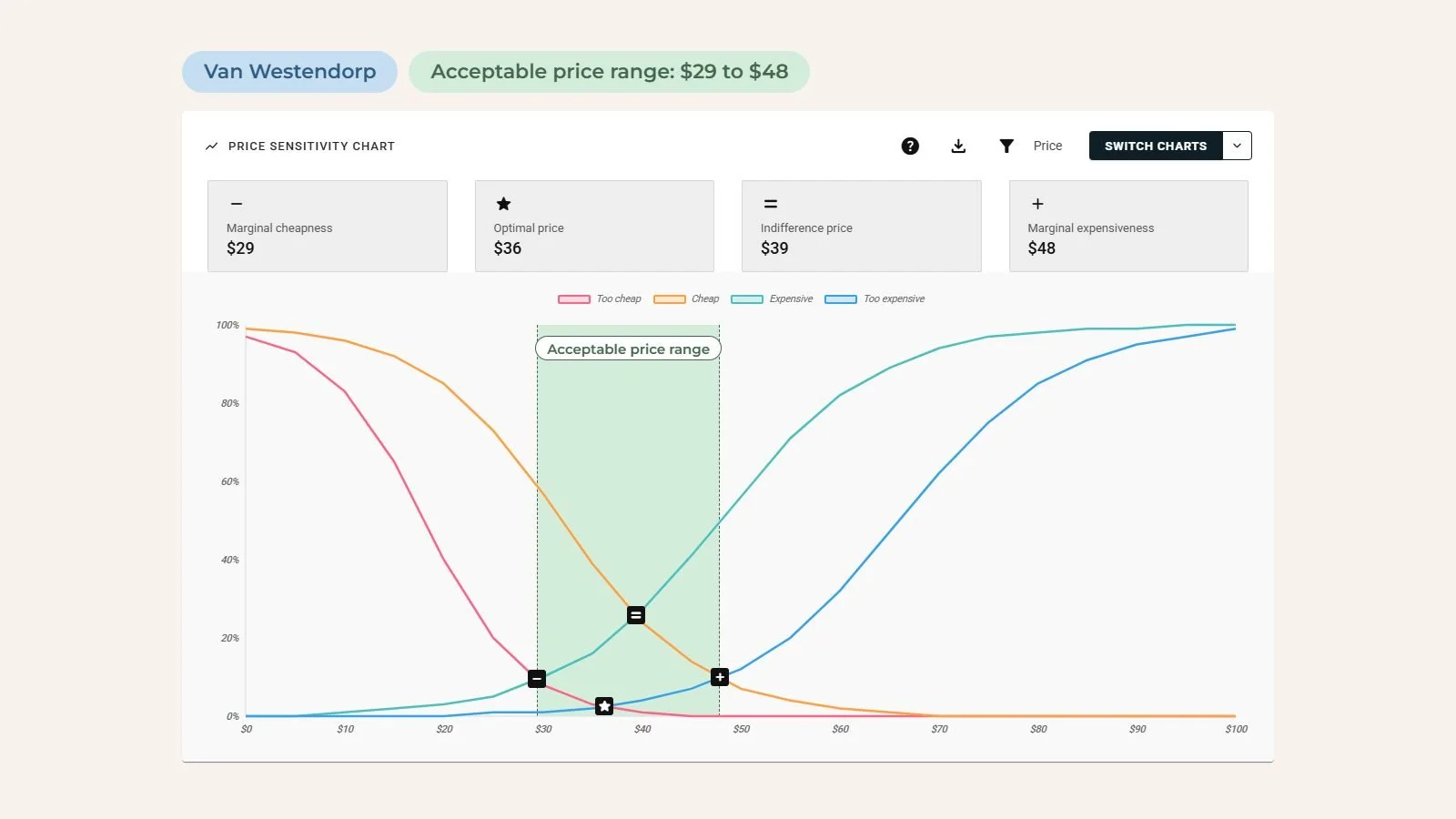
Each participant types in their own prices, and the survey turns everyone's answers into four lines on a chart, one per question. The most important result is the optimal price, where the "too cheap" line and the "too expensive" line cross. At that price, the smallest share of your target customers would reject the product outright on price. Two other crossing points mark the edges of the acceptable price range, meaning the prices most of your customers consider reasonable. Our guide on how to read a Van Westendorp chart explains each line and crossing point in detail.
Van Westendorp takes very little work to run, because participants answer four questions on a single screen and you don't have to design any product versions for them to compare. Around 100 participants shows you roughly where the optimal price sits, and the pricing consultancy 5 Circles Research suggests at least 200 participants for a business product and 400 for a consumer product before you rely on the result. If you want to compare customer segments, meaning groups like company size or job role, you'll need more, because each segment needs enough participants on its own. Our Van Westendorp sample size calculator works out the total for your study, and our guide on how to segment Van Westendorp results shows how to compare the groups.
What Van Westendorp can't tell you is anything about the parts of your product, because it prices the whole offer as one. Our Van Westendorp pricing guide covers the four questions and the chart in full.
What does conjoint analysis measure?
Conjoint analysis is a survey method that shows participants several versions of a product side by side and asks them to pick the one they'd choose. From those choices, you can work out how much each feature and each price affects their decision. Researchers have used conjoint analysis to study consumers since 1971, and Paul Green and V. Srinivasan reviewed how it works and where it applies in a 1978 paper in the Journal of Consumer Research.
The quickest way to see the difference between the two methods is to answer both yourself. The example survey below asks one Van Westendorp question and one conjoint question about the same smartphone.
Each version of the product in a conjoint survey is a profile. Every profile uses the same categories, such as storage, colour and price, with a different option picked in each category, such as 128GB, 256GB or 512GB of storage. Participants vote on several sets of profiles in a row (10 sets, for example), and because they keep giving up one feature to get another, their choices show what they value most.
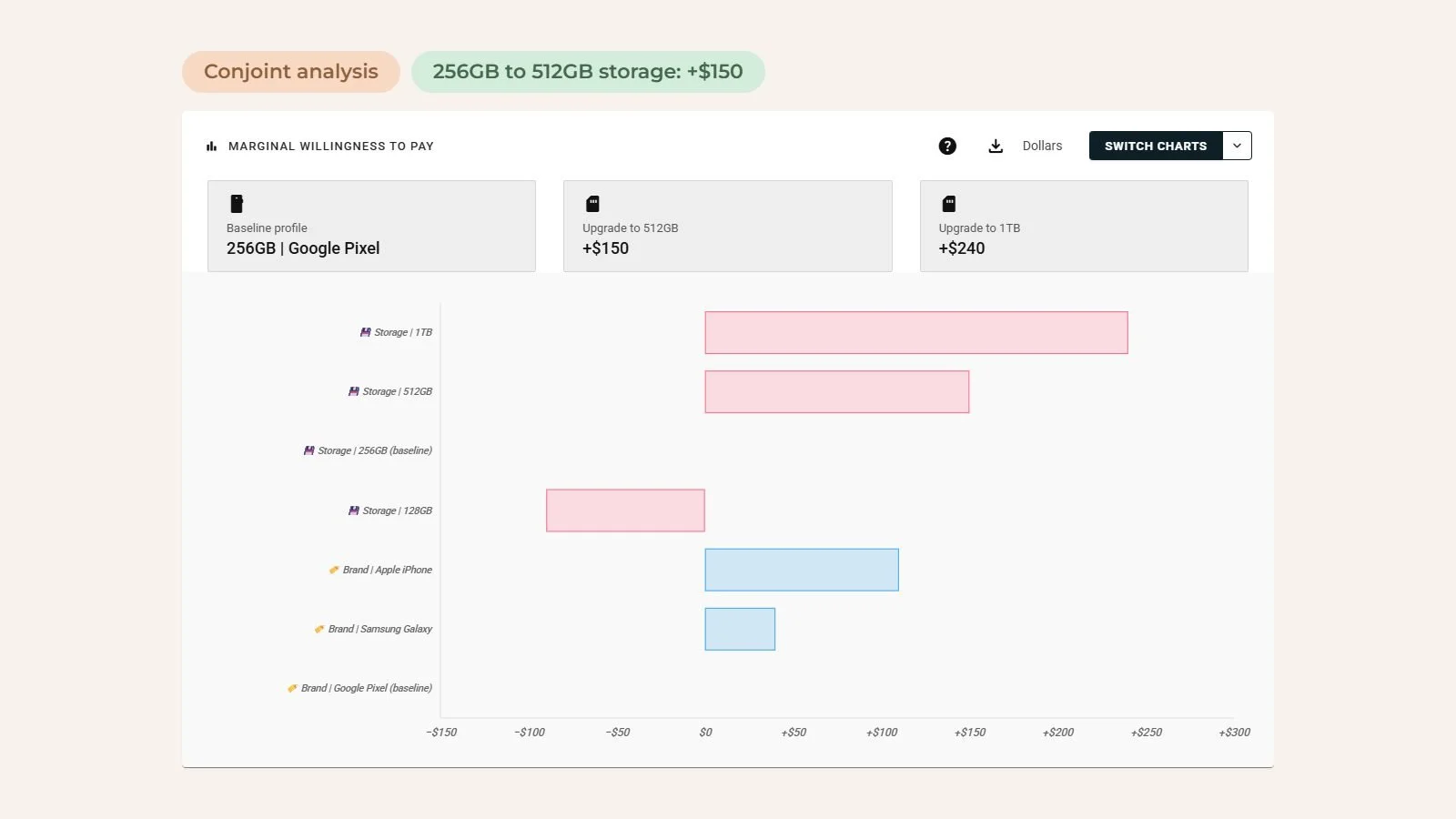
The analysis turns those votes into a score for every option, which shows how much that option makes a participant more likely to choose a profile. Because price is one of the categories, the analysis can also convert those scores into money. That calculation is marginal willingness to pay, meaning how much extra a customer would pay to change one feature of the product. A conjoint market simulator then lets you build full versions of the product and see what share of customers would choose each one.
Conjoint analysis takes more work than Van Westendorp at every stage. Before the survey goes live, you have to choose the categories and the options in each one, and that includes price, with realistic price options. You also have to decide how many profiles to show in each set and how many sets each participant votes on. DriveResearch puts an agency-run Van Westendorp study at about three to five weeks from start to finish, and a conjoint study at about five to eight weeks (DriveResearch, May 2026).
How many participants a conjoint survey needs depends on its design. OpinionX's conjoint calculator works it out from how many options sit in your largest category, how many profiles each set shows, and how many sets each participant votes on. With 4 options in your largest category, 3 profiles per set and 10 sets per participant, the calculator's strictest setting gives (4 × 400) ÷ (3 × 10) = 53.3, so about 54 participants. Treat that as the minimum though, not the target, because research agencies commonly plan for 200 participants or more, and 400 or more when they compare customer segments (DriveResearch). Our conjoint analysis guide walks through the whole setup step by step.
Setting up your first conjoint survey, or still deciding between conjoint and Van Westendorp for your pricing decision? Book a free 30-minute setup call and a research expert will help you choose your categories, options and price options, with no obligation.
Van Westendorp vs conjoint analysis: how do they compare?
The table below puts the two methods side by side, and the biggest difference sits in the first row: what each one actually prices.
| Van Westendorp | Conjoint analysis | |
|---|---|---|
| What it prices | The whole offer, as one product with one price | Each feature inside the offer, and the price alongside them |
| What participants do | Type their own prices into four questions on one screen | Pick their favourite profile in each of several sets of product versions, for example 10 sets |
| What you need before you start | A clear description of the product, and no price range at all | Your categories, the options in each one, and realistic price options to test |
| Time for an agency-run study | About 3 to 5 weeks | About 5 to 8 weeks |
| Participants needed | Around 100 completed responses, plus more per customer segment | A design-based minimum from the conjoint calculator, often 200 or more in practice |
| What you get | An acceptable price range and an optimal price for the offer | A score for every option, the money value of each feature, and a simulator to test full product versions |
When is a Van Westendorp price range enough?
A Van Westendorp survey is enough when you're pricing a product, service or new feature as a single offer, and you're happy to pick a price from an acceptable price range rather than needing an exact, feature-by-feature answer.
✅ You have no existing price or market reference point to start from, so you need your customers to tell you where the reasonable prices are.
✅ The offer has one price, like a single subscription plan, a one-off product or an add-on.
✅ You want a quicker, simpler study.
When is conjoint's extra depth worth it?
Conjoint analysis is worth the extra work when what goes into the offer is part of the decision, not just what it costs.
✅ You're building pricing tiers or bundles, and need to know which features belong in which tier.
✅ You need to know whether a specific feature justifies a higher price, and by how much.
✅ Your customers compare several versions of your product, or yours against other brands, before they buy.
Here's how that plays out with a smartphone. A Van Westendorp survey on a 256GB phone might show that participants accept prices between $650 and $900, with an optimal price around $780. That tells you where to price the phone, but not how much more to charge for a 512GB version. A conjoint survey with storage and price as categories can answer that. If participants would pay $150 more to go from 256GB to 512GB, you can price the bigger phone up to $150 higher before customers start choosing the smaller one instead.
What are the limitations and common mistakes?
First things first: don't use conjoint analysis to find a price from scratch. Conjoint can only compare the price options you put into the survey, so if every price you test is too low, the results will never show you that customers would pay more. No idea where the price should sit? Run a Van Westendorp survey first to find the acceptable price range, then use that range to pick the price options for a conjoint survey. Our guide on when not to use conjoint analysis covers this and nine other situations where a different method fits better.
Another common mistake is using Van Westendorp to price a tiered plan. Van Westendorp prices one offer at a time, so running it separately on each tier tells you nothing about which features should move between tiers, which is usually the actual decision.
Sadly though, both methods share the same limitation: they ask people what they would do instead of watching what they pay. People say in surveys that they'd pay about 21% more than they really do when money is on the line (Journal of the Academy of Marketing Science, 2020). Treat the result of either method as a strong guide for your pricing decision, then confirm it with your sales or a live price test.
Pricing one fixed offer? Our ultimate guide to Van Westendorp pricing surveys shows you how to run the survey and read the chart, step by step.
Want a single best price and already have a price range in mind? Our comparison of Van Westendorp vs Gabor Granger explains when testing specific prices gives you a more exact answer. And if you're still deciding which features to include before you price them, our MaxDiff analysis guide shows how to rank a long list of features by importance first.
Both Van Westendorp and conjoint analysis are on OpinionX's free plan, with up to 25 participants per survey, so you can run a pilot of either method before you commit. You can also add a Van Westendorp question and a conjoint question to the same survey, which lets you find the acceptable price range and test feature trade-offs with the same participants.
