
Multivoting: 6 Best Tools & Techniques for Group Decisions
“Multivoting is a way for a group to prioritise a list of options by letting each person cast several votes, ranked by preference. It turns a messy brainstorm into a ranked shortlist, which is why it’s a convergent-thinking step used in workshop facilitation and in Six Sigma’s DMAIC process.”
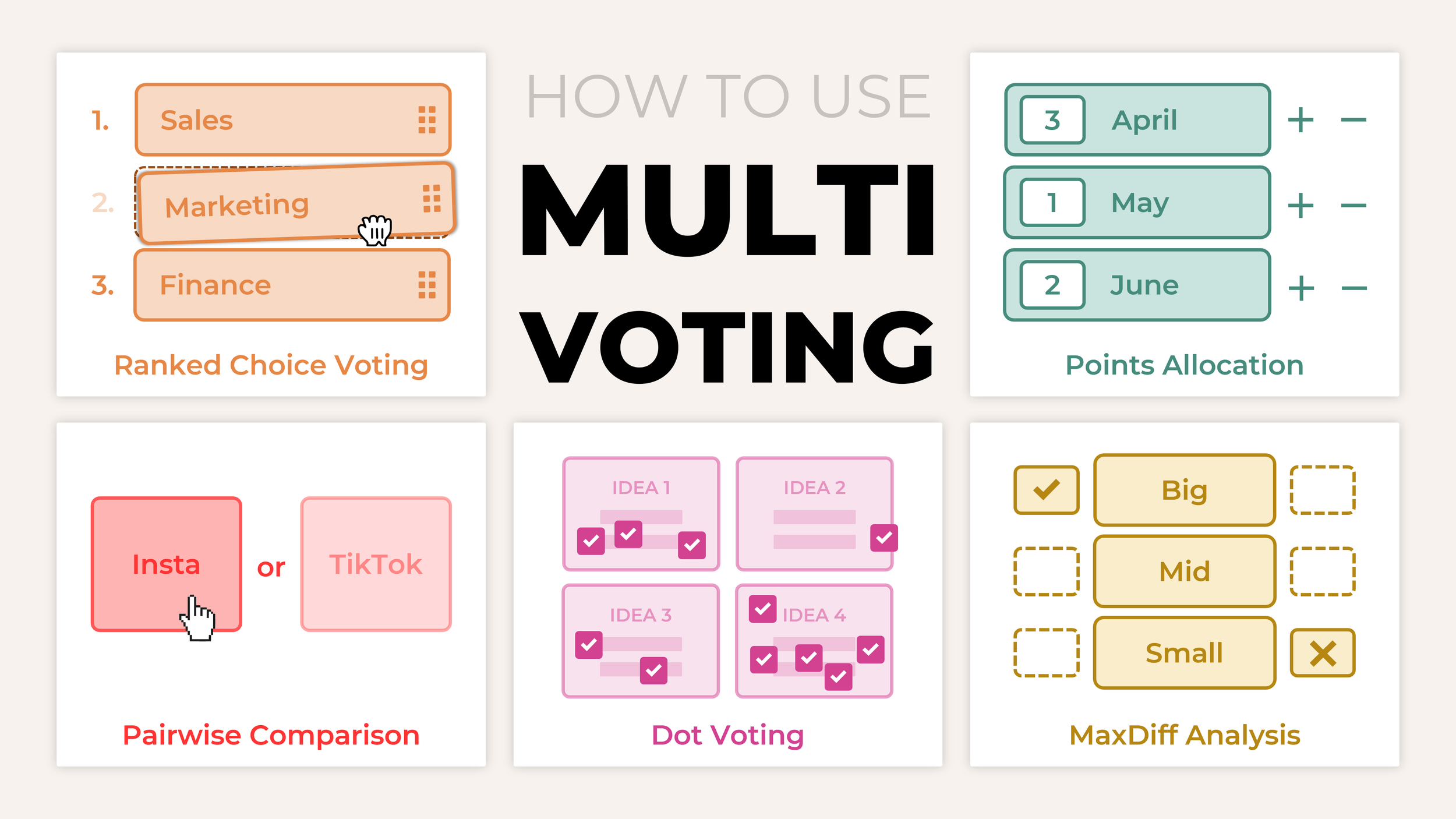
The six most common multivoting techniques are ranked choice voting, points allocation, pairwise comparison, MaxDiff analysis, consensus (agree/disagree) voting, and dot voting. Dot voting is the classic sticker-on-a-poster version; the other five run online and score automatically. For a long list of 10 or more options, pairwise comparison and MaxDiff handle the cognitive load better than asking people to rank everything at once. You can run any of the six free on OpinionX.
What is multivoting?
Multivoting lets a group prioritise a list of options, with each person casting several votes in order of preference. It makes group decision-making more participatory and consensus-driven.
How does multivoting work?
Multivoting works in several ways, but they share one principle: each participant votes multiple times on the list of options. The techniques below all do that differently.
Is multivoting divergent or convergent?
Divergent thinking generates lots of ideas and explores the options, usually through free-flowing work like brainstorming. Convergent thinking evaluates those ideas to find the most effective or practical way to solve the problem.
Multivoting is one of the most popular convergent-thinking methods. It turns a list of creative ideas or subjective options into a prioritised one, so teams can decide what to pursue. That makes it a natural next step after any brainstorming or divergent process. One example is Customer Problem Stack Ranking, a research technique teams use to find which problems their customers most urgently want solved.
What techniques can you use for multivoting?
The six most popular multivoting techniques are:
Here's how the six compare at a glance, and if you're not sure which fits your list, this guide to choosing a survey ranking method walks through the decision:
| Technique | How it works | Best for |
|---|---|---|
| Ranked Choice Voting | Rank the whole list, scored with the Dowdall Count | Short to medium lists, quick consensus |
| Points Allocation | Spend a fixed pool of points across options | Simple, intuitive group ranking |
| Pairwise Comparison | Vote on a series of head-to-head pairs | Long or subjective lists of 10+ options |
| MaxDiff Analysis | Pick best and worst from small sets | Ranking many items by importance |
| Consensus Voting | Agree or disagree with each statement in turn | Finding what everyone agrees on |
| Dot Voting | Stick physical or virtual dots on options | Quick in-person workshops |

1. Ranked choice voting
Ranked choice voting is a familiar method almost everyone has used at some point. You show the whole list at once and ask each person to rank it by preference.
^ Example of a ranked-choice multivoting survey hosted on OpinionX
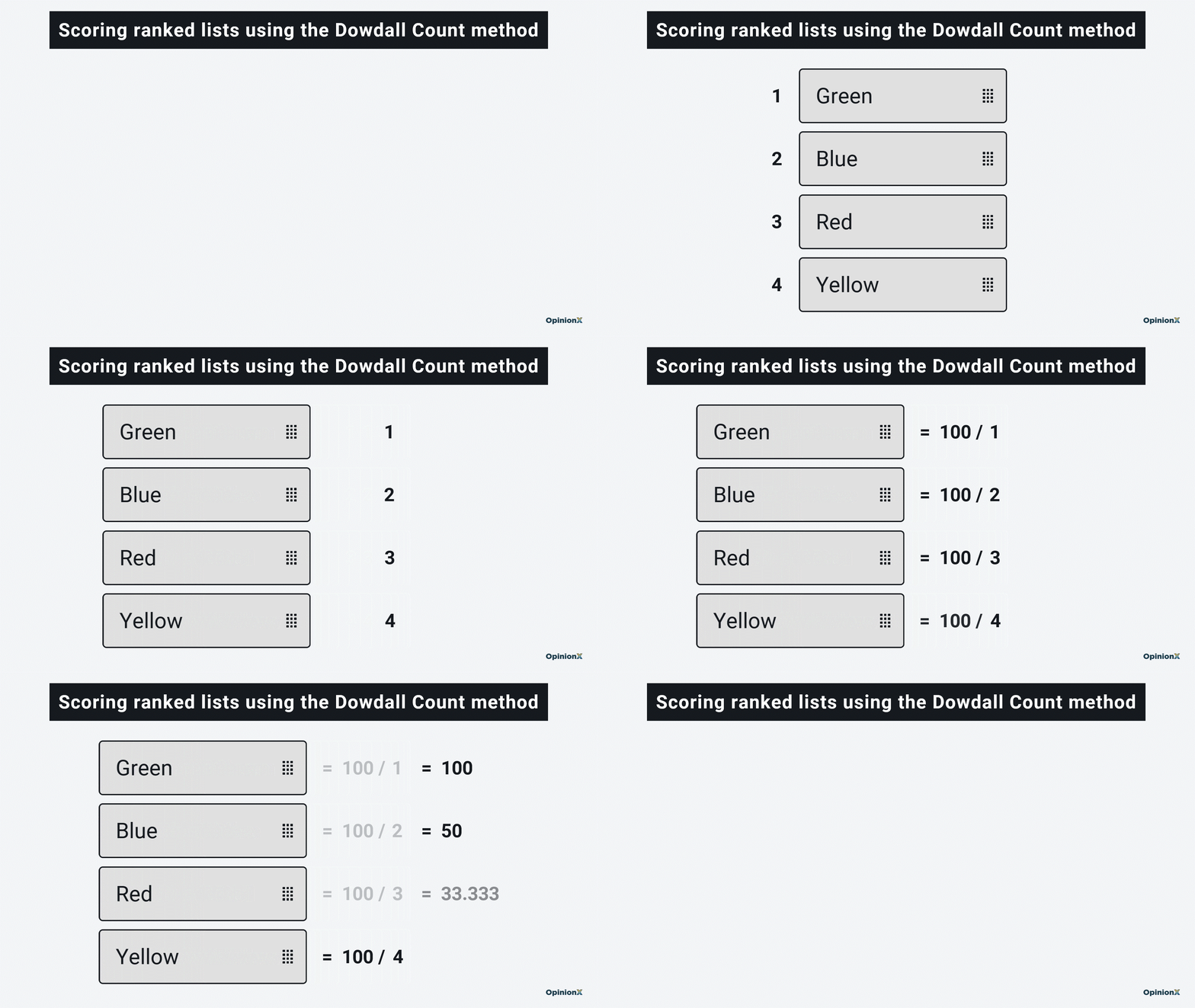
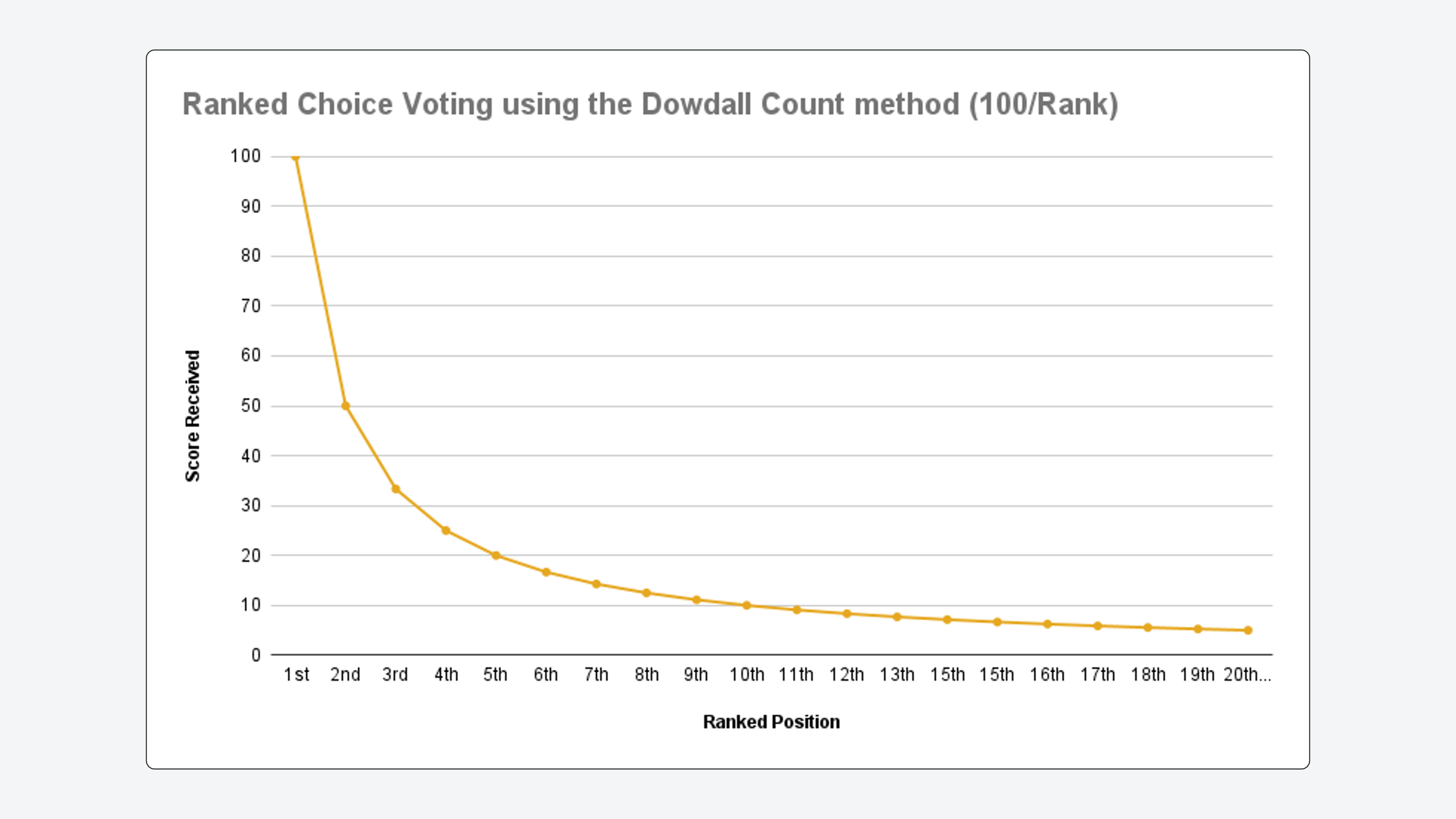
There are many ways to turn ranked choice votes into scores, but my favourite for multivoting is the Dowdall Count: each option scores 100/rank (rank something 4th and it gets 100/4 = 25 points).
The Dowdall Count is great for multivoting via ranked choice voting because:
It uses a simple formula anyone can follow.
It gives everyone's top pick the same weight, no matter how many options they rank.
It weights top-ranked options more and tails off for lower ones, which mirrors how real preferences usually look.
It lets people rank as many or as few options as they want without skewing the result.
It lets the facilitator set rules, like a minimum or maximum number of options per person.
You can create a free ranked choice voting survey on OpinionX for your multivote. Free gives you unlimited surveys with up to 25 participants each, the Dowdall Count, and options like a min or max number of votes per person. The paid Analyze plan ($900/year) lifts the participant cap.

2. Points allocation
Points Allocation, also called Constant Sum, gives each participant a pool of points to spend across the options by preference. It's popular for group ranking because it's so straightforward.
3. Pairwise comparison
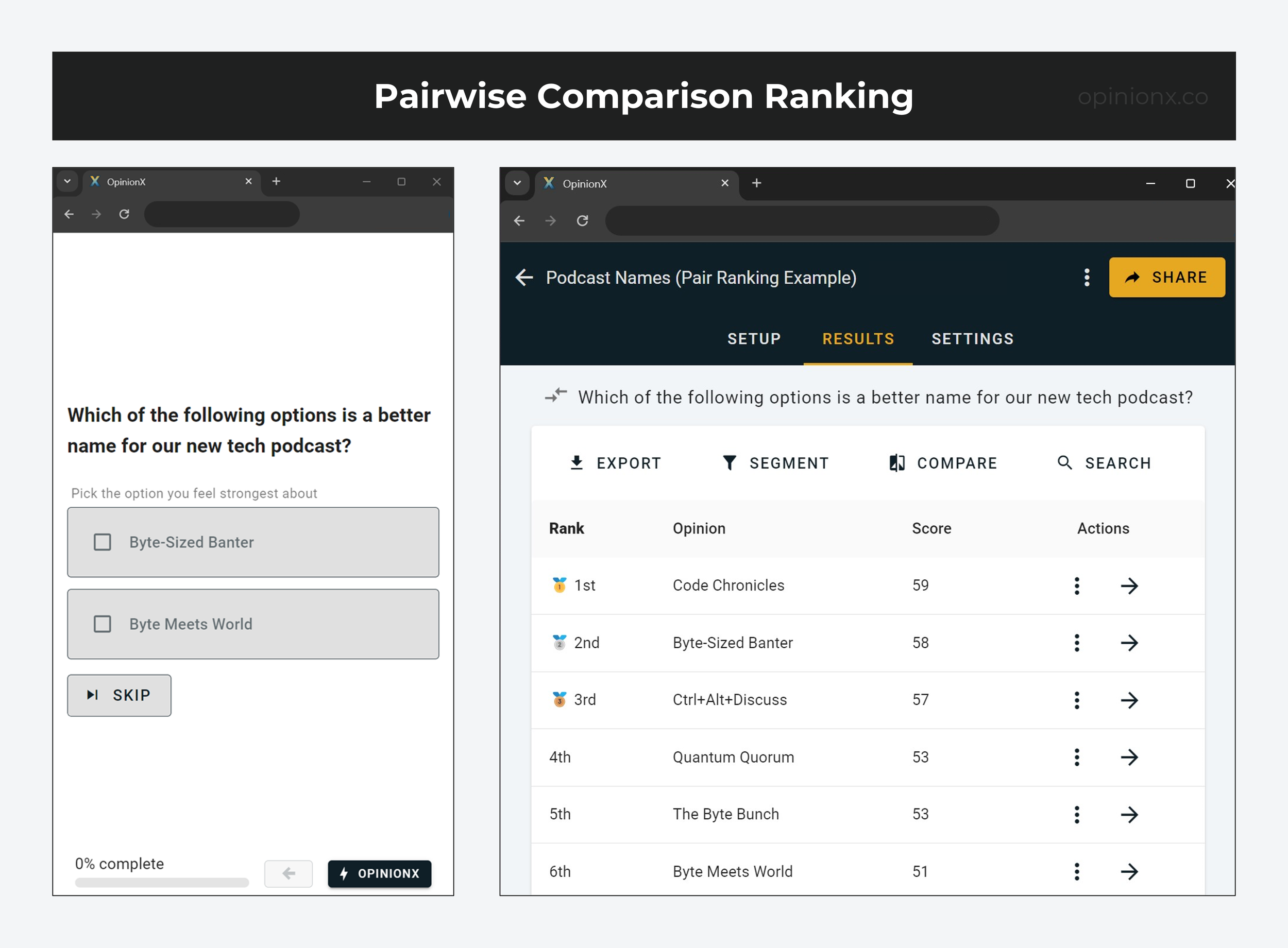
My favourite format for ranking a list is pairwise comparison, which breaks it into a series of head-to-head votes. With a long list, say 10 or more options, showing everything at once is a lot to rank. Pairwise handles those longer lists better.
Unlike the other two methods, pairwise measures preferences without making people spell out what they care about overall. That makes it good for subjective lists that are hard to rank in one go.
^ Example of a pairwise ranking survey hosted on OpinionX
Turning pairwise votes into scores is simple: wins divided by appearances. If an option appeared in 200 pairs and won 60, it scores 30%.
You can create free pairwise surveys on OpinionX, which picks the pairs for you and scores results on a 0-100 scale. There's also a calculator to work out how many pairs each person should vote on for a reliable result.

4. MaxDiff analysis
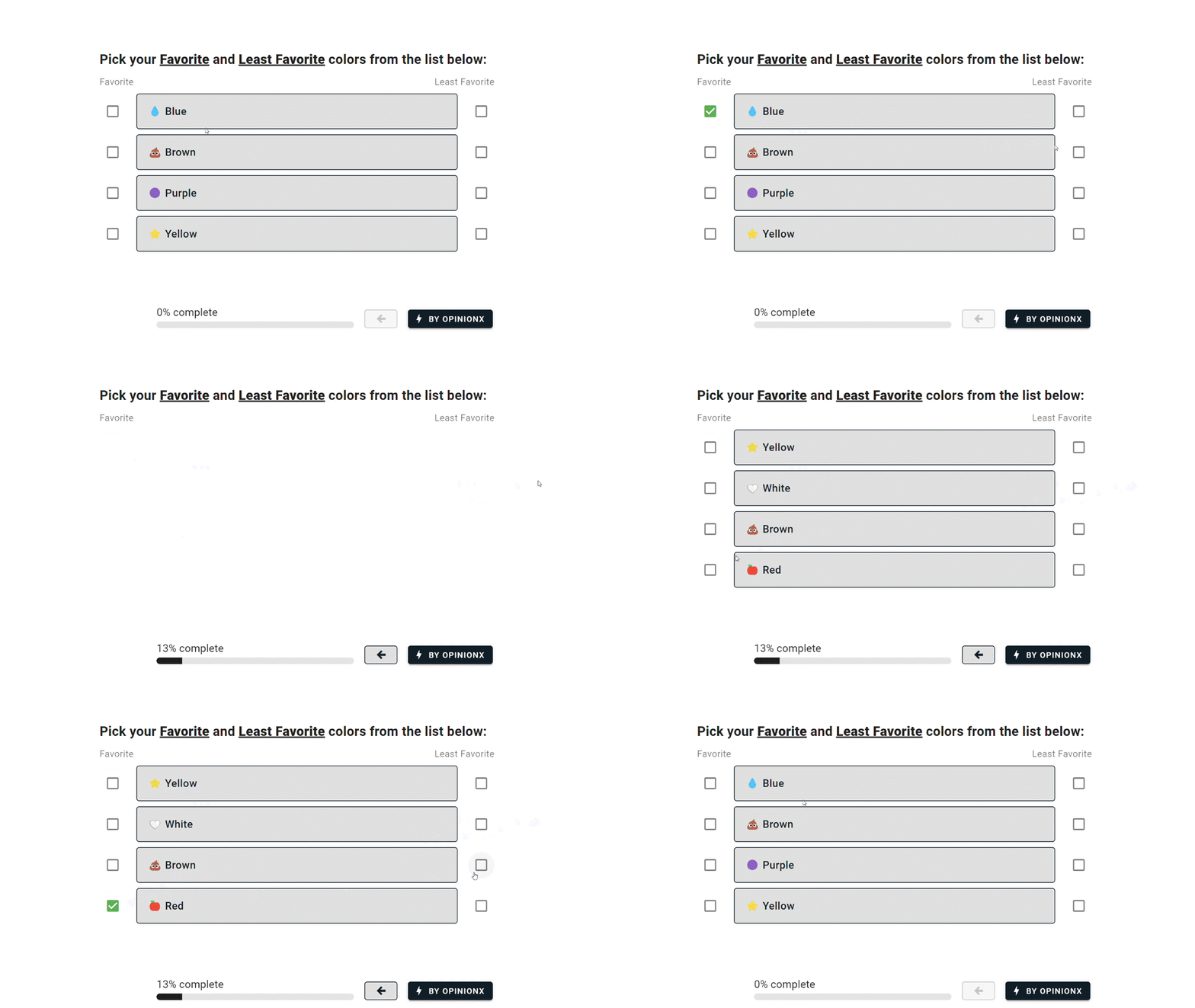
MaxDiff ranks preferences by asking people to pick the best and worst option from a set of 3-6 statements. Each vote shows a new set drawn from your full list.
Also called best-worst scaling, you can relabel "best" and "worst" to fit the study: Favourite / Least Favourite, Top / Bottom, Most Preferred / Least Preferred. Most MaxDiff surveys stick to 3-6 statements per set, but you can use more.
^ Example of a free MaxDiff survey hosted on OpinionX
MaxDiff scoring is close to the pairwise formula: take the "best" votes, subtract the "worst" votes, and divide by appearances, i.e. (best-worst)/appearances. To set the variables, use the built-in MaxDiff calculator on OpinionX, which picks the right number of options per set and sets per participant from your total options and expected participant count.

5. Consensus voting
Sometimes you care more about what everyone agrees on than the single highest-voted idea. Agreement ranking shows participants statements one by one and asks them to agree or disagree with each. It's a well-studied consensus method used in public consultation projects like the vTaiwan wikisurvey.

6. Dot voting
Dot voting is the traditional form of multivoting. Each participant gets a number of "dots" (usually post-its or stickers) to stick on a poster. You can do it in person with physical dots or on a virtual whiteboard. It's popular in in-person focus groups. It's quick and hands-on, but you have to tally it by hand, you can't ask any follow-up questions, and you can't segment or filter the results by group afterward.
How many votes does each person get in multivoting?
There's no fixed number of votes per person in multivoting; it depends on what you need. I prefer a ranked choice voting survey where each person ranks as many options as they like, scored with the Dowdall Count.
For a more traditional approach, I'd use a Points Rank format: give each person 10 points to allocate as 4 to their favourite, 3 to second, 2 to third, and 1 to fourth.
How do you use multivoting as part of Six Sigma / DMAIC?
Six Sigma (6σ) is a set of techniques and tools for process improvement. Motorola engineer Bill Smith introduced it in 1986, and it caught on as a way to hit specific value targets, like cutting pollution or raising customer satisfaction.
The most popular Six Sigma methodology is DMAIC (pronounced "duh-may-ick", /də.ˈmeɪ.ɪk/), used to improve existing business processes. It's an acronym for:
Define the system, the customer's requirements, and the project goals.
Measure the current process, collect the data, and calculate its "as-is" capability.
Analyze the data to verify cause and effect and find the root cause of the defect.
Improve the process based on that analysis, and standardise the new way of working.
Control the new process so deviations from target get corrected before they cause defects.
At every stage, teams need both divergent and convergent thinking to map the possible decisions and bring in the wider group. Multivoting is a useful tool inside DMAIC: it helps teams find the biggest issues and the best ways to solve them, democratically. That's why Six Sigma leaders are often experienced multivoting facilitators too!
Get started with your own multivote!
Creating a multivoting survey is quick and free on OpinionX: pick one of the 6 ranking formats, add your list of options, and share the link with your team or stakeholders.
Frequently asked questions
What is multivoting? Multivoting is a group prioritisation method where each person casts several votes across a list of options, ranked by preference. Aggregating everyone's votes turns a long list into an agreed, ranked shortlist.
What are the main multivoting techniques? Ranked choice voting, points allocation, pairwise comparison, MaxDiff analysis, consensus (agree/disagree) voting, and dot voting. The first five can run online and score automatically; dot voting is the in-person sticker version.
Which multivoting technique is best for a long list? Pairwise comparison or MaxDiff. Both break a long list into small, low-effort choices, so people don't have to rank 10+ options at once, which is where ranked choice voting gets unwieldy.
Is dot voting the same as multivoting? Dot voting is one multivoting technique, the classic sticker-on-a-poster version. Multivoting is the broader idea of giving each person multiple votes, which several other techniques do more precisely and score automatically.
Can you run multivoting online for free? Yes. All six formats run on OpinionX, free for unlimited surveys with up to 25 participants each.
Enjoyed this blog post? Subscribe to our free newsletter where we share actionable user research strategies with thousands of teams.