
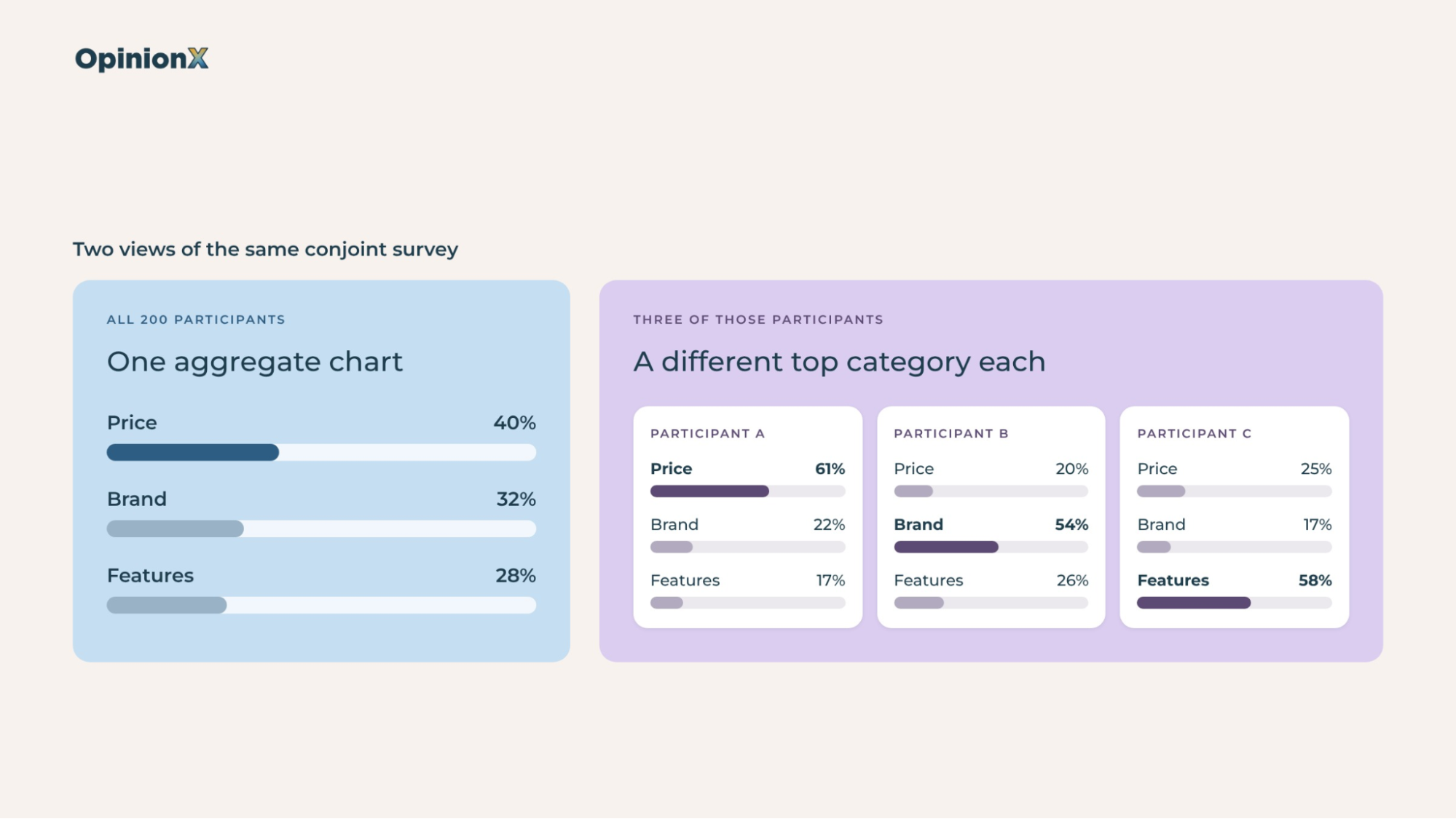
Almost every article on conjoint analysis assumes you're studying a large group of people. You run a conjoint survey with 200 customers and the results tell you price accounts for 40% of the purchase decision, brand for 32% and features for 28%. You use that to plan the product, then move on to the next project.
Aggregate results are a legitimate use of conjoint analysis, but they skip the more interesting half of what the method can do. Individual-level conjoint analysis takes the score the model already estimates for every single participant and treats that one person's scores as the result. That turns conjoint into a matching tool: a financial advisor or a matchmaker can learn what one client values from the trade-offs they make, instead of from questions like "how important is income to you?", which predict very little. In a 2008 speed-dating study, stated partner preferences matched people's actual romantic interest in only 2 of 72 checks (Eastwick and Finkel, Journal of Personality and Social Psychology, 2008).
Below are five businesses where individual scores do the matching, followed by why trade-offs beat asking people what they want and how far you can trust one person's scores (plus how to set it all up on OpinionX).
What changes when you study one person instead of a group?
Conjoint analysis is a survey method where participants choose between whole profiles (bundles of features), and their choices show how much they care about each feature. Picture two burgers: a beef burger with fries for €12 and a chicken burger with salad for €9. Nobody rates "price" or "side dish" on a scale; they pick a burger, and after enough of those choices the analysis works out how much each feature pulled them towards one profile or away from the other. OpinionX calls the features categories (price, side dish) and options (€9, €12, fries, salad), which researchers call attributes and levels.
OpinionX's conjoint surveys use a model called Hierarchical Bayes (HB-MNL for short), which estimates a separate set of scores for every person in the study, one per option, to show how much that person values each option compared with the alternatives. Researchers call these part-worth utilities, and our guide to the conjoint analysis calculation walks through how they're worked out.
Most research teams treat those individual scores as a step on the way to something else: they feed them into a market simulator or a segmentation analysis, then average them into one chart before anyone acts on them. That makes sense when you're making one product decision for a whole market, such as which features go into the next plan.
Individual-level conjoint asks "what does this specific person want?" instead of "what does our market want?". That's the question a business has to answer when its product is the match itself, whether that's a partner, a portfolio, a care home or a sales pitch for the person across the table. In those businesses, the quality of the match is what clients pay for, and the average across 200 people tells you very little about the client in front of you.
Which businesses can use individual-level conjoint results?
Most people never consider conjoint analysis for measuring one person's preferences because they've never seen anyone use it that way. We've worked on enough of these projects at OpinionX to spot the pattern: the business makes a recommendation to one person at a time, and that recommendation is the product. Today, it usually comes from an intake form or someone's gut feeling. Here are five examples.
1. Tailoring an enterprise demo to each stakeholder
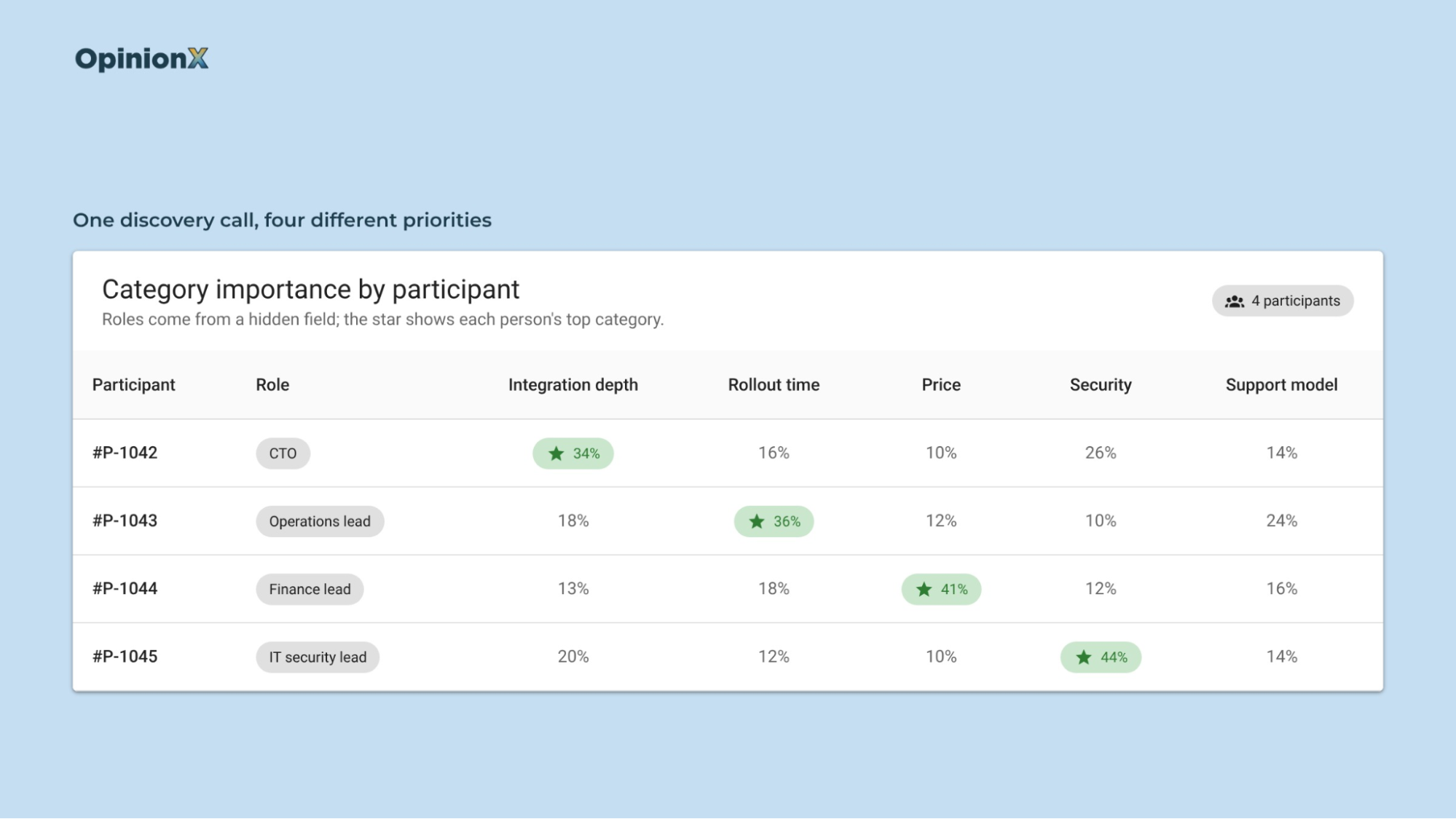
A discovery call with an enterprise prospect usually has four or five people on it, and each one cares about something different. The CTO is weighing integration depth and security and the operations lead wants to know how fast the tool can roll out (finance, of course, is there for price and contract terms), so a demo that tries to cover everything for everyone doesn't fully land with anyone.
Before the call, the account executive sends each named stakeholder a short conjoint survey with profiles that combine what decides a vendor purchase: implementation time, integration depth, support model, price and security certifications. The model produces a separate set of scores for each participant, so the account executive gets a clear picture of each person who'll be on the call instead of one muddled average of what "the account" wants.
That changes how they build the demo: they can lead with the integration story for the CTO and walk the operations lead through the rollout timeline, with the contract options ready before finance even asks. The bigger win though is seeing where the stakeholders disagree before the call starts. Gartner's survey of 632 B2B buyers found that 74% of buying groups showed unhealthy conflict during the decision, and that groups reaching consensus were 2.5 times more likely to report a high-quality deal (Gartner, May 2025). The same research found that tailoring content only to each individual lowered consensus, so use the individual scores to bring those disagreements up with everyone on the call rather than to build five separate pitches.
2. Onboarding a financial advisor's new client
Most financial advisors still onboard new clients with a risk-tolerance questionnaire full of standalone questions like "How would you feel if your portfolio dropped 20%?". People answer those in the abstract, without giving anything up, so the answers say little about how the client wants you to handle their money. In a 2015 review for the CFA Institute Research Foundation, Joachim Klement found that questionnaire-based risk profiling typically "explains less than 15% of the variation in risky assets between investors" (Klement, CFA Institute Research Foundation, 2015).
A conjoint survey swaps the abstract questions for realistic trade-offs: the client sees combinations of portfolio characteristics, such as growth potential, protection against losses, how quickly they can get their money out, tax efficiency and fees, and picks between them. No portfolio offers the best of all five, so the client's choices show what they prioritise rather than what sounds responsible on a form.
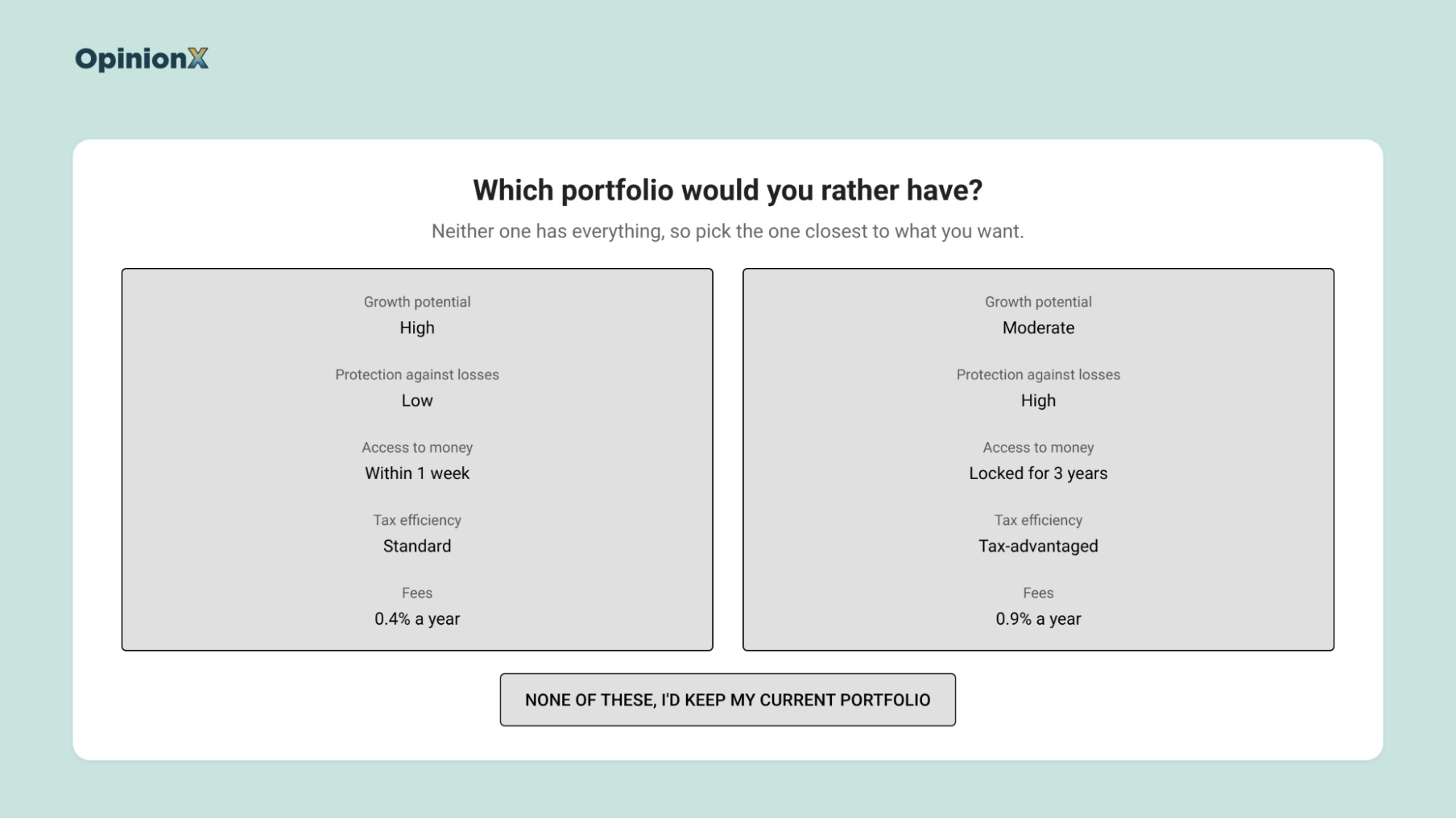
The output is a set of scores for that one client, and the advisor builds the first portfolio recommendation around what this person values most. The scores also hand the advisor an opening line: "Your answers show you weigh protection against losses well above tax efficiency, so here's how I've reflected that." That's a much stronger start than walking a client through a generic risk score.
3. Designing a personal training programme
A personal trainer's first session with a new client is usually a loose conversation about goals. The client says they want to "get fitter" or "tone up" and the trainer nods along, so the programme that follows tends to reflect what the trainer most enjoys coaching. A trainer who loves strength work writes a strength programme, and the mismatch only shows up weeks later, when the client quietly stops booking sessions.
A short conjoint survey at intake removes the guesswork: the client chooses between programmes that prioritise different outcomes (strength, cardio endurance, fat loss or mobility), each with a different weekly time commitment. Putting those against each other separates what the client says they want from what they'll accept, since someone might say they want maximum results until the hours it takes appear right next to it.
The trainer gets a preference profile for that client and builds the programme around their top two or three priorities, and the same scores give them the words to set expectations in the first session, before a mismatch turns into a cancelled membership.
4. Premium matchmaking
Mainstream dating apps guess what someone wants from how they swipe, which makes for messy data. People go for aspirational profiles that have little to do with the partners who'd make them happy, and most apps build their algorithm to keep people on the app rather than to make good matches.
Individual-level conjoint data is much cleaner: at intake, the client chooses between partner profiles that combine qualities like values, communication style, ambition, lifestyle, location and plans for children. Their choices show what they prioritise when they can't have everything, which is what they actually want as opposed to everything they'd like in theory.
This fits premium matchmaking best, where Fortune reported in 2015 that membership at established firms started around $15,000 per year and ran past $50,000 for top tiers (Fortune, 2015). At those firms a human matchmaker makes the recommendations from intake forms and professional judgement, so giving them a measured preference profile for every client is a direct upgrade to the product the client's paying for. Matchmaking needs extra care in two places:
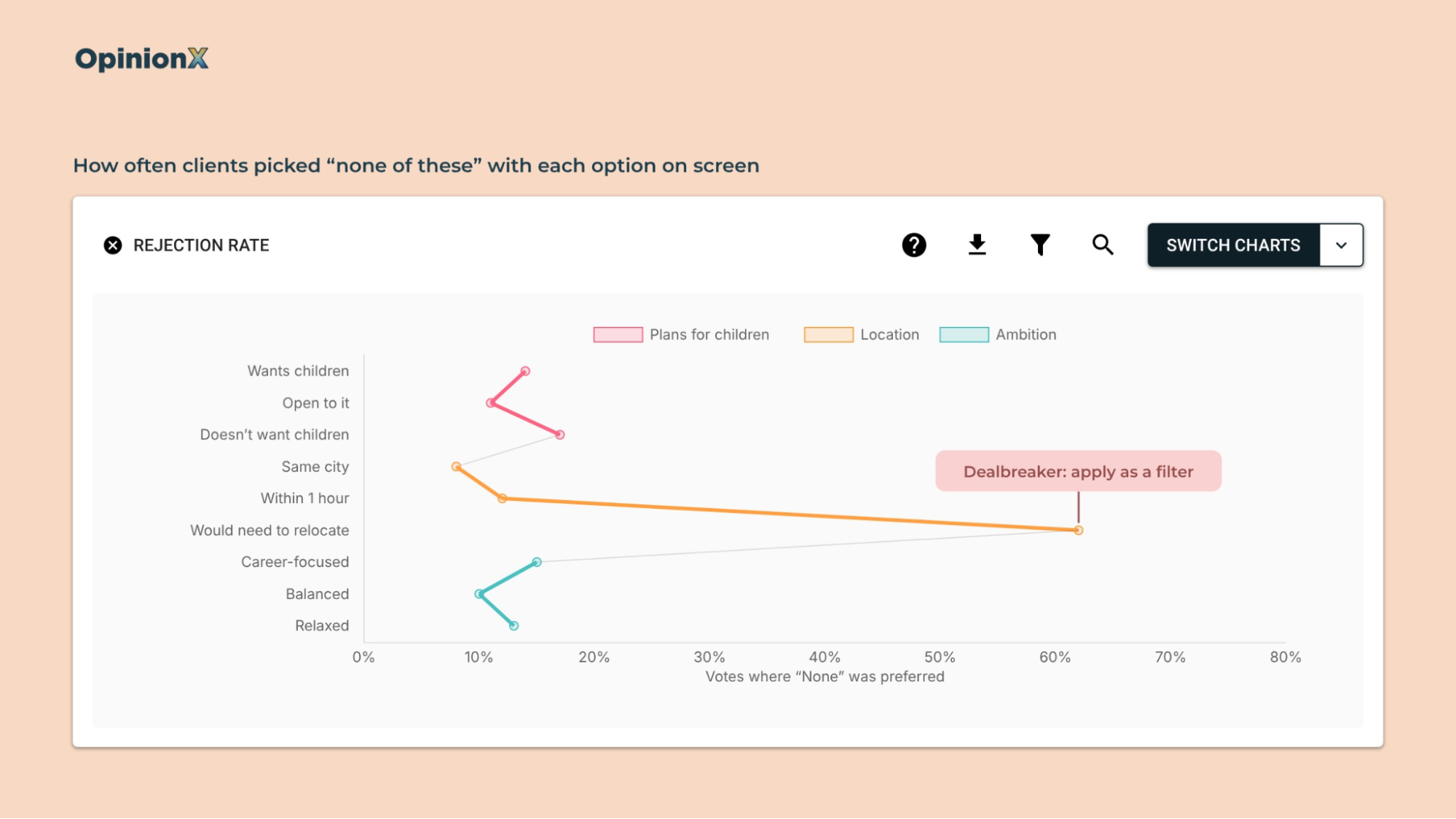
Dealbreakers. A client who won't relocate or has decided against having children will reject a profile that fails that rule, however good the rest of it looks, while a weighted score just treats that "never" as a strong dislike. Give the survey a "none of these" button with what the client would do instead as its label ("I'd keep waiting for a better match"), then treat any option that sends people to that button as a hard filter you apply before the score. Our guide to rejection rate in conjoint analysis shows how to spot them.
Both sides of the match. Matching works both ways, so each side gets its own survey with its own profiles, and comparing two clients' scores side by side gives the matchmaker a read on compatibility before introducing anyone.
The same approach works for surrogacy and egg-donor agencies, mentoring programmes and any service that introduces one person to another.
5. Placing a parent in senior care
Choosing an assisted living facility for an elderly parent is one of the highest-stakes decisions a family faces, and an adult child usually makes it on the parent's behalf, quickly and under stress. The person deciding often can't say exactly what they're after, and the parent may not be able to weigh in clearly.
A conjoint survey with the main decision-maker turns that overwhelm into a structured choice: they pick between facilities that combine features like staff experience with the parent's condition, how many staff there are per resident, activity programming, distance from family and visiting hours. The output is a preference profile that shows what this family cares about most.
A care network can then rank its facilities for each family by how well they fit that profile. That shortens placement for the operator and (more importantly) leads to a decision the family feels confident in, instead of one they rushed under pressure with half the information.
If one of these looks like your business and you're working out which categories and options belong in your intake survey, book a free 30-minute setup call and a research expert will go through the design with you.
Why does a conjoint survey beat asking people what they want?
Asking people what's most important to them, whether in a partner, a donor, a portfolio or a care home, has one basic flaw: it costs nothing to call everything important. A rating question like "How important is income to you, from 1 to 7?" lets someone give both income and kindness a 7. With nothing forcing a trade-off, people rate the qualities that sound good or feel emotionally important highest, even when practical limits are what drive their decisions. We've made the same argument about product research in our post on why traditional surveys fail at idea validation.
The speed-dating study by Paul Eastwick and Eli Finkel shows how far apart stated and actual preferences can be. The researchers asked 163 people what they wanted in a partner, then tracked who they felt drawn to over the next 30 days. In the authors' words, people's stated preferences "were unrelated to their in vivo preferences", which means the preferences they showed when they met people in person. Men and women gave different answers on paper (men said looks were more important to them, women said earning prospects were), yet in their choices physical attractiveness predicted romantic interest about equally for both, with a correlation of .43 for men and .46 for women.
Conjoint analysis forces the trade-off: a client can't put both the most experienced donor and the closest donor at the top if no available donor has both, so the scores show what people value when they have to choose, not what they think they should value or what they'd want in a world with no limits, which is most useful for high-stakes personal decisions.
Fair, conjoint analysis isn't the only alternative to a rating form, so here's how the common options compare for matching one person to the right match.
| Method | What it tells you about one person | Forces trade-offs? | Finds dealbreakers? | What it costs you |
|---|---|---|---|---|
| Intake form or questionnaire | How important each quality feels, one at a time | 🔴 No, people can call everything important | 🟡 Only if you ask, and people don't always stick to the dealbreakers they state | Almost nothing, but it's also the least predictive |
| MaxDiff of qualities | Which qualities that person cares about most and least | 🟢 Yes, between qualities in a list | 🔴 No, it never shows a whole option to reject | A short survey, but it only ranks qualities and can't say how much one is worth against another |
| Conjoint with whole profiles | A score for every option, from choices between realistic profiles | 🟢 Yes, in the same format as the decision they'll make | 🟢 Yes, with a "none of these" button | A 5 to 10 minute survey, plus a group of past clients who answer it first so the model has a base to work from |
| Behaviour data | Which recommendations the person accepted and which they turned down | 🟢 Yes, because these are decisions the person actually made | 🟢 Yes, in what they never accept | Time, since it only exists after the client has been through several recommendations |
The table shows the trade-off a matching business faces: the intake form is cheap and tells you little, while behaviour data is the most accurate but only exists once the client has been through a few recommendations, which is exactly when you no longer need a first guess. Conjoint analysis gives you a measured first guess on day one.
How far can you trust one person's conjoint scores?
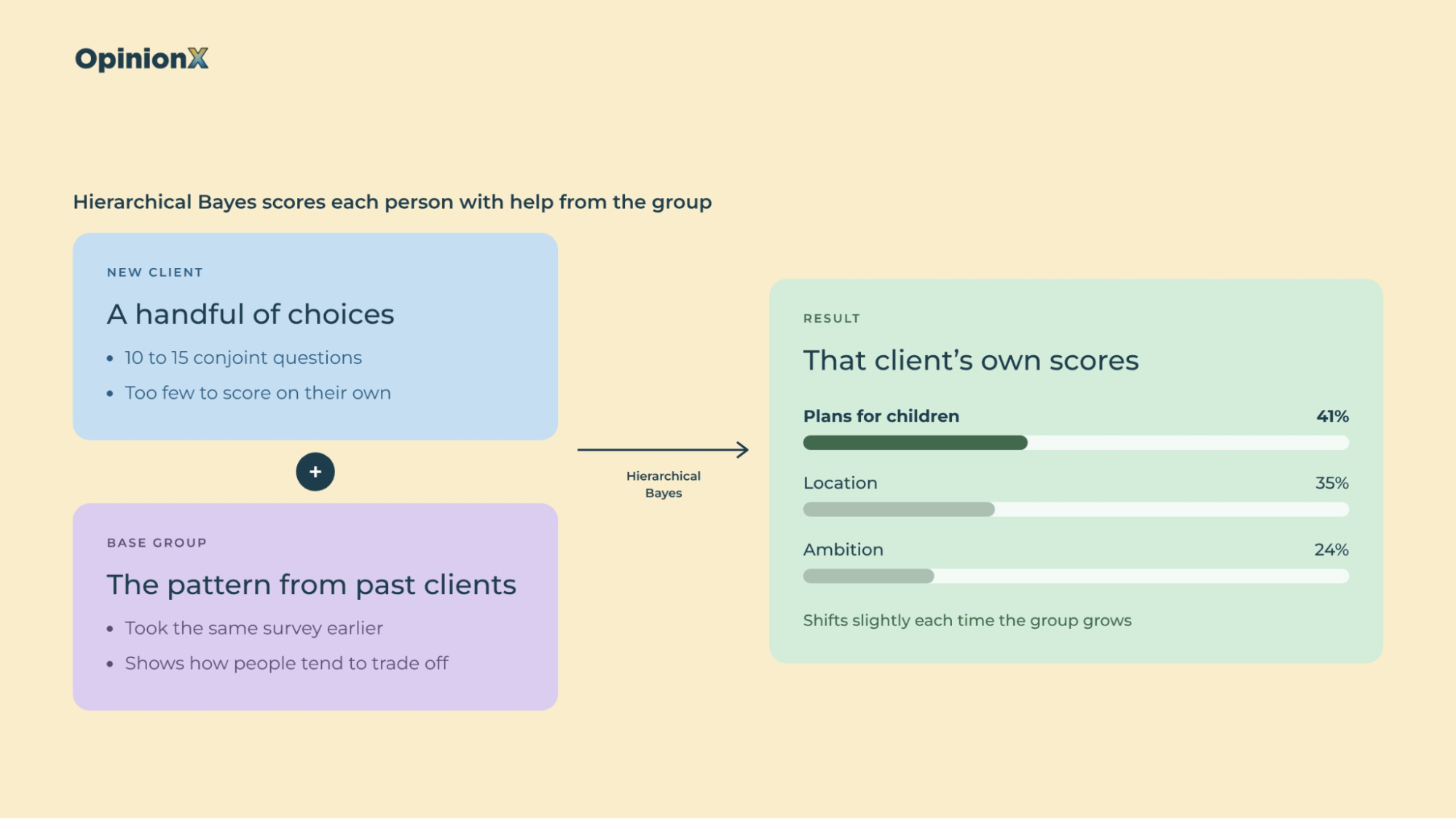
One person's conjoint scores are good enough to rank what they care about and build a first recommendation on, though they aren't precise to the decimal point.
Hierarchical Bayes needs a group to work with: the model estimates each person's scores by combining that person's choices with the pattern across everyone else in the same survey. That's what lets it produce stable scores from a short survey, but it also means one new client answering on their own gets weak, unstable scores. In practice, build the base first by sending the survey to a group of past or current clients, then keep it open as the intake survey for every new client so the model scores each newcomer alongside that group. On OpinionX, results recalculate after each new submission, which can take up to 10 minutes, and each recalculation can shift everyone's scores slightly because the group behind the model has grown.
A short survey also only gives a rough picture of each person, since someone who answers 10 to 15 conjoint questions has made enough choices to show their top priorities, but you can't trust small gaps between two options lower down their list. Use the scores to order a client's priorities and rank candidate matches, not to split hairs between two options that scored almost the same.
And of course, a conjoint answer is still a survey answer: a client choosing between two profiles knows nothing is at stake yet, which can make them more relaxed or more idealistic than they'd be facing an option they could actually sign up for. The advantage over a form is that the task looks like the decision they'll eventually make. Once you've recommended a few options and seen what the client accepted, check the conjoint scores against those decisions and adjust where they disagree. Our guide on when not to use conjoint analysis covers the cases where a different method fits better.
How do you run an individual-level conjoint on OpinionX?
Setting up an individual-level conjoint takes four steps. Anyone who can put together a Google Form can build the survey itself, and most of the thinking goes into which categories and options to include.
Step 1: Choose the categories and options. Pick the three to six categories people use to compare their options, such as price or location, with two to five options each that reflect what's in your pool. Keep the labels short and make sure no two options in a category overlap. If your list of possible categories is long, rank it first with a MaxDiff survey, which shows people small sets of items and asks them to pick the most and least important. You can put MaxDiff and conjoint questions in the same OpinionX survey so the same people answer both, and our MaxDiff analysis guide explains how that ranking works.
Leave protected characteristics, such as ethnicity or religion, out of any conjoint you use to score people. A 2006 study of about 22,000 online daters found that users who said they didn't care about a partner's ethnicity still favoured their own when choosing who to contact (Hitsch, Hortaçsu and Ariely, MIT Sloan working paper, 2006). Conjoint analysis would measure that kind of bias accurately, and your matching logic would then apply it to every client automatically.
Step 2: Build the survey. Create a survey on OpinionX and add a conjoint question (Conjoint Rank in the question menu) with your categories and options. The built-in sample size calculator tells you how many choices each participant needs to make so every option shows up enough times. Add the custom "none of these" button and label it with what people would do instead, so you can spot dealbreakers. Each participant then works through their own set of profile comparisons.
Step 3: Let the model score each person. OpinionX has used Hierarchical Bayes scoring since 9 December 2025, so every participant gets their own set of scores, not just a share of the average, and you can still read the preference chart for the whole base alongside them. To compare groups as well as individuals (new and returning clients, say), tag each participant with a multiple-choice question or pass the data in from your CRM through hidden fields.
Step 4: Export each person's scores and run the match. The Aggregated export gives one row per participant, with that person's score for every category and option. You can export all results to a single spreadsheet or send them live to Google Sheets, and if prices are part of the profile, our guide to marginal willingness to pay shows how to turn the results into money. Feed those scores into your matching logic: remove any option that breaks a client's dealbreakers, then rank what's left by how well it fits them. The ranked list can go to a human advisor or matchmaker, or drive the recommendation automatically. Our older post on participant-level data shows other ways teams use one person's answers, such as recruiting for follow-up interviews.
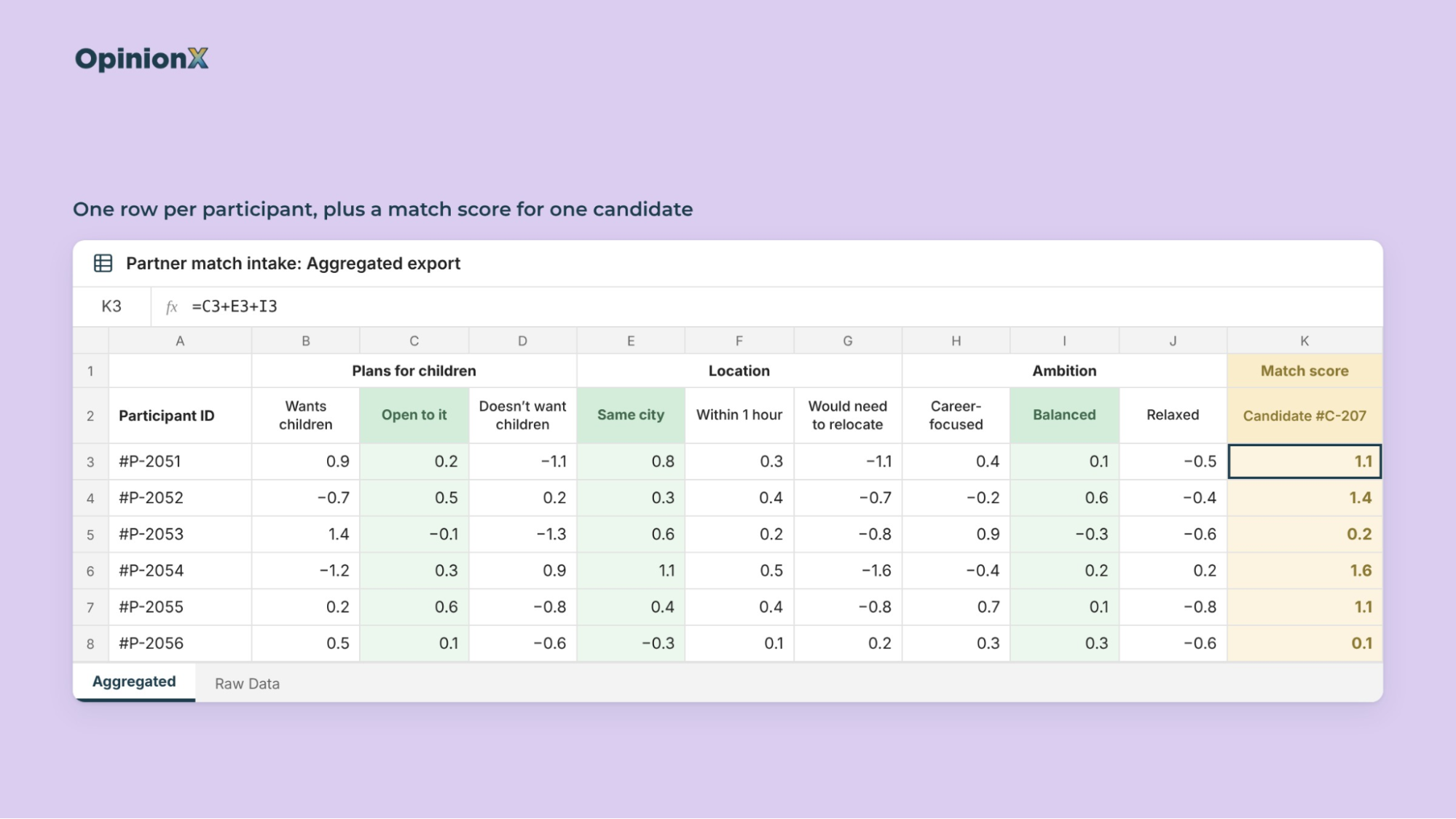
Want to see what one participant's conjoint scores look like in the export? A demo walks through a full set of conjoint results, from the preference chart down to each participant's row.
Frequently asked questions
What's individual-level conjoint analysis? Individual-level conjoint analysis uses each participant's own conjoint scores, instead of the group average, to understand what one specific person values. Hierarchical Bayes models estimate a score per option for every participant, which a business can use to match that person to a partner, product, portfolio or service.
Can conjoint analysis measure one person's preferences? Yes, as long as that person answers the same survey as a wider group. Hierarchical Bayes conjoint models estimate each participant's scores by combining their choices with the pattern across everyone else, so one person answering alone gets unstable scores. You can trust the scores to rank priorities, less so to separate options that scored almost the same.
Why don't stated preferences predict what people choose? Rating a quality on its own costs nothing, so people answer from their idea of themselves. In Eastwick and Finkel's 2008 speed-dating study, stated partner preferences matched actual romantic interest in only 2 of 72 checks. Conjoint analysis forces a trade-off between whole options, which is closer to the decision people eventually make.
How do you use conjoint scores to match people with options? Export each participant's conjoint scores, remove any option that breaks one of their dealbreakers, then rank the remaining options by how well their features match that person's scores. OpinionX's Aggregated export gives one row per participant with a score for every category and option.
Should a matching conjoint survey include protected characteristics? No. Characteristics such as ethnicity or religion shouldn't be categories in a conjoint survey you use to score or match people. Conjoint analysis measures any bias in people's choices accurately, and any matching logic you build on those scores would then apply that bias to every client.
New to the method? Start with our guide to what conjoint analysis is and how to set one up. If a simpler trade-off method might suit your intake better, our conjoint analysis alternatives guide compares eight of them, and if you also want to compare groups of clients, needs-based segmentation shows how to group people by what they want rather than who they are. For more studies that start from a business decision, browse our research use cases. Every method, including conjoint, is available on the free plan, which allows 25 participants per survey (enough to pilot your intake survey before you open it to every client).
