

The Full-Stack Researcher
Guides, Case Studies, & Actionable Advice for Mixed-Methods User Research

Competing Values Framework: Methods, Tools, Templates
The Competing Values Framework (CVF) is one of the most popular academic theories for understanding how organizations act. It uses a simple 2x2 matrix to quantitatively map an organization’s culture in a simple yet empirically validated way that allows leaders to plan strategies to change their culture over time.
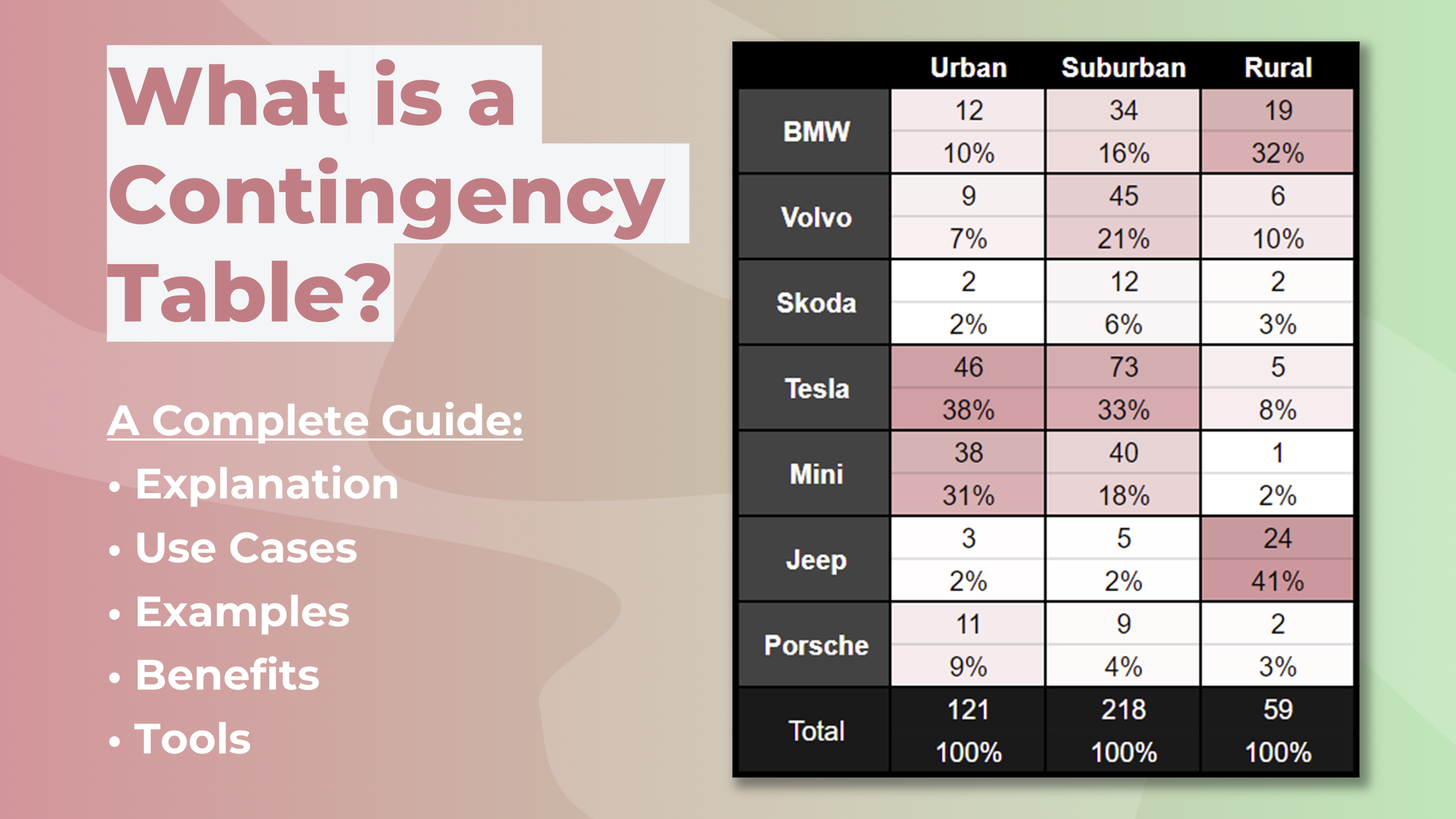
What is a Contingency Table in Survey Analysis?
Contingency tables compare two or more types of data to see how often they overlap in a matrix table. Learn how they works, what the best tools are, when to use it for your research, and what its advantages are over other survey analysis methods.

Crosstab Analysis: Explanation, Examples, Methods, Advantages, Use Cases, Tools
Crosstab Analysis lets you compare two or more types of data to see how often they overlap in a simple matrix table format. Learn how crosstabulation works, what the best tools are, when to use it for your research, and what its advantages are over other survey analysis methods.
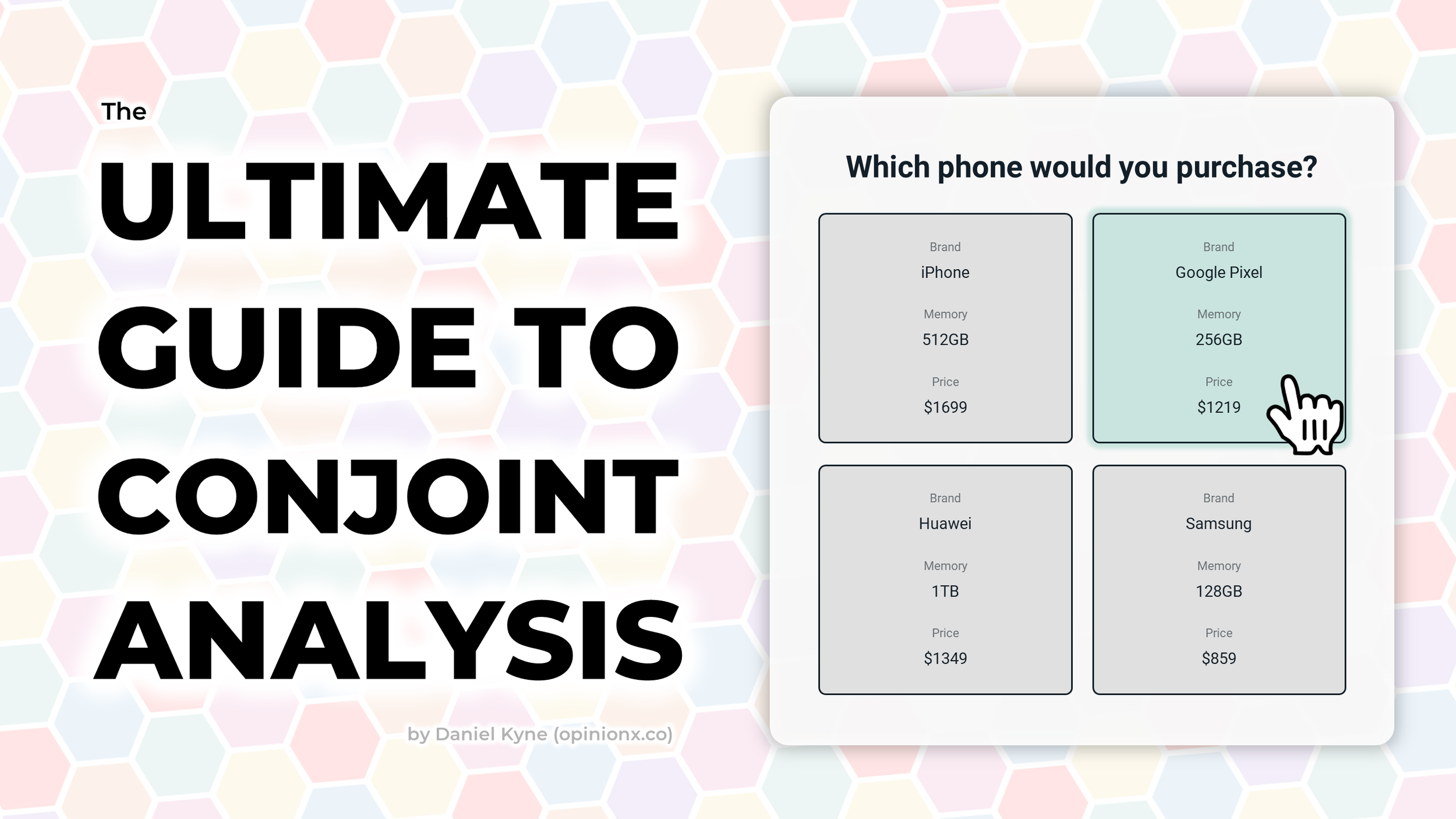
The Ultimate Guide to Conjoint Analysis: Explanation, Examples, Types, Tools, & Use Cases
Conjoint analysis is a popular market research method for understanding what’s most important to customers when they’re picking between products during a purchase decision. This post explains what Conjoint Analysis is, how it works, and how to design your own conjoint survey.

Multivoting: 6 Best Tools & Techniques for Group Decisions
From dot voting to MaxDiff: six ways for a team to turn a long list into a ranked shortlist, with worked examples and free tools to run each one.

How to Measure Company Culture using the OCAI Assessment
The Organizational Culture Assessment Instrument (OCAI) is a popular research method for quantitatively mapping a company’s culture. It offers a simple yet empirically-validated way to analyze both an organization’s present and preferred culture, helping leadership teams create data-driven strategies for transforming how their company works.

What is Best-Worst Scaling? (Examples, Methods, Free Tools)
Best-Worst Scaling is a method for ranking people’s preferences by asking them to choose the best and worst option from a series of statements.
![Pairwise Comparison: The EASIEST Way To Rank Any List [Video]](https://images.squarespace-cdn.com/content/v1/5e22fb8d8524a16d5bd5683c/1713432289160-D05G6IOJ43QCCUXOX1ZW/Pairwise+Comparison+-+Paired+Ranking+Pairwise+Voting+Survey+Method+Explained+-+Thumbnail.png)
Pairwise Comparison: The EASIEST Way To Rank Any List [Video]
Pairwise Comparison (also known as Paired Voting or Pairwise Ranking) is a simple yet powerful way of ranking a list of options by breaking them into a series of head-to-head votes. This video explains everything you need to know about Pairwise Comparison, including its origin, use cases, setup tips, and real-world examples.

19 PMF Survey Templates: Basic, Advanced & Expert (and 8 mistakes to avoid!)
104 questions from 18 real PMF survey templates analysed, the 8 most common mistakes, and three templates (basic, advanced, expert) built on what the survey is actually for.

The 12 Best Tools For Creating Product/Market Fit Surveys (PMF Survey)
Microsurvey tools, general survey builders, or ranking platforms? 12 PMF survey tools compared on free tiers, branching, segmentation and price.

How To Rank Any List of Names (Methods, Examples, Tools)
Seven voting methods to rank a list of names, from pairwise comparison to MaxDiff, with interactive examples. Free to run on OpinionX.

How to use PMF Surveys to reach Product/Market Fit Faster (Guide + Case Study)
Superhuman's PMF score was 22%, below the 40% benchmark. Segmentation showed it was really 32% among the right users, and told them what to build. Here's the method.

Head-To-Head Pair Voting (Methods, Tools, Examples)
Head-to-head pairwise voting is one of the easiest ways to rank a list of options. This guide explains the best methods and most popular tools to use, along with some real examples.

Pairwise Ranking (Tools, Examples, Methods)
The Ultimate Guide To Pairwise Ranking — best methods, most popular tools, example pairwise comparison surveys, types of pair ranking, calculation formulas, and more.

Paired Comparison (Methods, Examples, Tools)
The Ultimate Guide To Paired Comparison — definition, best methods, most popular tools, example surveys, types of paired comparison, calculation formulas, and more.
![Using Surveys for A/B Testing [Methods, Examples, Tools]](https://images.squarespace-cdn.com/content/v1/5e22fb8d8524a16d5bd5683c/1702477666020-LIDLTT4ANCMELA0C3VSU/Using+online+surveys+for+rapid+a-b+testing+experiments+optimization+preference+test+comparison.png)
Using Surveys for A/B Testing [Methods, Examples, Tools]
A website A/B test can need 200,000 users. A survey-based one needs about 29. How to run A/B tests with pairwise comparison and monadic studies.

How Labster prioritizes which user problems to solve next
How do you figure out what to build next when customers are all shouting for different things? Tudor, a UX Researcher at Series C scaleup Labster, learned first hand why you can't always listen to your loudest customers…
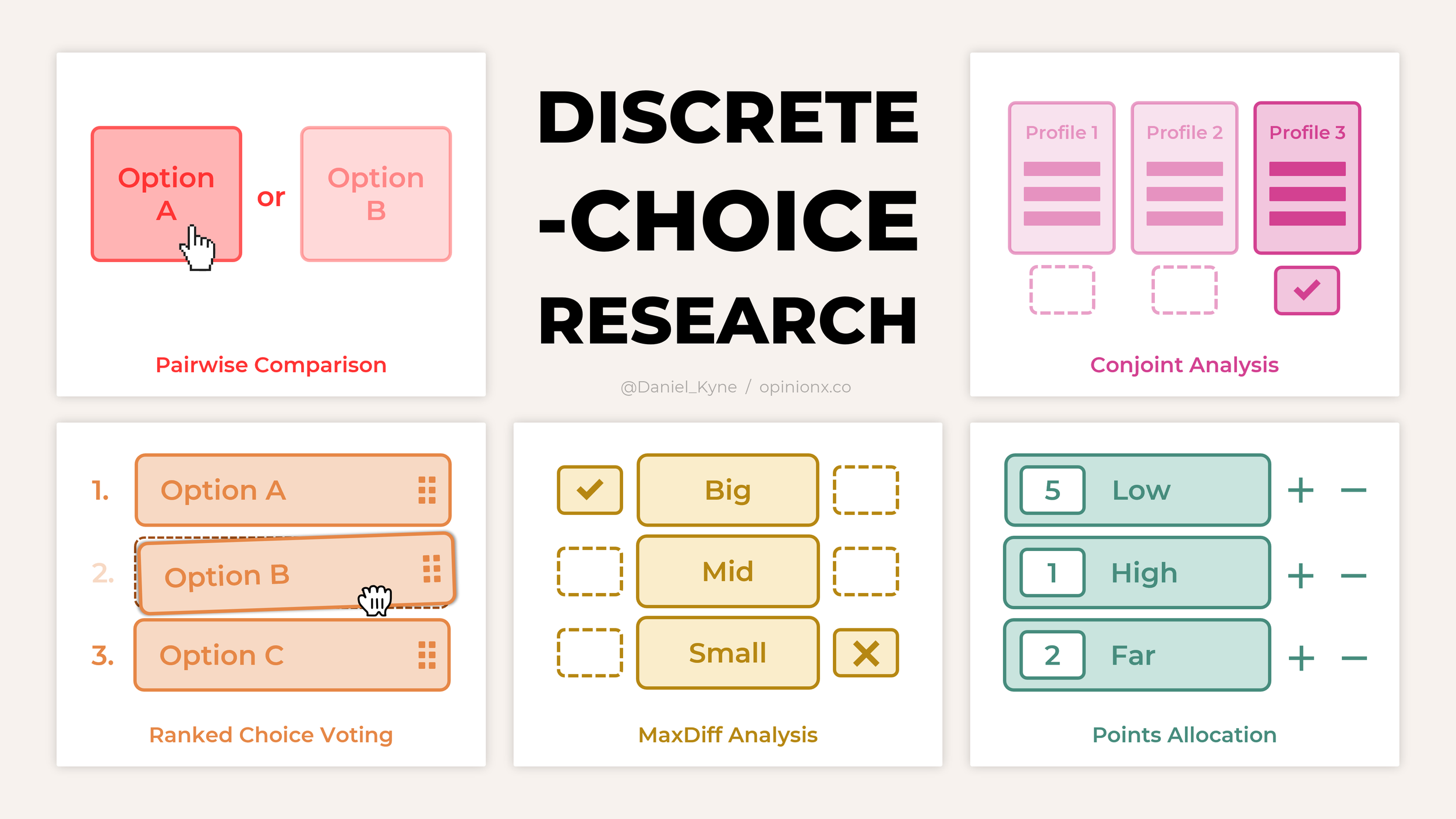
Discrete Choice Model: Survey Research & Analysis Guide
Discrete Choice Modeling is a category of research that measures the relative importance of a set of options according to a group of people, including conjoint, maxdiff, pairwise comparison, and more.
![What is Psychographic Segmentation [Guide & Examples]](https://images.squarespace-cdn.com/content/v1/5e22fb8d8524a16d5bd5683c/1699885107600-TQEISLOL3D62VVK6ZWQP/Psychographic+Segmentation+Guide+How+To+Method+Examples+Process+Research+UX+User+Customer.png)
What is Psychographic Segmentation [Guide & Examples]
Psychographic customer segmentation identifies groups of customers with a similar way of thinking about a topic or issue. Including 5 research methods, 6-step process, a real B2B case study, and how to run a psychographic segmentation survey.
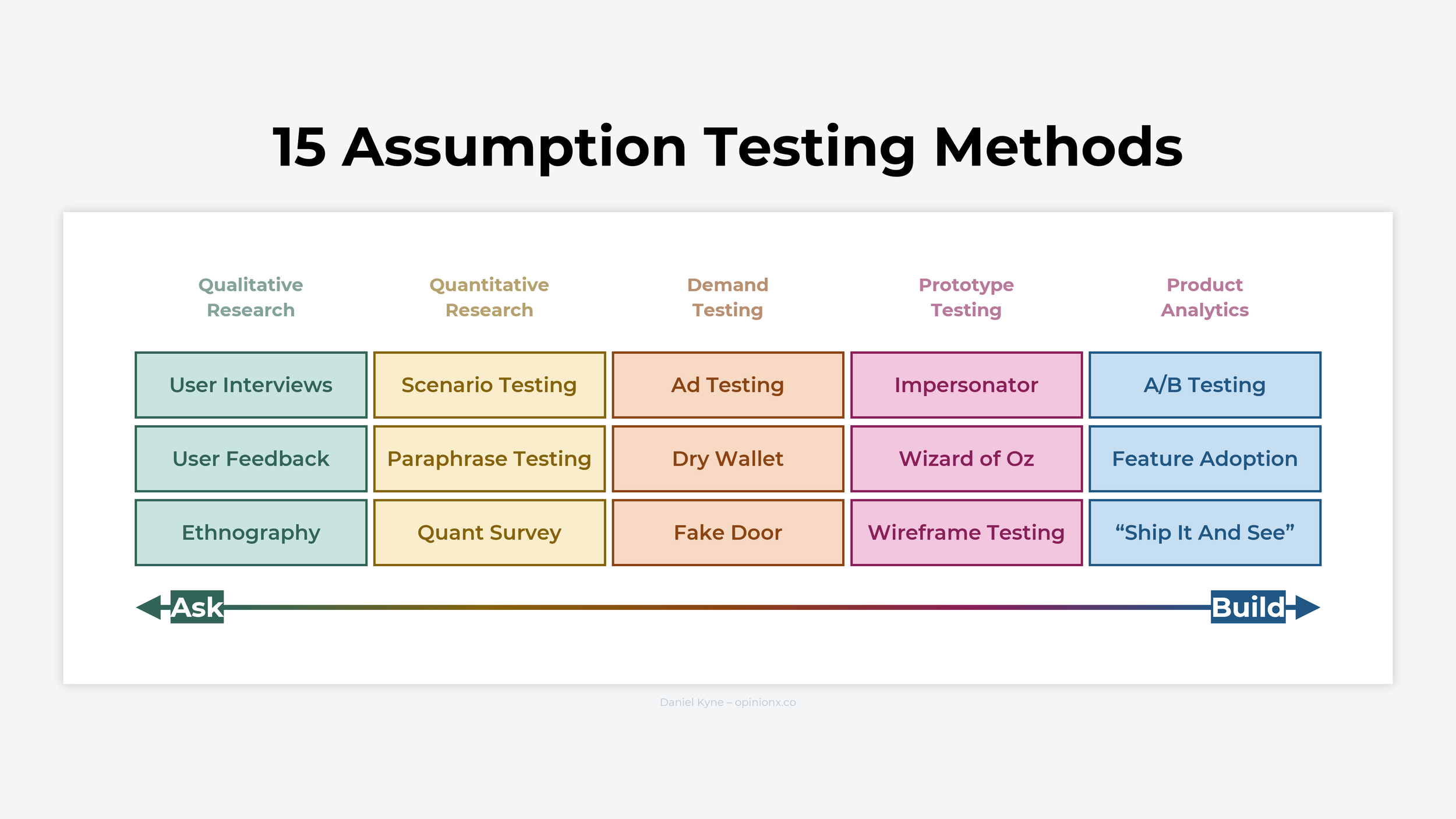
15 Assumption Testing Methods For Product Management Teams
15 ways to test the beliefs your product idea rests on, from a one-afternoon website (like DoorDash) to A/B tests. Plus how to plan and prioritise them.