Conjointly vs OpinionX: pricing, methods and features
Conjointly vs OpinionX comes down to two prices and one design choice. Conjointly's Professional plan costs $2,895 per team per year and OpinionX's Analyze plan costs $900 per year, as listed on both companies' pricing pages on 30 October 2026. Both tools offer conjoint analysis, MaxDiff, Van Westendorp and Gabor Granger, with unlimited users and a free plan. The design choice is how many advanced methods fit in one survey: Conjointly sets up each advanced method as its own experiment, while OpinionX lets you put several methods in one survey so the same participants answer all of them. Conjointly is the better fit for consumer brand teams that need Kano, TURF, ad tests or a built-in participant sample, while OpinionX fits product and UX research teams deciding what to build, who to build it for and what to charge.
Below, you'll find both free plans, both paid plans, the methods each tool offers, how each tool handles several methods in one survey, segmentation, security, participant sourcing and a full feature table.

This page was last updated in October 2026. Pricing and features change frequently. We recommend verifying current details directly with each provider mentioned on this comparison page. Tool comparisons inherently involve subjective judgment; the opinions expressed are those of the author based on firsthand testing.
How do Conjointly and OpinionX compare at a glance?
Conjointly and OpinionX both offer the four advanced survey methods product and pricing teams use most, and they differ on price, breadth and survey design.
💡 The four methods both tools offer
Conjoint analysis shows participants complete versions of a product and asks them to choose between them, which measures how much each feature and each price affects the choice.
MaxDiff shows participants small sets of items and asks for the most and least important in each set, which ranks a long list by importance.
Van Westendorp asks four questions about when a price feels too cheap, a bargain, getting expensive and too expensive, which gives you the price range your market accepts.
Gabor Granger shows participants one price at a time and asks if they'd buy at that price, which finds the price that earns the most revenue.
OpinionX
💰 Price: OpinionX's Analyze plan costs $900 per year, with unlimited participants and unlimited researcher seats, and the Accelerate plan is quoted on a call.
🔍 Trial: OpinionX's free plan includes every method and every analysis feature, capped at 25 participants per survey, with no credit card required.
☑️ Conclusion: OpinionX is the better fit for product managers and UX researchers who want several advanced methods in one survey and results split by customer segment.
Conjointly
💰 Price: Conjointly's Professional plan costs $2,895 per team per year with unlimited users, and the Ultimate plan starts at $10,000 per year (Conjointly pricing page, 30 October 2026).
🔍 Trial: Conjointly's free Basic plan includes every advanced method but analyses each one only up to 20 responses per study.
☑️ Conclusion: Conjointly is the better fit for consumer brand and marketing teams that need Kano, TURF, ad and claims tests or a built-in participant sample, and have the budget for the higher price.
How does support compare?
Conjointly and OpinionX both have live chat and email support on every plan. OpinionX adds a free setup call for every user, free plan included, plus 90 minutes of prepaid research consulting on Analyze and 6 hours on Accelerate. Conjointly's Professional plan includes up to 2 hours of support consultations per year, and its free Basic plan includes none.
Who is OpinionX for?
OpinionX is an advanced market research survey platform for in-house product managers and UX researchers who need to decide what to build, who to build it for and what to charge. It fits best with Series A to C product teams that run research every quarter, and with research and pricing agencies running studies for their clients.
OpinionX's conjoint analysis uses hierarchical Bayes, a statistical model that works out each participant's own preferences while borrowing information from the whole group, so individual results stay stable even when each person answers only a handful of questions. The conjoint results include a market simulator that forecasts share and revenue for product versions you build, and a marginal willingness to pay report that shows how much more customers would pay for a change to one feature. The Van Westendorp question type includes the Newton-Miller-Smith extension, two extra questions that add purchase likelihood and the revenue-maximising price. Every method and every analysis feature is available on the free plan.
Segmentation analysis on OpinionX lets you filter any method's results to one customer segment (a group defined by company size, job role, pricing plan and so on) in one click. You can compare two segments side by side, see up to 30 segments in one crosstab heatmap, or group participants by how they answered with K-means or AI persona clustering. Segments can come from survey answers or from customer data you already hold, passed in through hidden fields in the survey link or imported as a file.
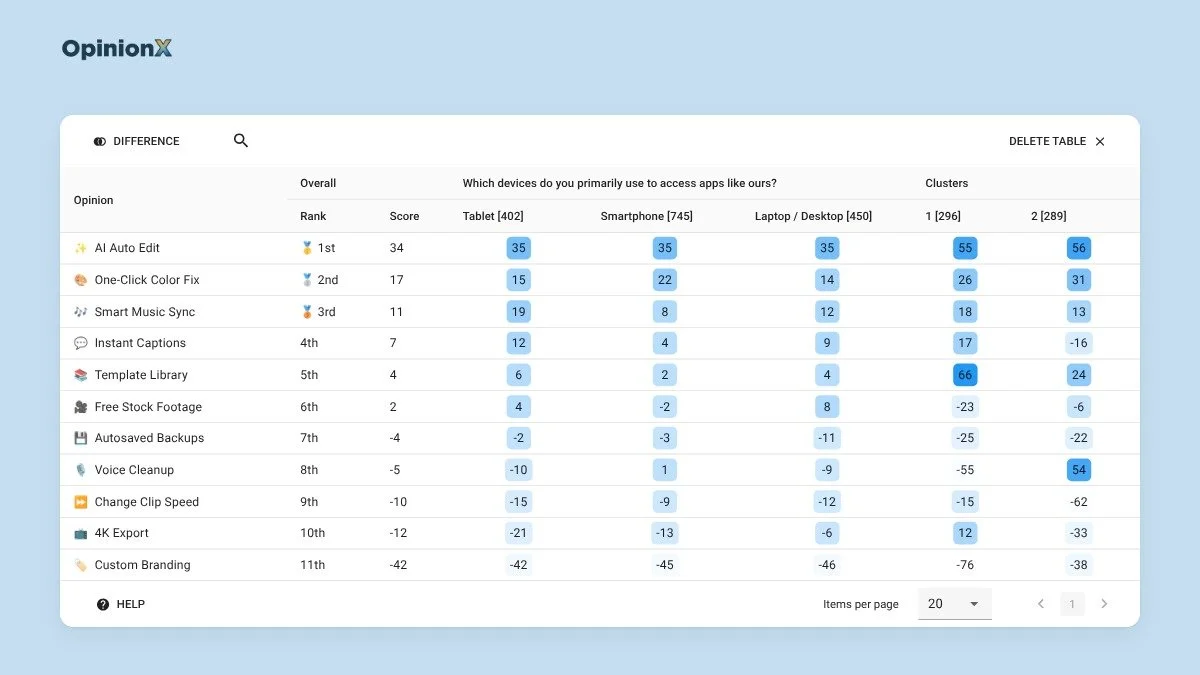
Want to see a 30-segment crosstab or the clustering view on a finished conjoint study? A demo walks through a live results dashboard, filters and all.
Who is Conjointly for?
Conjointly is a market research platform with more than 30 study types, and its strongest fit is consumer brand and marketing teams that test claims, packaging, product names, ads and product concepts alongside pricing. The same tool includes Kano, a survey that sorts features into must-haves, features that delight and features nobody notices, plus TURF (an analysis that finds the combination of items that reaches the most people), brand-price trade-off and brand-specific conjoint. OpinionX doesn't offer dedicated versions of those studies. If concept testing is the job you're comparing tools for, our guide to product concept testing explains four studies to run before you build.
Participant sourcing is Conjointly's second strength. Its self-serve sample sits inside study setup, with bids starting at $0.55 and averaging $1.55 per complete response, and it quotes predefined panels on request (Conjointly pricing page, 30 October 2026). Its response quality checks, including checks on open-text answers and detection of suspicious network patterns, are free when Conjointly supplies the sample. OpinionX lets you buy participants through panel providers on every plan, or bring your own, and our guide to finding free survey participants covers three ways to recruit without a paid panel.
Security paperwork is the third. Conjointly holds ISO/IEC 27001:2022 certification (an international standard for how a company manages information security), issued in November 2025, and includes SAML single sign-on, which lets your company's own login system control access, and two-factor authentication on every plan, free one included. OpinionX includes SAML single sign-on and two-factor authentication on the Accelerate plan and publishes its security documentation, but doesn't hold an ISO certificate yet. If your procurement team needs an ISO certificate this quarter, Conjointly passes that check and OpinionX doesn't.
The trade-off is cost: Conjointly's entry price is $2,895 per year, and it charges for several features on top of the licence. AI analysis of open-text answers is $0.15 per complete response, conversational surveys $0.10 per complete response and a branded survey domain $3,000 per year. Conjointly also sets up each advanced method as a separate experiment, which changes how you design research that uses more than one method.
How are the two survey builders different?
Conjointly starts from the study type: its study picker lists everything it offers, and you pick one before building the survey around it.
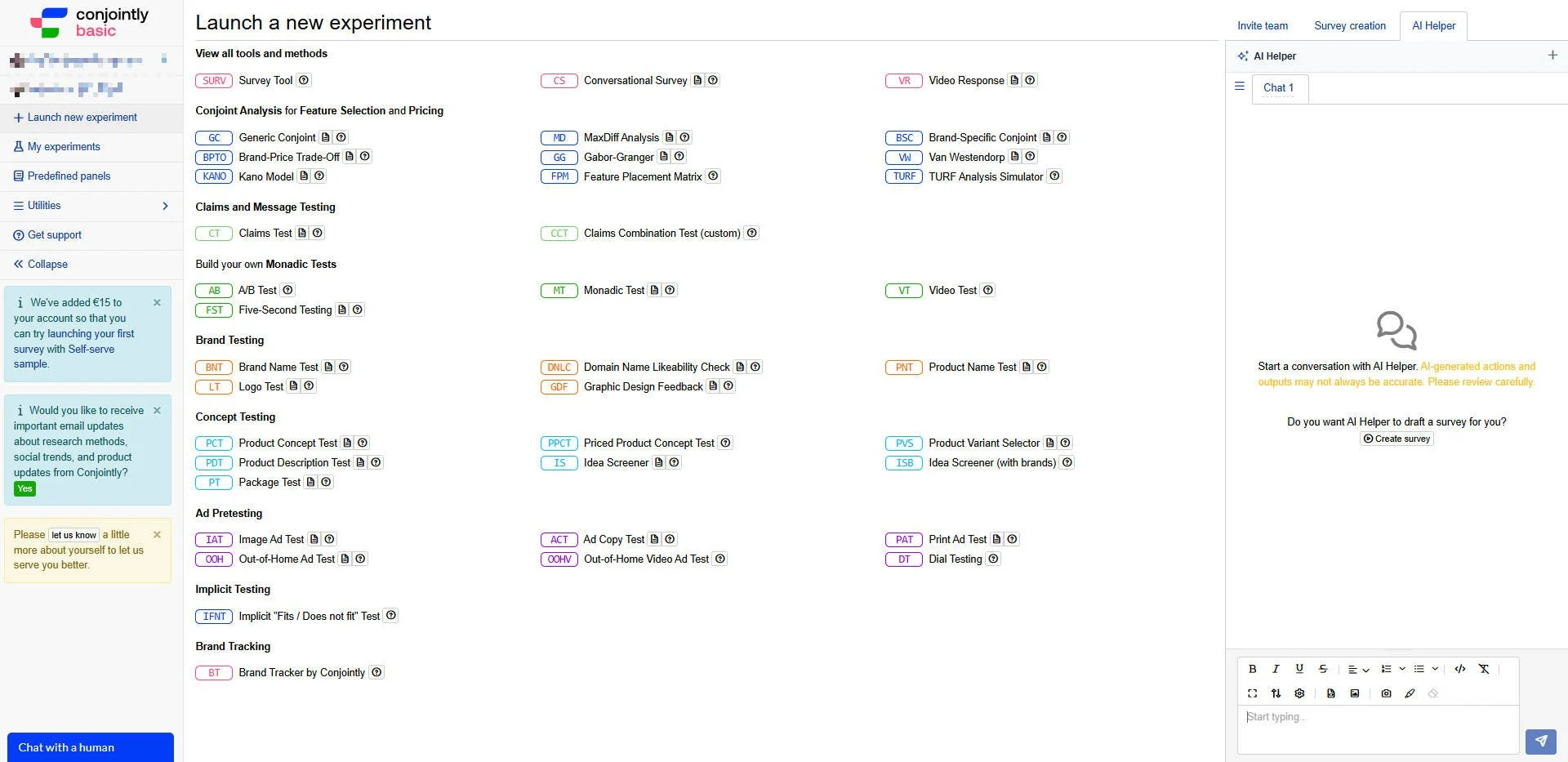
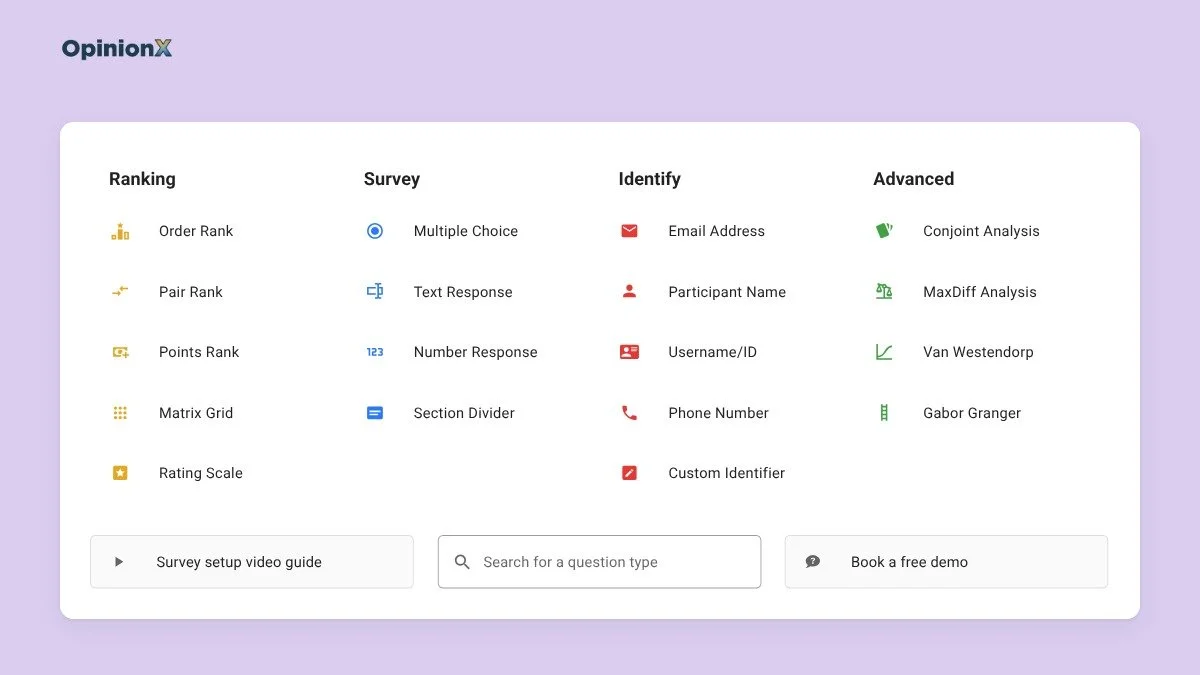
OpinionX works the other way round. Conjoint, MaxDiff, Van Westendorp and Gabor Granger are question types you add next to screening questions, rating scales and open-text questions, the same way you'd add a multiple-choice question. The conjoint question type calls attributes "categories" and levels "options", so a Price category might have the options $10, $15 and $20.
Can you combine conjoint and MaxDiff in one survey?
Yes on OpinionX, which lets you put conjoint, MaxDiff, Van Westendorp and Gabor Granger questions in one survey so the same participants answer all of them. Conjointly sets up each advanced method as its own experiment, so asking the same people a conjoint and a MaxDiff means linking two experiments with redirects and matching the data afterwards.
Conjointly's help documentation describes the linking process in four steps:
Build each experiment separately.
Set the first experiment's completion redirect to the second experiment's survey link, passing each participant's Conjointly ID along as a variable in the link.
Each experiment gives the participant a new ID, so after fieldwork you export the first experiment's participant list as a CSV file (a spreadsheet file you can open in Excel or Google Sheets) and upload it to the second experiment as external variables, matched on ID.
Build segments in the second experiment from the uploaded data.
Conjointly's documentation also says redirect linking works when you bring your own participants and doesn't work with Conjointly's self-serve sample. A team that buys sample from Conjointly and wants both a conjoint and a MaxDiff therefore pays for two separate samples, and different people answer the two studies.
On OpinionX the same research fits in one survey. A pricing study might rank 15 features with MaxDiff, then ask the Van Westendorp questions to find the acceptable price range, then show Gabor Granger prices inside that range. All three sets of answers sit on one participant record, so you can filter the Van Westendorp results to the participants who ranked a specific feature first without matching any files. Our guide to running Van Westendorp and Gabor Granger in one survey walks through that setup step by step. If you need two separate conjoint question types for two product lines, you can stack them in one survey, or use branching logic to send each participant to the right one based on an earlier answer.
Planning a survey that combines conjoint or MaxDiff with pricing questions? Book a free 30-minute setup call and a research expert will check your attributes, your price range and the order the methods should appear in.
How do Conjointly and OpinionX handle segmentation and external data?
Conjointly and OpinionX both let you segment results by customer data from outside the survey. Conjointly takes variables passed in the survey link and uploaded CSV files and uses them in its segmentation tab and simulator, while OpinionX takes hidden fields in the survey link and imported participant data and uses them across every method's results.
The difference is scope: a data upload on Conjointly belongs to one experiment, so a study that uses three methods needs three uploads, each matched on that experiment's own participant IDs. On OpinionX, one import segments every method in the survey at once, which is how the needs-based segmentation approach compares what each customer group cares about across several questions.
Bringing in customer data you already hold also keeps surveys shorter on both tools. Every classification question you don't ask, such as "What plan are you on?" or "How big is your company?", is one less reason for a participant to quit before reaching the conjoint questions.
What do the free plans include? 🆓
Conjointly's Basic plan and OpinionX's free plan both include the advanced methods (TURF aside on Conjointly), and their participant caps sit five apart, so neither free plan decides this comparison. Use either one to test a study design before you pay.
Conjointly Basic: free, with advanced methods capped at 20 responses
Unlimited surveys and unlimited users
Conjoint, MaxDiff, Kano, claims tests and other advanced methods analysed up to 20 responses per study; Conjointly saves later responses and unlocks them when you pay
TURF not included
SAML single sign-on and two-factor authentication included
No support consultations
OpinionX Free: every method, 25 participants per survey
Conjoint, MaxDiff, Van Westendorp, Gabor Granger and every analysis feature, including segmentation and clustering
Unlimited surveys and unlimited researcher seats
Exports to Excel, CSV and live Google Sheets
A shareable results link that viewers open without logging in
A free setup call to check your study design before launch
What do the paid plans cost? 💲
Conjointly's Professional plan costs $2,895 per team per year and OpinionX's Analyze plan costs $900 per year. Both plans include unlimited users and annual billing.
Conjointly Professional: $2,895 per team per year
Professional includes every advanced method without the 20-response cap, unlimited users, up to 2 hours of support consultations per year and password-protected reports. Billing is annual, by card only, and Conjointly charges on top for bought sample, AI analysis of open-text answers, conversational surveys and a branded domain.
Conjointly's Ultimate plan starts at $10,000 per year and adds procurement onboarding, tailored team training, team manager roles, extra research support and payment by purchase order or bank transfer.
OpinionX Analyze: $900 per year
Analyze includes every method, unlimited participants, unlimited researcher seats, data enrichment, custom exports, removal of OpinionX branding, custom survey links and favicons, and 90 minutes of prepaid research consulting. Billing is annual, and cancelling stops the plan renewing at the end of the year, with no refund for unused time.
OpinionX's Accelerate plan, quoted on a call, adds SAML single sign-on, two-factor authentication, private team folders, white-labelling and external collaborators. It also includes priority Slack Connect support, a dedicated account manager, 6 hours of consulting, a custom contract and payment by invoice or wire transfer.
How big is the price difference?
Conjointly Professional is $2,895 per year against $900 for OpinionX Analyze, a difference of $1,995 a year, so Conjointly's entry plan costs 3.2 times as much. Over three years that's $8,685 against $2,700. Both plans include unlimited users, so team size doesn't change the gap.
If you only need one study, you can subscribe to Analyze, run the study and cancel, and the account moves to the free plan when the year ends.
Conjointly vs OpinionX: feature comparison table
| Feature | OpinionX | Conjointly |
|---|---|---|
| Entry paid plan | ✅ $900 per year (Analyze) | ⚠️ $2,895 per team per year (Professional) |
| Top plan | Accelerate, quoted on a call | Ultimate, from $10,000 per year |
| Users per plan | ✅ Unlimited | ✅ Unlimited |
| Free plan, advanced methods | ✅ 25 participants per survey, every method | ✅ 20 responses per study, TURF excluded |
| Conjoint analysis with market simulator | ✅ | ✅ |
| MaxDiff | ✅ | ✅ |
| Van Westendorp | ✅ Automated, with the Newton-Miller-Smith extension | ✅ Dedicated tool |
| Gabor Granger | ✅ | ✅ |
| Several advanced methods in one survey | ✅ Same participants, one results page | ❌ One method per experiment, linked by redirect |
| Kano | ❌ | ✅ |
| TURF | ❌ | ✅ Paid plans |
| Brand-specific conjoint and brand-price trade-off | ❌ No dedicated tool | ✅ |
| Claims, ad, packaging and concept tests | ❌ | ✅ |
| Segment by survey answers | ✅ | ✅ |
| Segment by external data (survey link or file import) | ✅ One import covers every method | ✅ One upload per experiment |
| AI persona clustering | ✅ Every plan, free included | Not listed |
| AI analysis of open-text answers | ❌ | ✅ $0.15 per complete response |
| Built-in participant sample | ⚠️ Through panel providers | ✅ Self-serve sample, average $1.55 per complete response |
| Response quality checks | ❌ | ✅ Free with Conjointly sample |
| ISO 27001 certification | ❌ | ✅ ISO/IEC 27001:2022 |
| SAML single sign-on and two-factor authentication | ⚠️ Accelerate plan | ✅ Every plan, free included |
| Research consulting | ✅ Setup call for every user, 90 minutes on Analyze, 6 hours on Accelerate | ⚠️ None on Basic, up to 2 hours per year on Professional |
| Email invitations | ⚠️ $0.10 per email invite | ✅ $0.01 per email invite |
| Live chat support | ✅ | ✅ |
| Excel export | ✅ Plus live Google Sheets | ✅ |
| Billing | Annual | Annual |
What are OpinionX's limitations compared to Conjointly?
OpinionX is the wrong choice for some teams, and Conjointly is the better pick in four situations:
You test ads, packaging, claims or product names alongside pricing. Conjointly offers dedicated study types for each of these, and OpinionX doesn't.
You need Kano, TURF, brand-specific conjoint or brand-price trade-off. OpinionX offers none of these four as a dedicated method.
Your procurement team needs ISO 27001 certification now. Conjointly holds ISO/IEC 27001:2022, and OpinionX doesn't hold an ISO certificate yet.
You want to buy and quality-check sample in the same tool you design the study in. Conjointly's self-serve sample and response quality checks sit inside study setup, while OpinionX sources participants through panel providers.
When is OpinionX a better choice than Conjointly?
Pick OpinionX if:
You're on a product or UX research team deciding what to build, who to build it for and what to charge.
You need conjoint, MaxDiff and pricing questions answered by the same participants, in one survey.
You want to split every method's results by customer data you already hold.
Your research uses conjoint, MaxDiff, Van Westendorp and Gabor Granger, which OpinionX offers for $900 per year against Conjointly's $2,895 per year.
Frequently asked questions
Is OpinionX cheaper than Conjointly? OpinionX's Analyze plan costs $900 per year, while Conjointly's Professional plan costs $2,895 per team per year, so Conjointly's entry plan costs 3.2 times as much (both pricing pages, 30 October 2026). Both plans include unlimited users, so team size doesn't change the gap.
Which tool lets you put conjoint and MaxDiff in one survey? OpinionX lets you put conjoint, MaxDiff, Van Westendorp and Gabor Granger in one survey, so the same participants answer every method. Conjointly sets up each advanced method as a separate experiment, linked by redirects, with participant data exported and re-uploaded to match people across studies.
Can OpinionX and Conjointly segment results by customer data? Both tools segment results by customer data from outside the survey, but OpinionX applies one import to every method in the survey at once. Conjointly needs a separate upload for each experiment, matched on that experiment's own participant IDs, so a three-method study needs three uploads.
Is OpinionX or Conjointly better for product teams? OpinionX is a better fit for product and UX research teams deciding what to build, who to build it for and what to charge. OpinionX costs $900 per year against Conjointly's $2,895, puts several methods in one survey and segments every method by imported customer data.
Comparing more than two tools? Our review of conjoint analysis software compares 10 platforms on price, and our comparison of Conjointly, Sawtooth and OpinionX adds the specialist tool academic researchers use. For MaxDiff on its own, there's our review of MaxDiff analysis tools, which covers 9 survey platforms. If pricing research is the main job, our reviews of Van Westendorp survey tools and Gabor Granger tools look at 6 platforms each.